An SEO retainer is an ongoing agreement in which a business pays an SEO agency, consultant or specialist a recurring fee for continuous search engine optimisation work.
The fee is usually monthly, although other billing schedules are possible.
Unlike a one-off SEO project with a fixed end point, a retainer provides ongoing access to activities such as:
- Technical SEO
- Content optimisation
- Local SEO
- Google Business Profile management
- Link or citation work
- Reporting
- Strategy
- Monitoring
A good SEO retainer should clearly explain:
- What is included
- What is excluded
- How priorities are decided
- How progress will be reported
- How communication works
- How long the agreement runs
- How either party can end it
The value of a retainer is not simply that “SEO takes time”.
It is that search performance needs ongoing maintenance, improvement and adaptation.
What is an SEO retainer?
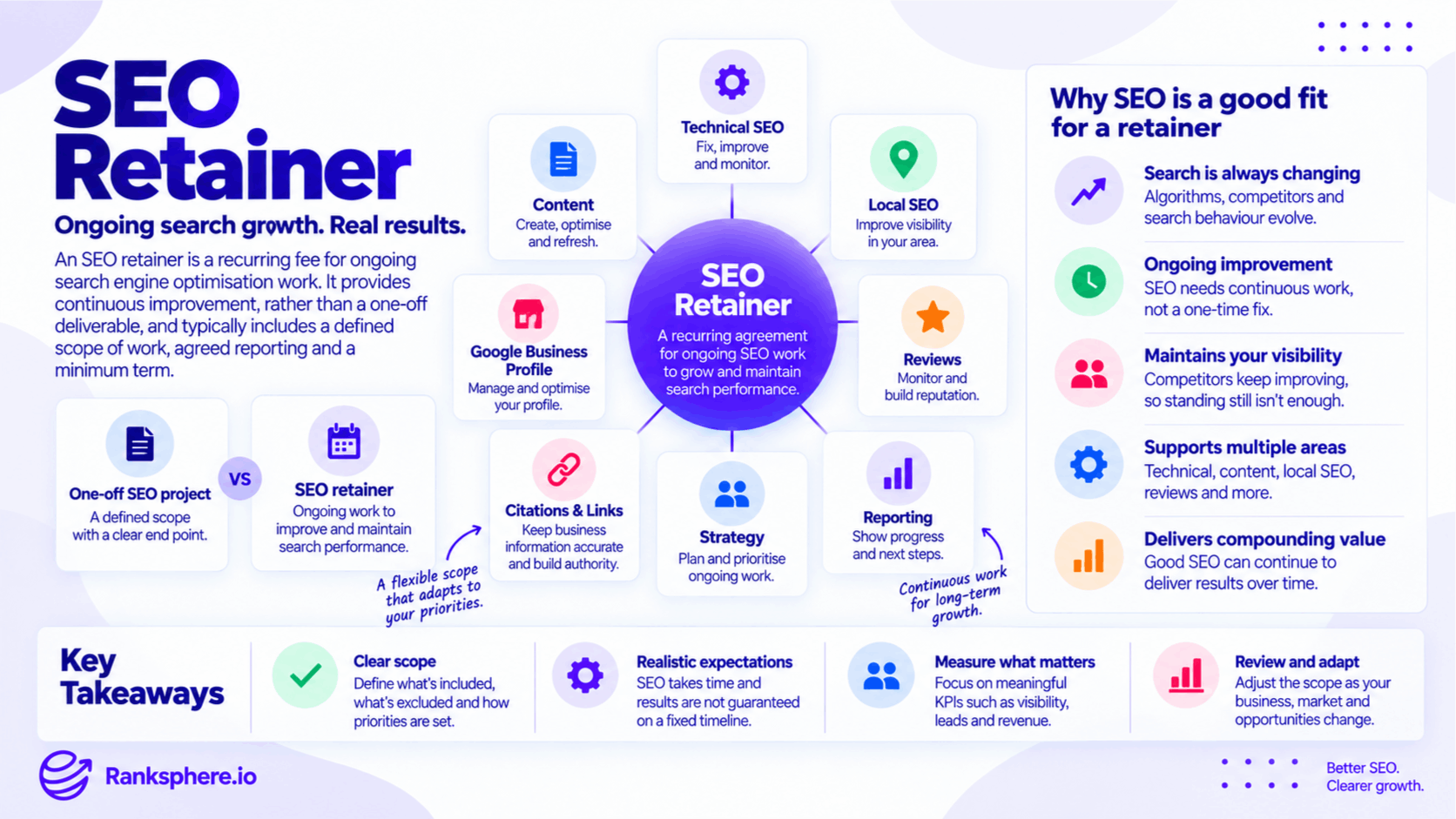
An SEO retainer is a recurring commercial arrangement rather than a single deliverable.
For example, a one-off project might be:
Complete a technical SEO audit and provide recommendations.
A retainer might be:
Monitor and improve the website, local visibility and content each month according to agreed priorities.
That distinction matters.
A project has a defined finish line.
A retainer is intended to support continuous work.
Why SEO is often sold on a retainer
SEO lends itself naturally to ongoing work because many of the things that influence performance change over time.
That includes:
- Competitors
- Website content
- Search behaviour
- Google interfaces
- Technical issues
- Business information
- Reviews
- Search algorithms
Some improvements can produce results quickly.
Others may take much longer.
The appropriate model depends on what needs to be done.
SEO results do not follow a fixed timeline
One of the most important things to explain to clients is that SEO does not have a standard result date.
A business may see improvement relatively quickly if:
- Major technical problems are fixed
- Important pages were previously not indexed
- Business information was inaccurate
- Competition is limited
Another campaign may take much longer because:
- Competitors are established
- The website is new
- The market is highly competitive
- Significant content work is needed
- Local visibility is weak across a large area
Avoid promises such as:
“You will see results in three months.”
A better approach is to explain what will be worked on, what early indicators can be monitored and which outcomes may take longer.
SEO work can compound
Some SEO improvements continue providing value after the original work is completed.
For example:
A useful service page may continue attracting visitors.
A legitimate backlink can continue pointing to the site.
A customer review remains part of the business's review history.
Technical improvements remain in place unless something changes.
This is why sustained SEO can compound over time.
But avoid saying everything resets when work stops.
It does not.
The greater risk is that progress slows while:
- Competitors continue improving
- Content becomes outdated
- Technical issues emerge
- New search opportunities are missed
- Business information changes
Ongoing SEO is therefore partly about growth and partly about maintenance.
Competitors continue changing
Search rankings are relative.
Even if your website stays exactly the same, competitors may:
- Improve their content
- Earn stronger links
- Gain more reviews
- Improve local profiles
- Launch better websites
- Add useful services
That means maintaining current performance may still require work.
Standing still does not automatically mean rankings fall.
But competitors improving around you can change your relative position.
Search changes
Google regularly changes:
- Search-result layouts
- Ranking systems
- Local features
- AI search interfaces
Major Google algorithm updates can also change visibility.
An ongoing SEO programme gives the business someone responsible for monitoring those changes and responding when necessary.
That does not mean reacting to every update.
Often the correct response is to wait until an update finishes, analyse what changed and then decide whether action is required.
Business information needs maintenance
Local SEO includes information that can become outdated.
For example:
- Opening hours
- Services
- Phone numbers
- Staff
- Business locations
- Holiday hours
A Google Business Profile therefore needs periodic maintenance.
Reviews also continue arriving and may need appropriate responses.
This is operational work rather than a one-time optimisation task.
What should an SEO retainer include?
There is no universal retainer package.
The right scope depends on:
- Business size
- Number of locations
- Competition
- Website condition
- Commercial objectives
- Available budget
A local plumber and a national ecommerce website should not receive the same retainer.
A good scope identifies the main areas of work without becoming so rigid that nobody can respond when priorities change.
Google Business Profile management
For local businesses, ongoing Google Business Profile work may include:
- Category reviews
- Service updates
- Opening hours
- Photos
- Profile monitoring
- Relevant updates
The exact work should depend on the business.
Do not add activity purely to make a monthly task list look busy.
Review management
A local SEO retainer may include support for:
- Review-request processes
- Review monitoring
- Response guidance
- Reputation reporting
The agency should not manufacture reviews or pressure customers into particular wording.
The objective is to build a sustainable process for receiving genuine feedback.
Citation management
Citation work may include:
- Auditing important listings
- Correcting inaccurate information
- Resolving duplicates where appropriate
- Monitoring core directories
Citation work should not become:
“We create 20 new listings every month forever.”
Once important listings are accurate, effort may be better spent elsewhere.
A flexible retainer allows priorities to change.
Content
Content work might include:
- New service pages
- Location pages
- Guides
- Existing-page improvements
- Content consolidation
- Content refreshes
Some retainers specify a fixed number of pages each month.
That can help define expectations.
But rigid quotas can also encourage unnecessary content.
A better agreement may specify a reasonable level of content capacity while allowing the actual work to follow priority.
One month may need two new pages.
The next may need four old pages improved instead.
Technical SEO
Technical work may include:
- Crawlability
- Indexing
- Redirects
- Canonicals
- Structured data
- Internal linking
- Website performance
- Broken pages
Be especially clear about who implements fixes.
An agency may:
Identify and implement technical fixes
or:
Identify issues and provide recommendations to the client's developer
Those are very different scopes.
This should be agreed before the work begins.
Reporting
The retainer should explain:
- Reporting frequency
- Metrics
- Format
- Whether calls or meetings are included
Reporting should focus on what the client needs to understand.
Useful measures may include:
- Local visibility
- Organic clicks
- Leads
- Calls
- Bookings
- Reviews
- Conversions
Avoid producing a huge report simply because the retainer needs to look busy.
Communication
Define how communication works.
For example:
- Monthly strategy call
- Email support
- Named account manager
- Response expectations
Unlimited access to an agency team is very different from one scheduled monthly meeting.
The agreement should reflect that.
What should be excluded from an SEO retainer?
Exclusions are just as important as inclusions.
Common examples include:
- Website redesign
- Development outside an agreed allowance
- Paid advertising
- Photography
- Video production
- Branding
- Large-scale copywriting
- CRM work
- Hosting
If an SEO agency says:
technical fixes included
does that mean:
up to two hours of development each month
or:
unlimited website development?
Those details matter.
Vague exclusions are a common source of conflict.
Fixed scope vs flexible priorities
An effective retainer needs both structure and flexibility.
Too vague:
“Ongoing SEO optimisation.”
Too rigid:
“Four blog posts, ten citations and five backlinks every month regardless of what the site needs.”
A stronger model defines the areas covered while allowing work to be prioritised according to impact.
For example:
Monthly SEO work may include technical fixes, content optimisation, local SEO, profile management and authority-building, prioritised according to performance data and current needs.
The client knows what they are buying.
The agency still has room to make sensible decisions.
Ranksphere's smart tasks turn audit findings into a prioritised list, helping make that monthly workflow visible by showing what needs attention, what has been completed and what should happen next.
SEO retainer pricing models
SEO retainers can be structured in several ways.
Flat monthly retainer
A fixed monthly fee is probably the simplest model.
For example:
£1,500 per month
for an agreed ongoing scope.
The advantage is predictability.
The challenge is making sure the scope matches the fee.
If a £1,500 service regularly requires £3,000 worth of work, the arrangement will eventually fail.
Tiered SEO packages
Agencies may offer different levels of service.
For example:
Essential
Growth
Advanced
Packages may vary according to:
- Number of locations
- Content capacity
- Reporting
- Strategy time
- Technical support
Packages can make buying simpler.
But avoid creating arbitrary bundles simply to create three pricing boxes.
Each level should correspond to a genuine difference in work.
Per-location pricing
Per-location pricing can make sense for multi-location SEO.
For example, managing:
2 locations
is usually less work than managing:
80 locations.
The model can scale according to:
- Number of profiles
- Number of location pages
- Reporting complexity
- Citation management
- Local rank tracking
But not every cost scales linearly.
A 50-location client does not necessarily require 50 times the strategy work of a one-location client.
Hourly retainer
Another option is a monthly minimum number of hours.
For example:
20 SEO hours per month
This makes resource allocation relatively transparent.
The downside is that clients may begin judging the relationship primarily by hours used rather than problems solved.
Hours can be useful commercially.
They should not become the only measure of value.
Performance-based SEO
Performance-based pricing may tie payment to:
- Rankings
- Traffic
- Leads
- Revenue
The appeal is obvious.
The problems are too.
Rankings are not controlled by the agency.
Traffic can change because demand changes.
Lead attribution can be incomplete.
Revenue can depend on the client's:
- Pricing
- Sales team
- Availability
- Website conversion rate
Performance models are not impossible.
They simply require unusually clear definitions and reliable attribution.
They can also create poor incentives if the agency is rewarded for short-term metrics at the expense of sustainable work.
Hybrid pricing
Some agencies use a combination of:
Base retainer + performance incentive
For example, a fixed monthly fee covers the underlying work while an additional payment depends on agreed commercial outcomes.
This can align incentives without asking the agency to carry all of the risk for factors outside its control.
Again, measurement must be clear before the agreement starts.
How much should an SEO retainer cost?
There is no universal correct price.
The appropriate cost depends on:
- Market
- Competition
- Number of locations
- Website size
- Technical complexity
- Content requirements
- Agency experience
- Reporting needs
A small local company should not necessarily pay the same amount as a national business operating hundreds of pages.
Likewise, two agencies quoting different prices may not be selling the same amount or quality of work.
Compare:
- Scope
- Resources
- Expertise
- Implementation responsibility
- Communication
- Reporting
not just the monthly number.
Cheap SEO retainers
A low price is not automatically bad.
A small business may genuinely need only a modest amount of work.
The problem occurs when the promised scope cannot realistically be delivered for the fee.
Suppose an agency promises:
- Strategy
- Technical implementation
- Four articles
- Citation management
- Review management
- Reporting
- Monthly meetings
for a price that covers only a handful of working hours.
Something eventually has to disappear.
Usually it is:
- Content quality
- Implementation
- Communication
- Reporting
That is not competitive pricing.
It is an unsustainable scope.
Expensive SEO retainers
The reverse is also true.
A higher fee is not automatically evidence of better SEO.
Ask:
- Who will actually work on the account?
- What is included?
- How are priorities chosen?
- Which work is implemented rather than merely recommended?
- How is success measured?
Pricing should make sense relative to the actual work and expertise provided.
Do SEO retainers need a minimum term?
Not necessarily.
Some agreements are month-to-month.
Others have an initial fixed term.
Common commercial structures include:
- Rolling monthly
- Three-month initial term
- Six-month initial term
- Twelve-month contract
There is no SEO rule requiring one.
The appropriate structure depends on:
- Scope
- Setup investment
- Expected timeline
- Commercial risk
- Client preference
Why agencies use minimum terms
A minimum term can give enough time to:
- Complete foundational work
- Implement recommendations
- Gather meaningful data
- Evaluate trends
It can also protect an agency that invests heavily during onboarding.
That can be reasonable.
But a minimum term should not be used to avoid accountability.
The client should understand:
- Why the term exists
- What will happen during it
- What can realistically be measured
Set expectations during onboarding
Timeline expectations should be discussed during client onboarding.
Do not allow a client to assume:
Month 1 = optimisation
Month 2 = rankings
Month 3 = leads
SEO rarely behaves that neatly.
Instead, explain:
Early stage
Research, audits, technical corrections, profile improvements.
Middle stage
Content improvements, stronger coverage, authority-building, increasing visibility.
Ongoing stage
Expansion, refinement, maintenance and performance analysis.
Those are phases, not guaranteed timelines.
What should be visible early?
Even when final commercial results take time, clients should still be able to see progress.
Early indicators might include:
- Technical problems fixed
- Incorrect listings corrected
- Profile information improved
- New pages indexed
- Reviews gained
- Content updated
- Local visibility movement
But distinguish:
work completed
from:
business outcomes achieved.
Fixing 20 citations does not automatically mean leads increased because of those citations.
Reporting during an SEO retainer
Early reporting matters because clients need to understand what is happening before large performance changes are obvious.
A good report should explain:
- What was done
- What changed
- What did not improve
- What has been learned
- What happens next
Do not fill the gap with vanity metrics because stronger outcomes have not arrived yet.
If rankings have not moved significantly, say so.
Then explain what work has been completed and what you are watching.
Outputs vs outcomes
A retainer produces both.
Outputs
- Pages published
- Technical issues fixed
- Citations corrected
- Reviews answered
Outcomes
- Better rankings
- More local visibility
- More organic clicks
- More calls
- More bookings
- More revenue
Both matter.
But outputs should not be passed off as outcomes.
“We published four articles”
means work happened.
It does not prove the campaign succeeded.
SEO retainers and KPIs
The retainer should be judged against agreed KPIs.
Those may include:
- Qualified leads
- Calls
- Bookings
- Revenue
- Organic traffic
- Local visibility
- Search impressions
The right KPI depends on the business.
A dental practice may care most about:
new-patient bookings
while a multi-location retailer may care more about:
store visibility and revenue.
Do not choose KPIs simply because the agency can make them increase.
SEO ROI
Ultimately, clients want to understand SEO ROI.
That can be difficult to calculate perfectly because customer journeys are not always linear.
Someone may:
- Discover the business through Google.
- Read reviews.
- Return three days later.
- Call directly.
Not every interaction is attributed neatly.
Still, reporting should move as close to meaningful commercial outcomes as the available data allows.
When should an SEO retainer change?
A retainer should not remain identical forever.
A new account may initially need:
- Technical work
- Citation cleanup
- Google Business Profile corrections
A year later, those areas may be stable.
The budget may be better used on:
- Content improvements
- New service opportunities
- Digital PR
- Conversion optimisation
Review the scope periodically.
Annual review is reasonable for many accounts, but important changes may justify revisiting it sooner.
When does a business no longer need an SEO retainer?
Not every business needs a permanent agency retainer.
A company may decide to:
- Bring SEO in-house
- Reduce activity
- Move to quarterly consulting
- Use project-based support
if its needs change.
This does not mean the SEO work failed.
A good provider should be able to explain what ongoing work remains valuable rather than implying the business can never stop paying.
Ending an SEO retainer
The agreement should make cancellation clear.
It should cover:
- Notice period
- Final reporting
- Access ownership
- Data ownership
- Account credentials
- Work in progress
The client should retain appropriate access to business assets such as:
- Google Business Profile
- Analytics
- Search Console
- Website
- Advertising accounts where relevant
These should not be used as leverage when a commercial relationship ends.
Common SEO retainer mistakes
- Using a vague scope. “Ongoing SEO” is not enough.
- Making the scope so rigid that useless work is produced every month.
- Promising rankings. No agency controls Google's results.
- Promising fixed result timelines.
- Failing to explain what is excluded.
- Selling more work than the monthly fee can support.
- Reporting activity as though it were an outcome.
- Using vanity metrics while leads decline.
- Failing to review the scope when priorities change.
- Locking clients into long agreements without explaining why.
- Treating a retainer as automatically necessary forever.
- Making access to the client's own accounts dependent on renewal.
- Reacting to every algorithm update instead of analysing first.
- Assuming SEO progress disappears immediately when a retainer ends.
SEO retainer best practices
- Define the scope clearly in writing.
- State what is included and excluded.
- Allow enough flexibility to prioritise high-impact work.
- Set realistic expectations during onboarding.
- Avoid guaranteed ranking or timeline promises.
- Agree KPIs before work begins.
- Separate completed work from performance outcomes.
- Report useful early progress without manufacturing success.
- Price the service according to the resources required to deliver it properly.
- Review priorities regularly.
- Make cancellation, notice and ownership terms clear.
- Keep client-owned accounts under the client's control.
- Explain why ongoing work is useful rather than relying on fear of losing rankings.
Example
“Calderbrook Legal receives two proposals for ongoing local SEO.
One agency quotes:
£750 per month.
The other quotes:
£1,400 per month.
On the surface, the cheaper proposal appears significantly better because both documents list similar deliverables.
But when the scopes are examined closely, the cheaper package promises:
- Ongoing technical implementation
- Content creation
- Google Business Profile management
- Citation work
- Review support
- Reporting
- Monthly strategy calls
The amount of work required is unlikely to fit sustainably within the available budget.
A few months into the campaign, priorities begin slipping.
Content is delayed.
Technical recommendations remain unimplemented.
Reporting becomes inconsistent.
The problem is not that SEO needs to be expensive.
The problem is that the agreement promised more work than could realistically be delivered.
The more expensive proposal takes a different approach.
It defines:
- Available resources
- Priority areas
- Implementation responsibility
- Reporting
- Review points
rather than promising an unlimited checklist.
Performance is then evaluated against agreed measures such as local visibility, organic search performance and qualified enquiries.
The lesson is not:
£1,400 is the correct SEO price.
It is:
a sustainable retainer is one where the scope, resources, expectations and price actually match.
A cheap retainer can be excellent when the scope is appropriate.
An expensive retainer can be poor when it is not.
The number matters less than whether the provider can consistently deliver the work the agreement promises.”
See also
- Client onboarding — where scope, expectations and access should be established
- Churn rate — how quickly clients leave a recurring service
- White-label reporting — communicating ongoing SEO performance clearly
- KPI — the measures used to judge the engagement
- SEO ROI — connecting SEO expenditure with business outcomes
- Local SEO audit — often the starting point for deciding what ongoing work is required