A Google algorithm update is a change to the systems Google uses to rank and present search results.
Google makes changes to Search throughout the year. Some are small and go largely unnoticed, while larger updates can affect rankings and organic traffic across many websites at once.
The updates SEO teams pay closest attention to are usually core updates and spam updates, but they do not mean the same thing.
A core update is a broad change to how Google assesses and ranks content. A spam update is more closely connected to Google's systems for identifying practices that go against its search spam policies.
Understanding that difference is important because the right response is not the same in each case.
Core updates vs spam updates
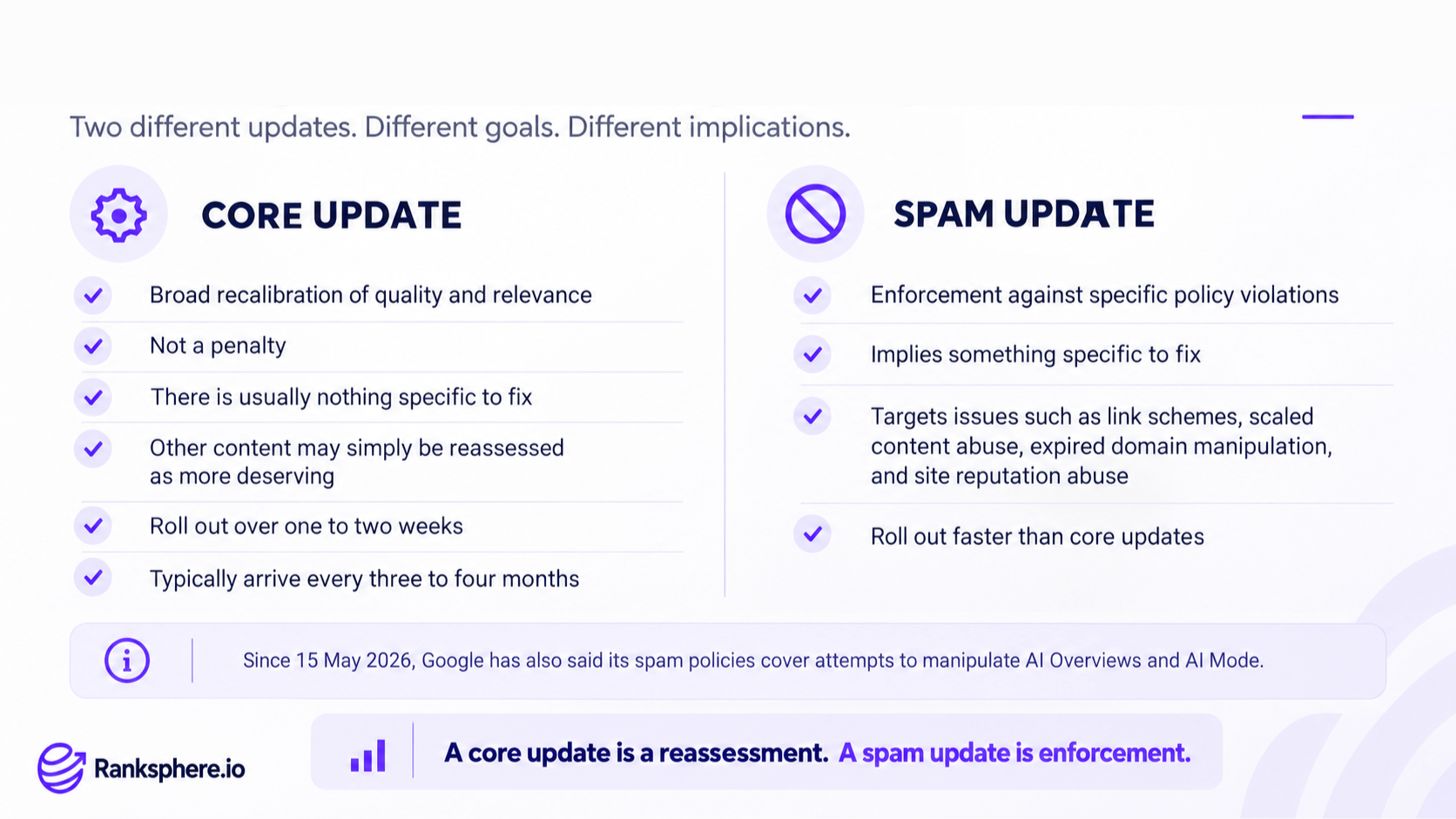
Google may announce different types of ranking updates, but core and spam updates are among the most important to understand.
Core updates
A core update is a broad change to Google's ranking systems.
It does not necessarily mean a website has done something wrong. Google may reassess which pages provide the most useful, relevant or satisfying result for a query, and rankings can move as a result.
A site can therefore lose visibility during a core update without receiving a penalty.
If a page declines, the useful question is usually not:
“What did Google penalise?”
It is:
“What are the results now rewarding that our page may not be doing as well?”
Spam updates
A spam update focuses more directly on detecting or reducing the visibility of content and practices that breach Google's spam policies.
That can involve areas such as:
- Link manipulation
- Scaled content abuse
- Expired domain abuse
- Site reputation abuse
- Other attempts to manipulate search visibility
If a site is affected by a spam-related system, the response is different from a core update. Review Google's current policies and identify whether the site is using tactics that should be removed or corrected.
Google's spam policies also apply to attempts to manipulate newer search experiences, including AI Overviews and other AI-powered search features.
Not every ranking change is an algorithm update
Rankings move every day.
Competition changes, pages are updated, Google recrawls content, search intent shifts and the layout of the results page can change.
That means a traffic decline should not automatically be blamed on a Google update.
Before drawing that conclusion, check:
- Whether Google has confirmed an update
- Whether the timing matches your traffic change
- Whether the decline affects the whole site or only certain pages
- Whether competitors moved at the same time
- Whether a technical issue appeared on the website
- Whether the SERP itself changed
Third-party volatility tools can be useful for spotting wider movement, but they do not confirm that Google has launched a particular update.
Google's Search Status Dashboard should be the main reference for officially confirmed Search ranking updates and rollout dates.
Recent Google algorithm updates
Google's update schedule changes from year to year, so any historical list should be treated as a snapshot rather than something permanent.
Recent confirmed updates have included:
- March 2025 core update — 13 to 27 March
- June 2025 core update — 30 June to 17 July
- December 2025 core update — 11 to 29 December
- February 2026 — an update affecting Discover rather than general Google Search
- March 2026 spam update — 24 to 25 March
- March 2026 core update — 27 March to 8 April
- May 2026 core update — 21 May to 2 June
- June 2026 spam update — 24 to 26 June
- August 2026 spam update — 18 to 21 August
Because this information changes, always check the Search Status Dashboard before making decisions based on an update timeline.
What to do when rankings drop during an update
The first step is not changing the website.
It is understanding what happened.
Rankings can move considerably while an update is still rolling out, so reacting to every daily change can make diagnosis harder.
A more useful process is:
- Confirm whether Google has announced an update
- Note when the rollout started and finished
- Avoid making unnecessary large-scale changes during the rollout
- Compare performance before and after the update
- Identify which pages and queries actually changed
- Check whether competitors or SERP features changed
- Decide whether the issue points to content, technical SEO, spam policies or something else
- Make focused improvements rather than rebuilding everything at once
Use Google Search Console to compare impressions, clicks, queries and landing pages across similar periods.
Looking at the whole site's traffic number is usually not enough.
How to analyse a core update
If rankings fall after a core update, break the data down before deciding what needs work.
Look at:
- Page type
- Search intent
- Topic
- Device
- Country or region
- Query type
- Organic clicks
- Impressions
- Ranking position
You may discover that only one part of the site was affected.
For example, informational articles may decline while service pages remain stable. Or older pages may lose visibility while recently updated content continues performing normally.
That tells you far more than simply saying “the site lost 20% after the update.”
For a core update, review whether the affected pages still provide a strong answer to the search.
Consider:
- Is the information accurate and current?
- Does the page fully satisfy the query?
- Is it based on real expertise or experience where that matters?
- Is important information easy to find?
- Has the SERP moved toward a different type of content?
- Are stronger competitors now offering something the page lacks?
- Does the content exist primarily for users, or mainly to target keywords?
The aim is not to find a secret technical switch.
It is to understand why another result may now be more useful to the searcher.
How to analyse a spam update
A spam update deserves a different review.
Start with Google's current spam policies and check whether the site uses practices that could fall within them.
Areas to investigate can include:
- Manipulative link building
- Large volumes of low-value pages
- Third-party content published mainly to exploit a site's authority
- Expired domains used primarily for ranking manipulation
- Cloaking or misleading redirects
- Automatically generated pages with little original value
- Other tactics intended primarily to manipulate search rankings
Do not assume every decline during a spam update proves a violation.
Check the timing and affected sections first.
But if the site has been using a questionable tactic, fixing the underlying practice is more useful than trying to replace it with another shortcut.
Algorithm updates and SERP changes
Traffic can decline even when your ranking barely moves.
This happens when the search results themselves change.
A query that previously showed ten traditional organic links might later include:
- An AI Overview
- A local pack
- Videos
- Shopping results
- Featured snippets
- More paid ads
- Other interactive search features
These elements can reduce the number of clicks available to standard organic results.
That is why ranking, impressions and click-through rate should be reviewed together.
If position stays stable but CTR falls, the problem may be the changing SERP rather than a loss of ranking strength.
Google algorithm updates and local SEO
Google algorithm updates can also affect local businesses, but local search needs to be measured differently.
A business may continue ranking well close to its premises while losing visibility further across its service area.
A single ranking checked from one location may never reveal that change.
For local SEO, compare:
- Local pack visibility
- Geo-grid coverage
- Organic rankings
- Google Business Profile activity
- Competitor movement
- Calls and enquiries
Ranksphere's rank tracker runs recurring scans with date-to-date comparison, helping you compare visibility before and after an update across the areas where customers actually search.
How long does recovery take?
There is no fixed recovery timeline after a Google algorithm update.
Some pages may improve after changes are recrawled and reassessed. Other improvements can take considerably longer to show, particularly when broader ranking systems are involved.
Avoid assuming that nothing worked simply because rankings did not return within a few days.
Instead:
- Make changes for clear reasons
- Record what was changed
- Allow Google time to recrawl and reassess the pages
- Monitor the affected queries and page groups
- Avoid repeatedly changing the same pages before you can evaluate the previous work
SEO recovery is easier to understand when changes are deliberate and documented.
Common Google algorithm update mistakes
- Panicking while an update is still rolling out. Rankings may continue moving until the rollout settles.
- Changing large parts of the site immediately. This can make it difficult to tell what actually caused or fixed the problem.
- Treating every core update as a penalty. A ranking loss does not automatically mean Google has punished the site.
- Blaming every traffic change on Google. Technical problems, competitors and seasonality can produce similar patterns.
- Only looking at total traffic. Segment by page and query to see where the change actually happened.
- Ignoring SERP changes. A stable ranking can still receive fewer clicks.
- Assuming one recovery timeline applies to every site. Different pages and problems can take different amounts of time to recover.
- Trying to reverse-engineer one ranking factor. Broad updates usually involve more than a single change.
Google algorithm update best practices
- Keep a dated record of confirmed Google updates.
- Track major website changes alongside ranking and traffic data.
- Use Search Console to compare affected pages and queries.
- Wait until a rollout has settled before making major conclusions.
- Analyse performance by page type and search intent.
- Check the live SERP rather than looking only at ranking numbers.
- Use geo-grid tracking for important local searches.
- Review Google's current spam policies when spam updates occur.
- Improve weak content continuously rather than waiting for an update to expose it.
- Document SEO changes so you can understand what happened later.
Example
“Hartwell Legal notices a sharp organic traffic decline around the time of a Google core update.
The immediate reaction is to assume something is wrong across the entire website.
But when the team reviews the data in Search Console, the service pages are largely unchanged.
Most of the decline comes from a group of older informational articles.
Several were written years earlier and cover broad legal topics in a generic way. They contain little that reflects the firm's actual experience and have not been reviewed recently.
Instead of redesigning the whole website, Hartwell focuses on the affected section.
Articles that still serve a useful purpose are updated with clearer explanations, current information and input from the firm's solicitors. Pages that no longer add anything useful are consolidated or retired.
The commercial pages are left alone because the data gives no reason to change them.
That is the right way to approach a Google algorithm update: identify what actually changed before deciding what needs fixing.”
See also
- Google Search Console — where changes in impressions, clicks and queries can be investigated
- Rank tracking — monitoring search visibility during and after an update
- Core Web Vitals — performance and user experience metrics worth monitoring separately
- E-E-A-T — a framework for thinking about experience, expertise, authoritativeness and trust
- Local pack — where changes in local visibility may appear
- Geo-grid rank tracking — measuring local ranking cha