Domain Authority, usually shortened to DA, is a third-party SEO metric created by Moz to estimate the relative ranking strength of a website.
It is measured on a scale from 1 to 100 and is influenced heavily by backlink data.
The most important thing to understand is this:
Domain Authority is not a Google metric.
Google does not use Moz's DA score to determine where a website ranks, and there is no public Google equivalent called “Domain Authority”.
That does not make DA useless.
It can be a useful comparison metric when used within the right context. The problem begins when it is presented as though increasing Domain Authority is itself an SEO objective or direct evidence that Google thinks a website has become more authoritative.
It does not tell you that.
What does Domain Authority measure?
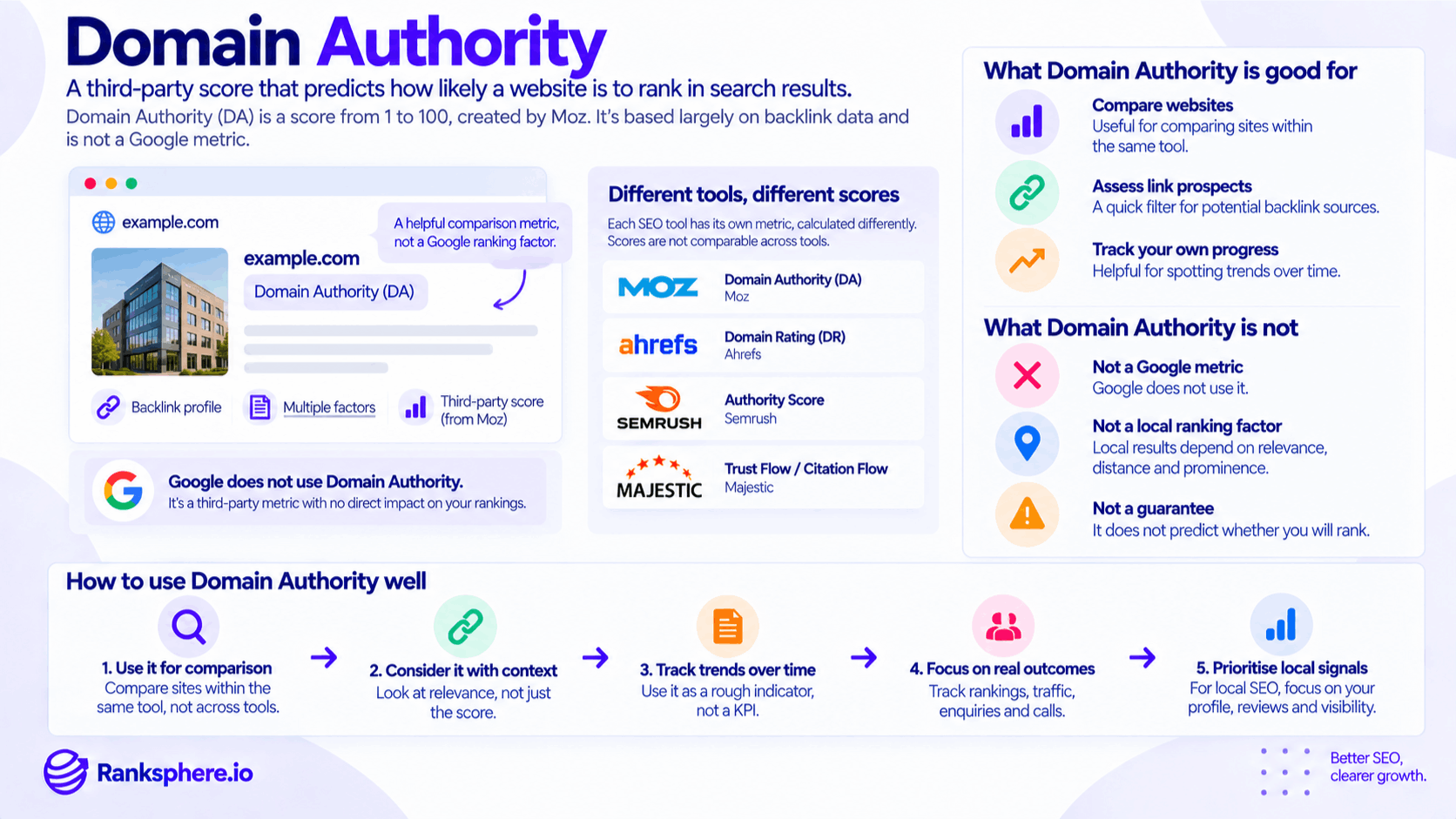
Domain Authority attempts to estimate the relative ranking strength of an entire domain.
In practice, it is heavily influenced by the site's backlink profile, including the websites linking to it and the relative strength of those linking domains.
This can make DA useful when comparing websites.
For example, if several competing sites operate in the same market, Domain Authority may give you one rough indication of how their backlink profiles compare.
But it cannot tell you:
- Whether your page matches search intent
- Whether your content is better
- Whether Google will rank you above a competitor
- Whether your Google Business Profile is optimised
- How close your business is to a local searcher
- Whether your page is properly indexed
- Whether the site's backlinks are relevant to the particular query
It is one third-party estimate, not a complete picture of SEO performance.
Is Domain Authority a Google ranking factor?
No.
Google does not use Moz Domain Authority as a ranking factor.
DA is calculated by Moz using Moz's own data and methodology.
Google has its own ranking systems, which consider many signals when deciding which pages to show for a search.
This distinction matters because SEO reports sometimes say things such as:
“Google considers your website more authoritative because DA increased from 25 to 32.”
That conclusion cannot be made from the DA score.
What you can accurately say is:
“Moz's estimate of the domain's relative authority increased according to its own model.”
Those are very different claims.
Who creates Domain Authority?
Domain Authority is a proprietary Moz metric.
Other SEO platforms have created their own authority-style metrics.
Common examples include:
Domain Authority — Moz
Domain Authority (DA) estimates the relative ranking strength of a domain using Moz's own model.
This is the metric people usually mean when they specifically use the abbreviation DA.
Domain Rating — Ahrefs
Domain Rating (DR) is Ahrefs' metric for the relative strength of a site's backlink profile.
Ahrefs measures DR on a 0–100 scale and describes it as logarithmic. Its calculation considers factors including the strength of linking domains and how many other domains those websites link to.
Authority Score — Semrush
Authority Score is Semrush's compound metric.
Its current methodology considers three broad areas:
- Link power
- Estimated organic traffic
- Spam-related or natural-profile signals
So Authority Score is not simply another name for Moz DA or Ahrefs DR.
DA vs DR vs Authority Score
These metrics may look similar because they usually appear as scores on roughly the same scale.
They are not interchangeable.
A website might have:
DA 31
DR 44
Authority Score 37
That does not mean one tool is right and the others are wrong.
Each platform:
- Has its own web index
- Sees a different set of backlinks
- Uses its own formula
- Updates data differently
- Weighs signals differently
Because of that, you should not compare:
DA 40 vs DR 40
as though they represent the same level of authority.
They do not.
Use the same metric within the same platform when making comparisons.
What is a good Domain Authority?
There is no universal “good” Domain Authority.
A DA of 25 might be relatively strong in one market and weak in another.
The useful comparison is usually against websites competing for the same audience and searches.
For example:
A local veterinary practice does not need to compare its DA with:
- Wikipedia
- BBC
- Amazon
- A national newspaper
Those sites operate in completely different environments.
Instead, compare it with other veterinary businesses competing in the same market.
Even then, treat DA as supporting information rather than the answer.
If your competitor has a higher DA but your page is more relevant to a particular search, you can still outrank them.
What Domain Authority is useful for
Used carefully, Domain Authority can help with several SEO tasks.
Comparing similar competitors
DA can provide a rough sense of how backlink strength differs between websites in the same competitive set.
For example, if the top-ranking competitors consistently have much stronger backlink profiles than your site, link acquisition may deserve investigation.
But DA alone does not prove backlinks are the reason they rank.
Always review:
- Page quality
- Search intent
- Internal linking
- Backlinks to the specific page
- Technical SEO
- Brand prominence
Reviewing backlink opportunities
Domain Authority can be one data point when assessing a potential backlink.
Suppose two websites offer relevant editorial opportunities.
DA may help provide additional context.
But it should not override more important questions:
Is the site relevant?
Is it legitimate?
Does it have real content and readers?
Why would it naturally link to us?
A highly relevant industry publication with a modest DA can be a much better link opportunity than an unrelated site with a larger score.
Tracking relative trends
Monitoring your DA over time can give you a rough indication of how Moz's view of your backlink profile is changing.
That can be useful internally.
But a rising DA should not automatically be reported as SEO success.
Ask whether the change is accompanied by improvements in:
- Rankings
- Organic visibility
- Relevant traffic
- Leads
- Sales
- Backlink quality
The business outcome matters more than the score.
Competitor research
Authority metrics can also help when quickly reviewing a competitive landscape.
If you are researching 50 competing domains, a third-party authority score can help you identify which sites deserve a closer look.
Use it for filtering.
Do not use it as the final judgement.
What Domain Authority cannot tell you
Domain Authority is much less useful when it is treated as a complete SEO score.
It cannot reliably tell you whether an individual page will rank.
A high-DA website can publish a poor page.
A lower-DA site can publish a highly relevant page that performs very well.
Search engines rank webpages for queries, not websites according to one universal authority number.
Domain Authority and local SEO
Domain Authority becomes especially easy to misuse in local SEO.
Google says local results are mainly determined by three broad factors:
Relevance
How closely the business matches what the searcher wants.
Distance
How far the business is from the searcher or location used in the query.
Prominence
How well known or established the business appears to be.
Google says prominence can draw on information from across the web, including links, articles and directories, as well as reviews and ratings.
Domain Authority does not measure that complete local ranking system.
It does not know:
- Where the searcher is standing
- How relevant your Business Profile category is
- Whether your business matches the query
- Your real local-pack coverage
- Your complete local reputation
That makes DA a poor headline metric for measuring local search performance.
Can a low-DA business outrank a high-DA business locally?
Yes.
A business with a lower Domain Authority can appear above a much larger website for a local search.
That does not mean links have no role in local SEO.
It means Domain Authority does not represent the complete local ranking system.
For example, a local optician may have stronger relevance and proximity for:
optician near me
than a national chain's more distant location.
Google evaluates local results using a combination of factors rather than sorting businesses according to Moz DA.
This is why comparing Domain Authority alone is particularly misleading for local businesses.
Domain Authority and organic rankings
DA can sometimes be more useful when analysing traditional organic search competition.
Suppose you are evaluating results for:
how to choose a heat pump
and the first page contains several established websites with strong backlink profiles.
Authority metrics may help you understand part of the competitive environment.
But they still do not tell you whether you can rank.
You also need to examine:
- Search intent
- Content depth
- Page-level backlinks
- Topic relevance
- Internal linking
- SERP features
- Website quality
Domain-level metrics are only one layer.
Domain Authority vs page authority
Another common mistake is assuming a domain-level score tells you how strong every page on that website is.
It does not.
A domain may have substantial overall authority while a particular page has:
- No backlinks
- Few internal links
- Weak content
- Poor relevance
Likewise, a relatively small website may have one exceptional resource that has earned many high-quality links.
When analysing a particular ranking opportunity, page-level factors often deserve at least as much attention as the domain-wide metric.
Domain Authority and backlinks
Domain Authority is closely associated with backlinks.
That makes it useful as a rough summary of a site's link profile.
But do not confuse:
More backlinks
with:
Better backlinks
A website might increase its backlink count through hundreds of:
- Low-quality directories
- Scraped pages
- Spam sites
- Automated links
without meaningfully improving its search performance.
Another website may earn only a handful of links from:
- Relevant publications
- Industry organisations
- Suppliers
- Trusted local organisations
and have a much stronger backlink profile in practical terms.
See backlink for the wider distinction between backlink quantity and quality.
Should you use DA when choosing backlinks?
You can use it as one filter.
Do not make it the rule.
A common outreach requirement is:
Only pursue websites with DA 40+.
That can exclude excellent opportunities.
For a local business, a relevant:
- Local newspaper
- Trade organisation
- Supplier
- Community website
- Industry publication
may be valuable even if its DA is relatively modest.
Evaluate backlink opportunities in roughly this order:
Relevance → legitimacy → editorial context → audience → authority metrics
The score should support your judgement rather than replace it.
Can Domain Authority be manipulated?
Third-party authority metrics can sometimes be influenced in ways that do not correspond to meaningful SEO improvement.
For example, a website may acquire large numbers of backlinks that increase a tool's authority score without producing:
- Relevant traffic
- Better rankings
- Qualified leads
- Stronger brand recognition
This is another reason not to buy links merely because a vendor promises:
“Increase your DA to 50.”
The objective of link building should be earning useful and relevant links.
Improving a third-party score may happen as a consequence.
It should not be the purpose.
Are authority scores logarithmic?
This depends on the metric.
Ahrefs explicitly describes Domain Rating as using a logarithmic 0–100 scale. That means moving from DR 70 to 71 requires substantially more relative growth than moving from DR 20 to 21.
Do not automatically assume that every authority metric uses exactly the same mathematical model.
Moz, Ahrefs and Semrush calculate their scores differently.
That is another reason cross-tool comparisons are unreliable.
Why authority scores can change unexpectedly
A score can change even when you have done nothing.
SEO platforms constantly:
- Discover new backlinks
- Lose old backlinks from their indexes
- Recrawl websites
- Change calculations
- Update spam detection
- Expand their databases
Semrush, for example, currently updates Authority Scores regularly as its underlying data changes.
So if an authority score drops, do not immediately assume Google has penalised the website.
Check what actually changed.
Your:
- Rankings
- Search visibility
- Organic traffic
- Conversions
may be completely unaffected.
Domain Authority and link equity
Link equity describes the SEO concept of ranking signals passing through links.
Domain Authority is not a direct measurement of Google's link equity.
It is a third-party attempt to estimate relative domain strength based on external data.
That distinction is important.
Google has its own systems.
Moz has its own model.
Do not treat a commercial SEO metric as a window directly into Google's algorithm.
Domain Authority and link building
Authority scores are commonly used to evaluate link building campaigns.
That can be useful when handled properly.
For example:
Instead of reporting:
“We built 20 DA 50+ links.”
a stronger report might explain:
- Which websites linked
- Why they were relevant
- Which pages received the links
- Whether they sent referral traffic
- Whether target pages gained visibility
- Whether enquiries or conversions changed
The link should matter more than the metric attached to the linking domain.
Better metrics for local SEO
For a local business, Domain Authority usually should not be the headline KPI.
More useful measurements often include:
- Local pack visibility
- Organic rankings for commercially relevant searches
- Geo-grid coverage
- Google Business Profile interactions
- Calls
- Enquiries
- Bookings
- Direction interactions where available
- Reviews and review growth
- Organic conversions
Ranksphere's rank tracker compares your visibility against competitors across your service area, providing a direct view of where the business is actually visible rather than relying solely on a proxy for backlink strength.
Domain Authority and geo-grid tracking
Geo-grid rank tracking is particularly useful for local businesses because local rankings can change depending on where the search is performed.
A single DA score cannot show that.
Imagine an optician with:
DA 18
That tells you something about Moz's assessment of the domain.
It does not tell you whether the business ranks:
- First around its premises
- Fifth two miles away
- Outside the local pack five miles away
Geo-grid data answers a completely different and usually more practical local SEO question:
Where can customers actually find this business?
Domain Authority and client reporting
Domain Authority can be included in an SEO report when there is a reason.
But it should be explained correctly.
Instead of:
“Domain Authority increased, so Google trusts your website more.”
say:
“Moz's Domain Authority increased, reflecting a stronger backlink profile according to Moz's model.”
Then show the outcome metrics.
For example:
- Organic visibility
- Rankings
- Leads
- Calls
- Sales
Clients should understand which numbers come from Google and which come from third-party SEO platforms.
Common Domain Authority mistakes
- Calling Domain Authority a Google metric. It belongs to Moz.
- Treating DA as a direct ranking factor.
- Assuming a higher-DA domain automatically outranks a lower-DA one.
- Comparing DA directly with Ahrefs DR or Semrush Authority Score.
- Using a fixed minimum DA as the main test for backlink opportunities.
- Ignoring relevance because a website has a high authority score.
- Using DA as the main KPI for local SEO.
- Assuming all authority metrics use the same logarithmic calculation.
- Panicking when the score falls without checking actual search performance.
- Buying backlinks specifically to increase DA.
- Treating a domain-level score as though every page on the site is equally strong.
Domain Authority best practices
- Use Domain Authority as a relative third-party indicator, not a Google score.
- Compare websites within the same SEO platform.
- Compare relevant competitors rather than unrelated major websites.
- Evaluate backlink prospects on relevance and legitimacy before DA.
- Use page-level analysis when evaluating specific search results.
- Track organic visibility and conversions alongside authority metrics.
- Explain clearly who creates the metric when reporting it to clients.
- Do not optimise purely to increase DA.
- Use local rankings and geo-grid visibility when evaluating local competition.
- Focus on business outcomes rather than movements in a proprietary score.
Example
“Whitfield Opticians receives an SEO report showing that its Domain Authority has increased over the previous six months.
The result is presented as the main achievement of the campaign.
The practice owner asks a more useful question:
Has this helped more people find or contact us?
The team looks beyond DA.
Organic enquiries have barely changed.
The business still has weak visibility across much of its service area, and several important Google Business Profile elements need attention.
The increase in Domain Authority is real according to Moz's metric.
It is simply not the most useful measure of the practice's current local SEO performance.
The reporting changes.
Instead of leading with DA, the team begins monitoring:
- Local pack coverage
- Commercial organic rankings
- Calls and enquiries
- Business Profile interactions
- Review growth
Domain Authority remains available as supporting information about the backlink profile.
It no longer defines whether the campaign succeeded.
That is the right way to use Domain Authority: as a comparative SEO metric, not a Google score and not a substitute for measuring whether the business is actually becoming more visible to the people it wants to reach.”
See also
- Backlink — one of the main inputs behind authority metrics
- Link equity — the SEO concept that authority metrics attempt to approximate
- Local ranking factors — relevance, distance and prominence in local search
- Geo-grid rank tracking — measuring local visibility from different locations
- Link building — earning links rather than chasing an authority score
- Rank tracking — measuring actual search visibility rather than a proxy metric