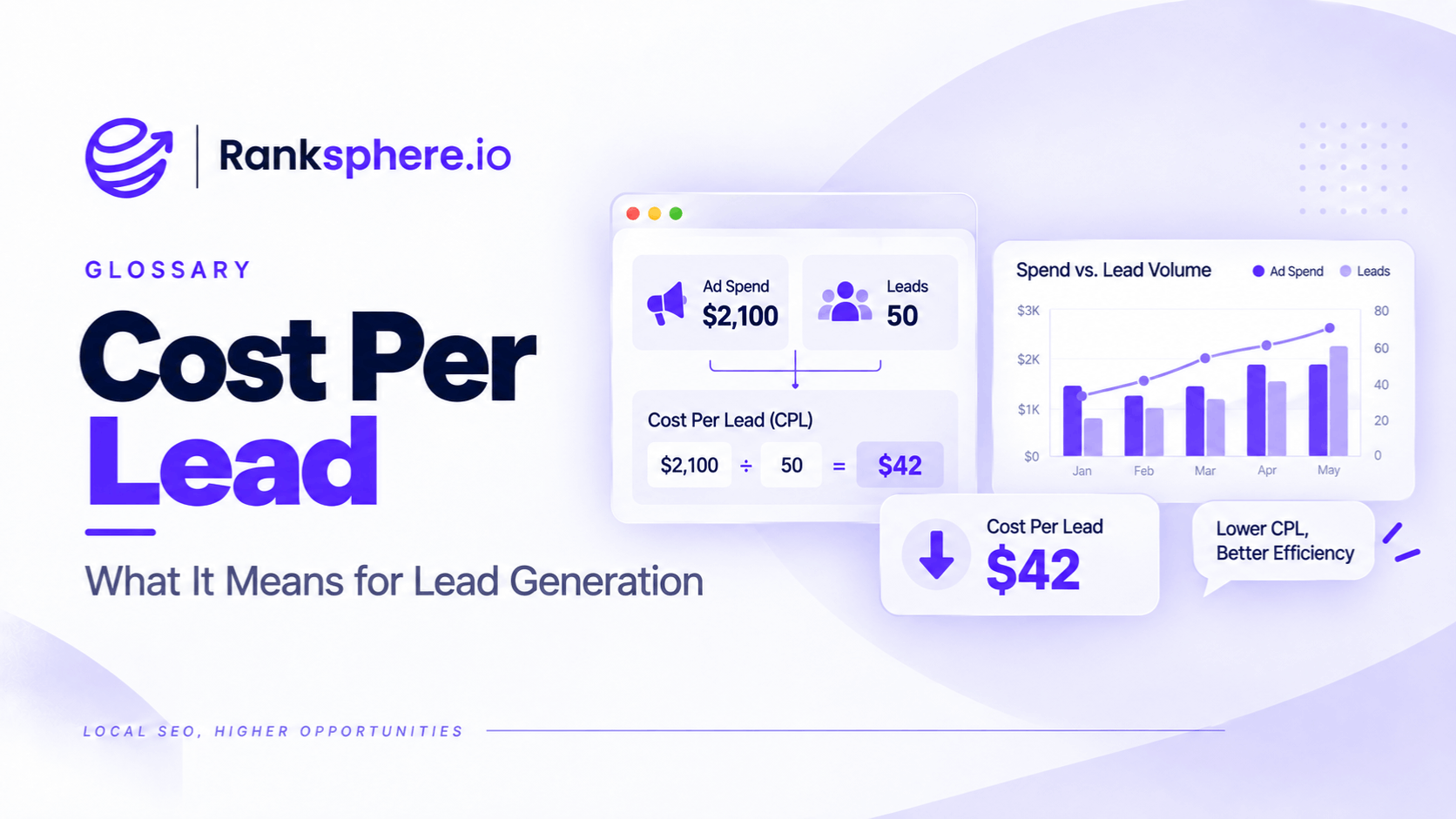
Cost per lead (CPL) is the average amount spent to generate one lead over a defined period.
The basic formula is:
Cost per lead = Total marketing cost ÷ Number of leads
If a business spends:
£5,000
and generates:
50 leads
its cost per lead is:
£100
The calculation is simple.
Deciding what counts as:
- Cost
- A lead
- Attribution
is where it becomes more complicated.
This is especially true for SEO and local businesses, where customers may contact the business through the website, Google Business Profile, phone calls or booking systems.
A useful CPL therefore depends less on the formula and more on whether the inputs have been defined consistently.
Cost per lead vs customer acquisition cost
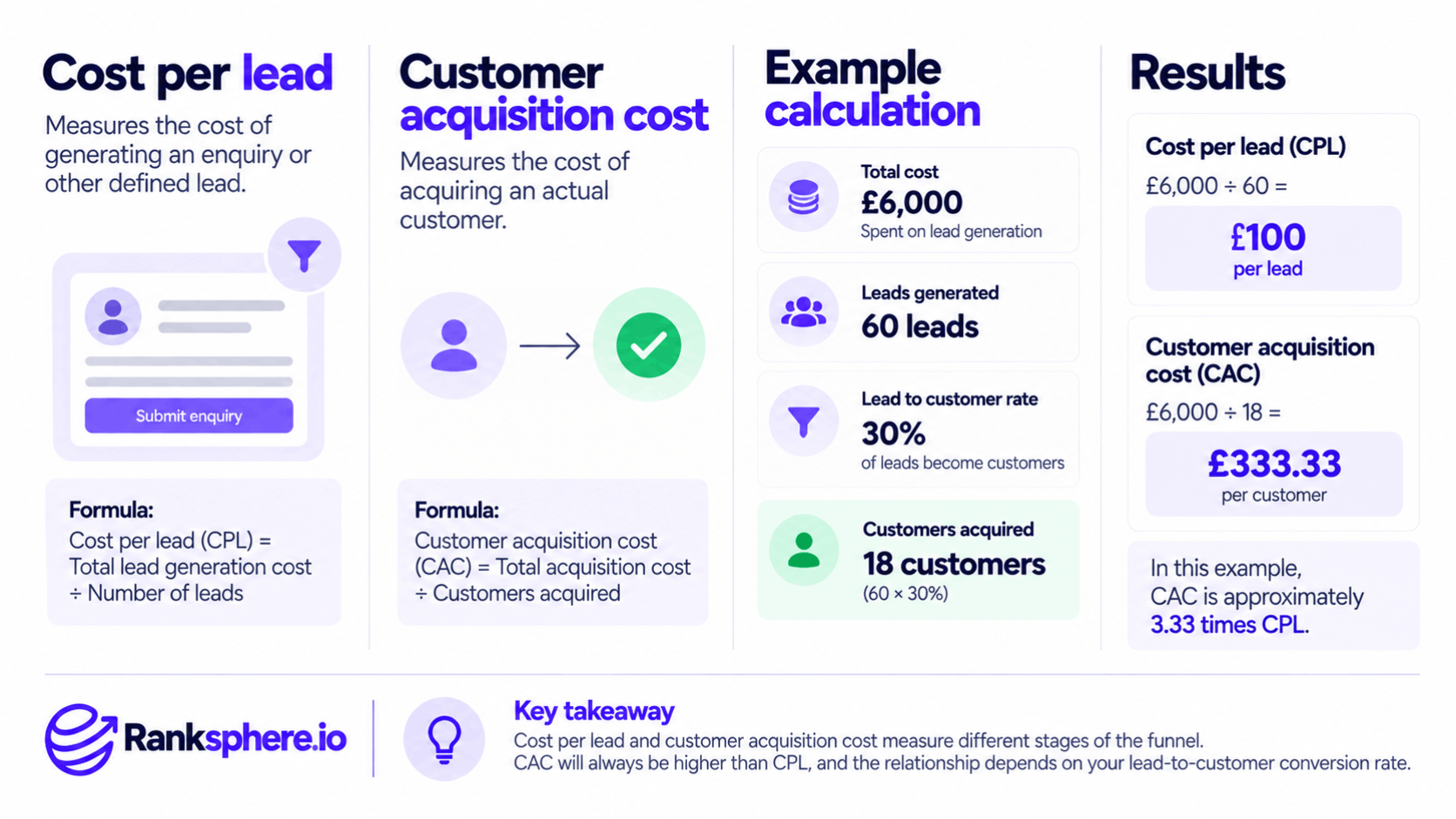
Cost per lead and customer acquisition cost are related, but they measure different stages of the funnel.
Cost per lead
Measures the cost of generating an enquiry or other defined lead.
Customer acquisition cost
Measures the cost of acquiring an actual customer.
The formula is:
Customer acquisition cost = Total acquisition cost ÷ Customers acquired
If a business spends:
£6,000
to generate:
60 leads
its CPL is:
£100.
If 30% of those leads become customers:
60 × 30% = 18 customers
The CAC is:
£6,000 ÷ 18 = £333.33
In this example:
CAC is approximately 3.33 times CPL.
That relationship depends entirely on the lead-to-customer conversion rate.
A low CPL can still produce a poor CAC
Suppose Campaign A generates cheap leads:
CPL: £30
but only:
5%
become customers.
Campaign B produces more expensive leads:
CPL: £100
but:
40%
become customers.
Campaign A:
CAC = £600
Campaign B:
CAC = £250
The cheaper lead source is actually more expensive at the customer level.
That is why CPL should never be assessed without looking at:
- Lead quality
- Close rate
- Customer value
What counts as a lead?
This should be defined before calculating CPL.
For a local service business, possible lead events might include:
- Submitted enquiry form
- Qualified phone call
- Completed consultation request
- Appointment booking
- Quote request
The definition should reflect an action that gives the business a realistic opportunity to acquire a customer.
Not every interaction is a lead
This distinction matters particularly in local SEO.
Google Business Profile Performance can report interactions including:
- Calls
- Direction requests
- Website clicks
- Bookings
But these do not all mean the same thing.
Google defines the Calls metric as the number of times someone clicked the call button on the Business Profile.
That does not prove that:
- The call connected
- Someone answered
- The caller was qualified
- A sale resulted
So a Business Profile call click is better described as:
a call interaction
until additional tracking confirms the call itself.
Direction requests are not automatically leads
Google's Directions metric records people who asked for directions to the business. Google also adjusts the metric to account for factors such as repeated taps, cancellations and spam.
That can indicate strong intent.
It does not prove somebody:
- Visited
- Made an enquiry
- Became a customer
So avoid putting every direction request into the CPL denominator and calling it a lead.
Report it separately unless you have a validated method connecting those requests with actual customer activity.
Completed bookings are stronger
Where supported, Google Business Profile can report completed bookings through compatible booking providers.
A completed appointment booking is much closer to a genuine business outcome than:
someone clicked Directions.
Build the lead definition around meaningful actions rather than trying to maximise the denominator.
Call tracking makes local CPL more useful
If phone calls are a major source of leads, proper call tracking is particularly valuable.
It can help distinguish:
Call-button click
from:
Connected call
from:
Qualified enquiry
from:
Customer.
Without that additional information, reporting:
25 GBP calls = 25 leads
can overstate performance.
The closer your tracking gets to the actual customer outcome, the more useful the CPL becomes.
Cost per qualified lead
For businesses receiving large numbers of weak enquiries, cost per qualified lead may be more useful than ordinary CPL.
For example:
A roofing company receives:
100 enquiries
but only:
30
are:
- In the service area
- Looking for work the company provides
- Genuine prospects
Raw CPL measures all 100.
Qualified CPL uses the 30 commercially useful opportunities.
That often provides a clearer view of marketing efficiency.
Cost per lead in SEO
Calculating CPL for SEO can be harder than calculating it for a short paid campaign because SEO costs and results do not always occur at the same time.
Work completed this month may affect performance over a longer period.
Examples include:
- Improving service pages
- Technical fixes
- Internal linking
- Local optimisation
- Content
That creates a timing problem.
A one-month calculation can make an SEO programme look unusually expensive if much of the month's work is investment whose impact has not yet appeared.
But the opposite mistake is assuming SEO inevitably becomes cheaper forever.
It does not.
There is no universal SEO payback period
Avoid rules such as:
Months 1–4 are the investment phase.
or:
SEO must be measured for at least 12 months.
Some businesses can see meaningful leads relatively quickly.
Others operate in:
- Highly competitive markets
- Long sales cycles
- New domains
- Difficult geographic markets
and take much longer.
The appropriate measurement period should reflect:
- Business maturity
- Sales cycle
- Campaign type
- Competition
- Existing visibility
The important requirement is that the period is long enough to make the calculation representative.
Monthly SEO CPL can still be useful
Do not dismiss monthly CPL completely.
It can help monitor:
- Tracking problems
- Sudden lead changes
- Cost increases
- Lead quality changes
The mistake is using one early month's number as the final judgement of a longer-term campaign.
For strategic decisions, a trailing period can provide more context.
For example:
Trailing 6-month CPL
or:
Trailing 12-month CPL
may smooth short-term volatility.
The right window depends on the business.
SEO leads are not free after the initial work
A common marketing claim is:
“SEO keeps generating leads for free once the page ranks.”
That is misleading.
An existing page may continue attracting search traffic without paying for every click.
But the programme may still incur costs such as:
- SEO retainers
- Staff time
- Content updates
- Development
- Hosting
- Tools
- Digital PR
- Reporting
- Maintenance
Pages can also:
- Lose rankings
- Become outdated
- Face stronger competitors
The better distinction is:
organic search does not normally charge a media fee for each website click.
That is not the same as:
future SEO leads cost nothing.
Paid search CPL is not necessarily flat
The reverse comparison also needs care.
Paid advertising does not guarantee:
Spend doubles → leads double.
Paid CPL can change because of:
- Auction competition
- Bid strategy
- Search demand
- Creative
- Landing pages
- Targeting
- Budget
- Conversion rate
So avoid presenting:
paid = fixed CPL
and:
SEO = continuously falling CPL.
Both channels can become more or less efficient over time.
Compare channels using the same definitions
If you compare SEO with paid search, use consistent methodology.
For example, do not compare:
Google Ads
Qualified enquiries
against:
SEO
Forms + call clicks + direction requests
The SEO denominator will be much broader.
Similarly, do not compare:
CAC from paid
with:
CPL from SEO.
Those measure different outcomes.
A useful channel comparison requires the same:
- Lead definition
- Qualification standard
- Attribution logic
- Time period where practical
Otherwise the cheaper channel may simply have the easier measurement standard.
Getting the SEO cost input right
The numerator deserves just as much attention as the lead count.
Depending on the purpose of the calculation, SEO cost might include:
- Agency or consultant retainer
- SEO software
- Content production
- Development work
- Digital PR
- Freelancers
- Internal staff time
- Relevant creative production
Do not exclude costs simply because they were paid from a different budget.
Internal time is still a cost
Suppose an in-house marketing manager spends:
20 hours a month
on SEO.
Treating that work as:
£0
makes the CPL artificially low.
If the goal is to understand the true economic cost of the channel, internal labour belongs somewhere in the model.
Be clear about the methodology used.
Avoid double-counting shared costs
The opposite problem is assigning every marketing cost to SEO.
For example, one developer may work across:
- Paid landing pages
- SEO
- Website maintenance
Allocating their entire monthly cost to SEO would overstate CPL.
Where costs are shared, use a reasonable allocation method and document it.
Attribution is the difficult part
A lead may interact with several channels before converting.
For example:
- Reads an organic guide
- Sees a social advert
- Searches the brand
- Returns organically
- Completes an enquiry form
Which channel gets the lead?
There is no single answer independent of the attribution model.
Google Analytics itself supports different attribution approaches because different touchpoints can contribute to the same conversion path.
That makes attribution methodology part of the CPL calculation.
Do not automatically exclude all branded leads
The original rule:
“Exclude branded search because those people would have arrived anyway.”
goes too far.
A branded search tells you that the person knew the brand at the time of the search.
It does not tell you how they discovered it.
They may previously have encountered the business through:
- Non-branded organic search
- PR
- Advertising
- Word of mouth
- Social media
Search Console now lets eligible sites analyse branded and non-branded queries separately. Google says branded traffic often comes from users already familiar with a site, while non-branded traffic can indicate broader audience growth.
That makes segmentation useful.
It does not make all branded leads automatically incremental or non-incremental.
Use a non-branded CPL where appropriate
If you specifically want to answer:
How much are we spending to generate measurable non-branded organic enquiries?
then calculating a separate non-branded CPL can make sense.
For example:
SEO cost ÷ attributable non-branded leads
But label it clearly.
Do not present it as:
the one true SEO CPL.
You may also report:
- Overall organic CPL
- Non-branded CPL
- New-customer CPL
depending on the question the business needs answered.
Search Console can help with branded segmentation
Search Console's current branded/non-branded query filter can separate queries containing:
- Brand name
- Domain
- Brand-specific services or products
- Common variations and misspellings
from non-branded queries on eligible properties.
This is particularly useful when assessing:
- Brand demand
- Broader discovery
But it does not automatically connect every Search Console query to an individual CRM lead.
Attribution still needs additional measurement.
Google Business Profile interactions need attribution caution
There is another local complication.
Google's current Business Profile Performance documentation says profile performance can include data associated with both:
- Organic Search
- Google Ads
depending on the metric and setup.
So:
every profile interaction = SEO lead
is not a safe assumption.
Use:
- UTM tagging where appropriate
- Call tracking
- Booking data
- CRM records
to get closer to channel-level attribution.
Ranksphere's white-label reports bring local performance into client-ready documents, where Business Profile interactions can sit alongside website conversions rather than being automatically treated as identical lead types.
Cost per lead vs conversion rate
Conversion rate is one of the main variables affecting CPL.
If traffic and spend stay the same but conversion rate improves, CPL falls.
For example:
Before
1,000 visits
20 leads
£4,000 cost
CPL = £200
After
1,000 visits
40 leads
£4,000 cost
CPL = £100
No additional traffic was required.
The website converted existing demand more effectively.
That is why CPL should not be treated entirely as a ranking or traffic metric.
CPL and customer lifetime value
CPL tells you how much a lead costs.
It does not tell you whether that cost is commercially sensible.
For that, you need information such as:
- Close rate
- Gross margin
- First-year customer value
- Customer lifetime value
Suppose two businesses both have:
£120 CPL.
Business A
Average customer value:
£250
Business B
Average customer value:
£5,000
The same CPL has very different economics.
Lifetime value alone is not enough
Even lifetime value needs care.
Revenue is not the same as profit.
If possible, evaluate acquisition cost against:
- Gross profit
- Contribution margin
- Customer lifetime value
rather than revenue alone.
A £2,000 customer may sound attractive.
If fulfilment costs £1,900, the economics are very different from a £2,000 customer with £1,200 of contribution margin.
Cost per lead does not tell you whether the channel is profitable
CPL answers:
What did we spend per lead?
Profitability asks a wider question.
You still need:
- Lead-to-customer rate
- CAC
- Margin
- Customer value
A channel with a high CPL can be excellent if its leads:
- Close frequently
- Spend more
- Stay longer
A low CPL can be poor if the enquiries rarely become customers.
Lead quality should be part of reporting
A useful lead report can separate:
Total leads
Every defined enquiry.
Qualified leads
Enquiries matching commercial criteria.
Customers
Leads that converted.
That lets you calculate:
CPL
Cost per qualified lead
CAC
rather than relying on one headline number.
CPL by landing page
For SEO, it can also be useful to analyse which landing pages contribute to leads.
For example:
Service pages
£80 CPL
Location pages
£110 CPL
Informational guides
£250 direct CPL
The guide figure may look weak if measured only by immediate conversions.
But informational content may contribute earlier in longer journeys.
Again, attribution context matters.
CPL by service
Different services may also justify different CPL targets.
For example:
A solicitor acquiring a high-value commercial case can afford a very different lead cost from a business selling a £50 service.
One account-wide target can hide these differences.
Segment by:
- Service
- Product
- Location
where the business economics differ materially.
Use cohorts where the sales cycle is long
If leads take weeks or months to become customers, do not calculate CAC using:
this month's spend ÷ this month's customers
without checking whether the customers came from this month's leads.
The cohorts may not align.
A more useful approach can track:
leads generated in January
and then measure how many eventually became customers.
This prevents the sales cycle from distorting channel economics.
Trailing CPL can smooth volatility
A trailing average can be useful for recurring SEO programmes.
For example:
Trailing 6-month CPL
can reduce distortion from one unusually strong or weak month.
But it should not replace monthly monitoring.
Use both:
Monthly
For operational changes.
Trailing period
For strategic efficiency.
Seasonality affects CPL
Suppose a roofing business spends roughly the same amount every month.
During peak demand it generates:
60 leads.
During a quiet season:
20.
The CPL changes dramatically without any change in SEO quality.
Search demand matters.
Compare:
- Year on year
- Equivalent seasons
where appropriate.
Common cost-per-lead mistakes
- Counting every Google Business Profile interaction as a lead.
- Treating call-button clicks as confirmed qualified calls.
- Treating direction requests as completed enquiries.
- Automatically assigning every Business Profile interaction to SEO.
- Using website forms as the only lead type when calls and bookings genuinely matter.
- Comparing SEO CPL with paid CAC.
- Assuming paid CPL remains flat as spend changes.
- Assuming SEO CPL will continually decline over time.
- Claiming old SEO work generates future leads at no cost.
- Using a universal four-month or twelve-month measurement rule.
- Automatically excluding every branded lead because it “would have arrived anyway.”
- Including every branded lead as unquestionably generated by SEO.
- Leaving internal labour out of the cost calculation.
- Using total lead count without checking lead quality.
- Reporting CPL without close rate, CAC or customer value.
Cost-per-lead best practices
- Define exactly what counts as a lead before calculating CPL.
- Separate interactions, leads, qualified leads and customers.
- Use call tracking or CRM data where phone enquiries are important.
- Report direction requests separately rather than automatically treating them as leads.
- Include the relevant cost of retainers, tools, content, development and internal time.
- Avoid double-counting shared marketing costs.
- Choose a measurement period appropriate to the sales cycle and maturity of the campaign rather than imposing a universal minimum.
- Use a trailing CPL alongside monthly performance when SEO results are volatile.
- Compare channels using the same lead definitions and attribution rules.
- Use branded keywords segmentation where useful, but do not automatically exclude every branded conversion.
- Read CPL alongside conversion rate, close rate, CAC and customer lifetime value.
- Use qualified-lead CPL where raw enquiry quality varies significantly.
Example
“Consider a hypothetical veterinary practice called Marden Veterinary.
After four months of SEO work, the practice has spent:
£4,400
and its CRM contains:
11 enquiries attributed to organic search.
On those figures:
£4,400 ÷ 11 = £400 CPL.
The practice manager compares that with a much lower figure from another marketing channel and concludes that SEO is too expensive.
Before making that decision, the team checks the measurement.
It finds several problems.
The other campaign reports every enquiry.
The SEO report uses only website forms.
That is not a fair comparison.
Google Business Profile shows additional:
- Call-button clicks
- Direction requests
But the team does not simply add all of them to the SEO lead total.
Google defines calls as call-button clicks and directions as requests for directions, not qualified leads.
Instead, the practice introduces proper call tracking and connects qualified enquiries to its CRM.
Direction requests remain a separate local-intent metric.
The team uses branded keywords analysis in Search Console to understand the mix of branded and non-branded discovery.
It does not automatically remove every branded enquiry.
Instead, the report shows a separate:
non-branded acquisition view
alongside overall organic performance.
Marden measures:
- CPL
- Qualified-lead CPL
- Lead-to-client conversion rate
- CAC
- First-year customer value
Now the business can answer a much better question than:
“Are SEO leads cheap?”
It can ask:
“What does it cost us to acquire a commercially valuable customer, and how does that compare with what the customer is worth?”
No invented month-18 recovery or falling CPL is required.
The important lesson is the measurement framework.
Cost per lead is only as useful as the definition of a lead, the costs included and the attribution model behind it. For SEO—especially local SEO—do not inflate the denominator with every profile interaction or distort the calculation by assuming branded searches, direction requests and call-button clicks all mean the same thing. Define the outcome first, then calculate the cost.”
See also
- Customer lifetime value — understanding what an acquired customer is worth
- SEO ROI — the broader financial return from organic search
- Conversion rate — how efficiently traffic becomes leads
- Attribution — deciding which marketing touchpoints receive credit
- Branded vs non-branded keywords — separating explicit brand demand from broader discovery
- SEO retainer — one part of the cost side of the calculation