Attribution is the process of assigning credit for a conversion or other important action to the marketing touchpoints that contributed to it.
For example, a customer might:
- Discover a business through an informational Google search.
- Visit the website.
- Leave without making contact.
- See the business again in the local pack.
- Read its reviews.
- Search the brand name several days later.
- Call.
Which interaction deserves credit for the lead?
That is the attribution problem.
Different attribution models answer the question differently, but no model captures every influence on a customer's decision.
This is especially true for local businesses, where word of mouth, offline advertising, signage, Google Business Profile interactions and phone calls can all affect the customer journey without leaving a complete trail inside analytics.
What is marketing attribution?
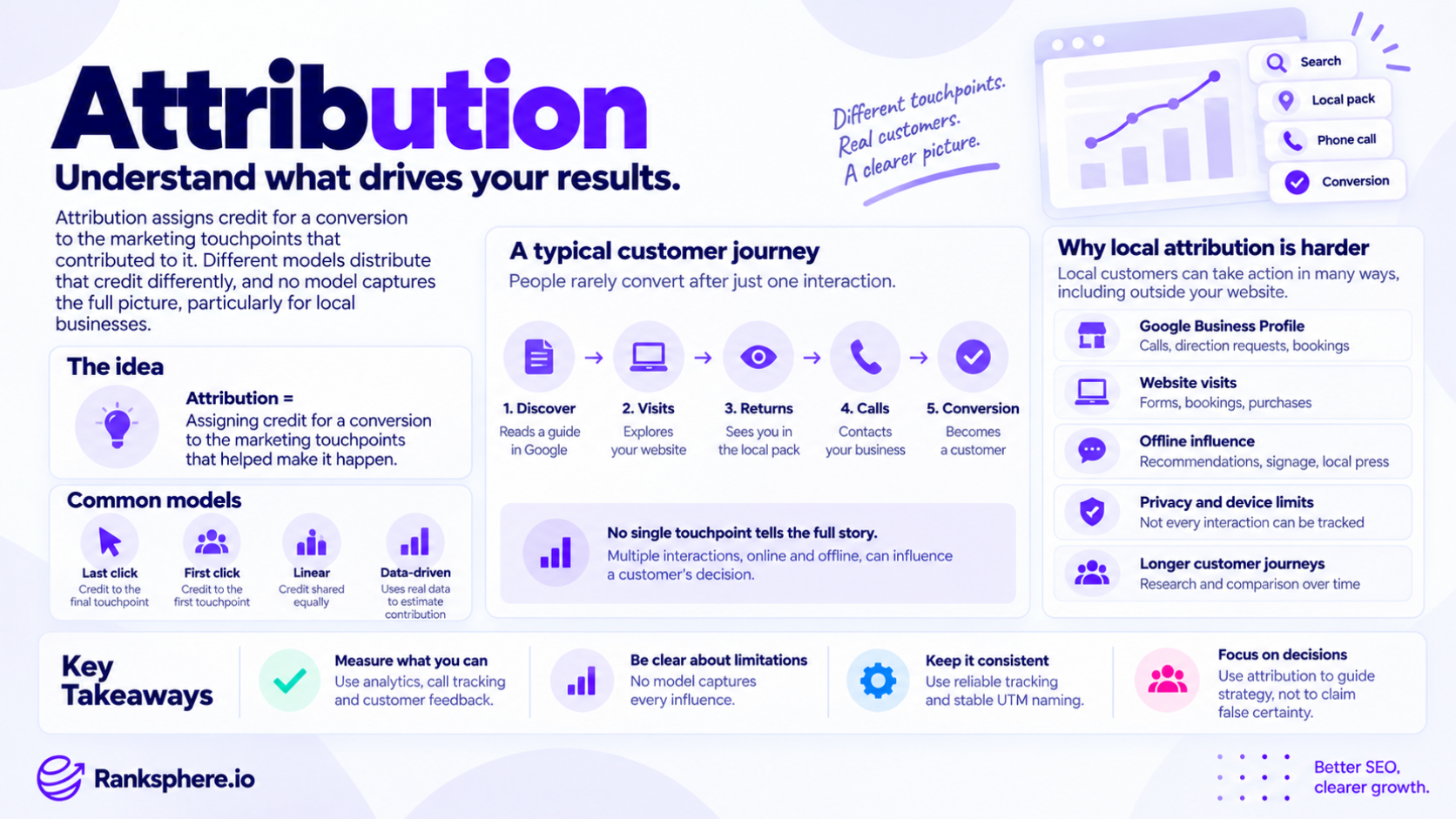
Marketing attribution attempts to connect a business outcome with the marketing activity that helped produce it.
That outcome might be:
- A phone call
- A form submission
- A booking
- A purchase
- A qualified lead
The purpose is to answer questions such as:
- Which channels generate leads?
- Which pages help customers discover us?
- Which campaigns assist conversions?
- Where should we invest more?
- Which activities appear to contribute little?
The difficulty is that customer journeys are rarely as clean as analytics reports make them look.
Why attribution is imperfect
Analytics can only measure interactions it can observe.
Imagine someone who:
- Notices your van on Monday
- Hears your company recommended by a neighbour on Wednesday
- Searches your service on Friday
- Reads your reviews
- Searches your brand name the following week
- Calls through Google
Several influences contributed to the decision.
Your analytics platform may see only part of that journey.
This does not make attribution useless.
It means attribution should be treated as evidence about the customer journey, not a perfect reconstruction of everything that influenced it.
Attribution vs conversion tracking
Conversion tracking and attribution are related but different.
Conversion tracking
Answers:
Did a conversion happen?
For example:
- Form submitted
- Booking completed
- Phone call recorded
Attribution
Answers:
Which marketing interaction should receive credit for that conversion?
You can therefore have excellent conversion tracking and still have imperfect attribution.
A business might know exactly how many new customers it received without knowing precisely which touchpoint caused each one to convert.
Attribution models
An attribution model determines how credit is distributed across observable marketing touchpoints.
Several models are commonly discussed in marketing.
Last-click attribution
Last-click attribution gives the conversion credit to the final eligible marketing interaction before the conversion.
Suppose a customer journey is:
Informational article → social post → branded Google search → conversion
A last-click model may give the credit to:
branded search
because that was the final measurable marketing interaction.
The advantage is simplicity.
The weakness is that it can understate earlier discovery activity.
The branded search may have happened only because another channel introduced the customer to the company first.
First-click attribution
First-click attribution does the opposite.
It gives the conversion credit to the first recorded interaction.
In the same journey:
Informational article → social post → branded search → conversion
the article receives all the credit.
This highlights discovery but can understate everything that helped move the person towards the final decision.
First-click attribution remains a useful concept when discussing marketing measurement, but it is no longer one of GA4's available reporting attribution models. Google removed first click, linear, time decay and position-based attribution models from GA4 in November 2023.
Linear attribution
A linear model divides credit evenly between the recorded touchpoints.
If there are four interactions:
25% + 25% + 25% + 25%
This avoids giving everything to one interaction.
But it assumes every touchpoint contributed equally, which may not reflect reality.
Linear attribution is also no longer available as a GA4 reporting attribution model.
Time-decay attribution
Time-decay attribution gives more credit to interactions closer to the conversion.
The assumption is that later interactions had more influence on the decision.
That can make sense in some buying journeys.
But proximity in time does not automatically mean greater influence.
A detailed comparison guide read three weeks earlier may have mattered more than a branded search immediately before the phone call.
Time-decay attribution is no longer available in GA4 either.
Position-based attribution
Position-based attribution historically gave more weight to the first and last interactions while sharing the remaining credit between middle touchpoints.
The idea was to recognise both:
discovery
and:
conversion.
Again, it is a useful model for understanding attribution theory, but Google removed it from GA4's available reporting models in 2023.
Data-driven attribution
Data-driven attribution uses observed conversion and non-conversion paths to estimate how different recorded interactions contribute to key events.
Google Analytics uses data-driven attribution by default for event-scoped attribution reporting.
This is more sophisticated than assigning fixed percentages based only on touchpoint order.
But it does not solve every attribution problem.
It can only work with the information available to the system.
It cannot automatically know that a customer:
- Saw your delivery van
- Was recommended by a colleague
- Read an offline leaflet
- Walked past your shop every day
Data-driven does not mean all-knowing.
Attribution models in GA4
Current GA4 attribution is simpler than many older SEO guides suggest.
Google currently provides attribution-reporting options including:
- Data-driven attribution
- Paid and organic last click
- Google paid channels last click
First-click, linear, time-decay and position-based models are no longer available in GA4.
This distinction matters because content that tells users to switch between six or seven GA4 attribution models is now outdated.
Why local attribution is difficult
Local businesses often have larger measurement gaps because much of the customer journey can happen away from the website.
A customer might:
- Search for a plumber.
- See three businesses in the local pack.
- Read reviews.
- Tap the call button.
- Book the job.
There may never be a website session.
That means website analytics alone cannot tell the whole story.
Google Business Profile interactions
A Google Business Profile can generate customer actions directly from Google Search and Maps.
Google's current Business Profile performance reporting can include metrics such as:
- Calls
- Website clicks
- Direction requests
- Bookings where supported
Google defines its Calls metric as the number of times customers click the call button on the Business Profile. It does not confirm that every click became a connected or qualified call.
These interactions should therefore be interpreted carefully.
Calls from the profile
A call-button click is a useful signal for many local businesses.
But it does not tell you:
- Whether the call connected
- How long it lasted
- Whether it was a new customer
- Whether the enquiry was relevant
- Whether it resulted in revenue
For deeper measurement, call tracking can help connect calls with marketing sources and, depending on the setup, provide more information about call quality.
Direction requests
Direction requests can indicate strong intent for businesses such as:
- Restaurants
- Shops
- Clinics
- Showrooms
But a request for directions is not proof that the person arrived.
Treat it as a useful local interaction or micro-conversion unless you have a reliable way to connect it with an actual visit.
Bookings
Where Google reports completed bookings through an eligible booking provider, these may sit much closer to a true conversion.
Google distinguishes completed bookings from more general profile interactions where the relevant integration exists.
As always, use the metric according to what it actually represents.
Offline influence
Local marketing is particularly difficult to attribute because offline activity often influences online behaviour.
Examples include:
- Vehicle graphics
- Shopfront signage
- Flyers
- Sponsorship
- Recommendations
- Networking
- Local press
Someone may first encounter the company offline and later search its name.
Analytics then sees:
branded organic search
but not the original offline influence.
That branded search did not necessarily create the demand.
It may simply have captured it.
Branded search can absorb credit
Branded search frequently appears late in the customer journey.
Consider:
- Customer searches flat roof problems.
- Reads your guide.
- Leaves.
- Remembers the company name.
- Searches the brand three days later.
- Submits an enquiry.
A last-click model may attribute the conversion to the branded search.
That is technically consistent with the model.
But it would be misleading to conclude that the earlier content contributed nothing.
This is one reason channel performance should not be judged from a single attribution view.
Long consideration periods
Some services have long decision cycles.
Examples include:
- Roofing
- Dental implants
- Legal services
- Private healthcare
- Home renovations
A customer may research intermittently for weeks or months.
During that period they might use:
- Reviews
- Social media
- Recommendations
- Direct website visits
Longer journeys create more opportunity for attribution gaps.
Zero-click search
Zero-click search creates another measurement problem.
A potential customer can learn about a company directly from a search result without visiting the website.
For example, they may see:
- Reviews
- Business information
- Opening hours
- Search-result excerpts
That exposure may influence a later decision without creating a trackable website interaction.
The same problem can exist when information is encountered through AI-powered search experiences.
Visibility can contribute to awareness even when there is no immediately attributable website click.
Attribution and AI search
AI search makes attribution more complicated rather than eliminating it.
A customer may:
- Ask an AI system for advice.
- Encounter your business or content.
- Remember the name.
- Search the brand later.
- Convert.
If no referral click occurred during the first interaction, your normal analytics may never connect the final conversion with that initial exposure.
Do not assume every increase in branded search came from AI.
The point is simply that some discovery can remain unobservable.
Use UTM parameters
UTM parameters can make controlled links easier to identify in analytics.
For example, the website URL used on a Google Business Profile might be tagged so that visits from that link can be distinguished from other Google organic traffic.
Google Analytics supports campaign parameters such as:
- utm_source
- utm_medium
- utm_campaign
- utm_content
to identify manually tagged marketing traffic.
The important part is consistency.
Tag the Google Business Profile website link
Without campaign tagging, traffic from a Business Profile website link may be harder to separate cleanly from broader Google traffic.
A consistent UTM structure can make profile-originated website visits easier to analyse.
For example:
utm_source=google
utm_medium=organic
utm_campaign=gbp
The exact naming convention matters less than using one consistent system across the organisation.
For multi-location businesses, consider including a location identifier where it genuinely helps analysis.
Tag Google Posts where useful
If Google Posts contain website links, separate tracking can help identify traffic from individual post CTAs.
For example, utm_content might distinguish:
- summer_offer
- implant_open_day
- emergency_service_update
Do this when the additional detail is genuinely useful.
Do not create dozens of UTM variations that nobody will analyse.
Do not use UTMs on internal links
UTM parameters are intended for identifying incoming campaign traffic.
Do not add them to links between pages on your own website.
Doing so can distort acquisition and attribution data by making an internal click look like a new campaign interaction.
Use normal internal links for internal navigation.
Keep UTM naming consistent
These two values may be treated as different campaign values:
SpringCampaign
and:
spring_campaign
Inconsistent naming fragments reporting.
Create a naming convention covering:
- Source
- Medium
- Campaign
- Content
and use it consistently.
Google likewise recommends consistent campaign values to avoid fragmented reporting.
Use call tracking where calls matter
For businesses where the phone is a major source of leads, call tracking can close an important measurement gap.
Depending on the implementation, it may help identify calls originating from:
- Organic landing pages
- Paid search
- Campaign pages
- Other marketing sources
The exact setup matters.
Call tracking should be implemented without creating misleading public business information.
Do not replace business information carelessly
Local businesses depend on accurate core information.
A tracking implementation should not leave inconsistent phone numbers across important public sources.
If dynamic number insertion is used on the website, it should be implemented so the business's underlying contact information remains clear and accurate.
Tracking should improve attribution without creating a local SEO problem of its own.
Ask customers how they found you
One of the simplest attribution tools is still:
How did you hear about us?
Possible answers might include:
- Recommendation
- Social media
- Saw your vehicle
- Previous customer
- Local advertisement
This can reveal influences analytics cannot see.
But self-reported attribution has limitations too.
People may:
- Forget
- Remember only the most recent interaction
- Choose the easiest answer
Treat it as supplementary evidence rather than perfect truth.
Make the question more useful
Instead of asking only:
How did you hear about us?
you may get better information by asking:
What first made you aware of us?
or:
Was there anything you saw or read before contacting us?
For higher-value sales, staff can also ask during qualification.
The aim is to understand the journey without making the customer complete an interrogation.
Track qualified leads
Attribution becomes much more useful when it connects to lead quality.
Suppose:
Organic search generated 60 enquiries.
Useful.
But if only:
8 were qualified
while another source generated 30 enquiries and 20 were qualified, the second source may be commercially stronger.
Where possible, connect marketing data with:
- CRM outcomes
- Qualified-lead status
- Appointments
- Sales
- Revenue
That moves attribution closer to business value.
Separate attributed and unattributed conversions
Not every conversion will have a reliable source.
That is normal.
A useful report might show:
Attributed conversions
Conversions with a sufficiently reliable marketing source.
Unattributed or unknown
Conversions where the source cannot confidently be determined.
Do not force every lead into a channel simply to make the report add up perfectly.
“Unknown” is better than a confident but incorrect answer.
Do not treat attributed conversions as total impact
Suppose SEO is credited with:
42 conversions.
That means:
42 conversions were attributed to SEO under this measurement setup and model.
It does not necessarily mean:
SEO influenced exactly 42 people and nobody else.
Some influence may be missed.
Some credit may be shared.
Some journeys may be impossible to reconstruct.
The distinction should be made clear in reporting.
Compare models when useful
Where the analytics platform allows it, comparing data-driven attribution with last-click reporting can show how much channel credit changes under different assumptions.
GA4's attribution reports currently support comparisons between data-driven and last-click approaches.
The purpose is not to find the model that makes your preferred channel look best.
It is to understand how dependent your conclusions are on the attribution method.
Data-driven attribution still has blind spots
Data-driven attribution is more sophisticated than a fixed-rule model.
But it should not be described as objectively correct.
Its output depends on:
- Available data
- Observable interactions
- Platform methodology
- Privacy restrictions
- Device and browser behaviour
Google also uses modelling in some situations where key events cannot be directly observed.
That can improve reporting, but it remains a model of behaviour rather than a complete record of every customer's decision process.
Attribution windows matter
Analytics systems only look across defined windows of time when assigning credit.
That can matter greatly for long consideration cycles.
A customer who researches a roofing company months before converting may fall outside the window used by a particular report or platform.
When analysing attribution, understand:
- What timeframe is being considered
- Which interactions are eligible
- Which channels can receive credit
Otherwise two reports can produce different answers while both are technically correct within their own rules.
Attribution and privacy
Modern analytics also operates under increasing privacy constraints.
Measurement can be affected by:
- Consent choices
- Browser restrictions
- Device switching
- Cookie limitations
- Data retention
- Ad blockers
That means perfect person-level attribution is not a realistic expectation.
A useful measurement system accepts uncertainty rather than trying to hide it.
Branded search volume as a supporting signal
Changes in branded search demand can sometimes provide useful context.
If more people begin searching specifically for the company name, that may indicate increasing awareness.
But branded search can be influenced by:
- SEO
- Advertising
- PR
- Word of mouth
- Offline activity
- Existing customers
So:
branded searches increased
does not prove:
our content campaign caused the increase.
Use it as a supporting signal, not a substitute for attribution.
Total enquiries still matter
Even when individual sources are difficult to trace, total business performance matters.
If:
- Search visibility rises
- Total qualified enquiries rise
- Revenue rises
that is useful evidence.
It does not prove one channel caused every increase.
But it prevents the business from focusing so narrowly on attributed conversions that it loses sight of the actual commercial trend.
Attribution should guide decisions, not dictate them
Suppose a content programme appears to produce relatively few last-click conversions.
Before cutting it, ask:
- Does it generate first-time visitors?
- Does it rank for discovery searches?
- Do assisted journeys include it?
- Do customers mention reading it?
- Is branded demand growing?
- Does it support later commercial pages?
Attribution data should inform the decision.
It should not automatically make it.
Reporting attribution honestly
A good report should make three categories clear:
Measured
Events directly observed by the tracking setup.
Attributed
Credit assigned according to a defined model.
Unmeasured or uncertain
Activity the system cannot reliably connect.
This is more useful than presenting one precise number with no explanation of how it was produced.
Clients do not need false certainty.
They need enough information to make sensible decisions.
Ranksphere and local attribution
For multi-location businesses in particular, tracking needs to remain consistent across profiles.
Ranksphere's GBP management keeps profile links and tracking consistent across locations, helping teams separate profile-driven website traffic more reliably and maintain a consistent measurement setup across locations.
That still does not solve every attribution gap.
It improves the part that can be measured.
Common attribution mistakes
- Treating attributed conversions as total marketing impact.
- Assuming last click reveals what created demand.
- Using outdated GA4 attribution-model advice. First click, linear, time decay and position-based are no longer current GA4 reporting options.
- Assuming data-driven attribution captures offline or otherwise invisible interactions.
- Failing to tag controlled campaign links consistently.
- Not distinguishing Google Business Profile website traffic from broader traffic where useful.
- Using UTM parameters on internal website links.
- Ignoring phone calls when calls are a major lead source.
- Treating call-button clicks as confirmed qualified calls.
- Treating direction requests as proven visits.
- Assuming self-reported “how did you hear about us?” data is perfect.
- Changing UTM naming conventions repeatedly.
- Forcing every conversion into a channel when the source is genuinely unknown.
- Using branded search growth as proof that one specific marketing activity caused it.
- Cutting channels purely because a last-click report gives them little credit.
Attribution best practices
- Define what counts as a conversion before analysing attribution.
- Understand which attribution model your analytics platform is using.
- Use UTM parameters on appropriate inbound marketing links you control.
- Keep campaign naming consistent.
- Never use campaign UTMs to track internal site navigation.
- Tag Google Business Profile website links where the additional separation is useful.
- Use call tracking when phone leads are commercially important.
- Connect marketing sources with qualified leads and revenue where possible.
- Ask customers how they discovered the business as a supplementary data source.
- Report Google Business Profile interactions alongside website analytics.
- Separate attributed conversions from unknown or untraceable conversions.
- Compare total enquiries and commercial performance alongside channel attribution.
- Be explicit about offline, privacy and cross-device measurement gaps.
- Use attribution to guide decisions rather than pretending it provides perfect causation.
Example
“Kingsdown Roofing reviews its acquisition reporting and notices that branded organic search receives a large share of conversion credit.
At first glance, the conclusion seems obvious:
People already know the company, so informational content is not generating business.
The team investigates further.
Several customers who eventually searched the Kingsdown Roofing brand had previously visited educational content about flat-roof problems.
Some also mention those guides when asked how they found the company.
The journey may look like:
non-branded informational search → guide → later branded search → enquiry
Under a last-click view, the branded search gets the conversion credit.
That does not mean the guide caused every later enquiry.
But it does show why the last interaction alone cannot answer the entire marketing question.
The measurement setup is improved.
The Google Business Profile website link is consistently UTM-tagged.
Relevant campaign links use a standard naming convention.
Phone attribution is improved.
Branded and non-branded search behaviour is analysed separately.
The enquiry process also asks customers how they first became aware of the company.
Now the agency has several sources of evidence:
- Analytics
- Google Business Profile interactions
- Call data
- Customer responses
- Search trends
- Total qualified enquiries
None provides a perfect picture on its own.
Together, they produce a much more useful one.
That is the right way to think about attribution:
not as a system that reveals exactly which marketing touchpoint caused every sale, but as a framework for combining the evidence you can measure while being clear about the parts of the customer journey you cannot see.”
See also
- UTM parameters — identifying traffic from controlled marketing links
- Call tracking — connecting phone enquiries with marketing sources
- Conversion rate — measuring how often users complete desired actions
- Google Analytics 4 — where website and app attribution is reported
- Zero-click search — visibility and interaction that may occur without a website visit
- KPI — choosing meaningful performance measures despite attribution gaps