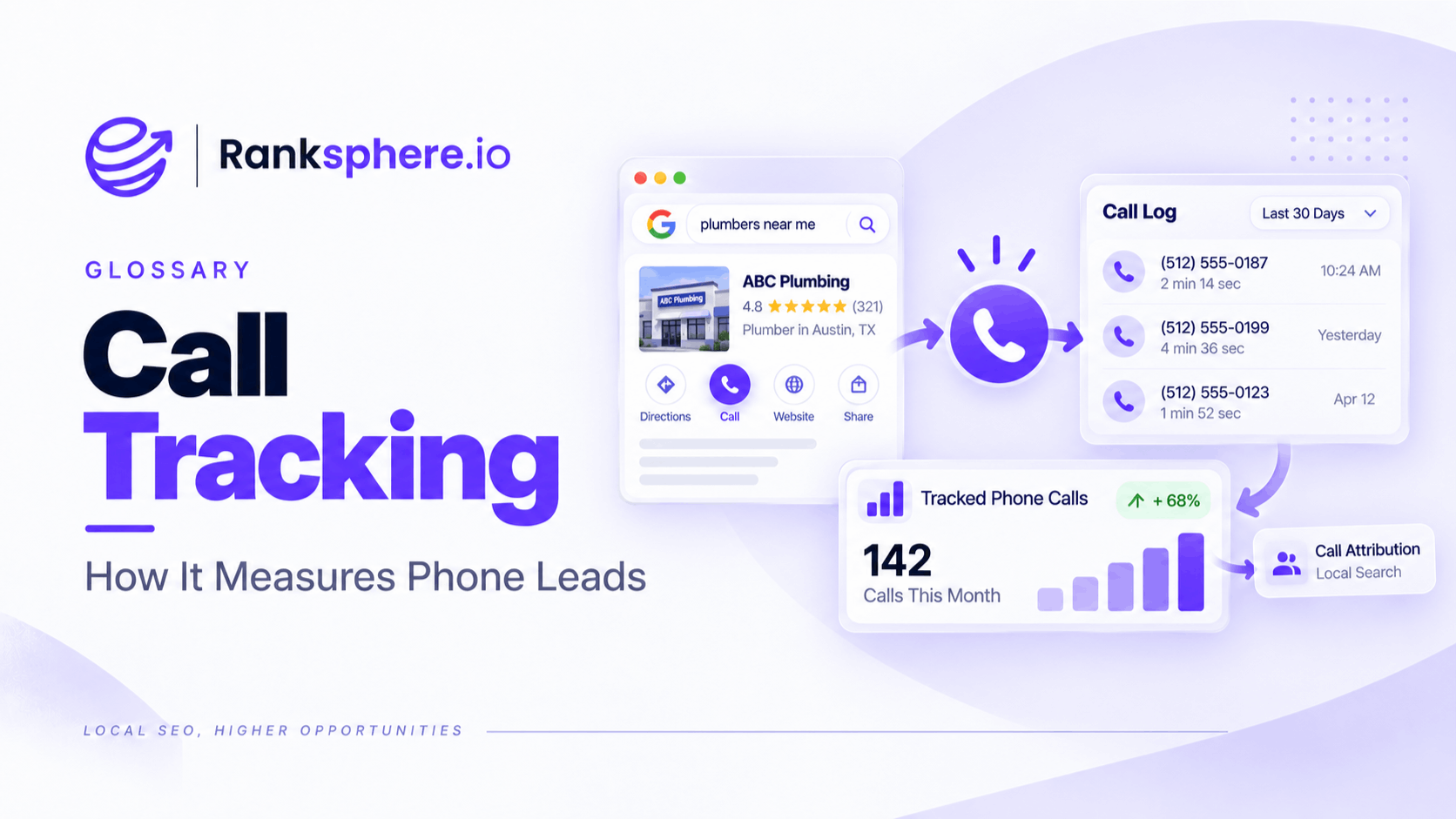
Call tracking is the use of trackable phone numbers and call data to identify which marketing sources generate phone enquiries.
A tracking number routes calls through to the business's normal phone line, allowing the business to measure where the call originated without requiring the customer to use a different process.
For a local business, this can fill an important measurement gap.
A plumber, dentist, solicitor or heating engineer may generate a large share of new enquiries by phone. Without call tracking, calls from:
- Google Business Profile
- Organic search
- Paid advertising
- Campaign landing pages
- Offline advertising
can all arrive at the same number with very little information about what generated them.
Call tracking helps connect those phone enquiries with their source.
The important part is implementing it carefully.
A poor setup can create confusing business information or unreliable attribution. A good setup improves measurement while keeping the company's permanent contact details clear and accurate.
What is call tracking?
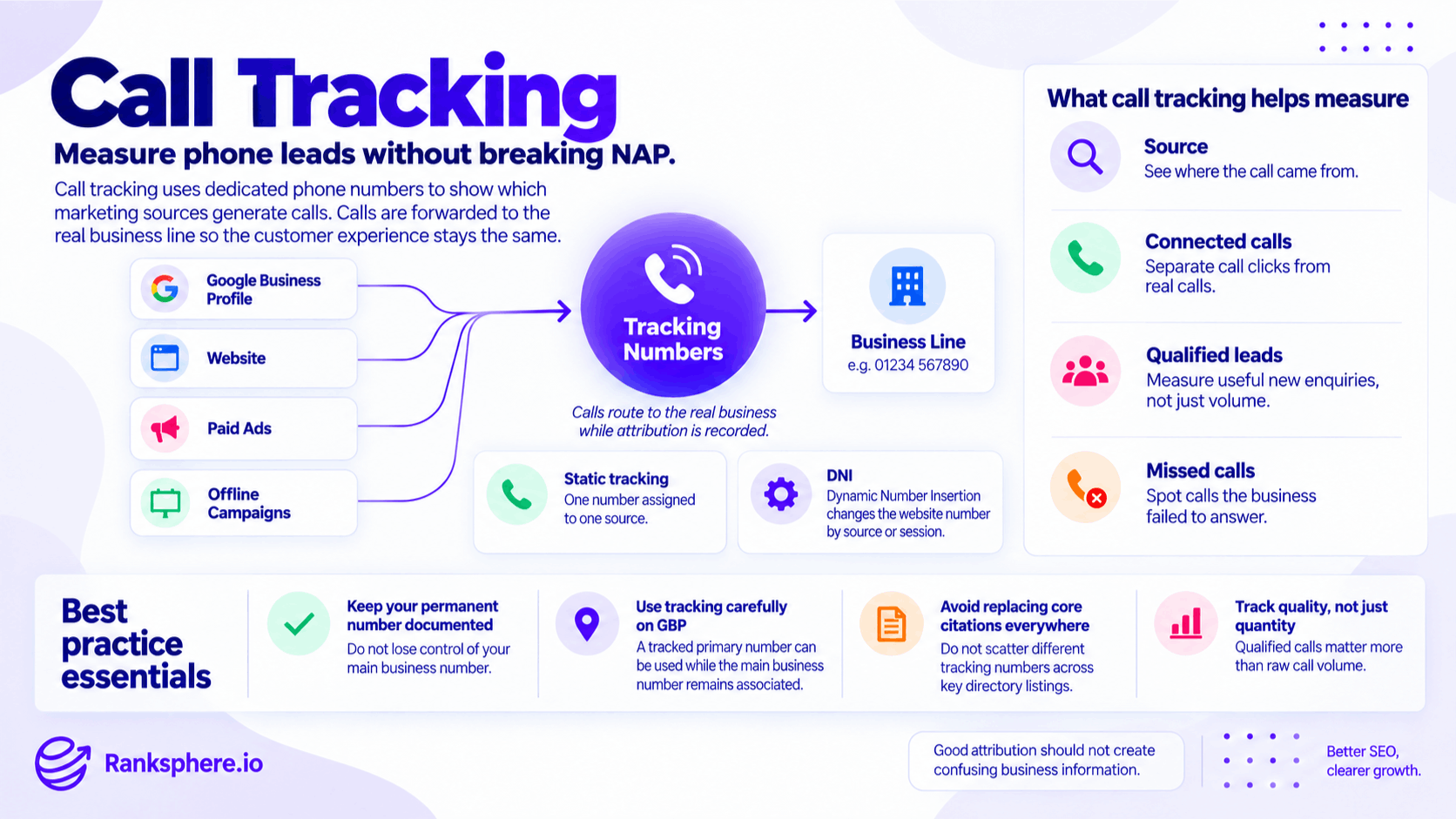
Call tracking assigns phone numbers to particular marketing sources or visitors.
When someone calls one of those numbers:
- The call is forwarded to the business.
- The tracking platform records information about the call.
- The business can analyse where the enquiry originated.
Depending on the system and configuration, recorded information might include:
- Marketing source
- Landing page
- Call time
- Call duration
- Caller status
- Campaign
- Whether the caller is new or returning
More advanced systems may also help classify whether calls were:
- Answered
- Missed
- Qualified
- Sales enquiries
- Existing customers
The exact capabilities depend on the provider.
Why call tracking matters for local SEO
Phone calls are particularly important in local search because customers can call directly from the local pack or Google Business Profile without visiting the website first.
Consider a customer searching:
emergency plumber near me
They may:
- See the local pack.
- Read the reviews.
- Choose a business.
- Tap the phone button.
There may be no website session.
If reporting depends only on Google Analytics, that customer journey is largely invisible.
Call tracking can help provide more information about the phone enquiry itself.
Google Business Profile already reports calls
Before adding a third-party call-tracking system, understand what Google already provides.
Google Business Profile performance reporting can show the number of times customers clicked the call button on a profile.
That is useful.
But it is important to understand what the number represents.
It records:
call-button clicks
not necessarily:
- Connected calls
- Qualified enquiries
- New customers
- Sales
Someone could tap the call button and cancel before connecting.
Another caller could be an existing customer.
A supplier could call.
So Google Business Profile's Calls metric can be a useful interaction measure without being identical to qualified-call tracking.
What additional information can call tracking provide?
A dedicated system can potentially tell you more about the call after the customer initiates it.
Depending on the platform, you may be able to measure:
- Whether the call connected
- Call duration
- First-time vs repeat callers
- Source or campaign
- Landing page
- Missed calls
- Qualified leads
This can move reporting from:
“62 people clicked Call.”
towards:
“62 call interactions produced 48 connected calls, of which 19 were qualified new enquiries.”
That is much more commercially useful.
Static call tracking
A static tracking number is a dedicated number associated with a particular marketing source.
For example:
Google Business Profile → Number A
Printed campaign → Number B
Specific advertisement → Number C
Every call to Number A can then be associated with the source where that number was published.
Static call tracking is simple and useful when one number represents one clearly defined source.
Dynamic number insertion
Dynamic number insertion, or DNI, works differently.
Instead of permanently publishing a different number on the webpage, a script dynamically changes the number displayed to a website visitor.
The displayed number may vary according to factors such as:
- Marketing source
- Campaign
- Referrer
- Session or visitor
All of the tracking numbers still route to the business.
The purpose is to connect a website visitor's journey with the phone call they later make.
Source-level vs session-level tracking
Not all DNI setups work the same way.
Source-level tracking
Different channels receive different numbers.
For example:
Organic search → Number A
Paid search → Number B
Facebook → Number C
This tells you which broad channel generated the call.
Session-level tracking
A pool of numbers can be used to associate individual website sessions with calls.
That can provide much more detailed attribution, such as:
- Keyword or campaign context where available
- Landing page
- Pages visited
- Traffic source
Session-level tracking requires enough numbers in the pool to support expected website traffic.
Do you need static tracking and DNI?
Not necessarily.
A business could use:
Static tracking only
if it mainly wants to measure calls from a particular profile or campaign.
It could use:
DNI only
if its main concern is attributing calls generated through the website.
Or it could use:
both
if it needs separate visibility into direct Google Business Profile calls and website-generated calls.
The correct setup depends on what question the business is trying to answer.
Do not add tracking complexity simply because the software supports it.
Call tracking and NAP consistency
NAP stands for:
Name
Address
Phone number
Historically, local SEO advice placed heavy emphasis on making these details character-for-character identical everywhere.
Modern local SEO is more nuanced.
Search engines can understand harmless formatting differences.
The more important concern is avoiding genuinely conflicting business information.
For example:
Current phone number: 01234 567890
Old disconnected number: 01234 111222
is a meaningful inconsistency.
Using call tracking should not result in a local business appearing to have several unrelated permanent phone numbers.
Call tracking on Google Business Profile
Google currently allows a Business Profile to contain a primary phone number plus up to two additional phone numbers.
This makes it possible to retain more than one legitimate contact number on the profile.
A common implementation used by call-tracking providers is:
Primary number: tracking number
Additional number: permanent business number
The tracking number is what customers see and call, while the permanent number remains associated with the profile.
For example, CallRail's current Google Business Profile integration uses exactly this configuration.
This is an industry implementation pattern rather than a Google instruction that every business should use a tracking number as its primary phone.
Google's phone-number requirements still apply
The phone number used on the Business Profile should genuinely connect customers with the business.
Google's guidelines say that phone numbers should connect to the individual business as directly as possible and be under the business's control. Google also allows up to two additional phone numbers alongside the primary one.
That means a tracking setup should not:
- Route customers somewhere unrelated
- Use a number the business cannot control
- Introduce misleading contact information
The tracking layer should sit between the customer and the real business without changing where the customer ultimately reaches.
Should the tracking number be primary?
If the purpose is to track direct calls from the Google Business Profile, the visible number needs to be the tracked number.
That is why providers such as CallRail use:
tracking number as primary
and:
permanent business number as additional.
If the permanent number remains primary and the tracking number sits only as an additional number, customers will generally continue using the main visible number, reducing the usefulness of the tracking setup.
But this should be implemented deliberately.
Do not swap numbers casually without understanding the:
- Forwarding
- Profile configuration
- Website setup
- Citation ecosystem
Keep the permanent business number
If you use a temporary or provider-owned tracking number, keep a clear record of the business's permanent phone number.
For a Google Business Profile setup using a tracking number as primary, retaining the established business number as an additional number is a commonly used local SEO approach.
This is useful for both consistency and future portability.
The business should never become unnecessarily dependent on a phone number it cannot retain.
Number ownership matters
Before adopting a call-tracking provider, ask:
- Who owns the tracking number?
- Can it be ported?
- What happens if the account closes?
- How long can the number be retained?
- What happens to callers after cancellation?
A number that becomes widely recognised by customers can become a business asset.
Do not create unnecessary lock-in.
Call tracking on the website
Website call tracking is usually handled through DNI.
The website retains its permanent business number as the underlying contact information, while the tracking script can show an appropriate tracking number to eligible visitors.
For example:
A visitor from organic search may see one tracked number.
A visitor from paid search may see another.
The calls still reach the same business.
The difference exists for attribution.
Keep business information clear in the site's underlying data
When implementing DNI, make sure the website still contains accurate business information.
Relevant places include:
- Contact information
- Appropriate HTML
- LocalBusiness schema
The permanent business identity should not depend on a temporary number being dynamically displayed to a visitor.
How DNI interacts with page markup varies by provider, so test the actual implementation rather than assuming every script behaves identically.
Call tracking and UTM parameters
UTM parameters can help distinguish website visits originating from controlled marketing links.
For example, the Google Business Profile website link can use a consistent campaign tag so visits from that link can be identified separately in analytics.
A call-tracking system may then use:
- Referrer data
- Landing-page data
- UTM parameters
- Session data
to help associate website calls with their source.
UTMs and call tracking solve related but different measurement problems.
UTMs identify visits.
Call tracking identifies phone enquiries.
Used together, they can produce a clearer attribution picture.
Tag the Google Business Profile website link
A consistently tagged website link can make traffic from the profile easier to separate from broader Google traffic.
For example:
utm_source=google
utm_medium=organic
utm_campaign=gbp
The precise naming convention can vary.
Consistency matters more.
If a business has multiple locations, location-specific campaign identifiers can also make reporting easier.
DNI does not need to show the same number as the profile
One point worth clarifying is that a website visitor arriving from Google Business Profile does not necessarily need to see the exact same tracking number that appears on the profile.
A DNI platform may use a different number or number pool for website sessions.
The tracking system can still connect:
profile link → website visit → website call
through campaign and session data.
The goal is accurate attribution, not visual number matching for its own sake.
Call tracking on directory citations
Be cautious about placing unique tracking numbers across ordinary directory citations.
For core business listings, maintaining the established business number is usually the cleaner approach.
If every directory receives a different number, you can create an unnecessarily fragmented public phone footprint.
That can make:
- Data management
- Customer recognition
- Citation auditing
more complicated.
Are tracking numbers ever appropriate on directories?
There can be exceptions.
For example, a business may pay for a specific advertising placement on an industry directory and want to measure calls generated by that advertisement.
A source-specific tracking number may make sense if:
- The arrangement is deliberate
- The number reaches the correct business
- The core business listing remains accurate
- The tracking setup will be maintained
The principle is not:
never use tracking numbers outside Google Business Profile.
It is:
do not replace your permanent business number across core citations indiscriminately just to collect attribution data.
Call tracking for offline marketing
Static numbers can also help measure offline campaigns.
Examples include:
- Flyers
- Direct mail
- Newspaper advertising
- Billboards
- Vehicle campaigns
A dedicated number associated with one campaign can give the business additional evidence about how many calls that campaign generated.
Again, attribution is not automatically perfect.
Someone may see the flyer, later search the business and call another number.
But tracking can improve the observable part of the journey.
Call recording
Some call-tracking systems offer call recording.
This can be useful for:
- Lead qualification
- Sales coaching
- Identifying missed opportunities
- Understanding common customer questions
But recording laws and consent requirements differ by jurisdiction.
Do not enable call recording without understanding the applicable legal and privacy requirements.
Tracking the source of a call and recording the conversation are separate decisions.
Qualified calls matter more than raw calls
Suppose two marketing channels produce:
Channel A: 70 calls
Channel B: 40 calls
At first glance, Channel A appears better.
But after qualification:
Channel A: 8 qualified new leads
Channel B: 24 qualified new leads
The picture changes completely.
This is why call tracking becomes much more useful when calls can be connected with:
- Lead quality
- Appointment
- Sale
- Revenue
Call volume alone can still be a vanity metric.
Call duration can help, but it is not qualification
A 12-minute call may look more valuable than a 30-second call.
Often it is.
But not always.
A short call could be:
“Can you attend today?”
“Yes.”
and result in a valuable job.
A long call could be an existing customer discussing an administrative problem.
Treat duration as useful context rather than a definitive measure of lead quality.
Missed calls
Call tracking can also reveal an operational problem SEO reporting often misses:
the business is generating calls that nobody answers.
If marketing generates:
100 calls
but:
27 are missed
the next optimisation opportunity may not be another service page.
It may be:
- Better call handling
- Out-of-hours routing
- Additional staff
- Faster callbacks
This is one reason attribution data can improve more than marketing.
It can reveal what happens after the lead arrives.
Call tracking and conversion rate
Calls can form part of conversion rate reporting.
But define what counts.
Possible definitions include:
phone-number clicks
connected calls
qualified calls
booked appointments from calls
These are not interchangeable.
For a serious local SEO reporting setup, qualified calls are usually more commercially informative than simple button clicks.
Call tracking and attribution
Call tracking improves attribution by making phone enquiries less anonymous.
It can help answer questions such as:
- Did this call come directly from Google Business Profile?
- Did the caller first visit through organic search?
- Was the call generated by paid search?
- Which landing page preceded the call?
It does not create perfect attribution.
Offline influence, repeat visits, cross-device behaviour and word of mouth can still remain invisible.
Use call tracking as another source of evidence rather than as a complete reconstruction of the customer journey.
Is call tracking worth it?
Not for every business.
The decision depends on:
- Call volume
- Lead value
- Number of marketing channels
- Attribution needs
- Reporting requirements
- Cost of the platform
It may be worth it when:
- Phone calls are a major lead source
- Multiple channels generate calls
- Individual leads are commercially valuable
- An agency needs better attribution
- The business wants to measure lead quality
It may be unnecessary when:
- Calls are rare
- Almost all leads come through one obvious source
- The business does not need deeper call-level reporting
- Google Business Profile's existing interaction data is sufficient for the reporting objective
Measurement complexity should earn its keep.
Google Business Profile call data may be enough
If the only question is:
“How many times did people tap Call on our Google Business Profile?”
Google already provides that metric.
A third-party system becomes more useful when the business needs to understand:
- Whether calls connected
- Which calls were qualified
- Which website sources generated calls
- How several channels compare
- What happened after the call began
Do not pay for a sophisticated attribution system when the business does not need that level of detail.
Test call forwarding
A tracking number that does not forward correctly can cost the business real enquiries.
Test:
- Primary tracking numbers
- Website DNI numbers
- Routing rules
- Out-of-hours handling
- Multi-location routing
Do this after setup and after meaningful configuration changes.
For high-value call-driven businesses, periodic testing is sensible.
Check tracking after website changes
DNI can break when:
- Themes change
- Templates are rebuilt
- Contact sections change
- Tag-management setups are modified
- JavaScript conflicts occur
After a website redesign or migration, confirm that:
- Numbers swap correctly
- Calls route correctly
- Attribution is recorded
- The permanent contact information remains accurate
Call tracking should be part of post-launch QA.
Check profile numbers after edits
Google can review edits made to Business Profiles before publishing them, and profile information can change through normal management activity.
If a tracking number is part of the setup, periodically confirm that:
- The intended primary number remains present
- The permanent business number remains correctly associated
- Calls still forward
Ranksphere's GBP management keeps number fields consistent across locations and helps teams monitor profile information across multiple locations.
Multi-location call tracking
Call tracking becomes more useful—and more complicated—for businesses with multiple locations.
Each location may need:
- Its own permanent number
- Its own Google Business Profile tracking number
- Correct forwarding destination
- Location-specific UTM structure
- Clear reporting labels
Do not let calls from:
Manchester
route to:
Birmingham
because two profiles accidentally share the wrong tracking configuration.
Document every number and destination.
Keep a phone-number inventory
For larger organisations, maintain a record containing:
- Permanent business number
- Tracking number
- Source
- Forwarding destination
- Location
- Provider
- Status
This becomes particularly important when:
- Agencies change
- Employees leave
- Numbers are replaced
- Locations close
A tracking number nobody remembers owning is a future attribution problem.
Common call-tracking mistakes
- Treating Google Business Profile call-button clicks as confirmed qualified calls.
- Replacing the permanent business number without documenting it.
- Using a tracking number the business does not control.
- Assuming tracking number primary/business number additional is an official Google requirement rather than an implementation method.
- Scattering different tracking numbers across core citations unnecessarily.
- Assuming every directory must always use a tracking number or must never use one.
- Using DNI without testing what search engines and users actually receive.
- Forgetting the permanent business information in the site's underlying contact data and schema.
- Assuming a visitor from Google Business Profile must see the same tracking number on the website.
- Failing to track lead quality after the call.
- Treating long call duration as proof of a good lead.
- Ignoring missed calls.
- Not testing call forwarding after configuration changes.
- Keeping call tracking when the insight is not worth the cost or complexity.
Call-tracking best practices
- Start with the attribution question you are trying to answer.
- Use static numbers for clearly defined offline or profile sources where appropriate.
- Use DNI when website-level call attribution is needed.
- Keep the business's permanent phone information documented and accurate.
- If using a tracking number as the Google Business Profile primary number, retain the established business number appropriately and ensure the tracked number connects directly to the business.
- Use UTM parameters on controlled inbound links where they improve attribution.
- Avoid indiscriminately replacing canonical phone numbers across core citations.
- Keep LocalBusiness schema accurate.
- Track qualified calls rather than raw volume wherever possible.
- Monitor missed calls as well as answered ones.
- Test routing after setup and significant changes.
- Understand number ownership and portability before committing to a provider.
- Use the simplest tracking setup that answers the business question.
Example
“Bexhill Heating wants to know how many phone enquiries are being generated through Google Business Profile compared with its website.
Previously, every caller reached the same permanent number.
The business could see overall call volume, but not where those calls originated.
It adds a dedicated tracking number for the Google Business Profile while retaining the established business number appropriately within the profile.
The tracked number routes directly to Bexhill Heating.
The website link on the profile is also tagged with UTM parameters, allowing website visits from the profile to be identified.
On the website, DNI is configured to attribute phone calls from relevant marketing sources.
The setup now separates two journeys:
Direct profile call
Google Search or Maps → Business Profile → tracking number → call
and:
Website-assisted call
Google Business Profile → tagged website link → website → dynamically tracked number → call
The business then goes one step further.
Instead of reporting every call as a lead, it reviews whether calls were:
- Connected
- Missed
- Existing customers
- New enquiries
- Qualified opportunities
That changes the conversation.
One source produces more calls.
Another produces fewer calls but more qualified jobs.
The useful insight is no longer:
“Google generated 90 calls.”
It becomes:
“This source generated these calls, this many were genuine new enquiries, and this many turned into work.”
That is where call tracking becomes valuable.
The goal is not to put different phone numbers everywhere. It is to understand which marketing activity produces meaningful phone enquiries while keeping the business's contact information accurate, manageable and trustworthy.”
See also
- NAP — keeping core business information accurate across important sources
- Attribution — assigning marketing credit to customer journeys
- UTM parameters — identifying traffic from controlled inbound links
- Conversion rate — measuring how often interactions become desired actions
- Google Business Profile — an important source of direct local calls
- Citation — third-party business listings where phone-number accuracy matters