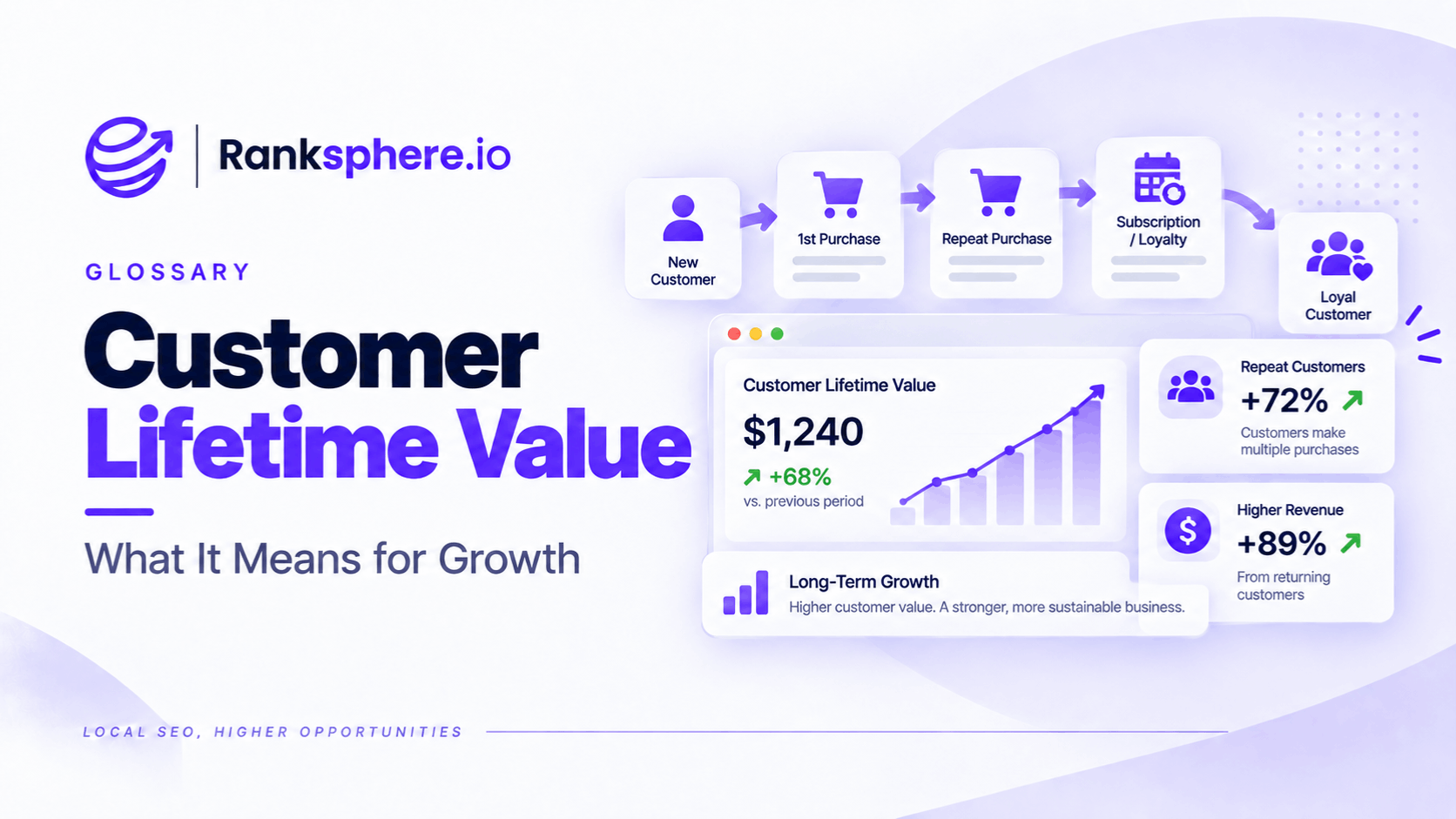
Customer lifetime value, usually shortened to LTV or CLV, estimates the total financial value a customer is expected to generate during their relationship with a business.
Instead of asking:
How much did this customer spend today?
LTV asks:
How much is a typical customer likely to be worth over the entire relationship?
That distinction can materially change how a business evaluates marketing.
A dental practice that values every new patient only by the first appointment may conclude that acquiring patients is expensive.
The same practice may reach a very different conclusion once it understands:
- How often patients return
- How long they normally remain
- Which treatments they purchase
- How much gross profit those relationships generate
LTV does not make expensive marketing automatically worthwhile.
It gives the business a more realistic number to compare against the cost of acquiring customers.
What is customer lifetime value?
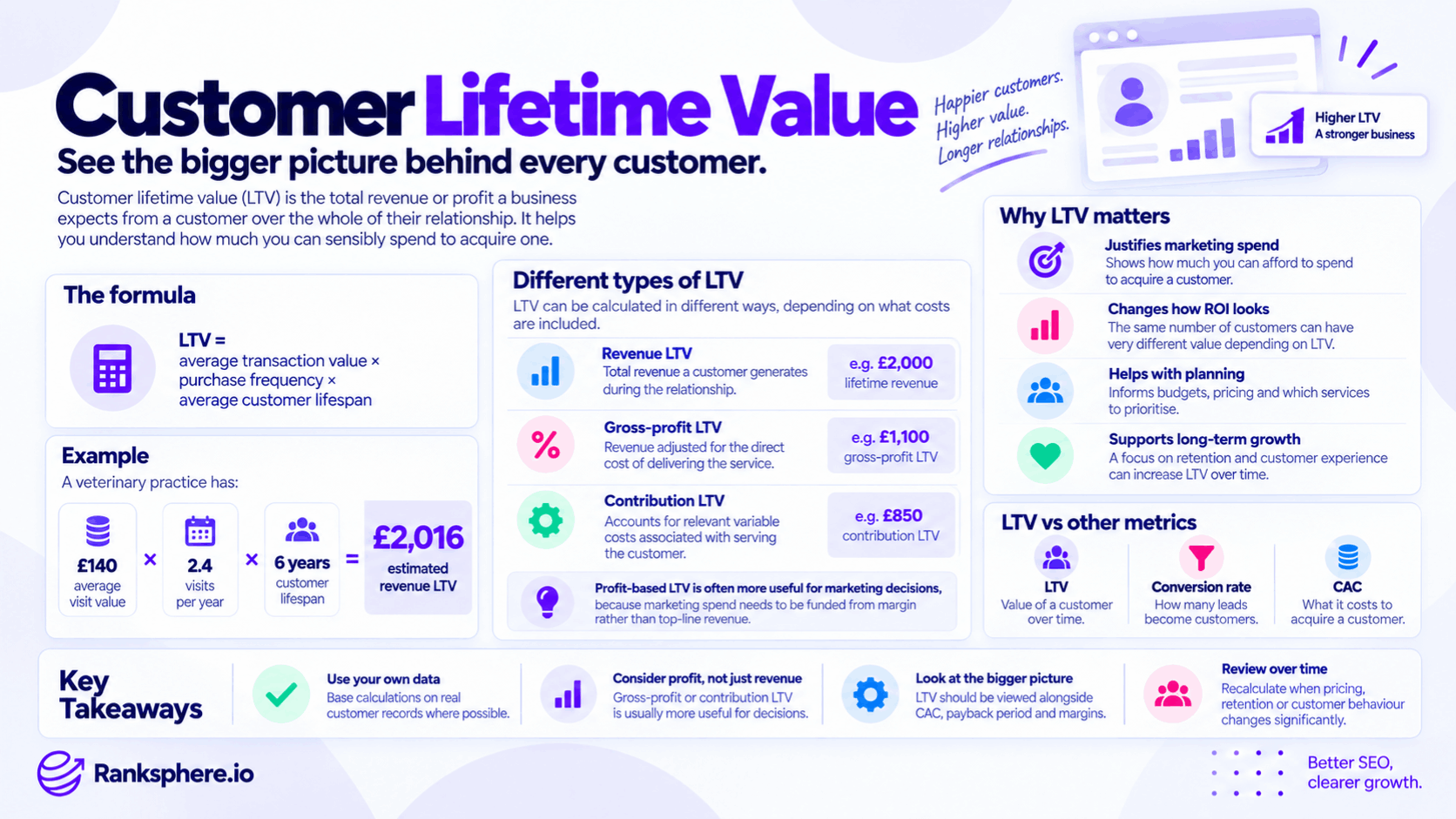
Customer lifetime value measures the expected value of a customer over the period they remain with a business.
Depending on how the business calculates it, that value may be expressed as:
- Revenue
- Gross profit
- Contribution margin
Those are not interchangeable.
For example:
Revenue LTV: £2,000
does not necessarily mean:
£2,000 available to spend acquiring the customer.
The business still has costs associated with delivering the service.
That is why it is useful to distinguish between different versions of LTV.
Revenue LTV vs profit LTV
Revenue LTV
Estimates how much total revenue a customer generates during the relationship.
Gross-profit LTV
Adjusts that revenue for the direct cost of delivering the product or service.
Contribution LTV
Can go further by accounting for relevant variable costs associated with serving the customer.
For marketing decisions, profit or contribution-based LTV is often more useful because marketing spend ultimately needs to be funded from margin rather than top-line revenue.
A simple customer lifetime value formula
For many local businesses, a straightforward starting formula is:
LTV = average transaction value × purchase frequency × average customer lifespan
For example:
A veterinary practice has:
Average visit value: £140 Average visits per year: 2.4 Average customer relationship: 6 years
The estimated revenue LTV is:
£140 × 2.4 × 6 = £2,016
That tells the practice that a typical customer generates roughly £2,016 in revenue across the relationship.
It does not mean the practice earns £2,016 in profit from that customer.
Adjusting for gross profit
Suppose the same customer produces:
£2,016 lifetime revenue
and the relevant gross margin is:
55%
Then estimated gross-profit LTV would be:
£2,016 × 55% = £1,108.80
That figure may be more useful when deciding how much the business can afford to spend on acquisition.
The appropriate margin calculation depends on the business.
A service company with relatively low variable costs may look very different from a retailer or business with significant materials and fulfilment costs.
The simple formula is an estimate
The formula:
transaction value × frequency × lifespan
is useful because it is easy to understand.
But it assumes customer behaviour is reasonably stable.
In reality:
- Some customers leave early
- Some become much more valuable
- Purchase frequency changes
- Pricing changes
- Customers buy different services
For businesses with enough historical data, cohort-based calculations can provide a more reliable view.
Cohort-based LTV
A cohort is a group of customers acquired during the same period or under similar circumstances.
For example:
Customers first acquired in 2023
could be tracked to see:
- How many remained active
- How much they spent
- Which services they purchased
- How profitability developed over time
This uses actual customer behaviour rather than assuming every customer follows the same average relationship.
For smaller local businesses, a simple formula may be sufficient.
For larger businesses with good CRM and accounting data, cohort analysis can improve the estimate.
Why customer lifetime value matters
LTV helps answer one of the most important commercial questions in marketing:
How much can we afford to spend to acquire a customer?
A customer worth:
£150
over their entire relationship
creates very different economics from a customer worth:
£3,000.
Without that context, businesses can judge marketing using the wrong financial benchmark.
LTV and local SEO
Customer lifetime value can be particularly useful when evaluating SEO ROI.
Suppose local SEO generates:
20 qualified enquiries
during a period.
Knowing that number alone is not enough.
You still need to understand:
- How many became customers
- Which services they purchased
- How valuable those customers became
LTV helps move reporting from:
SEO generated 20 leads
towards:
What were those customers actually worth?
Do not confuse lead value with customer lifetime value
A lead is not yet a customer.
That distinction matters.
Suppose:
Customer LTV = £2,000
and:
Lead-to-customer close rate = 25%
A rough expected value per qualified lead might be:
£2,000 × 25% = £500
before accounting for:
- Profit margin
- Attribution
- Sales costs
- Other adjustments
The £2,000 is the customer lifetime value.
The £500 is an estimated lead value.
Do not call both LTV.
Close rate is not part of LTV
Close rate measures how many enquiries become customers.
It belongs in calculations involving:
- Lead value
- Conversion rate
- Marketing ROI
It does not determine the lifetime value of somebody who has already become a customer.
Keeping these metrics separate makes reporting much easier to understand.
LTV can change how marketing spend looks
Consider two businesses generating the same number of customers.
Business A
Average customer LTV:
£250
Business B
Average customer LTV:
£2,500
A marketing campaign costing:
£1,000
has very different economics for each business.
That does not automatically make it profitable for Business B.
Margins, retention and acquisition costs still matter.
But LTV provides necessary context.
LTV and SEO retainers
An SEO retainer should not be justified simply by saying:
“One customer is worth £2,000, therefore £1,200 per month is cheap.”
That skips several steps.
A more useful calculation asks:
- How many incremental customers can reasonably be attributed?
- How much lifetime value do they generate?
- What proportion is gross profit?
- How quickly is that value realised?
- What did acquisition cost?
That gives a more defensible view of whether the investment makes sense.
LTV varies between customers
A single company-wide average can hide important differences.
For example, a dental practice may acquire patients initially seeking:
- Hygiene
- Dental implants
- Emergency treatment
- Orthodontics
Those customers may have very different:
- Purchase patterns
- Retention
- Treatment value
- Margins
Segmenting LTV can therefore provide much more useful marketing information.
Segment by initial service
A useful analysis might compare customers according to the service that first brought them into the business.
For example:
| Initial service | Average customer value |
| Hygiene | £X |
| Emergency dentistry | £X |
| Dental implants | £X |
| Orthodontics | £X |
The purpose is not simply to chase the highest number.
Some high-value services may also have:
- Higher acquisition costs
- Lower close rates
- Longer sales cycles
Look at the economics together.
Segment by customer type
Other useful segments can include:
- Residential vs commercial
- New vs returning
- Product category
- Location
- Customer cohort
Only segment where there is enough data to make the result meaningful.
Averages based on three customers can create more noise than insight.
LTV by marketing channel
Businesses can also compare LTV between acquisition sources.
For example:
- Organic search
- Paid search
- Referrals
- Social media
But be careful with claims such as:
“SEO customers retain better.”
That may be true for one business.
It is not a universal rule.
Use the company's own customer records to see whether retention or customer value actually differs by channel.
Attribution still matters
Even if customer LTV is known accurately, you still need to determine which marketing activity deserves credit for acquiring the customer.
A journey might look like:
- Customer discovers the business through Google.
- Reads reviews.
- Leaves.
- Returns through branded search.
- Calls.
- Becomes a customer.
Which channel gets the acquisition?
That is an attribution question.
LTV determines the customer's value.
Attribution determines how that value is allocated across marketing activity.
Do not mix the two.
What data do you need to calculate LTV?
The exact inputs depend on the business, but the simplest model requires three numbers.
Average transaction value
How much does the typical customer spend per transaction?
Use accounting or CRM records where possible.
Purchase frequency
How many times does a customer typically purchase during a year or another appropriate period?
Customer lifespan
How long does the average customer relationship last?
These three inputs create the basic revenue-LTV calculation.
Average transaction value
Do not use:
the most common product price
as a substitute for average customer spend.
A veterinary clinic may charge:
£60
for one consultation, but customers may regularly purchase:
- Medication
- Vaccinations
- Follow-up care
Use actual transactional data where possible.
Purchase frequency
Purchase frequency varies significantly by business model.
For example:
A roofer may serve a homeowner once every many years.
A veterinary clinic may see the same customer several times per year.
A subscription business may bill monthly.
Use a period that makes sense for the business rather than forcing every company into an annual model.
Customer lifespan
Retention can be one of the hardest inputs.
A business should ideally calculate it from its own customer history.
For example:
- When did the customer first purchase?
- When did they last purchase?
- At what point do we consider them inactive?
The definition needs to be consistent.
A customer who has not visited a dentist for six months is not necessarily lost.
A subscription customer who cancelled six months ago clearly is.
Define retention properly
Before calculating average lifespan, decide what:
retained customer
means.
This will vary by business.
For example:
Dental practice
May still consider a patient active after 12 months.
Emergency plumber
Customer relationships may naturally be sporadic.
SaaS
Retention can often be measured continuously from subscription status.
The metric should reflect real customer behaviour.
Do not rely on industry averages when your own data exists
Industry benchmarks can provide context.
They should not replace the company's own numbers.
Two dental practices in the same city can have different:
- Pricing
- Retention
- Treatment mix
- Margins
The business's own historical data is generally more useful for financial decision-making.
What if the business has never calculated LTV?
Start simple.
Pull a representative sample of customer records and estimate:
- Average spend
- Frequency
- Relationship length
Label the result clearly as an estimate.
Do not pretend a rough calculation is more precise than the underlying data.
Then improve the model as better records become available.
LTV and referrals
Referrals deserve attention, but they should normally be measured separately from customer lifetime value.
Suppose Customer A:
- Spends £2,000
- Refers Customer B
Customer B is another customer with their own LTV.
Adding Customer B's entire value into Customer A's LTV and then also counting Customer B separately can double-count revenue.
A better approach is to track referral value separately.
Customer referral value
You might measure:
- Percentage of customers who refer somebody
- Average number of referred customers
- Value of those customers
This tells you whether certain customers have additional acquisition value.
But keep the terminology clear.
Customer lifetime value
Value generated directly by that customer's purchases.
Referral value
Additional value created when the customer helps acquire others.
The two can be analysed together without pretending they are the same metric.
Word-of-mouth still matters
For many local businesses, referrals are commercially significant.
A good customer can introduce:
- Friends
- Family
- Colleagues
- Neighbours
That can make retention and customer experience even more valuable.
But if you cannot measure referral behaviour reliably, do not simply increase LTV by an arbitrary percentage.
Unknown value is better labelled as unknown.
LTV and customer acquisition cost
LTV becomes much more useful when compared with customer acquisition cost, or CAC.
A basic formula is:
CAC = relevant sales and marketing acquisition costs ÷ new customers acquired
For example:
If a business spends:
£6,000
on acquisition during a period and gains:
30 new customers
then:
£6,000 ÷ 30 = £200 CAC
The exact cost definition should remain consistent.
What should CAC include?
Depending on the analysis, acquisition costs might include:
- Advertising
- SEO
- Agency fees
- Sales commissions
- Marketing software
- Acquisition-related staff time
A channel-specific calculation may use only costs reasonably associated with that channel.
A company-wide CAC can be broader.
Do not compare a narrow marketing cost against a fully loaded LTV and call it like-for-like without explaining the methodology.
LTV to CAC ratio
A common marketing metric is:
LTV ÷ CAC
Suppose:
Gross-profit LTV = £1,200
and:
CAC = £300
Then:
LTV:CAC = 4:1
This means estimated lifetime gross profit is four times acquisition cost.
That can be useful context.
But there is no universal ideal ratio for every business.
The 3:1 rule
A frequently cited rule of thumb is:
LTV should be roughly three times CAC.
Treat that as a broad benchmark, not a law.
The appropriate ratio can depend on:
- Margins
- Cash flow
- Growth strategy
- Retention risk
- Capital availability
- Time to recover acquisition cost
A business with strong cash reserves may accept a longer payback period.
Another may need acquisition spend returned much faster.
Payback period matters too
Two customers can have the same lifetime value but very different economics.
Customer A
Generates most of their value within three months.
Customer B
Generates the same total value over six years.
The second requires the business to wait much longer for the return.
That is why payback period can be as important as total LTV.
LTV is future value
Lifetime value often includes revenue the business has not earned yet.
That means it should not be treated as:
cash received today.
If a new veterinary customer has an estimated five-year LTV of £2,000, the business does not immediately receive £2,000.
The value is expected to arrive gradually.
For longer customer relationships, sophisticated financial analysis may also discount future cash flows.
Most small local businesses will not need a complex discounted cash-flow model, but they should still understand the timing difference.
LTV and SEO ROI
LTV can improve an SEO ROI calculation when repeat business materially affects customer economics.
For example:
Using:
first transaction = £150
may substantially understate value if customers typically remain for years.
But using:
full revenue LTV = £2,000
without accounting for:
- Margin
- Retention uncertainty
- Attribution
- Time
can overstate it.
A defensible ROI calculation makes those assumptions visible.
LTV should not replace revenue reporting
There is still value in reporting:
- Immediate revenue
- First-year revenue
- Lifetime value
separately.
For example:
First transaction: £250 First-year revenue: £700 Estimated lifetime revenue: £2,200
That gives management a clearer picture of when the value arrives.
First-year value can be useful
For businesses with long customer relationships, first-year value can be a practical middle ground.
It is:
- Easier to verify than full lifetime value
- Less speculative
- Still more informative than the first transaction alone
A dental practice may therefore report:
first-year patient value
alongside:
estimated lifetime value.
Both answer useful but different questions.
Avoid false precision
An LTV calculation based on averages should not be presented as:
£2,081.04
unless that level of precision is genuinely useful.
The underlying inputs themselves are estimates.
Something like:
approximately £2,080 revenue LTV
is usually more honest.
LTV changes over time
Customer lifetime value is not permanent.
It can change because:
- Prices increase
- Customer retention improves
- Service mix changes
- Purchase frequency falls
- Margins change
Recalculate when the business changes enough to make the old assumptions unreliable.
An annual review can be a useful operational habit, but it is not a universal requirement.
Fast-changing businesses may need to review it more frequently.
LTV and churn
Churn rate and retention directly affect lifetime value in recurring business models.
If customers stay longer, LTV may rise.
But the relationship varies according to the business.
For local service companies without subscriptions, retention may need to be defined through repeat-purchase behaviour rather than formal churn.
LTV and conversion rate
Conversion rate belongs earlier in the funnel.
For example:
100 qualified leads
× 25% close rate
= 25 customers
If those customers have an estimated gross-profit LTV of:
£1,000 each
then the cohort represents:
£25,000 estimated lifetime gross profit
before considering the timing and attribution limitations.
Conversion rate determines how many customers are acquired.
LTV estimates what each customer is worth.
LTV and KPIs
Customer lifetime value can also help determine which KPIs matter.
For example, a business may care about:
- New customers
- Repeat purchase rate
- Retention
- Gross profit per customer
rather than only:
- Website sessions
- Lead volume
The appropriate reporting depends on what actually drives customer economics.
LTV and service prioritisation
Understanding customer value can influence which services receive marketing attention.
But avoid a simplistic rule such as:
market only the service with the highest LTV.
A high-value service might also have:
- Low demand
- High delivery costs
- Low close rate
- Limited capacity
A lower-LTV service could be strategically valuable because it brings customers into a longer relationship.
Evaluate:
- Demand
- Margin
- Conversion
- Capacity
- Lifetime value
together.
Acquisition service vs lifetime service mix
A customer may enter through one service and later buy others.
For example:
A veterinary customer may initially book:
vaccination
but later purchase:
- Routine consultations
- Medication
- Dental treatment
That means the lifetime value belongs to the customer relationship, not just the original service.
When segmenting LTV by acquisition service, make that distinction clear.
Reporting LTV to clients
Ranksphere's white-label reports bring local performance into client-ready documents, allowing lead and visibility metrics to be presented alongside the business data needed to interpret their commercial value.
LTV is most useful when shown with the assumptions behind it.
For example:
Qualified leads: 32 Close rate: 28% Estimated customers: 9 Average first-year customer value: £760 Estimated revenue LTV: £2,080 Estimated gross-profit LTV: £1,145
Now the client can see how the calculation works.
Keep measured and estimated data separate
Some numbers may come directly from records.
Others may be estimates.
Label them.
For example:
Measured
Average transaction value: £138
Measured
Visits per year: 2.6
Estimated
Average customer lifespan: 5.8 years
That is much more credible than presenting all three as equally certain.
Common customer lifetime value mistakes
- Using the first transaction as though it represents the entire customer relationship.
- Using lifetime revenue as though it were lifetime profit.
- Adding referrals directly into LTV and risking double-counting.
- Including close rate inside the customer LTV calculation.
- Using industry averages when reliable business data exists.
- Guessing retention without checking customer records.
- Assuming every customer behaves like the average.
- Comparing future lifetime revenue directly with current marketing spend without acknowledging timing.
- Ignoring gross margin.
- Treating a 3:1 LTV:CAC ratio as a universal rule.
- Ignoring payback period.
- Assuming one customer-acquisition channel always produces higher-retention customers.
- Calculating LTV once and never revisiting the inputs.
- Reporting an estimated value with unrealistic numerical precision.
Customer lifetime value best practices
- Use the business's actual customer records wherever possible.
- Separate revenue LTV from profit or contribution-based LTV.
- Use a simple model first, then improve it when better data exists.
- Define what an active and retained customer means for that business.
- Segment by customer or acquisition type where the sample is large enough.
- Track referral value separately from direct customer LTV.
- Compare LTV with acquisition cost and payback period.
- Keep close rate in lead-value and conversion calculations rather than LTV itself.
- Use first-year value alongside lifetime value when long relationships make full LTV uncertain.
- Make assumptions visible in SEO ROI reporting.
- Review the calculation when pricing, margins, retention or customer behaviour materially changes.
Example
“Marden Veterinary is assessing whether a marketing programme costing:
£1,100 per month
is commercially worthwhile.
The practice initially looks only at the first visit.
A typical new customer spends around:
£138
on that visit.
If marketing produces nine new customers during the month, the immediate comparison looks like:
£1,242 first-visit revenue
against:
£1,100 marketing spend.
That looks marginal.
But the practice then reviews its customer records.
It finds that the average customer:
- Spends £138 per visit
- Visits around 2.6 times per year
- Remains active for approximately 5.8 years
A simple revenue-LTV estimate is therefore:
£138 × 2.6 × 5.8 = approximately £2,080 per customer
Nine new customers represent roughly:
£18,700 in expected lifetime revenue.
That is useful information.
But the practice does not conclude that the £1,100 marketing spend instantly produced £18,700 of profit.
The value will be realised over several years.
The practice still needs to consider:
- Gross margin
- Which customers can genuinely be attributed to the marketing
- Retention uncertainty
- Acquisition cost
- Payback period
It therefore calculates several figures:
First-visit revenue
First-year customer value
Estimated lifetime revenue
Estimated lifetime gross profit
This gives management a much more realistic view of the economics than either extreme:
“One new customer is worth only £138”
or:
“One new customer is worth £2,080 immediately.”
That is what customer lifetime value is for.
It expands the financial view beyond the first transaction without pretending that future revenue has already been earned. Used properly, LTV helps businesses understand what customers are worth, what acquisition can reasonably cost and whether marketing is creating sustainable economic value.”
See also
- SEO ROI — using customer value to assess financial return
- Conversion rate — determining how many leads become customers
- KPI — choosing performance metrics that reflect business value
- Churn rate — understanding retention and customer loss
- Attribution — determining which channels contributed to customer acquisition
- White-label reporting — presenting customer value alongside marketing performance