Link building is the process of earning or acquiring links from other websites to your own.
Those links, known as backlinks, can help search engines discover pages, understand relationships between websites and assess signals of relevance and prominence.
Good link building usually happens because there is a genuine reason for another website to reference your business or content.
That might be because you:
- Published useful research
- Provided expert commentary
- Sponsored a local organisation
- Created a valuable resource
- Worked with a supplier
- Were mentioned in local news
Problems arise when links are manufactured mainly to influence search rankings.
The goal should not be to collect as many links as possible.
It should be to earn links that make sense for real people.
What is link building?
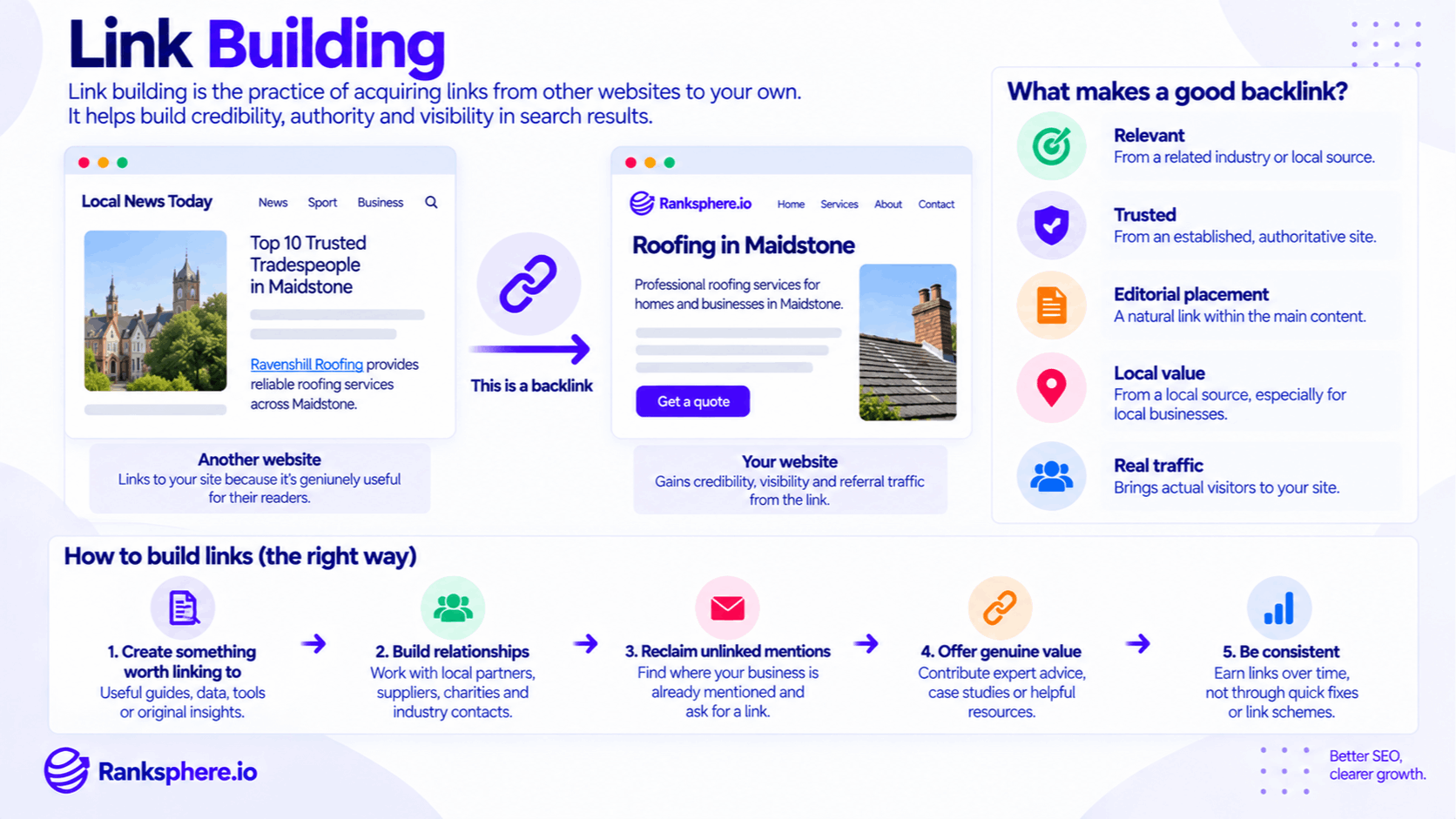
At its simplest, link building means encouraging other websites to link to yours.
For example, a local newspaper might write about a roofing company after a major storm and link to its website.
A supplier might publish a case study featuring one of its customers.
A professional association might list a member business.
Those are all forms of link acquisition.
The key difference is why the link exists.
A useful backlink normally has a genuine editorial, commercial or organisational reason behind it.
A link created purely because someone was paid to place a keyword-rich anchor in an unrelated article is much more likely to fall into manipulative territory.
Why link building matters for SEO
Links remain part of Google's ranking systems, although they are only one element among many.
Useful backlinks can contribute to SEO in several ways.
They help search engines discover pages
Search engine crawlers follow links between websites.
A backlink can therefore help a new page or website become discoverable.
This is not the only way Google finds URLs, but links form part of the wider crawling system.
They can contribute to prominence and authority signals
Links from relevant and reputable websites can help establish that other sites recognise your business or content as worth referencing.
SEO practitioners often describe the value passed through links as link equity.
It is not possible to calculate the exact amount of value an individual link passes.
Different links carry different weight depending on their context.
They provide topical context
The page containing the link, surrounding copy and anchor text can all provide information about the destination.
A link from a regional construction publication to a roofer's storm-damage guide has clear contextual relevance.
A link from an unrelated site created solely to place SEO links does not.
They send referral traffic
A backlink can also send real visitors.
That value exists even if you ignore rankings completely.
A good link might generate:
- Enquiries
- Sales
- Partnerships
- Brand awareness
- Media opportunities
That is why a useful test is:
Would we still want this link if Google did not exist?
If the answer is yes, it probably has genuine value.
What makes link building legitimate?
Legitimate link building creates or discovers reasons for other sites to link.
Examples include:
- Publishing original research
- Contributing expert commentary
- Creating useful tools
- Building genuine partnerships
- Supporting local organisations
- Reclaiming existing brand mentions
- Producing resources worth referencing
The link is a consequence of something useful happening.
That does not mean every legitimate link has to be completely spontaneous.
Outreach is perfectly normal.
You can tell someone about a resource and ask whether it would be useful to their readers.
The publisher should still have a genuine reason to include it.
What actually works in link building?
The most sustainable approaches tend to create value beyond the backlink itself.
Digital PR
Digital PR uses original stories, research or data to earn coverage.
Examples include:
- Industry surveys
- Local market data
- Trend analysis
- Original research
- Expert commentary
If journalists find the information useful, they may reference and link to the source.
The important part is having something worth covering.
Expert commentary
Journalists, publishers and industry websites often need credible sources.
A genuine expert can provide:
- Quotes
- Explanations
- Technical context
- Professional opinions
If the contribution is useful, the publication may reference the expert or business.
This works particularly well when the person responding actually has relevant experience.
Useful resources
Some pages naturally attract links because they solve a problem.
Examples include:
- Calculators
- Templates
- Checklists
- Original datasets
- Detailed guides
- Research tools
The resource needs to be genuinely useful.
Publishing a generic 500-word article and labelling it a “linkable asset” does not make people want to reference it.
Unlinked brand mentions
Sometimes another website already mentions your business without linking.
For example:
Netherby Veterinary warned local dog owners about an increase in thefts.
If a relevant article mentions the practice but does not link to it, a polite request can sometimes turn that mention into a backlink.
The publisher should still decide whether the link benefits its readers.
Broken link building
Broken link building involves finding relevant pages that link to content that no longer exists.
If you have a useful replacement, you can let the website owner know.
The approach only works when your replacement genuinely matches what the original link was supposed to provide.
Sending generic replacement suggestions at scale usually becomes spam.
Suppliers and business partners
Existing business relationships often provide natural link opportunities.
For example:
- Supplier case studies
- Partner directories
- Stockist pages
- Customer showcases
- Testimonials
- Project features
These links work because there is a real relationship behind them.
Community involvement
Local businesses may earn links through real community activity.
Examples include:
- Sponsoring a sports club
- Supporting a charity
- Participating in a local event
- Joining a chamber of commerce
- Working with a community organisation
The activity should exist for its own reason.
The backlink is an additional benefit.
For local businesses, these opportunities are often more realistic than large national digital PR campaigns.
See local link building for strategies specifically suited to local companies.
Link building for local businesses
Local businesses usually do not need the same link strategy as national publishers or large ecommerce brands.
Local SEO depends on a combination of factors including:
- Relevance
- Distance
- Prominence
Backlinks can contribute to prominence and support the organic website results, but they work alongside:
- Google Business Profile optimisation
- Reviews
- Citations
- Useful local content
- Strong internal linking
The right priority depends on what is currently weakest.
There is little value in spending heavily on link outreach while the business profile contains incorrect information or important service pages are barely linked internally.
Build the foundation first.
Then earn links that strengthen it.
Local links vs national links
A national publication is not automatically better than a small local website.
For a local business, links from locally relevant organisations can make a great deal of sense.
For example:
- Local newspapers
- Sports clubs
- Community groups
- Chambers of commerce
- Regional trade organisations
- Suppliers
- Local charities
These sources may have smaller audiences than national publications, but their relevance can be much stronger.
Judge the site by context, not simply by size.
Link building and citations
Link building and citation building overlap, but they are not identical.
A citation generally refers to a business listing or mention containing information such as:
- Business name
- Address
- Phone number
It may include a backlink.
An editorial backlink usually exists because another publisher specifically referenced the business or its content.
Both can be useful within local SEO, but they serve different purposes.
Ranksphere's citation management handles the structured-listing layer across 500+ directories, while editorial links usually come from genuine coverage, relationships or useful resources.
What is a link scheme?
A link scheme is a pattern of linking intended primarily to manipulate search rankings rather than provide genuine value.
Common examples include:
Buying links for ranking purposes
Paying for advertising is normal.
Paying specifically for an unqualified backlink intended to influence rankings is different.
Sponsored or compensated placements should be appropriately identified.
Google recommends:
rel="sponsored"
for paid links.
nofollow can also be used in situations where a publisher does not want to associate a standard link with ranking credit.
Large-scale link exchanges
There is nothing inherently wrong with two businesses linking to each other.
Partners do this naturally.
The problem comes from large-scale arrangements such as:
“Link to our website with this keyword and we will link to yours.”
when the main purpose is manipulating rankings.
Paid guest-post networks
Guest contributions can be legitimate when they genuinely inform another site's audience.
They become risky when the process is primarily:
- Pay for article
- Insert keyword-rich link
- Repeat across dozens of websites
The problem is the manufactured ranking link rather than the existence of contributed content itself.
Private blog networks
A private blog network consists of websites created or controlled largely to generate backlinks.
The sites imitate independent editorial sources but exist primarily to manipulate link signals.
That is fundamentally different from gaining coverage on genuine publications.
Automated link building
Automated systems may generate links across:
- Directories
- Blog comments
- Profiles
- Forums
- Low-quality websites
Large-scale automated link creation generally produces links with little genuine editorial value.
Low-quality directory submission at scale
Directories are not automatically bad.
Legitimate industry and local directories can be useful.
The problem is submitting a business to hundreds or thousands of unrelated directories simply to increase backlink counts.
Contractual link requirements
Some commercial relationships naturally involve attribution.
But requiring followed links using specific keyword anchors purely to influence rankings can become problematic.
Where a link is part of sponsorship or compensation, qualify it appropriately.
Paid links and rel="sponsored"
Paid exposure itself is not prohibited.
Companies advertise, sponsor organisations and pay for placements every day.
The SEO issue is whether a compensated link is presented as though it were an independent editorial endorsement.
Google recommends marking paid links with:
rel="sponsored"
For example:
<a href="https://example.com" rel="sponsored">
Example Company
</a>
The nofollow attribute can also be used in relevant situations.
These attributes help search engines understand the nature of the relationship.
They should not be viewed simply as switches that guarantee a specific amount of ranking value does or does not pass. Google treats link attributes as signals or hints within its systems.
Is guest posting bad for SEO?
No.
Guest posting itself is not inherently bad.
An expert writing a useful article for a respected industry publication can be completely legitimate.
The problem is guest posting at scale primarily to insert ranking-focused links.
A legitimate contribution usually has a reason beyond:
“We needed another backlink.”
Look at:
- Publication relevance
- Audience
- Editorial standards
- Author expertise
- Reason for the contribution
If the website appears to exist mainly to publish paid guest posts from unrelated industries, that is a warning sign.
Link exchanges
Reciprocal links are also not automatically a problem.
A web designer might link to a photographer whose work appears in a project.
The photographer might independently reference the same project.
That can be completely natural.
The concern is excessive, systematic exchange created primarily to influence rankings.
Do not be afraid of legitimate relationships simply because links happen in both directions.
Link building and anchor text
Anchor text is the clickable wording used in a link.
Natural backlinks tend to use varied wording.
For example:
- Netherby Veterinary
- the local veterinary practice
- this veterinary guide
- advice from Netherby Vets
Be cautious of campaigns promising dozens of links using an exact keyword such as:
best vet Newcastle
Publishers normally choose their own wording.
Trying to control every external anchor can make the pattern look manufactured.
Link building and Domain Authority
Third-party metrics such as Domain Authority can help compare websites within a particular SEO tool.
They are not Google ranking metrics.
Do not choose link opportunities purely because one site has a large score.
A high-scoring website may still be:
- Irrelevant
- Filled with paid guest posts
- Poorly maintained
- Unrelated to your audience
Likewise, a small local newspaper may have a lower third-party score but be highly relevant to the business.
Evaluate the actual site.
Link building and internal linking
Before investing heavily in external link building, review your own internal linking.
Internal links are under your direct control.
They can help:
- Connect important pages
- Support crawling
- Clarify topic relationships
- Direct visitors to commercial pages
- Distribute internal link signals
A business may spend months trying to earn backlinks while its most important service page receives almost no useful links from its own website.
Fixing that first is often sensible.
Should you buy link-building packages?
Be cautious with packages sold primarily around numbers.
For example:
50 high-authority backlinks every month
sounds measurable.
But it says nothing about:
- Relevance
- Editorial standards
- Audience
- Placement
- Referral traffic
- Why the site would naturally mention your business
Warning signs include:
- Guaranteed backlink counts
- Guaranteed Domain Authority
- Exact-match anchor promises
- Lists of unrelated guest-post websites
- No discussion of your audience
- Links delivered from the same network repeatedly
Good link building is difficult to package into identical monthly quantities because genuine opportunities do not appear on a fixed production line.
How many links do you need?
There is no universal target.
The answer depends on:
- Your industry
- Your location
- Your competitors
- The queries you target
- Existing reputation
- Content quality
A small local dentist and a national insurance website operate in completely different competitive environments.
Do not set targets such as:
“We need 100 backlinks this year.”
A better goal might be:
Earn relevant mentions and links from organisations our customers and industry genuinely recognise.
How to prioritise link opportunities
Before pursuing a link, ask:
- Is the website relevant to our business, location or audience?
- Does it have a genuine readership or purpose?
- Is there a sensible reason for it to mention us?
- Would the placement still be worthwhile without SEO?
- Could real people follow the link?
- Is the relationship transparent if money is involved?
These questions are more useful than looking only at an authority metric.
Reclaiming existing opportunities first
Many businesses already have potential link opportunities they have never used.
Before launching cold outreach, check:
- Unlinked press mentions
- Supplier websites
- Trade memberships
- Sponsorships
- Partnerships
- Local organisations
- Case studies
- Associations
These are often easier to pursue because the relationship or mention already exists.
Common link-building mistakes
- Buying link packages based on volume.
- Assuming every paid or reciprocal link is automatically prohibited. Context and intent matter.
- Using exact-match anchor text across placed content.
- Guest posting at scale solely for backlinks.
- Targeting websites only because they have high authority scores.
- Ignoring local relevance.
- Sending outreach without giving the publisher a useful reason to link.
- Building external links before fixing basic site problems.
- Ignoring existing relationships and unlinked mentions.
- Submitting to large numbers of irrelevant directories.
- Treating backlinks as the only measure of a campaign's success.
Link-building best practices
- Create something genuinely worth referencing.
- Prioritise relevance over raw backlink numbers.
- Start with existing relationships.
- Look for local and industry-specific opportunities.
- Use expert knowledge when contributing to publications.
- Reclaim legitimate unlinked mentions.
- Keep external anchor text natural.
- Qualify sponsored links appropriately.
- Review internal linking before investing heavily in outreach.
- Measure referral traffic and business value as well as backlink counts.
- Treat link building as an ongoing relationship activity rather than a monthly quota.
Example
“Netherby Veterinary wants to improve its backlink profile.
The first proposal it receives is a monthly outreach package promising links from pet and lifestyle blogs.
Before signing, the practice reviews the relationships it already has.
It discovers that:
- Three local rescue organisations regularly refer animals to the practice
- The business sponsors a village show
- Two vets sit on a regional professional committee
- Several local news articles mention the practice without linking to it
The practice starts there.
It contacts the publications that already mentioned the business and politely asks whether a website link would be useful to readers.
The rescue organisations update their recommended-vet resources.
The village show's website includes the practice on its sponsor page.
The professional committee correctly lists the vets and their practice.
None of these links was manufactured simply to hit a backlink quota.
They exist because the business already had genuine relationships, expertise and community involvement worth referencing.
That is the most sustainable way to approach link building: give other websites a real reason to mention you, then make it easy for them to reference the right page. The backlink should be the result of something useful, not the entire reason the activity exists.”
See also
- Backlink — a link from another website to yours
- Local link building — earning links within a local market
- Link equity — the signals associated with links
- Nofollow — one way to qualify certain links
- Anchor text — the clickable wording used in a link
- Citation — business mentions and listings used in local SEO