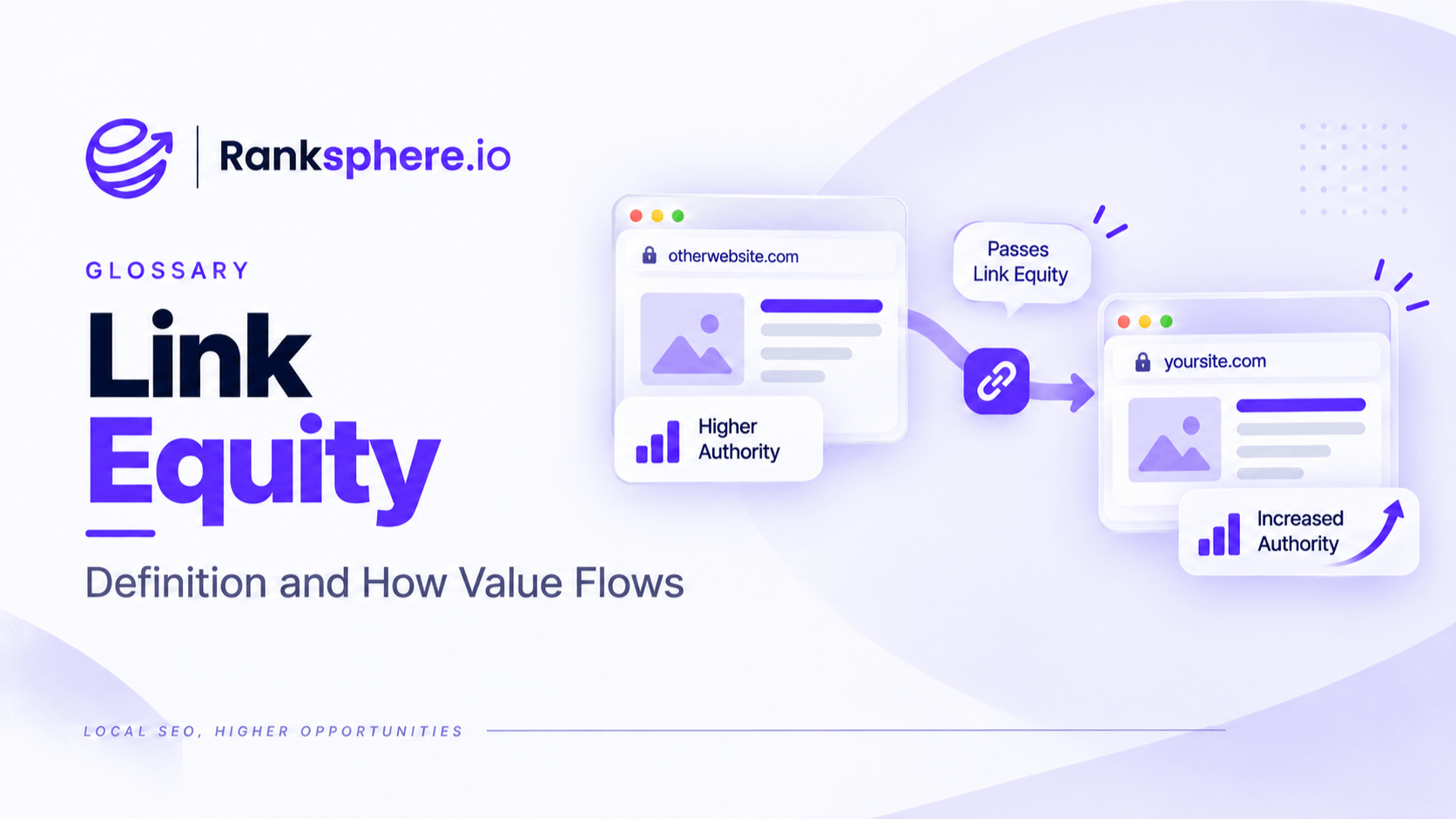
Link equity is an SEO term used to describe the ranking signals that can pass from one webpage to another through a link.
It is sometimes called link juice, although link equity is the more useful term.
The idea comes from PageRank, Google's original link-based system, which treated links as part of the way importance could flow across the web.
Modern search systems are far more complex than the original PageRank model, and Google does not provide a public link-equity score or formula.
So link equity should be treated as a practical SEO concept rather than something you can calculate precisely.
The important idea remains useful:
where a page links, how relevant that link is, and how the pages on a site connect can influence how search engines understand and value those relationships.
What does link equity mean?
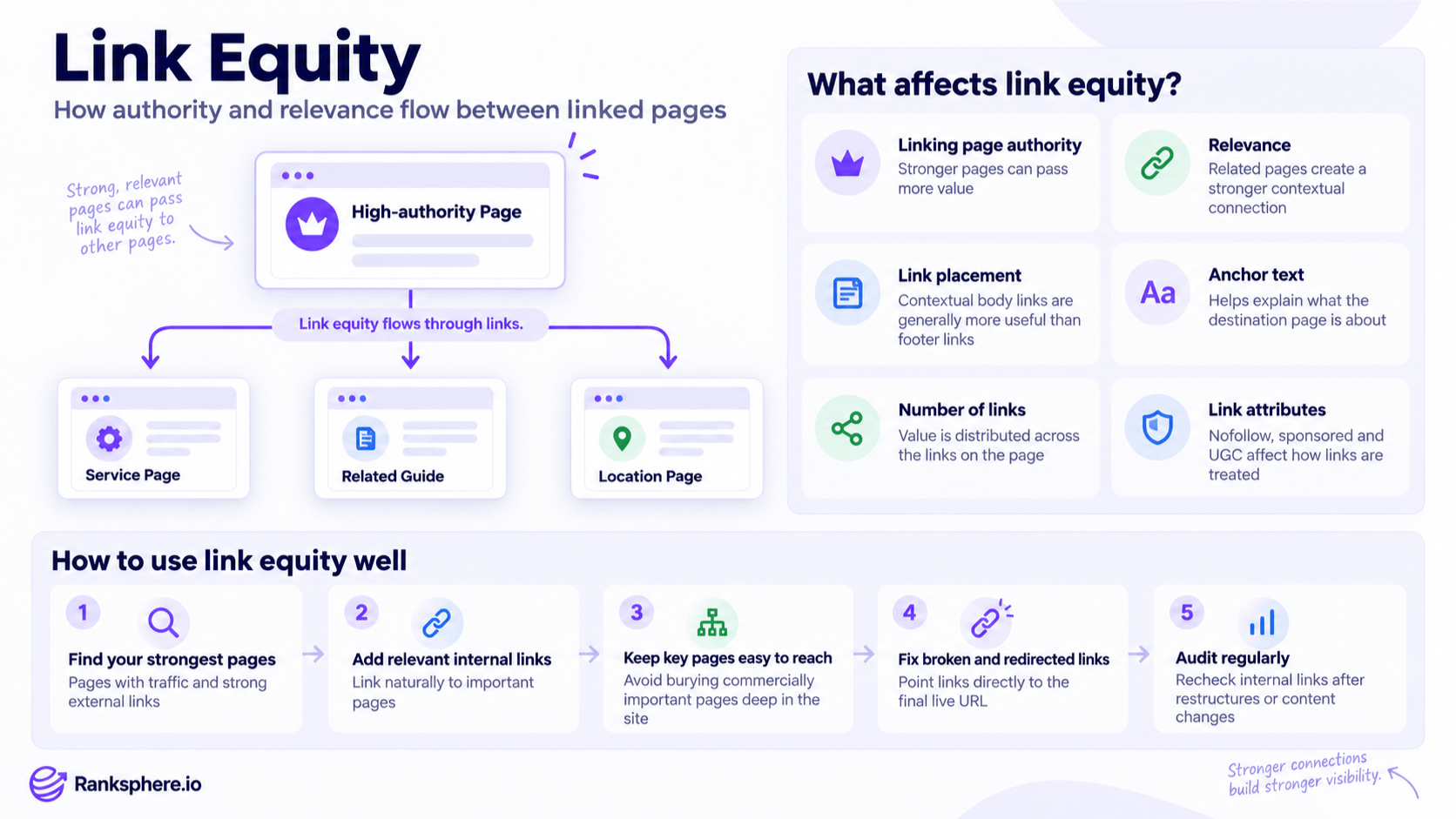
When one page links to another, the link can pass signals about the destination.
Those signals can include:
- Importance
- Relevance
- Context
- Relationship between topics
For example, if a respected legal publication links to a law firm's guide on employment tribunals, that link provides more than a route for visitors.
It also gives search engines context about the page being referenced.
Similarly, internal links help explain which pages your own website considers important and how those pages relate to one another.
This is why link equity applies to both:
- External backlinks
- Internal links
Link equity and PageRank
The concept of link equity is closely connected to PageRank.
PageRank was built around the idea that links could be used to evaluate the relative importance of pages across the web.
A page receiving links from other important pages could, in turn, pass some of that value through its own links.
That basic model helped shape modern SEO thinking around link equity.
But do not assume today's ranking systems work like a simple PageRank calculator.
Google uses many systems and signals, and nobody outside Google can see exactly how much ranking value any individual link contributes.
Link equity is therefore best used as a mental model for understanding link relationships, not a number to calculate.
What affects link equity?
Not every link is treated equally.
Several factors can influence how useful or meaningful a link is.
The linking page
A link from a page that itself has strong external and internal signals may carry more weight than a link from an obscure page with little connection to the wider web.
But avoid reducing this to one third-party authority score.
The quality and relevance of the actual page matter.
Relevance
A link makes more sense when the source and destination are contextually related.
For example:
A roofing guide linking to a roof repair service has an obvious relationship.
A gardening article linking to an employment solicitor does not.
Relevant connections help users and search engines understand why the destination belongs there.
Link placement and context
Links inside relevant editorial content can provide clear context because the surrounding text explains why the page is being referenced.
Links in:
- Navigation
- Footers
- Sidebars
can still be useful.
They simply serve different purposes.
Avoid assuming that every contextual link is automatically stronger than every navigation link.
What matters is whether the link makes sense within the structure and content of the site.
Anchor text
Anchor text is the clickable wording of a link.
Descriptive anchor text can help explain what the destination contains.
For example:
employment tribunal deadlines
is more descriptive than:
click here
But anchor text should remain natural.
Do not force the same exact keyword into every internal or external link.
Link attributes
Attributes such as:
- nofollow
- sponsored
- ugc
give search engines additional information about the nature of a link.
They should not be treated as simple on/off switches for a measurable amount of PageRank.
Google uses these attributes as signals or hints when evaluating links.
Does the number of links on a page matter?
PageRank's original model helped popularise the idea that a page's value is divided among the links leaving it.
That remains a useful conceptual model.
But it should not be treated as literal modern SEO arithmetic.
For example, you cannot reliably say:
A page has 100 points of authority and 10 links, so each link gets 10 points.
Search engines evaluate links in a much more sophisticated context.
Still, there is a practical lesson:
Do not add hundreds of unnecessary links to a page simply because you want every URL to receive a link.
Navigation should remain useful, and contextual links should exist because they help the reader.
Internal link equity
Internal link equity is particularly useful because it is something you can influence directly.
You cannot control which external websites link to you.
You can control how your own pages connect.
Internal linking helps search engines understand:
- Which pages are important
- How topics relate
- Which pages sit within the same section
- How users can move through the site
A page linked prominently from several relevant parts of the website is more integrated into the site's architecture than one that receives almost no internal links.
Does the homepage have the most link equity?
Often, but not always.
Homepages commonly receive:
- Many external backlinks
- Sitewide internal links
- Brand mentions
- Navigation links
That can make the homepage an important source of internal link signals.
But some websites have articles, tools or resource pages that attract far more external links than the homepage.
So rather than assuming the homepage is always strongest, review which pages actually have:
- Valuable backlinks
- Strong internal support
- Relevant visibility
Those pages may provide useful internal-link opportunities.
Site architecture and link equity
Site architecture influences how internal links are distributed.
For example:
Home → Services → Employment Law
creates a clear path.
A page buried several layers deep may receive fewer internal links and less navigational prominence.
But depth itself does not automatically determine link equity.
A page six clicks from the homepage could still receive strong contextual links from highly relevant pages.
The better question is:
How well connected is this page within the site's real structure?
Important pages should have clear, relevant routes through the website.
Orphan pages and link equity
An orphan page has no internal links pointing to it.
That means it receives no internal link support from the rest of the website.
It may still have:
- External backlinks
- Sitemap inclusion
- Historical signals
so it is not accurate to say an orphan page receives no link equity at all.
But for an important commercial or informational page, the absence of internal links is usually a structural weakness.
If the page matters, connect it to relevant parts of the site.
How internal links distribute value
Suppose a blog article has:
- Several strong backlinks
- Good organic visibility
- Relevant information about one of your services
and the article never links to that service page.
That may be a missed opportunity.
A useful contextual link can:
- Help visitors discover the service
- Explain the relationship between the topics
- Strengthen the internal connection between the pages
The objective is not simply to “send authority”.
The link should make sense to someone reading the article.
Link equity and backlinks
Backlinks are one of the main sources of external link signals.
A page that earns useful backlinks may become an important part of the site's overall link structure.
For example, a detailed guide may naturally earn links while a commercial service page does not.
Internal linking can then connect those two pages.
That gives the guide a useful commercial next step and helps integrate the service page into the site's relevant topic structure.
Where link equity can be disrupted
Some technical and structural issues can make link relationships less efficient or less clear.
Broken links
A link pointing to a 404 page sends visitors and crawlers to a URL that no longer provides the expected content.
Fix internal broken links where possible.
If a relevant replacement exists, update the link directly.
Links to redirected URLs
A link to a URL that redirects can still lead crawlers and visitors to the final destination.
But if you control the internal link, it is generally cleaner to point directly to the final URL.
For example:
Less efficient
Page A → Old URL → 301 → New URL
Better
Page A → New URL
Redirects are useful for preserving old URLs.
They should not become the permanent internal-link structure where you can update the link directly.
Redirect chains
Long redirect chains create unnecessary hops.
For example:
A → B → C → D
is less efficient than:
A → D
Search engines can follow redirects and consolidate signals, but avoiding unnecessary chains makes crawling and maintenance cleaner.
Your existing 302 redirect guidance covers temporary redirects in more detail.
Canonicalisation problems
A canonical tag helps indicate which URL should be treated as the preferred version among duplicate or substantially similar pages.
The issue is not simply that link equity gets “split” between duplicates.
Search engines can consolidate signals across canonicalised versions.
Problems arise when signals conflict.
For example:
- Internal links point to URL A
- The sitemap lists URL A
- The canonical points to URL B
That creates unnecessary ambiguity.
Keep internal links, canonical signals and sitemap URLs aligned where possible.
Do footer links dilute link equity?
Not in a simple mathematical sense.
A footer containing useful navigation is perfectly normal.
Problems arise when a footer becomes a large block of keyword-focused links added primarily for SEO.
For example:
- Plumber Maidstone
- Plumber Ashford
- Plumber Canterbury
- Plumber Dover
- Plumber Tonbridge
repeated across every page may create poor navigation and an unnatural linking structure.
The issue is not that each link receives exactly one-fiftieth of some fixed authority pool.
It is that the website is creating a large number of repetitive links with limited usefulness.
Keep footer navigation focused on what visitors genuinely need.
What is PageRank sculpting?
PageRank sculpting was an old SEO tactic that attempted to control how internal link value flowed through a page.
A common approach was to add nofollow to links considered unimportant.
The theory was:
If ten links share the available PageRank and five are nofollowed, the other five should receive more.
Google explained in 2009 that its treatment of nofollow meant the withheld amount was not simply redistributed among the remaining followed links.
That made internal nofollow-based PageRank sculpting ineffective as a strategy.
The better approach is simpler:
Build a useful internal-link structure.
Do not use nofollow on ordinary internal links solely to try to preserve or redirect PageRank.
Should you nofollow internal links?
Generally, normal internal navigation does not need nofollow.
If one of your own pages is useful enough to link to, let the link behave normally.
Do not use nofollow to try to concentrate authority on:
- Service pages
- Product pages
- Category pages
If a page should not be indexed or crawled, use the appropriate technical controls for that purpose rather than attempting to manipulate internal PageRank with nofollow.
How to find internal link-equity opportunities
Start by identifying important pages that are poorly connected.
Look for:
- High-value service pages with few incoming internal links
- Strong articles that mention services without linking to them
- Orphan pages
- Links pointing at redirects
- Broken links
- Old pages that still point to retired URLs
Then ask:
Where would a link genuinely help the reader?
Ranksphere's website audit maps internal links and finds broken and redirected ones, helping identify structural issues across the site.
Strong pages vs high-traffic pages
Be careful not to equate traffic with link equity.
A page may receive high traffic because it ranks for a popular query while having very few backlinks.
Another page may receive modest traffic but have several strong external links.
When looking for internal linking opportunities, consider:
- External backlinks
- Internal link prominence
- Topic relevance
- Page purpose
- Search visibility
Traffic can be useful context.
It is not a direct measurement of link equity.
Link equity and contextual internal links
Contextual internal links are useful when the content naturally connects two pages.
For example, a guide about:
Employment Tribunal Deadlines
might naturally link to:
Employment Law Services
with wording such as:
speak to our employment law team
That link helps the visitor move from research to action.
It also tells search engines that the informational page and commercial service page are related.
That is a much better reason to add the link than:
“This page has authority, so we need to drain some of it into the service page.”
Think relationships first.
Link equity follows from a sensible structure.
Link equity and anchor text
Anchor text adds context to the link.
For example:
Poor
click here
More descriptive
employment law services
Also natural
our employment solicitors
help with an employment dispute
You do not need to use the same keyword every time.
Natural variation usually makes the site's linking structure easier to read.
Link equity and external links
Linking to other websites does not automatically “leak authority” in a way that means you should avoid useful external links.
If another source genuinely helps the reader, link to it.
Examples might include:
- Official government guidance
- Primary research
- Industry standards
- Technical documentation
The purpose of a page is not to trap PageRank.
It is to help the user.
Do not remove useful citations because you are worried about losing link juice.
Common link equity mistakes
- Treating link equity as a measurable score. Google does not provide one.
- Using simple division formulas. Modern link evaluation is not arithmetic you can calculate from the number of outgoing links.
- Nofollowing internal links to sculpt PageRank. This is outdated.
- Assuming all footer links are weak. Judge their purpose and relevance.
- Leaving internal links pointing to redirects when they can be updated directly.
- Ignoring broken links.
- Assuming canonicalised duplicates simply divide authority equally.
- Treating traffic as a direct measure of link equity.
- Ignoring internal linking while focusing entirely on backlinks.
- Assuming orphan pages have no external link signals.
- Avoiding useful external links because of fear of “leaking link juice.”
Link equity best practices
- Build clear internal links between genuinely related pages.
- Give important pages useful routes through the site.
- Link from relevant pages that already have strong external or internal signals.
- Use descriptive, natural anchor text.
- Point internal links directly to final live URLs.
- Fix broken internal links.
- Reduce unnecessary redirect chains.
- Keep canonical, sitemap and internal-link signals aligned.
- Reconnect important orphan pages.
- Do not use nofollow to sculpt internal PageRank.
- Think about usefulness and relationships rather than trying to calculate link juice.
Example
Larkfield Legal has a detailed guide about employment tribunal deadlines.
The article performs well organically and has earned several backlinks from relevant legal and employment publications.
The firm's employment law service page, however, is much less connected.
Most of its internal links come from the main navigation.
During an internal-link review, the team notices that the tribunal guide repeatedly discusses situations where someone may need professional legal advice but never links to the employment service.
The firm adds a small number of contextual links where they make sense naturally.
Other relevant employment-law articles are reviewed at the same time, and useful connections are added to the service page.
The service page becomes more clearly integrated into the site's employment-law content.
Whether its rankings change depends on many factors, so the links should not be treated as a guaranteed ranking lever.
But the website is structurally better:
- Visitors have a clearer next step
- Related content is connected
- Anchor text provides useful context
- A commercially important page receives stronger internal support
That is the most useful way to understand link equity: not as a fixed quantity you move around with mathematical precision, but as part of how links communicate importance, relevance and relationships across a website and the wider web.
See also
- Backlink — an external link pointing to your website
- Internal linking — how pages are connected within your own site
- Anchor text — the clickable wording that provides context
- Nofollow — an attribute that changes how a link is treated
- Site architecture — the structure that influences internal-link distribution
- Domain authority — a third-party metric, not Google's measure of link equity