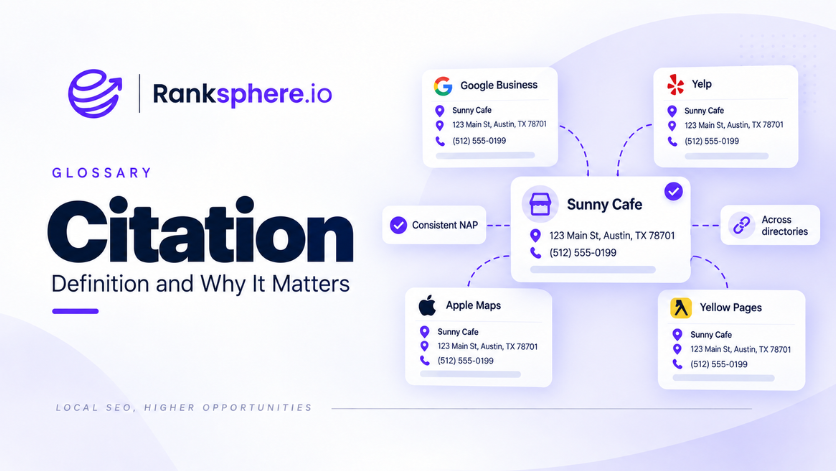
A local citation is an online mention of a business’s name, address and phone number. It may appear in a business directory, review site, social profile, map service, local website or editorial article, and it does not need to include a backlink to count as a citation.
For local SEO, citations are useful because they give search engines another source of information about the business. When the same details appear consistently across trusted websites, it becomes easier to understand who the business is, where it operates and how customers can contact it.
That does not mean you need hundreds of directory listings. Citation work is less about volume and more about having accurate information in the places that actually matter.
Why local citations are important?
Imagine looking up the same business on Google, Apple Maps, Yelp and a local directory.
If every source shows the same address and phone number, there is very little ambiguity. If one lists an old address, another has a disconnected number and a third uses a different business name, the picture becomes less clear.
That is why citation accuracy still matters.
Citations can also support the wider signals associated with prominence, one of the three main local ranking factors. But their value goes beyond SEO. Customers use directories, navigation apps, review platforms and voice search to find local businesses, so incorrect details can cost you enquiries even if your Google rankings are strong.
Local citations can help you:
- Keep your business information consistent across the web
- Give search engines more confidence in your location and contact details
- Reach customers through directories, maps and other discovery platforms
- Reduce the chance of people calling an old number or visiting the wrong address
- Build a wider local presence beyond Google Search
Structured and unstructured local citations
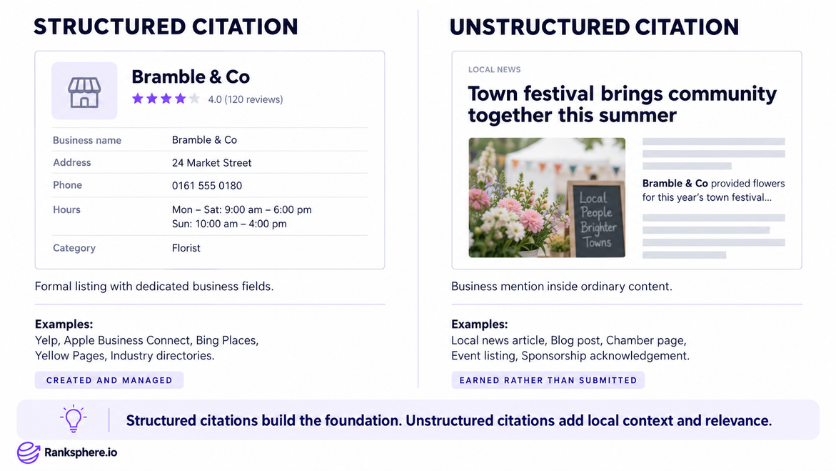
Local citations generally fall into two groups.
Structured citations are business listings with dedicated fields for information such as your name, address, phone number, opening hours and category.
Examples include Yelp, Apple Business Connect, Bing Places, Yellow Pages and industry-specific directories.
These are usually the citations you can claim, create and update yourself.
Unstructured citations appear naturally within other content.
A local newspaper might mention your business in an article. A chamber of commerce may list you as a member. A community website could name your company as an event sponsor.
These mentions are not formatted like traditional business listings, but they still connect your business with a place, industry or community.
Both types have value. Structured listings give you a solid foundation, while unstructured mentions can add useful local and industry context.
Which citations are worth having?
There was a time when citation building largely meant submitting a business to as many directories as possible.
That is no longer a useful way to approach it.
A shorter list of relevant, established sources is generally more valuable than hundreds of listings on directories that nobody uses.
Start with the places that matter most:
- Core platforms, Google Business Profile, Apple Business Connect, Bing Places and other widely used platforms
- Data aggregators, services that collect and distribute business information to other platforms, covered in data aggregator
- Industry directories, relevant websites for your profession or sector, such as legal, healthcare, hospitality or home-service directories
- Local websites, chambers of commerce, local organisations, business associations and community sites
- Review platforms, general and industry-specific sites where customers actively research businesses
The question to ask is not simply, “Can I get listed here?”
Ask whether the website is relevant, trusted and likely to be useful to customers.
Ranksphere's citation management checks your listings across 500+ directories, flagging mismatches, duplicates and gaps against a single reference record.
Common mistakes
- Focusing on the number of citations. More listings do not automatically mean better local SEO. Quality and accuracy matter more.
- Building new citations before checking the old ones. Adding fresh listings while incorrect information is still circulating only creates more cleanup later.
- Leaving outdated details online. Old phone numbers, previous addresses and former business names can stay live long after a change.
- Using different contact information unnecessarily. Your main business details should be consistent and clearly associated with the same company.
- Using tracking numbers without considering NAP. Call tracking can be useful, but it needs to be implemented carefully so it does not create problems with NAP consistency.
- Treating citations as a one-time task. Businesses move, rebrand and change contact details, so listings need to be reviewed over time.
- Ignoring local mentions outside directories. Press coverage, partnerships, sponsorships and membership pages can be valuable local citations too.
Best practices
- Audit your existing citations first. Find incorrect, outdated and duplicate listings before creating anything new.
- Keep one clear reference version of your business details. Use it whenever you create or update listings.
- Prioritise important platforms. Start with major search, map and directory services before moving into niche sources.
- Choose directories that make sense for the business. Industry and local relevance are more important than raw listing volume.
- Claim important listings where possible. This gives you more control over future updates.
- Check citations after major business changes. A move, rebrand or phone-number change should always trigger another audit.
- Look for genuine local mentions. Community partnerships, local press and industry organisations can build visibility in ways a generic directory cannot.
Example
“Bramble & Co is a florist that moves to a larger shop a few streets away.
The owner updates the Google Business Profile straight away, but several older listings are left untouched.
Months later, customers are still finding the previous address through map services, review websites and wedding directories. One listing even shows an old phone number that is no longer in use.
A citation audit uncovers the problem.
The business starts with the platforms customers use most, then works through the remaining directories and industry listings. The old address is replaced, outdated phone numbers are corrected and duplicate listings are dealt with.
There is no dramatic overnight ranking change. The more immediate benefit is simpler: customers are now finding the correct shop, calling the right number and seeing the same information wherever they search.
That is a better way to think about citation management. It is not a race to collect as many listings as possible. It is ongoing maintenance of the business information people and search engines rely on.”
See also
- NAP, the core business details used across local citations
- Citation building, creating new business listings on relevant platforms
- Citation audit, checking where your business is listed and whether the information is correct
- Data aggregator, services that distribute business information to other platforms
- Duplicate listing, multiple listings that can create confusion around the same business
- Local ranking factors, the wider signals that influence local search visibility