AI Overviews are generative AI responses that appear within Google Search when Google's systems determine that an AI-generated answer would add something useful to the normal search experience.
They can combine information retrieved from multiple webpages into a generated response and provide links to relevant sources so users can explore the subject in more detail.
AI Overviews are now part of a wider set of generative Search experiences that also includes AI Mode.
For website owners, the important point is that Google does not describe AI Overviews as a completely separate search ecosystem.
Google's current guidance says its generative AI features are rooted in the same core Search ranking and quality systems used across Google Search. There are no separate technical requirements or special AI markup needed to qualify for inclusion.
That means the fundamentals still matter:
- Useful, original content
- Crawlable and indexable pages
- Clear site structure
- Accurate information
- Strong technical SEO
- Good page experience
The search interface has changed.
The need to create something worth finding has not.
How AI Overviews work
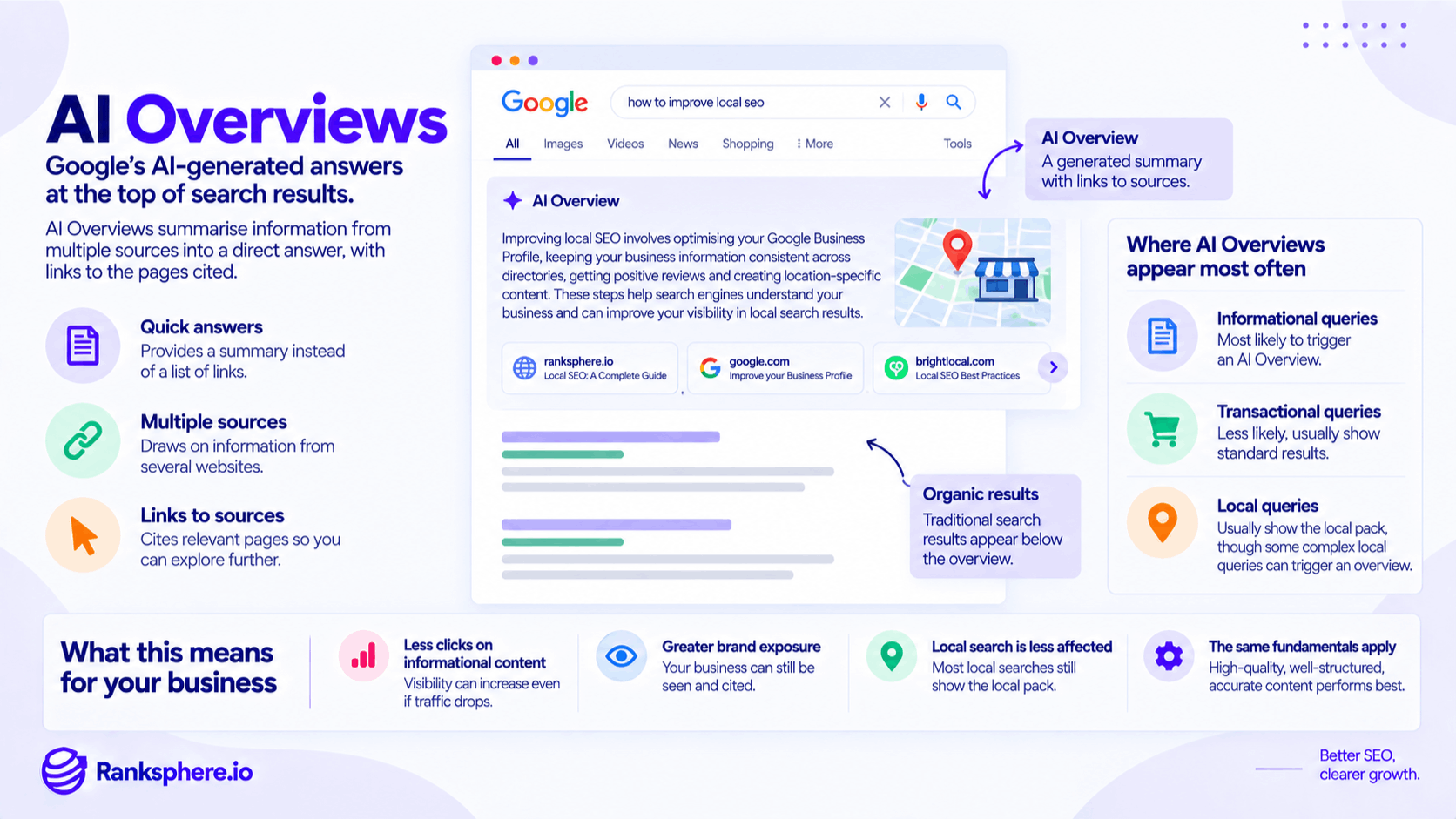
AI Overviews differ from traditional search results because Google can generate a response rather than simply display a list of links.
Google describes its generative Search systems as using techniques including retrieval-augmented generation, or RAG.
In simplified terms:
- Google retrieves relevant information using its Search systems.
- Its generative AI processes information from those retrieved sources.
- It generates a response designed to answer the user's question.
- Relevant web links may appear alongside or within that response.
Google also uses a technique called query fan-out, where the system can generate several related searches to explore different parts of a user's question.
For example, someone might search:
How do I repair a lawn full of weeds without damaging the grass?
The system could explore related questions about:
- Weed identification
- Herbicides
- Non-chemical removal
- Lawn repair
- Preventing regrowth
That creates a different search experience from matching one webpage against one exact keyword phrase.
AI Overviews vs featured snippets
AI Overviews and featured snippets can both provide answers directly within Google, but they work differently.
Featured snippets
A featured snippet typically extracts information from a webpage and displays that content prominently.
One source usually provides the main answer.
AI Overviews
An AI Overview generates a response using Google's AI systems and can draw on information retrieved from multiple sources.
That means there is not necessarily one page that simply “wins the AI Overview” in the same way people traditionally talked about winning a featured snippet.
A website may instead appear as one of several supporting sources.
This makes the goal less about formatting one exact passage for extraction and more about making your content genuinely useful within the wider topic.
Do you need special AI Overview optimisation?
No separate technical system is required.
Google explicitly says that normal SEO best practices remain relevant to its generative AI features and that there are no additional technical requirements for appearing in AI Overviews or AI Mode.
A page generally needs to:
- Be indexed
- Be eligible to appear in Google Search
- Be eligible to show a snippet
- Meet Google's normal technical requirements
- Comply with Search policies
Meeting those requirements does not guarantee that a page will appear.
But you do not need:
- AI Overview schema
- A special meta tag
- An AI sitemap
- A separate AI version of your page
- A specific content length
- A special “citation optimisation” formula
Google's 2026 guidance goes further and says website owners can ignore tactics such as artificial content chunking and unnecessary AI-specific files when those are presented as special shortcuts to generative Search visibility.
Is SEO still relevant to AI Overviews?
Yes.
Google's current guidance is explicit that SEO remains relevant because its generative AI features rely on core Search ranking and quality systems.
That includes familiar fundamentals such as:
- Making content crawlable
- Avoiding unnecessary duplication
- Creating useful original information
- Building a clear website structure
- Making pages work well across devices
- Following JavaScript SEO best practices
- Maintaining good page experience
So the rise of AI Overviews does not mean traditional SEO has stopped mattering.
It means the ways searchers consume information are changing.
What type of content works well in generative search?
Google's newer guidance places particular emphasis on non-commodity content.
That means content that adds something beyond information anyone could reproduce by summarising the existing web.
For example:
Commodity content
7 Tips for First-Time Homebuyers
might simply repeat generic advice available on hundreds of websites.
More distinctive content
Why We Recommended a Drain Survey Before This First-Time Buyer's Purchase
could contain:
- First-hand experience
- Original photographs
- Specific reasoning
- Real problems encountered
- Professional insight
The second page gives Google's systems something distinctive to retrieve.
More importantly, it gives the reader something they could not get from a generic summary.
Original experience matters
First-hand information is particularly useful in a generative search environment.
Examples include:
- Your own data
- Original research
- Customer case studies
- Project photographs
- Professional observations
- Unique comparisons
- First-hand reviews
- Practical lessons
Google's current guidance specifically encourages unique viewpoints and expert or experience-led content rather than simply recycling information already widely available.
For a local business, that is an opportunity.
A plumber does not need to publish another generic definition of:
What causes a blocked drain?
They may have more to offer by explaining:
The three drainage faults we most commonly find in Victorian terraces in Canterbury
with actual examples from completed work.
That is harder to replace with a generic AI summary.
Clear content structure still matters
Good structure helps people understand a page.
Google's guidance recommends organising content into logical sections and using headings where they improve readability.
For example:
How long does rotator cuff recovery take?
followed immediately by a clear answer is useful.
But avoid turning every page into a collection of artificial question-and-answer blocks purely because someone says AI systems prefer “chunks”.
Google specifically advises against treating content chunking as a special generative AI optimisation hack.
Use headings because they help the reader understand the page.
Not because you are trying to manipulate an AI citation.
AI Overviews and query fan-out
Query fan-out is one of the more important differences in generative Search.
Instead of processing only the literal search phrase, Google's systems may issue several related queries to collect enough information to answer a broader question.
Suppose someone searches:
What should I consider before replacing a flat roof on a Victorian house?
The system may need information around:
- Roofing materials
- Costs
- Building regulations
- Insulation
- Expected lifespan
- Planning considerations
- Property type
This does not mean you should create a separate page for every possible fan-out query.
Google specifically warns that manufacturing large numbers of pages around query variations can become scaled content abuse when done primarily to manipulate Search.
Cover the subject naturally.
Do not manufacture the cluster around imagined AI prompts.
Do pages need to rank highly before being cited?
Not according to any public rule from Google.
Google's generative AI systems use core Search ranking systems to retrieve relevant webpages, so normal organic relevance and quality clearly matter.
But avoid rules such as:
“You must rank in the top ten to appear in an AI Overview.”
Google has not published such a requirement.
Generative Search can also involve query fan-out, which means a page may be relevant to one of the related searches rather than the exact wording the user originally entered.
A better goal is:
Create the strongest relevant source you can, rather than trying to reverse-engineer a citation position.
AI Overviews and backlinks
Backlinks remain part of the wider SEO ecosystem because Google's generative AI systems are grounded in Search.
But there is no published formula saying:
More backlinks = more AI Overview citations.
Links can contribute to a website's wider prominence and organic performance.
They should still be earned because they make sense to real users.
Do not launch a separate link-building campaign solely to “increase AI citations”.
AI Overviews and entities
Clear business and entity information can make a website easier to understand generally.
That includes keeping information such as:
- Business name
- Services
- Location
- Author identity
- Organisation details
clear and consistent.
For local businesses, Google also recommends establishing accurate business details through Google Business Profile so information such as the business's location, type, contact information and photos can appear appropriately across Search and Maps.
But avoid claiming that completing a Business Profile is a direct AI Overview ranking factor.
It is better described as part of maintaining accurate business information across Google's search ecosystem.
Google Business Profile and AI search
A Google Business Profile remains important for local visibility.
Keep information such as:
- Business category
- Address or service area
- Opening hours
- Phone number
- Services
- Photos
accurate and current.
That improves the underlying business information Google has available for local Search and Maps.
Do not think of profile optimisation as a separate “AI SEO” trick.
It is simply good local SEO.
AI Overviews and local search
Local search deserves separate treatment because not every search-result page behaves the same way.
A straightforward query such as:
dentist near me
may produce a local interface centred on businesses and maps.
A more complicated question such as:
What should I compare when choosing a dentist for implants?
may produce a more explanatory search experience.
The exact appearance can vary by query, location, user and Google's current Search systems.
So avoid assuming:
AI Overviews only appear for informational searches
or:
local searches never trigger AI answers.
Google says AI Overviews appear when its systems determine they are helpful in addition to traditional Search, and they do not trigger for every query.
That is a safer and more durable way to describe the behaviour.
AI Overviews and the local pack
AI Overviews have not made the local pack obsolete.
People still need concrete local information such as:
- Nearby businesses
- Opening hours
- Directions
- Reviews
- Phone numbers
Those needs are different from purely explanatory searches.
For local businesses, the practical approach remains:
maintain strong local search fundamentals while also publishing genuinely useful information where customers need deeper answers.
Do not abandon either side.
AI Overviews and zero-click search
AI Overviews contribute to the broader zero-click search discussion.
A searcher may receive enough information from Google's generated response that they do not immediately visit a website.
That can reduce clicks for some queries.
However, the effect varies by:
- Query
- Industry
- Search intent
- SERP layout
- User behaviour
Avoid quoting a universal percentage for AI Overview traffic loss.
Studies use different samples and methodologies, and the search interface continues to change quickly.
What matters is what happens to your own pages and queries.
AI Overviews do not make clicks irrelevant
Website visits still matter.
If someone needs:
- Detailed instructions
- Original research
- Product information
- Current pricing
- Appointment availability
- Bespoke advice
- A booking
- A quote
they may still need to visit the source.
Google itself has continued changing AI Search interfaces to provide more direct and prominent links to webpages and says these features are intended to help people discover relevant sites.
The goal should therefore not be:
“How do we force people to click?”
It should be:
“What can our page provide that remains useful after the initial answer?”
AI Overviews and brand visibility
A website can appear in a generative search experience without receiving a click.
That creates a distinction between:
Visibility
and:
Traffic
Someone might see your:
- Brand
- Website
- Article
- Product
without immediately visiting it.
That exposure may still be useful, but avoid automatically calling it a conversion or assuming it will produce later branded searches.
Measure what you can rather than inventing attribution.
Measuring AI Overview visibility
This area has changed significantly.
In June 2026, Google introduced dedicated Generative AI performance reporting in Search Console, and Google says those reports were rolled out to all websites worldwide by 31 August 2026.
The reporting can show information such as:
- Generative AI impressions
- Pages appearing in AI features
- Countries
- Devices
- Performance over time
This gives website owners a more direct way to monitor visibility within Google's generative search experiences.
That is much more useful than relying entirely on third-party estimates of whether a page was “cited”.
Search Console and AI Overviews
Google Search Console should now be part of AI Search reporting.
Use it to monitor:
- Which pages appear in generative AI features
- How impressions change
- Geographic patterns
- Device differences
- Overall organic traffic trends
Then combine that data with website analytics and conversions.
The goal is not simply to maximise AI impressions.
Ask whether that visibility contributes to:
- Qualified visits
- Leads
- Sales
- Bookings
- Brand discovery
Visibility is useful.
Business impact matters more.
AI Overviews and generative engine optimisation
Generative engine optimisation — often shortened to GEO — is commonly used to describe work intended to improve visibility in AI-generated answers.
Google's current position is straightforward:
For Google Search, optimisation for generative AI remains part of SEO.
Google explicitly says site owners should prioritise proven SEO practices over special AEO or GEO hacks.
That does not mean generative search deserves no separate analysis.
It means you should be suspicious when someone sells:
- Secret AI markup
- Citation formulas
- AI keyword density
- Mandatory llms.txt files
- Content chunking tricks
- Guaranteed AI citations
There is no evidence that those create a shortcut around normal Search quality systems.
AI Overviews and AI Mode
AI Overviews and Google AI Mode are related but different.
AI Overviews appear within standard Search when Google determines a generated summary is useful.
AI Mode is a more conversational search experience that supports deeper questions and follow-ups.
Google says the two features may use different models and techniques, meaning the answers and links shown can differ.
So a site appearing in one does not automatically mean it will appear in the other.
Images and video
Generative Search is not limited to text.
Google's current guidance recommends using high-quality relevant images and video where they improve the content because these assets can also surface within generative Search experiences.
For a local business, that might mean:
- Original project photography
- Before-and-after images
- Demonstration videos
- Real premises
- Product examples
- Expert walkthroughs
Again, the same rule applies:
Do not create media purely because you think an AI system requires it.
Create it because it improves the page.
Common AI Overview mistakes
- Treating AI Overviews as a completely separate search engine. Google's generative features still rely on core Search systems.
- Assuming top-ten organic ranking is a formal citation requirement. Google has published no such rule.
- Publishing one page for every possible AI query. This can create thin or scaled content.
- Using artificial “content chunks” solely for AI extraction. Google specifically says special chunking tactics are unnecessary.
- Creating AI-specific files because someone says they are mandatory.
- Assuming a Business Profile directly guarantees AI Overview inclusion.
- Withholding useful information to force clicks.
- Judging success only by website traffic.
- Treating every generative impression as a conversion.
- Quoting AI Overview trigger or CTR statistics without checking their date and methodology.
- Buying an AI optimisation service built around secret citation formulas.
- Creating generic AI-written content at scale. Commodity content is increasingly easy to replace.
AI Overview best practices
- Keep pages crawlable, indexable and eligible for normal Google Search.
- Continue following strong technical SEO practices.
- Create useful, original and non-commodity content.
- Add first-hand expertise and experience where possible.
- Use clear headings and logical page structure for readers.
- Answer important questions clearly without manufacturing artificial content chunks.
- Keep time-sensitive information accurate.
- Maintain clear and consistent business information.
- Use relevant original images and video where helpful.
- Avoid producing pages for every minor query variation.
- Monitor generative AI visibility through Search Console.
- Measure conversions and business outcomes alongside impressions.
- Treat GEO and AEO as extensions of good SEO rather than substitutes for it.
Example
“Ravensworth Physiotherapy has a detailed guide about rotator cuff recovery.
For several years, the article has generated consistent organic traffic.
Over time, the clinic notices that search behaviour around the topic is changing.
The page is still visible, but Google now provides more information directly within its generative Search experiences for some related queries.
Rather than adding hundreds of words or rewriting the article around supposed AI citation formulas, the clinic reviews the page itself.
The team improves what genuinely matters.
A physiotherapist reviews the medical information.
Outdated sections are corrected.
First-hand clinical observations are added where appropriate.
The page is reorganised so major questions are easier to find.
Original diagrams are added.
The author's qualifications are made clear.
Related treatment pages receive useful internal links.
The clinic then uses Search Console's generative AI reporting alongside its normal organic data to understand where the page appears and whether those appearances contribute to useful visits or enquiries.
The goal is no longer:
“How do we trick Google into citing this page?”
It is:
“How do we make this one of the best sources available when someone needs reliable information about this subject?”
That is the more sustainable approach to AI Overviews.
Google's interface will continue to change.
Useful, distinctive information remains the asset underneath it.”
See also
- Google AI Mode — Google's more conversational generative Search experience
- Zero-click search — searches that end without an external website visit
- Featured snippet — an extracted answer from a webpage
- Generative engine optimisation — optimisation for visibility in generative search experiences
- Local pack — Google's local business results
- Entity — a distinct person, place, organisation or concept understood by search systems