
An industry directory is a website that lists businesses, professionals, or service providers within a particular industry. Examples include professional registers, trade association directories, approved-installer lists, and specialist platforms for healthcare, legal services, or construction.
Unlike general business directories that cover almost every type of company, industry directories focus on a specific profession or sector.
For local businesses, these listings can be particularly valuable because they help potential customers find providers with relevant experience, qualifications, or industry memberships.
For example, someone looking for a boiler installer may visit a manufacturer's approved-installer directory rather than searching through a general business listing website.
Industry directories are also an important part of local citation building. They can help businesses maintain accurate information across the web, strengthen their professional credibility, and attract visitors from relevant sources.
However, the value of a directory depends on its quality and how people use it, not simply whether it focuses on a particular industry.
Why Industry Directories Matter for Local SEO
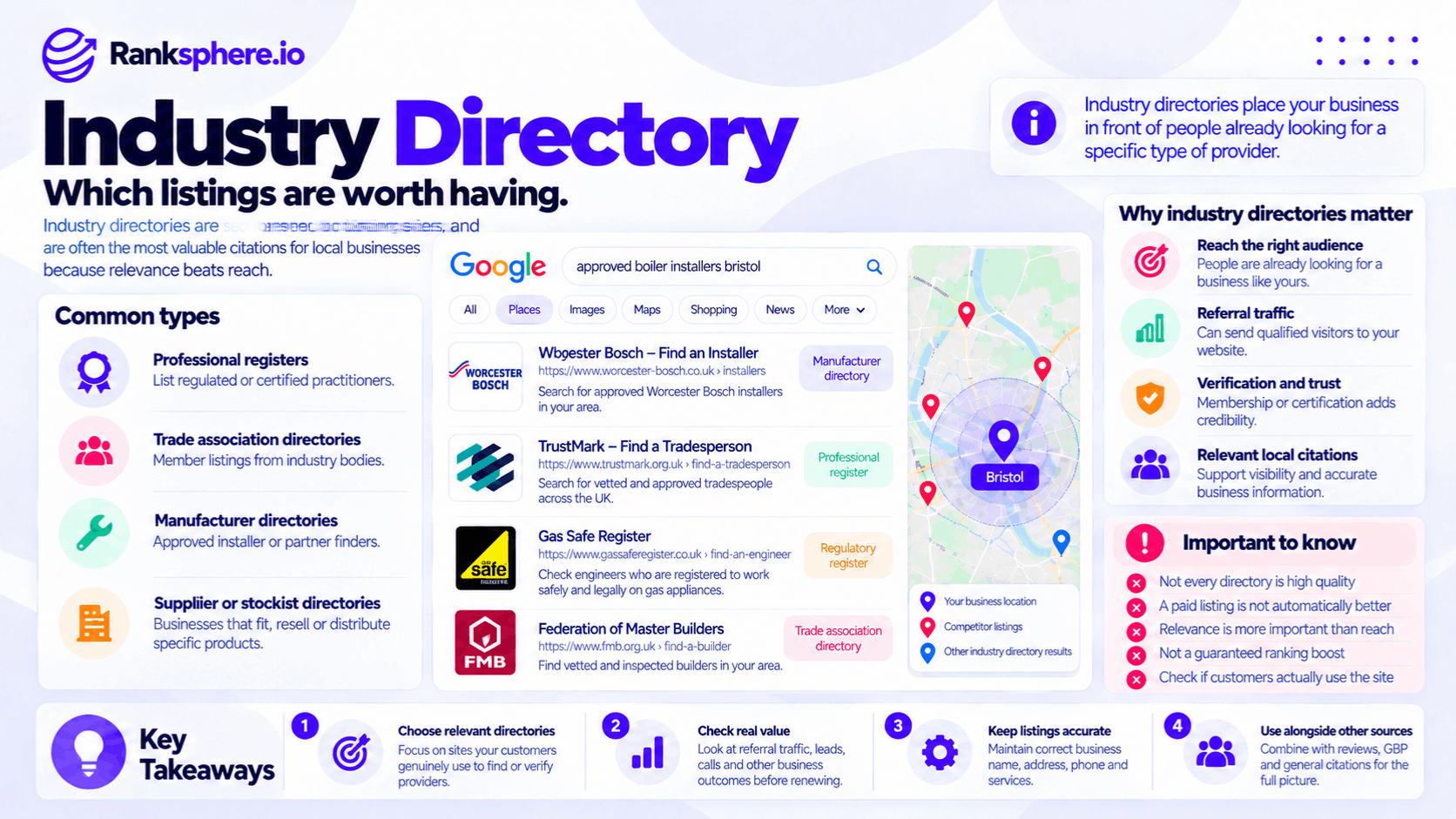
Industry directories can support local SEO in several ways.
Their main advantage is relevance. They connect a business with websites and audiences directly related to its services.
1. Industry Relevance
A listing on a website dedicated to your profession provides more specific context than a listing on a general directory.
For example, a plumbing contractor listed in a recognised heating industry directory is appearing alongside businesses offering similar services.
This can help customers understand what the company specialises in.
Relevant industry listings may also provide useful external links and business information that search engines can discover.
However, Google doesn't assign a publicly documented ranking boost simply because a citation appears on an industry-specific directory.
Relevance is an important consideration, but it shouldn't be treated as a guaranteed ranking advantage.
2. Relevant Referral Traffic
One of the most practical benefits of industry directories is their potential to generate referral traffic.
Someone browsing a professional directory may already be looking for a particular type of service.
For example, a homeowner visiting a boiler manufacturer's website to find an approved installer has a specific need.
If they click through to a local contractor's website, that visit may be more relevant than traffic from a broad directory covering unrelated businesses.
However, not every industry directory generates meaningful traffic.
Some directories receive few visitors or exist primarily to sell listings.
The best way to evaluate a listing is to look at the quality of the website, the audience it serves, and the enquiries it generates.
3. Professional Credibility
Some industry directories verify businesses before including them.
For example, professional registers may require:
- Registration with a recognised body
- Relevant qualifications
- Active membership
- Professional licences
- Insurance documentation
- Compliance with specific industry requirements
These checks can help customers evaluate whether a provider meets relevant professional standards.
However, not all directories verify their members, and a listing should never be presented as proof of qualifications it doesn't actually confirm.
4. More Qualified Visitors
A general business directory may attract visitors researching many different products and services.
A specialist directory is more likely to attract people looking within a particular industry.
For example, someone using a professional legal directory is probably more interested in legal services than a visitor browsing a general local business website.
That doesn't guarantee the visitor will become a customer.
But it can make the directory a relevant acquisition channel.
5. Listings That Competitors Cannot Easily Replicate
Some directories require verified membership, specific qualifications, or a commercial relationship.
That can make them harder to join than open-submission directories.
For example, a manufacturer may only list contractors who have completed an approved training programme.
A competitor cannot necessarily obtain the same listing simply by paying a submission fee.
These requirements can add value when they represent genuine professional standards.
Types of Industry Directories
Industry directories serve different purposes, and not every type will be relevant to every business.
The most useful starting point is to identify where customers would naturally look for qualified providers.
Professional Registers
Professional registers list individuals or businesses registered with a recognised professional or regulatory body.
Examples may include:
- Medical practitioner registers
- Legal professional registers
- Healthcare regulatory registers
- Licensed contractor registers
Some are maintained by statutory regulators, while others are operated by professional organisations.
These listings can be particularly important in industries where customers need to verify professional registration or qualifications.
However, inclusion requirements and fees vary.
A business should confirm whether registration is mandatory, voluntary, or available only to qualifying professionals.
Trade Association Directories
Trade associations represent businesses or professionals working in a particular sector.
Many maintain directories of their members.
Examples include associations for:
- Roofing contractors
- Plumbing and heating professionals
- Electricians
- Building contractors
- Healthcare providers
- Legal professionals
A trade association listing may help customers find providers who belong to a relevant organisation.
Some associations also offer networking, training, or business-development opportunities.
Before joining, check whether the association's membership benefits justify any fees.
Manufacturer and Supplier Directories
Manufacturer and supplier directories are often overlooked.
These websites may list:
- Approved installers
- Authorised dealers
- Stockists
- Service partners
- Certified technicians
For example, a roofing materials manufacturer may maintain a directory of contractors trained to install its products.
A heating equipment manufacturer may provide a search tool for customers looking for approved local installers.
These listings can attract people who already know what product or service they need.
If your business installs, supplies, or services another company's products, it's worth asking whether that company operates a directory.
Some listings are included as part of an existing partnership, while others require training, certification, or a fee.
Industry Review Platforms
Some platforms combine professional listings with customer reviews.
Examples include:
- Avvo for legal professionals
- Healthgrades for healthcare providers
- Houzz for home design and renovation professionals
These websites may allow potential customers to compare providers, review business information, and read customer feedback.
The usefulness of a platform depends on the business's market, location, and target audience.
For example, a directory popular in the United States may have limited relevance to a business operating in the United Kingdom.
Local Specialist Directories
Some industry-specific directories focus on a particular region.
Examples include:
- Regional trade associations
- Local professional networks
- Sector-specific chamber of commerce listings
- Regional business membership organisations
These may have smaller audiences than national platforms but can still be useful when they reach people in the business's service area.
For local SEO, a highly relevant regional directory may provide more practical value than a larger website with little local audience.
How to Choose the Right Industry Directories
Not every directory deserves your time or money.
Before creating a listing, evaluate whether the website is relevant, credible, and likely to provide value.
Would Potential Customers Use It?
Start with the simplest question:
Would someone looking for your services realistically use this directory?
For example, an approved-installer directory on a manufacturer's website has a clear purpose.
Customers use it to locate businesses qualified to install or service that manufacturer's products.
A directory filled with unrelated businesses and advertisements may offer much less value.
Does the Directory Verify Its Listings?
Check whether the directory has meaningful requirements.
For example:
- Does it verify professional registration?
- Does it require active membership?
- Does it check business information?
- Does it verify qualifications or certifications where relevant?
Verification can improve the directory's usefulness to customers.
However, it should be considered alongside other factors rather than treated as the only measure of quality.
Does It Appear in Relevant Search Results?
Search for the types of services your customers need.
For example, a roofing business might research queries related to approved roof installers or local roofing associations.
If a specialist directory regularly appears for relevant searches, that may indicate an opportunity to reach potential customers.
However, a directory ranking well doesn't guarantee your individual listing will receive traffic.
Is the Directory Maintained?
Look for signs that the platform is actively managed.
Check whether:
- Business information is current
- Broken listings are corrected
- Search and filtering features work
- Contact information is accurate
- The website appears useful to visitors
A neglected directory may offer limited value and create problems if outdated business information remains published.
Are Your Competitors Listed?
Review whether established competitors appear in the directory.
This can help identify directories relevant to your industry and location.
However, competitor participation isn't proof that a listing is valuable.
A business may be listed simply because it submitted its details years ago or pays for an annual membership.
Use competitor listings as a research starting point, not the final decision.
Are Paid Industry Directory Listings Worth It?
Some industry directories charge membership or listing fees.
Others offer free listings to qualifying businesses.
Paying for a listing isn't necessarily a problem, but the cost should be justified by the value provided.
Check Referral Traffic
Before renewing a paid directory listing, review whether it sends measurable website traffic.
You can use GA4 to identify referral sources and examine related engagement and conversions.
For example, if a directory sends twenty visitors over twelve months but no enquiries, you may want to investigate whether the listing is worth renewing.
However, website sessions are not the only consideration.
Some customers may contact a business directly through the directory without visiting its website.
Measure Enquiries, Not Just Visits
A directory sending five visitors who submit two enquiries may be more valuable for customer acquisition than one sending fifty visitors who don't contact the business.
Useful metrics include:
- Referral sessions
- Enquiry form submissions
- Tracked phone calls
- Appointment bookings
- Qualified leads
- Revenue, where attribution is available
If a directory provides its own lead reporting, compare those figures with your internal records.
Consider the Other Membership Benefits
Some paid professional directories are part of broader association memberships.
The fee may also provide access to:
- Professional training
- Certification programmes
- Networking
- Industry events
- Technical resources
- Member support
In these cases, the decision shouldn't be based on referral traffic alone.
Evaluate the entire membership rather than only the directory listing.
Avoid Paying for Listings Without Clear Value
Be cautious of directories whose primary business model appears to be selling listings rather than helping customers find relevant providers.
Before paying, review the website's credibility, audience, and membership requirements.
A high third-party authority score isn't enough to justify an annual fee.
How to Keep Industry Directory Listings Accurate
Creating a listing is only the beginning.
Business information can change over time, and outdated listings may confuse customers.
Maintain Consistent Business Information
Use accurate NAP information across your directory listings.
NAP stands for:
- Name
- Address
- Phone number
Your business details should be consistent and reflect the same underlying business information.
However, minor formatting differences don't automatically make a citation incorrect.
For example, common abbreviations or different phone-number formatting may still identify the same business.
Focus on factual accuracy rather than forcing every directory to use identical punctuation.
Claim and Manage Your Listings
Where the directory allows it, claim your business listing.
This may give you access to update:
- Contact information
- Website URL
- Business description
- Service categories
- Opening hours
- Business locations
Claiming a listing also makes it easier to correct errors later.
Some professional registers are managed directly by the issuing body, so updates may require contacting the organisation rather than editing a dashboard.
Keep Access Details Organised
Record which directories your business uses and who is responsible for managing them.
For each listing, keep track of:
- Directory name
- Listing URL
- Account owner
- Login or account recovery method
- Membership status
- Renewal date
- Last review date
Credentials should be stored securely rather than in an unprotected spreadsheet.
This prevents problems when employees or agencies change.
Include Industry Directories in Citation Audits
A citation audit should cover relevant industry directories alongside major business platforms and general directories.
Review listings for:
- Incorrect addresses
- Outdated phone numbers
- Missing website links
- Duplicate profiles
- Incomplete information
- Expired professional details
Ranksphere's local citation management tool helps businesses review listings across more than 500 directories and identify information that needs attention.
Update Listings When Business Details Change
When a business moves, changes phone numbers, or updates its website, review its important directory listings.
Don't assume every directory updates automatically.
Prioritise platforms customers actively use and directories that publish professional information requiring accuracy.
Reviewing important listings at least annually is a useful starting point, although changes should be updated as soon as practical.
Common Industry Directory SEO Mistakes
Several mistakes can reduce the value of directory listings or create unnecessary costs.
- Focusing only on general directories. Businesses may overlook relevant professional registers, trade associations, and supplier directories.
- Missing manufacturer listings. Approved-installer or stockist directories may offer opportunities to reach highly relevant customers.
- Paying for listings without reviewing performance. Directory subscriptions can continue for years without anyone assessing their value.
- Assuming every industry directory is trustworthy. Relevance alone doesn't guarantee quality or credibility.
- Failing to claim listings. Unmanaged profiles can become outdated and harder to correct.
- Publishing inconsistent business details. Incorrect addresses, phone numbers, or website URLs can confuse customers.
- Treating citation building as a one-time task. Business information and directory requirements change over time.
- Judging directories only by authority scores. SEO metrics don't establish whether a listing generates customers.
- Overlooking direct enquiries. Not every customer contacts a business through its website.
Industry Directory Best Practices
To get more value from industry-specific directories:
- Prioritise relevant professional registers and recognised industry organisations.
- Ask manufacturers and suppliers whether they maintain installer, dealer, or stockist directories.
- Check whether potential customers actually use the platform.
- Review eligibility and verification requirements before applying.
- Claim and manage listings wherever possible.
- Keep business names, addresses, and phone numbers accurate.
- Track referral traffic and measurable enquiries.
- Review paid listing performance before renewing.
- Store account access and renewal information securely.
- Include important directories in regular citation audits.
- Update listings whenever business information changes.
The goal isn't to appear in as many directories as possible.
It's to maintain accurate listings on platforms that help customers discover and evaluate your business.
Example of Industry Directories in Local SEO
Consider a hypothetical plumbing company called Carrick Plumbing.
The business has 22 directory listings, including three paid placements costing approximately £900 per year.
These subscriptions have been renewed automatically for several years.
During an SEO review, the agency compares the directory listings with GA4 referral traffic and the company's enquiry records.
What the Agency Finds
The paid directories have produced relatively little measurable website activity.
For illustration, assume the results are:
| Directory | Annual referral sessions | Enquiries |
| Paid directory A | 4 | 0 |
| Paid directory B | 0 | 0 |
| Paid directory C | 11 | 0 |
The agency then checks the company's other external listings.
Two unpaid industry-specific sources stand out.
| Industry listing | Annual referral sessions | Enquiries |
| Boiler manufacturer's approved-installer directory | 61 | 9 |
| Regional trade association directory | 23 | 4 |
These hypothetical figures illustrate how a relevant industry listing can generate useful enquiries even when it doesn't attract large amounts of traffic.
How the Business Responds
Before cancelling the paid directories, the agency checks whether they generate phone calls or other enquiries that aren't visible in GA4.
It also reviews their relevance and any additional membership benefits.
If the listings provide little value, the company may decide not to renew them.
The agency then contacts two other equipment suppliers to ask whether they maintain approved-installer directories.
Both suppliers operate directories, although each has its own eligibility requirements.
The company reviews whether it qualifies and whether those listings are worth pursuing.
Example Shows
“The value of an industry directory isn't determined solely by its authority score, size, or listing fee.
A relevant supplier directory may connect a business with customers who already need a specific service.
A paid general directory may provide little measurable value if customers rarely use it.
By comparing referral traffic, enquiries, listing quality, and membership benefits, businesses can decide which directories deserve ongoing attention.
For local SEO, industry directories are most valuable when they combine professional relevance, accurate business information, credibility, and opportunities for genuine customer enquiries.
A few carefully chosen listings may provide more practical value than dozens of unrelated directories.”
See Also
- Citation — Business listings and mentions across external websites.
- Citation Building — Creating and maintaining accurate business listings.
- Referral Traffic — Website visits originating from external links.
- NAP — Keeping business names, addresses, and phone numbers accurate.
- Local Link Building — Earning relevant links from businesses and organisations.
- Citation Audit — Reviewing listings for accuracy, completeness, and duplication.