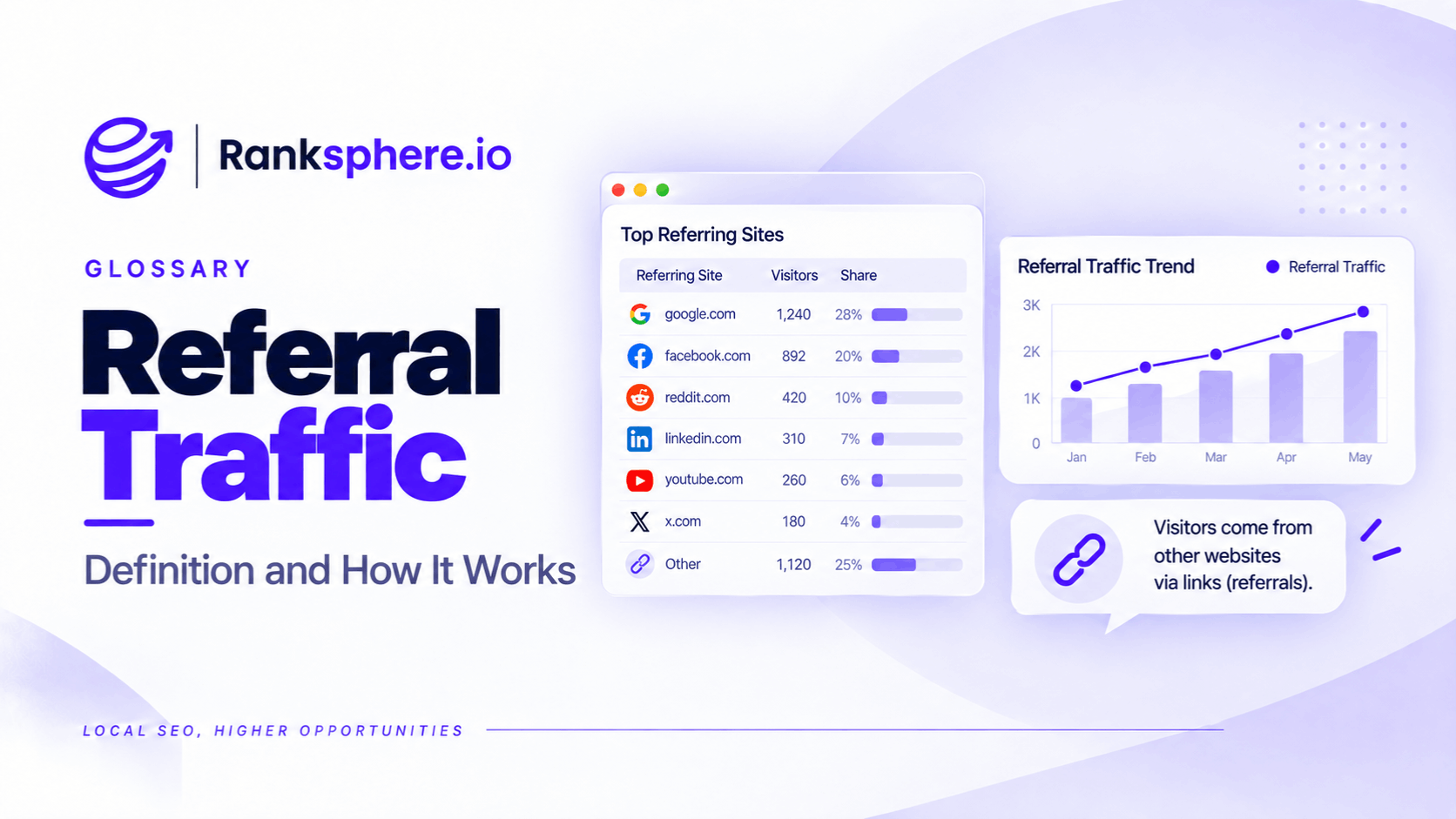
Referral traffic is website traffic that comes from visitors clicking links on other websites. In Google Analytics 4 (GA4), these visits are generally reported under the Referral channel when they don't qualify for another channel, such as organic search or social.
For example, someone might find a roofing contractor through a local trade association's website, click through to the contractor's website, and request a quote.
If GA4 records the visit and identifies the referring website, that session may appear as referral traffic.
This makes referral traffic particularly useful for understanding which external websites actually send visitors to your business.
Backlink analysis tools can estimate the potential SEO value of a link, but referral traffic provides evidence of visitors arriving through it.
For local businesses, those visits can be valuable because they may come from directories, suppliers, local organisations, and community websites whose audiences are already interested in the services being offered.
What Does Referral Traffic Tell You?
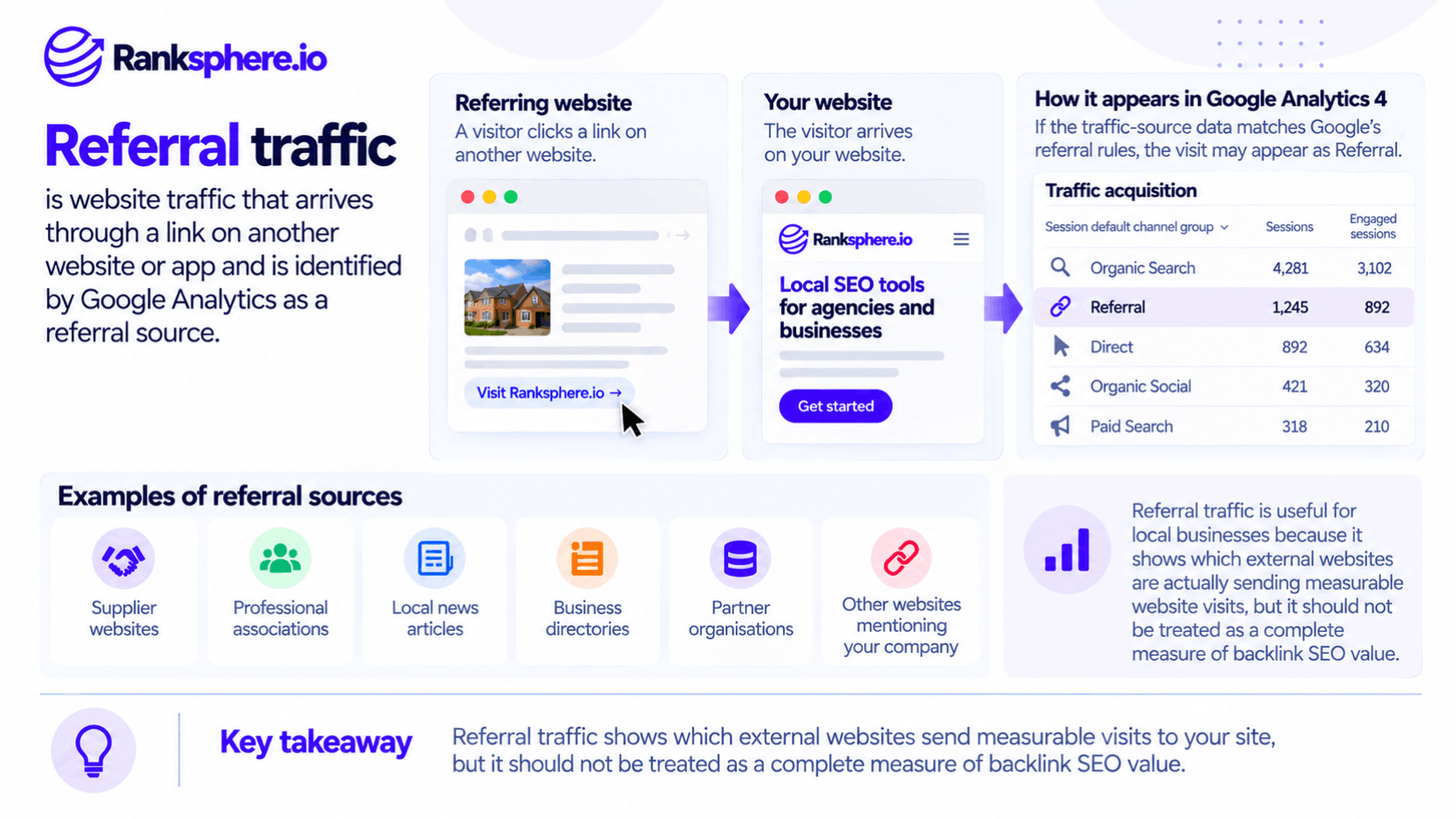
Referral traffic helps you understand which external websites contribute to website visits and, where conversion tracking is configured, meaningful customer actions.
It can answer several useful questions.
Which Backlinks Send Visitors?
A backlink is a link from another website to yours.
SEO tools often evaluate backlinks using metrics such as domain authority, estimated traffic, or referring domain strength.
These metrics can provide context, but they don't tell you how many people actually clicked a particular link.
Referral traffic can show whether a referring website sends measurable visits.
For example, a business directory with a high third-party authority score might send only two visitors a month.
Meanwhile, a smaller local website could send twenty visitors who are actively looking for the service.
The second source may be more valuable for customer acquisition, even if its estimated SEO authority is lower.
However, this doesn't mean referral sessions measure the entire SEO value of a backlink. Links may still support discovery and other search-related signals without generating noticeable referral traffic.
Which Directory Listings Attract Visitors?
Local businesses often appear in directories, professional associations, and industry listings.
These listings are commonly called citations when they mention a business's identifying information.
Some listings may send visitors directly to the business website.
Others may receive little traffic or provide information without generating a website click.
Reviewing referral traffic can help identify which directories produce measurable visits and enquiries.
That's particularly useful when deciding whether to renew a paid listing.
However, referral traffic should be considered alongside other benefits, such as enquiries made directly through the directory and the listing's relevance to the business.
Which Partnerships Generate Enquiries?
Local businesses often receive website visitors through relationships with other organisations.
Examples include:
- Manufacturers listing approved installers
- Trade associations linking to members
- Chambers of commerce
- Local suppliers
- Community organisations
- Business partners
These sources can attract relevant visitors because the referring website often serves an audience already interested in the business's products or services.
For example, someone looking for an approved boiler installer may visit the manufacturer's website before choosing a local contractor.
Referral traffic helps identify whether those partnerships are generating website visits.
Which Press Mentions Generate Traffic?
Local news coverage can also generate referral traffic.
A newspaper article mentioning a business and linking to its website may create a temporary increase in sessions.
This can help businesses evaluate the immediate traffic generated by digital PR.
However, not every press mention includes a link, and not every reader clicks through.
Referral traffic measures the identifiable website visits, not the full brand awareness generated by the coverage.
Which Referral Sources Lead to Conversions?
Traffic volume is only part of the picture.
Consider two referring websites:
- Website A sends 40 visitors who don't submit any enquiries.
- Website B sends six visitors, two of whom request quotes.
Website A generated more traffic, but Website B produced more measurable enquiries.
That's why referral traffic should be evaluated alongside conversions.
For a local business, the most useful sources aren't necessarily those sending the most visitors. They're the ones contributing to meaningful customer actions.
Why Referral Traffic Matters for Local SEO
Local link building often focuses on earning links from relevant businesses, organisations, and websites within a particular area.
These links can help potential customers discover a business outside Google Search.
Examples include:
- Approved-installer directories
- Local trade associations
- Business networking organisations
- Community sponsorship pages
- Regional news websites
- Local business directories
A small number of relevant sources may contribute a meaningful share of referral visits.
This can make referral traffic useful when evaluating whether local partnerships are worth maintaining or expanding.
Referral Traffic vs Backlink Authority
Backlink analysis tools use proprietary scores to estimate aspects of a website's link strength.
These scores aren't Google's own ranking metrics, and a higher score doesn't automatically mean a link will send more customers.
Referral traffic measures something different: identifiable visitors arriving through external links.
Neither metric tells the complete story.
A high-authority link may send little traffic but still have SEO value.
A small local website may send highly relevant visitors even if its authority score is relatively low.
For local businesses, the most useful evaluation combines:
- The relevance of the referring website
- The quality and context of the link
- Referral visits
- Enquiries or conversions
- Other benefits of the relationship
This provides a more practical picture than relying on authority scores alone.
Evaluating Paid Directory Listings
Some local businesses pay annual fees to appear in directories.
Before renewing, review whether those listings are producing useful results.
Check:
- Referral sessions from the directory
- Website enquiries attributed to that source
- Leads received directly through the directory
- The cost of maintaining the listing
- Whether the directory is relevant to your industry or location
A listing sending no measurable website traffic may still generate calls or other direct enquiries.
However, if it produces little evidence of value and carries a recurring fee, it may deserve reconsideration.
Ranksphere's local citation management tool helps businesses review their listings across more than 500 directories.
That information can be considered alongside GA4 referral traffic to understand where a business is listed and which referring websites generate measurable visits.
Why Some Referrals Don't Appear as Referral Traffic
Google Analytics doesn't classify every visit from an external link under the Referral channel.
How a session is attributed depends on the available traffic-source information, campaign parameters, and GA4's channel rules.
Several situations can affect reporting.
Social Media Traffic
Links from social platforms are generally classified into social channels when GA4 recognises the source.
For example, visits from Facebook, Instagram, or other recognised social platforms may appear under Organic Social rather than Referral.
This means the Referral channel won't necessarily include all visitors arriving through external websites.
Email and Messaging Apps
Links shared through email clients and private messaging applications don't always pass identifiable referral information.
Depending on the application, tracking setup, and URL parameters, those visits may appear as:
- Referral
- Organic Social
- Direct
- Another configured channel
Some visits may be classified as direct traffic because GA4 cannot identify their original source.
This is one reason referral reports don't capture every visitor who arrived through a shared link.
Self-Referrals
A self-referral occurs when your own website appears as a referral source.
For example, a business's domain may show up in its own traffic acquisition reports.
This can indicate a tracking or attribution configuration issue.
Possible causes include:
- Incorrect cross-domain measurement
- Misconfigured analytics tags
- Session interruptions
- Redirect or domain changes
Self-referrals deserve investigation because they can make acquisition reports harder to interpret.
However, the right solution is to identify the underlying cause rather than simply hide the referring domain from reports.
Payment Gateway Referrals
Payment providers may appear as referral sources when visitors leave a website to complete a payment and then return.
For example, a customer might begin checkout on a business website, complete a payment through an external provider, and return to a confirmation page.
If the payment provider is treated as a new referral source, it may interfere with attribution.
GA4 provides an unwanted referrals feature that can help prevent specified domains from being treated as new referral sources.
This is useful for recognised payment processors and other legitimate cross-site steps that shouldn't overwrite the original acquisition source.
Referral Spam
Some analytics reports may contain suspicious referral sources.
These can originate from automated traffic, bot activity, or attempts to introduce misleading referral information.
Although GA4 has protections against known bot traffic, unusual referral data can still require investigation.
Look for sources with unexpected patterns, irrelevant domains, or traffic that doesn't behave like genuine visitors.
Avoid making decisions based on suspicious traffic without reviewing the data.
How to Analyse Referral Traffic in GA4
Google Analytics 4 provides several ways to review website acquisition.
For referral traffic, the Traffic acquisition report is a useful starting point.
You can examine Referral as a session channel and review the sources associated with those visits.
1. Identify Your Top Referral Sources
Start by reviewing which referring websites generate the most sessions.
This can reveal:
- Directories that people actually use
- Local organisations sending visitors
- Supplier partnerships
- Media coverage
- Community websites
Look beyond the total traffic figure.
A source generating many visits isn't automatically valuable if those visits don't result in useful engagement or customer actions.
2. Compare Conversions by Source
Review key events or conversions associated with referral sessions.
Depending on the business, these may include:
- Contact form submissions
- Quote requests
- Appointment bookings
- Purchases
- Tracked phone interactions
This helps identify which sources contribute to business outcomes.
For example, an association directory sending ten relevant visitors may generate more enquiries than a general directory sending fifty.
The useful question isn't simply which website sends the most traffic.
It's which sources send visitors who take meaningful action.
3. Track Links You Control with UTM Parameters
UTM parameters allow you to identify specific campaigns and placements.
For example, if your business has links on several pages of a partner's website, UTM parameters can help distinguish the placements.
They can also help track links used in:
- Sponsorship campaigns
- Email newsletters
- Local partnerships
- Digital PR campaigns
- Promotional materials
However, tagging a link can change how GA4 classifies its traffic.
For example, a link tagged with campaign information indicating email traffic may appear under Email rather than Referral.
Use consistent naming conventions and remember to review the relevant source and campaign dimensions, not just the Referral channel.
4. Review Referral Traffic Before Renewing Paid Listings
If a directory charges an annual listing fee, review its performance before renewing.
Consider measurable sessions, enquiries, and other benefits received during the period.
Some listings may send very little website traffic but still provide visibility or direct contact opportunities.
Others may have no clear business value.
Referral reporting can help make the renewal decision more informed.
5. Investigate Unusual Traffic Spikes
A sudden increase in referral traffic may come from a new article, community mention, or partnership.
For example, a local newspaper might publish an article featuring a plumbing company and link to its website.
The resulting traffic spike can help the business understand the immediate impact of that coverage.
However, unexplained increases should also be checked for referral spam, tracking changes, or unusual automated activity.
Common Referral Traffic Reporting Mistakes
Several mistakes can lead businesses to misunderstand the value of their external links.
- Judging backlinks only by authority scores. Third-party metrics don't tell you whether people visit your website through a link.
- Assuming traffic is the only measure of backlink value. A relevant link may have SEO or brand benefits even when it sends few visitors.
- Renewing paid directories without reviewing performance. Listings should be assessed against their cost and the value they provide.
- Ignoring self-referrals. Your own domain appearing as a referral source may indicate an attribution problem.
- Judging sources only by session volume. A small number of highly relevant visitors may produce more enquiries than a large volume of unrelated traffic.
- Expecting every backlink to send visitors. Some links provide value without generating measurable clicks.
- Missing referral spikes. New press coverage or community mentions can generate valuable traffic that goes unnoticed.
- Assuming all external link clicks appear under Referral. Social platforms, email links, and tagged campaigns may be classified differently.
Referral Traffic Best Practices
To make referral traffic reporting more useful:
- Review referral sources regularly, such as quarterly.
- Compare sessions with conversions and meaningful customer actions.
- Evaluate paid directory listings before renewal.
- Use UTM parameters consistently on campaign links you control.
- Investigate self-referrals and correct tracking issues.
- Configure unwanted referrals appropriately for payment providers.
- Review sudden traffic spikes for genuine coverage or suspicious activity.
- Consider backlink relevance alongside referral traffic and authority estimates.
- Invest in partnerships that produce measurable value for the business.
Referral traffic works best when it is treated as part of a broader evaluation of external links and partnerships.
The goal isn't to collect links from as many websites as possible.
It's to build relationships and earn placements that help people discover your business.
Example of Referral Traffic in Local SEO
Consider a hypothetical plumbing company called Carrick Plumbing.
The company pays for three directory listings, costing approximately £900 per year.
These listings have been renewed automatically for several years.
During an SEO review, the agency examines referral traffic over the previous twelve months.
What the Agency Finds
The three paid directories have generated relatively few website visits.
For illustration, assume they produced:
| Source | Referral sessions | Website enquiries |
|---|---|---|
| Paid directory A | 4 | 0 |
| Paid directory B | 0 | 0 |
| Paid directory C | 11 | 0 |
The agency also identifies several unpaid sources sending visitors.
| Source | Referral sessions | Website enquiries |
|---|---|---|
| Manufacturer's approved-installer listing | 61 | 9 |
| Regional trade association | 23 | 4 |
| Local cricket club sponsorship page | 7 | 1 |
| Local newspaper article | 140 | 6 |
These figures are hypothetical, but they illustrate why looking beyond backlink counts and authority scores matters.
The manufacturer's approved-installer listing sends fewer visitors than the newspaper article but generates more enquiries.
The paid directories, meanwhile, show little measurable website activity.
How the Business Uses the Findings
Before cancelling anything, the agency checks whether the paid directories generate enquiries outside the website, such as direct calls or messages.
It also considers their relevance and any other benefits.
If the listings offer little measurable value, the business may decide not to renew them.
At the same time, the company can invest more effort into relationships that have demonstrated value, such as:
- Maintaining its approved-installer listing
- Participating in relevant trade associations
- Building relationships with local journalists
- Supporting community organisations
The agency continues to monitor referral sessions and conversions rather than relying only on the number of backlinks acquired.
Example
“A backlink from a smaller, relevant website can generate valuable customer enquiries even if its third-party authority score isn't particularly high.
Likewise, a directory with an impressive SEO score may provide little measurable referral traffic.
Neither observation proves the link's full SEO value.
But referral traffic gives businesses something practical to measure: identifiable visits and customer actions originating from external websites.
For local SEO, the best links aren't always the ones with the highest authority scores. They're often the ones that are relevant to your business, useful to customers, and capable of generating meaningful results.”
See Also
- Backlink — Links from other websites to your own.
- Local Link Building — Earning relevant links from local businesses and organisations.
- Citation — Business listings and mentions across external websites.
- Direct Traffic — Visits without an identifiable referral or campaign source.
- UTM Parameters — Tracking specific marketing campaigns and links.
- Domain Authority — A third-party estimate of a website's link strength.