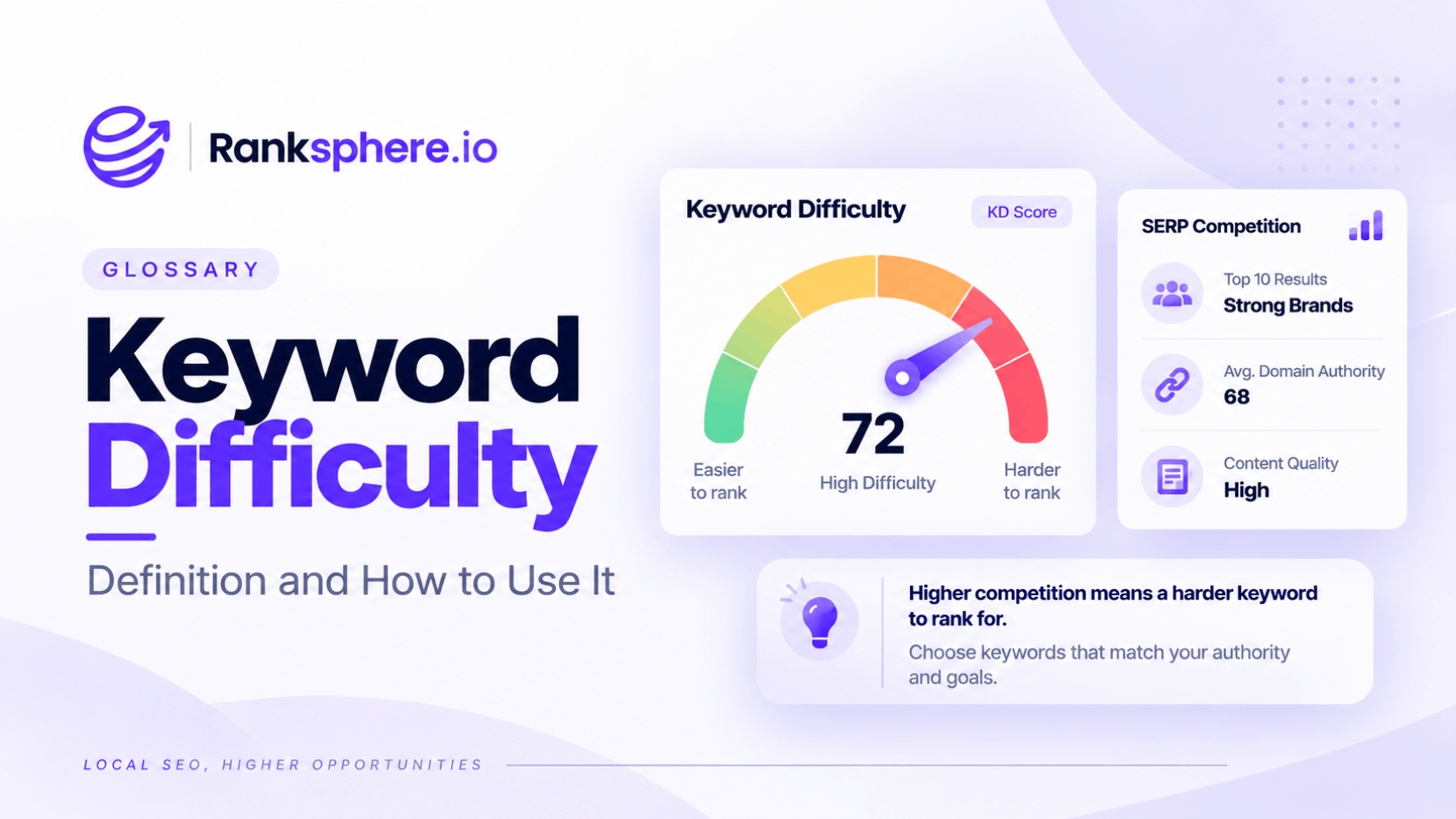
Keyword difficulty is an SEO metric used to estimate how competitive it may be to rank organically for a particular search term. Most SEO tools express it as a score, often from 0 to 100, with higher numbers indicating stronger competition.
The important word is estimate.
There is no universal keyword difficulty score used by Google. Each SEO platform has its own formula, and those formulas often rely heavily on the authority and backlink profiles of the pages already ranking.
That makes keyword difficulty useful for comparing opportunities, but it should never be treated as a simple “easy” or “impossible” label.
For local businesses in particular, the score may tell only part of the story because national organic competition can look very different from the businesses competing in one town or city.
How keyword difficulty is calculated
SEO tools do not all calculate keyword difficulty in the same way.
Most look at the strength of the pages already ranking on the first page of Google. Backlinks and referring domains are often important parts of the calculation, while some tools also include other signals.
Depending on the platform, the score may consider:
- The number of websites linking to the ranking pages
- The perceived authority of those websites
- The strength of the domains already appearing in the results
- Search volume
- SERP features
- The competitiveness of the current results
Because each provider uses its own model, the same keyword can receive very different scores across different tools.
A difficulty score of 35 in one platform does not necessarily mean the same thing as 35 in another.
For that reason, keyword difficulty works best when you use one tool consistently and compare keywords within the same system.
Why keyword difficulty can be misleading for local SEO
Keyword difficulty is usually based on the organic search results available to the tool.
That becomes important when the keyword has strong local intent.
Someone searching for “boiler repair” may see a local pack, local service businesses and organic results influenced by their location. A national SEO difficulty score cannot fully describe that local competition.
Local visibility also depends on local ranking factors, including relevance, distance and prominence.
This means a keyword that looks highly competitive nationally may still represent a realistic opportunity in a particular town.
The reverse can also happen.
A keyword with a relatively low difficulty score may be difficult in your area because several strong local competitors already dominate the results.
For local SEO, ask:
- Which businesses appear from the location you are targeting?
- Does Google show a local pack?
- How established are the competing Google Business Profiles?
- How many recent reviews do those businesses have?
- How useful are their service and location pages?
- Does your business genuinely match the search intent?
The keyword difficulty score provides context. The actual local SERP shows you the competition you will need to deal with.
Keyword difficulty and the local pack
Traditional keyword difficulty scores are usually designed around organic rankings rather than your chances of appearing in the local pack.
That distinction matters.
For many local service searches, potential customers will see map results before they reach the standard organic listings.
In those cases, your competition is not determined solely by backlinks to a service page.
Your Google Business Profile, business category, reviews, location, relevance and wider local presence can all matter.
That does not make organic SEO irrelevant. A strong website still supports local visibility and gives customers somewhere useful to go after discovering the business.
It simply means you should not use an organic keyword difficulty score as the only measure of whether a local search term is worth pursuing.
What to check alongside keyword difficulty
Before deciding whether to target a keyword, open the search results and look at the competition yourself.
Search intent
Start with search intent.
A keyword may have an attractive difficulty score, but it is not useful if the searcher wants something your page cannot provide.
Check whether Google is showing:
- Guides
- Service pages
- Product pages
- Local businesses
- Comparison websites
- Directories
- Videos
- Maps
This tells you what type of content or result Google currently sees as useful for the query.
The businesses already ranking
For local terms, look specifically at the businesses appearing in your target area.
Check:
- Their reviews
- Business categories
- Website quality
- Location pages
- Service coverage
- Content quality
- Local visibility across different search points
This is much closer to the competition your business actually faces.
The quality of the ranking pages
Do not assume every first-page result is strong simply because it ranks.
Sometimes the current pages are thin, outdated or poorly matched to the query.
A high difficulty score may look intimidating, but weak results can still indicate an opportunity if you can provide something more useful and relevant.
Ranksphere's rank tracker shows competitor movement across your service area, giving you a clearer view of how local competitors perform in the places your customers actually search from.
Keyword difficulty vs search volume
Keyword difficulty is often reviewed alongside search volume, but neither metric should make the decision on its own.
A keyword might have:
- High search volume and high competition
- High volume but weak commercial intent
- Low volume and strong buying intent
- Low difficulty but little relevance to the business
- High difficulty nationally but relatively weak local competition
The best opportunities usually make sense across several factors.
Consider:
- Relevance to the business
- Search intent
- Commercial value
- Local competition
- Search volume
- Existing website authority
- The strength of the current SERP
Keyword difficulty is simply one piece of that picture.
Common keyword difficulty mistakes
- Treating the score as a Google metric. Keyword difficulty is created by SEO tools, not Google.
- Comparing scores from different platforms directly. Each tool uses its own methodology.
- Rejecting a keyword because the score looks high. The actual competition may be weaker in your local market.
- Assuming a low score means an easy ranking. Search intent and local competitors can still make the query difficult.
- Ignoring the search results. A score cannot replace looking at the pages and businesses currently ranking.
- Using difficulty without considering intent. An easy keyword is still a poor target if it does not match the customer journey.
- Reporting the number as a fact. It should be presented as an estimate rather than a definitive measure of ranking difficulty.
Keyword difficulty best practices
- Use one tool consistently. This makes comparisons more meaningful.
- Treat difficulty as a guide rather than a pass-or-fail score.
- Check the live SERP before prioritising an important keyword.
- Analyse the competition in your actual market. National averages may not represent local reality.
- Look at the local pack as well as organic results.
- Consider search intent before competition. There is little value in ranking for a query that does not fit your business.
- Balance difficulty with commercial value. A competitive keyword may still be worth pursuing if the potential business value is high.
- Review competition over time. Rankings and competitors change, so keyword difficulty should not be treated as permanent.
Example
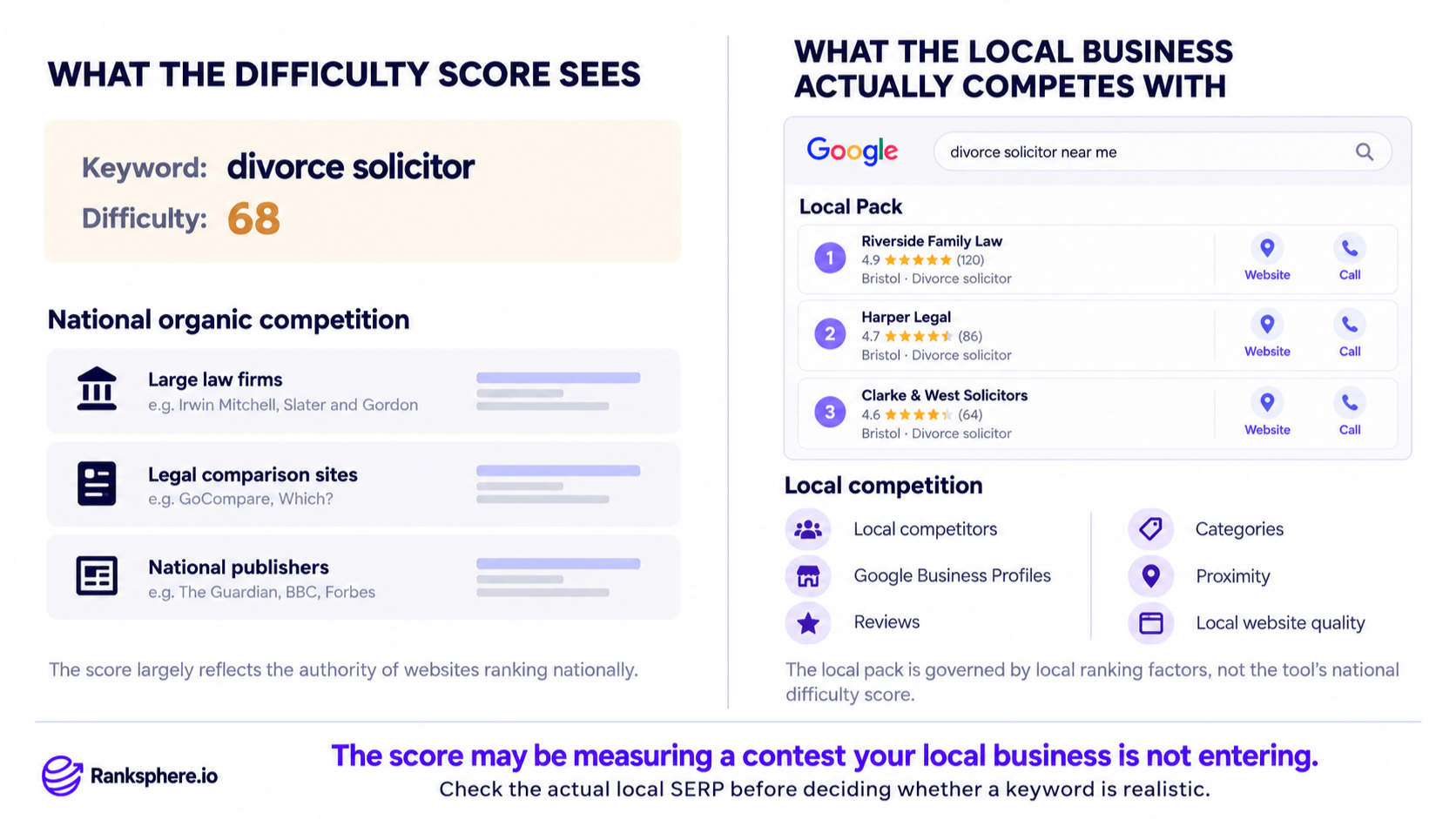
“Marlowe Family Law is researching the keyword “divorce solicitor.”
An SEO tool gives the term a relatively high keyword difficulty score because the national organic results include established legal websites, directories and large firms.
At first, that makes the keyword look unrealistic.
But when the search is checked from Marlowe's actual service area, the results tell a more useful story.
Google shows a local pack containing nearby solicitors, followed by a mixture of local firms and national legal websites.
Instead of abandoning the keyword because of the national difficulty score, Marlowe reviews the businesses it is actually competing against.
The team looks at their Google Business Profile categories, reviews, service pages and local visibility. That gives them a far clearer idea of what needs improving than the difficulty score alone.
The lesson is not to ignore keyword difficulty.
It is to use it for what it is: an estimate of competition that needs to be checked against the real search results, especially when local intent is involved.”
See also
- Keyword research, where keyword difficulty is used alongside other metrics
- Search volume, estimating how often a keyword is searched
- Local ranking factors, the signals that influence local search visibility
- Local pack, the map-based results that appear for many local searches
- Domain authority, another third-party SEO metric used to estimate website strength
- Search intent, understanding what the person behind the search actually wants