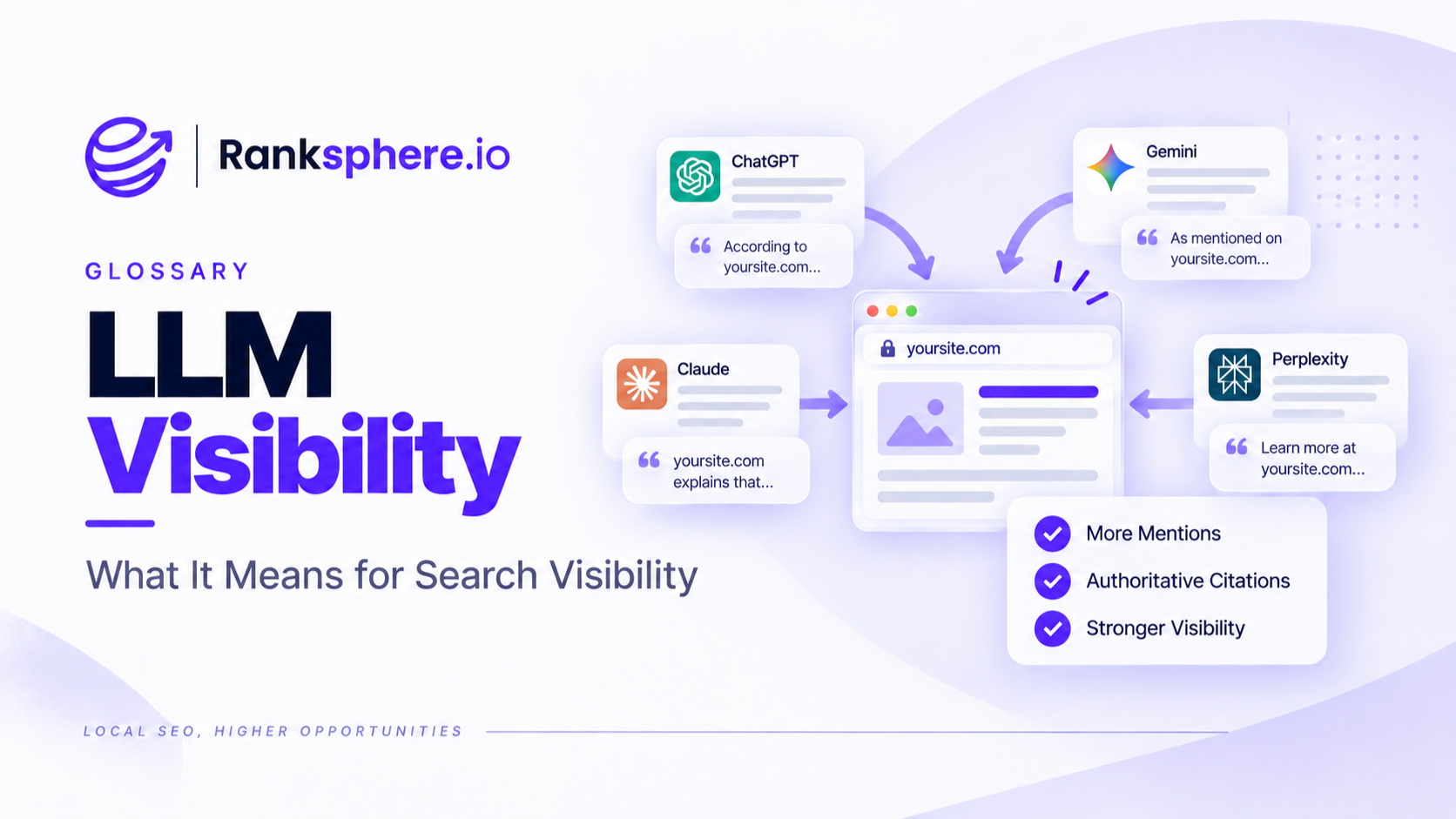
LLM visibility describes how often a brand, business, product or website appears in answers generated by large language model assistants and AI-powered search tools.
That can include platforms such as:
- ChatGPT
- Claude
- Gemini
- Perplexity
- Google AI Overviews
- Google AI Mode
Visibility can take several forms.
A brand might be:
- Mentioned by name
- Recommended
- Described in an answer
- Linked as a source
- Cited for a specific fact
- Included alongside competitors
Unlike traditional SEO, there is usually no universal ranking position to track.
A company might appear in one generated answer, disappear from the next and return when the same question is asked again.
That makes LLM visibility a genuine measurement problem.
It is measurable, but not with the same precision as conventional search rankings.
What does LLM visibility measure?
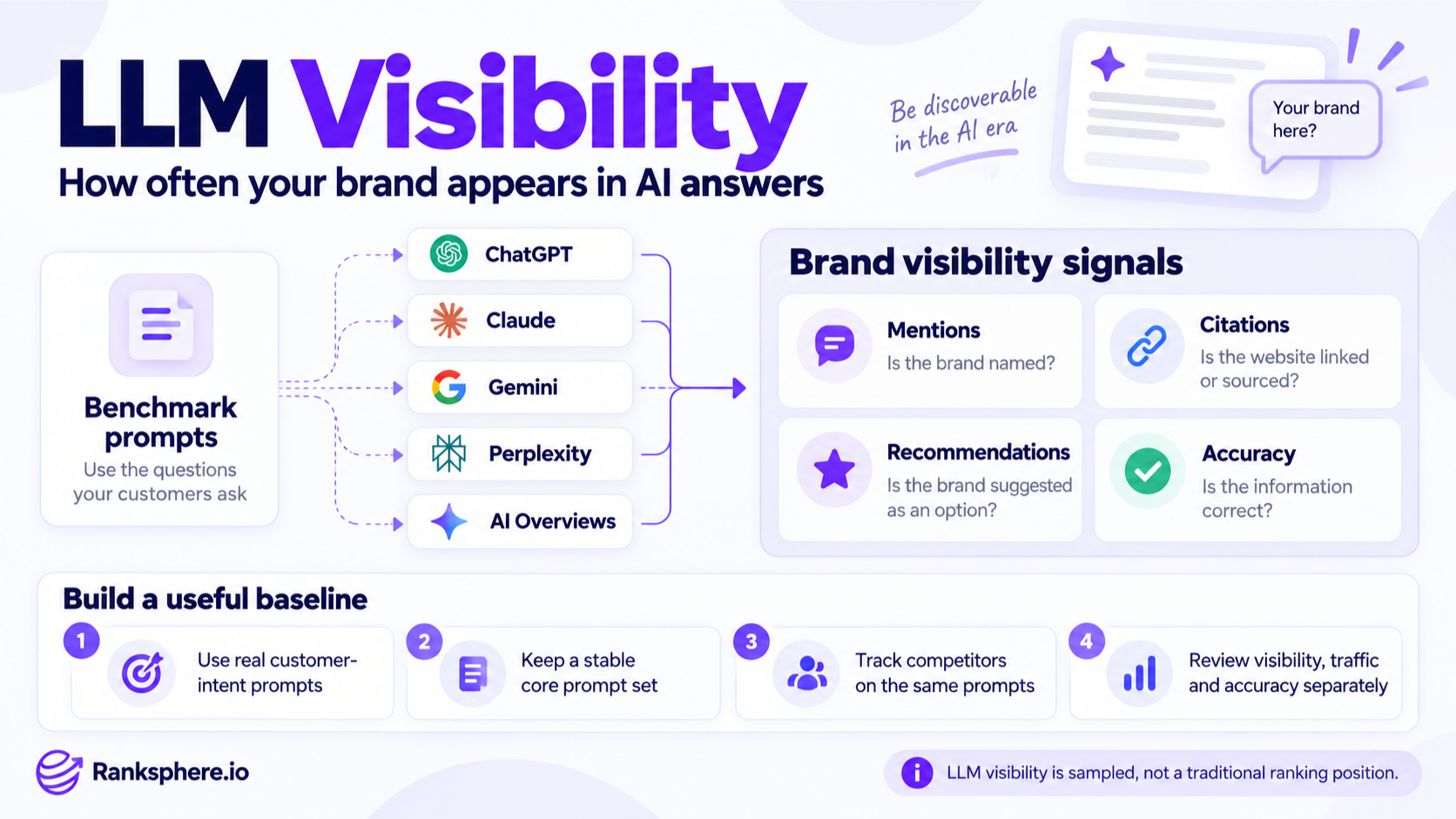
At its simplest, LLM visibility asks:
When people ask AI systems questions relevant to our business, how often do we appear?
But presence alone is not enough.
A useful measurement programme should also look at:
- Whether the brand is mentioned
- Whether its website is cited
- How the brand is described
- Which competitors appear
- Whether the information is accurate
- Whether the answer leads to referral traffic
For example, appearing in an answer that says:
“Wilbury Veterinary does not provide emergency care”
is technically visibility.
But if the practice actually does provide emergency care, that visibility is harmful.
This is why accuracy and context matter just as much as mention rate.
Why LLM visibility is difficult to measure
Traditional search gives marketers relatively structured data.
Google Search Console can report:
- Queries
- Clicks
- Impressions
- CTR
- Average position
AI assistants are different.
Their answers can vary between requests, platforms, models and users.
That makes measurement less exact.
Answers can vary between runs
Ask the same assistant the same question several times and the answer may not be identical.
The system may:
- Use different sources
- Mention different businesses
- Phrase recommendations differently
- Omit a brand it previously included
That means one prompt run should not be treated as a stable measurement.
If the result matters, sample it more than once.
Different users can receive different answers
AI responses may vary according to factors such as:
- Location
- Account settings
- Conversation context
- Personalisation
- Language
- Device
- Current web results
This is particularly important for local businesses.
A response to:
best dentist near me
cannot be meaningfully benchmarked unless you also understand what location context the system is using.
Models change
AI platforms update models frequently.
A visibility change may occur because:
- A model changed
- Retrieval systems changed
- Search providers changed
- Ranking or citation logic changed
even if nothing changed on your website.
This makes short-term fluctuations difficult to attribute.
Prompt volume is largely unknown
Traditional SEO tools estimate how often people search for keywords.
There is currently no equivalent universally reliable dataset showing how many people ask:
Which accountant should I use for a small ecommerce business in Manchester?
across ChatGPT, Claude, Gemini and Perplexity.
That means a prompt can be commercially sensible without you knowing how often real people use that exact wording.
Prompt sets should therefore be based on customer intent, not imaginary AI search-volume figures.
Mentions do not always include links
A brand can appear in an AI answer without its website being cited.
For example:
Three established firms in the area include Carrick Plumbing, Smith & Sons and Oakfield Heating.
Carrick Plumbing has gained visibility.
But there may be no clickable link.
A citation tracker looking only for URLs could miss the mention entirely.
This is why LLM visibility monitoring should distinguish between:
Mention
and:
Citation
They are not the same thing.
Citation does not necessarily mean endorsement
Being cited also does not automatically mean the system recommends the business.
A website might be cited because it supplied:
- A definition
- A statistic
- Product information
- A quotation
while another business is actually recommended.
So a good report should record why the brand appeared, not simply whether a URL was present.
LLM visibility vs traditional rank tracking
Traditional rank tracking asks:
Where does this page rank for this keyword?
LLM visibility asks something closer to:
How often does this brand appear when relevant questions are asked, and in what context?
Those are different measurements.
A traditional result might be:
Position 4
An LLM result might be:
Mentioned in 11 of 30 benchmark prompts
Cited in 6
Recommended in 4
Incorrectly described in 2
Neither replaces the other.
They answer different questions.
Google is easier to measure than most AI platforms
Google has moved further towards first-party measurement.
Search Console now includes a dedicated Generative AI performance report covering AI Overviews and AI Mode.
Google says the report rolled out worldwide by 31 August 2026.
It shows generative AI impressions and allows them to be analysed by dimensions including:
- Page
- Country
- Device
- Date
That gives website owners first-party visibility data rather than relying entirely on manual prompt sampling.
What Google Search Console can and cannot show
There is an important distinction between Google's standard Search performance reporting and the dedicated Generative AI report.
The dedicated report focuses on generative AI impressions.
It does not currently provide the same dedicated breakdown of:
- Queries
- Clicks
- CTR
- Average position
within that AI-specific report.
However, Google also records clicks, impressions and position from AI Mode and AI Overviews within its broader Search performance measurement.
So the practical situation is:
Google can measure AI visibility directly, but isolating every traditional performance metric specifically to generative results remains limited.
Measuring ChatGPT visibility
ChatGPT does not provide publishers with an equivalent impression dashboard showing every prompt in which their brand appeared.
That means brand-level visibility usually still requires sampling.
Referral traffic is easier to measure.
OpenAI says ChatGPT Search links automatically include:
utm_source=chatgpt.com
which allows publishers to identify visits from ChatGPT in analytics platforms.
This lets you measure:
- Referral sessions
- Landing pages
- Conversions
- Engagement
It does not tell you how many users saw your brand in ChatGPT and did not click.
That remains the visibility gap.
Measuring Claude, Perplexity and other assistants
Measurement varies by platform.
Referral traffic may appear in analytics when someone clicks through to the website.
But publishers generally do not have the equivalent of traditional Search Console data showing:
- Total brand impressions
- Prompt volume
- Every citation
- Average AI position
That leaves prompt monitoring as one of the main practical methods for comparing AI visibility over time.
What can actually be measured?
A useful LLM visibility programme can track several different metrics.
Mention rate
How often is the brand named?
For example:
12 mentions across 30 benchmark prompts
This is straightforward, but it says nothing about whether those mentions were positive, relevant or accurate.
Citation rate
How often is the website linked or cited?
For example:
7 citations across 30 benchmark prompts
Keep citations separate from mentions.
A business may receive one without the other.
Recommendation rate
How often is the brand presented as an option when the prompt requests recommendations?
This should only be calculated across prompts where a recommendation would actually make sense.
Do not include informational prompts in the denominator.
Share of voice
You can compare your brand with competitors across the same benchmark set.
For example:
| Brand | Prompts Mentioned |
| Your business | 14 |
| Competitor A | 18 |
| Competitor B | 9 |
This gives useful competitive context.
But call it sampled AI share of voice, not total market share.
You are measuring your prompt set, not every conversation happening on the platform.
Sentiment or description
Track how the assistant describes the brand.
Possible categories might include:
- Positive
- Neutral
- Negative
- Mixed
More useful still is recording the actual themes.
For example:
Known for emergency care
Described as expensive
Praised for specialist expertise
This tells you more than a single sentiment score.
Accuracy
Accuracy is one of the most valuable measurements.
Check:
- Business name
- Address
- Opening hours
- Services
- Pricing where public
- Service area
- Contact details
- Professional credentials
Incorrect AI answers can reveal a problem even when overall visibility looks strong.
Referral traffic
Where platforms send measurable visits, track:
- Sessions
- Landing pages
- Conversions
- Revenue or leads
- Engagement
This helps connect AI visibility with business outcomes.
How to build an LLM visibility baseline
Start with a fixed benchmark set.
The prompts should reflect questions real customers could reasonably ask.
For a veterinary practice, that might include:
- emergency vet in [town]
- which vets near [town] offer weekend appointments?
- where can I take my dog for emergency care near [town]?
- vets in [town] that treat rabbits
- what should I look for when choosing a local vet?
Include a mix of:
- Informational questions
- Service searches
- Recommendation queries
- Comparison queries
- Local questions
Do not build the entire set around prompts designed to force your brand to appear.
That would make the benchmark meaningless.
How many prompts should you track?
There is no magic number.
A smaller business may start with a manageable set of perhaps 20–50 high-value prompts.
A larger company may need hundreds across:
- Product categories
- Markets
- Locations
- Customer types
Quality matters more than quantity.
Twenty prompts reflecting genuine customer decisions are more useful than 500 automatically generated variations nobody is likely to ask.
Keep a core prompt set stable
Comparability depends on consistency.
If you test:
best emergency vet in Bristol
this month and replace it next month with:
which animal hospital should I use?
you are no longer comparing like with like.
Maintain a fixed core benchmark set.
You can still add a separate set of exploratory prompts to reflect new products, services or search behaviour.
That gives you both:
Consistency for trend measurement
and:
Flexibility for discovery
Run prompts more than once
Because generated answers can vary, a single run can give a misleading result.
Where practical, repeat important prompts several times.
For example, instead of saying:
We appeared for 12 of 30 prompts
after one run, you could test the benchmark across several runs and calculate how consistently each brand appears.
That gives you a better picture of visibility stability.
The right number of repetitions depends on:
- Budget
- Tooling
- Number of prompts
- Importance of the measurement
The principle matters more than a fixed number.
Control location where possible
Local LLM tracking becomes particularly difficult when geography is involved.
A prompt such as:
best accountant near me
depends heavily on what “near me” means.
For repeatable testing, use explicit geography where appropriate:
accountants for small businesses in Bristol
rather than:
accountant near me
If a platform or monitoring tool allows location controls, keep those settings consistent between runs.
Even then, remember that a synthetic location test may not reproduce every real user's personalised result.
Record the platform and model
Where that information is available, record:
- Platform
- Model
- Date
- Search or browsing mode
- Location configuration
This helps explain sudden changes.
For example:
Visibility fell after the platform changed its default model
is a very different finding from:
Visibility fell immediately after we removed important business information from the website.
Without version information, those causes are harder to separate.
Measure competitors on exactly the same prompts
A visibility percentage is difficult to interpret in isolation.
Suppose your business appears in:
40% of benchmark prompts
Is that good?
Maybe.
If the main competitor appears in 15%, your relative presence looks strong.
If every competitor appears in 80%, it does not.
Track the same competitors against the same queries, on the same platforms and during the same measurement period.
Accuracy matters more than many visibility scores
One of the most useful outcomes of LLM monitoring has nothing to do with winning more mentions.
It is discovering incorrect information.
An assistant may report:
- Wrong opening hours
- An old business address
- A service that has been discontinued
- A service you actually provide as unavailable
- Incorrect pricing
Do not assume the website is necessarily the cause.
The error could come from:
- Old directory listings
- Outdated webpages
- Third-party articles
- Stale search indexes
- Incorrect structured data
- The model itself generating the wrong answer
Investigate before changing anything.
Where does incorrect AI information come from?
There is rarely one guaranteed source.
An AI system may retrieve information from several places or generate an incorrect connection between otherwise accurate facts.
Check:
- Your website
- Google Business Profile
- Major citations
- Industry directories
- Social profiles
- Old press coverage
- Relevant third-party pages
Then determine whether the incorrect information exists publicly.
If your public information is already correct, the problem may simply be on the AI system's side.
Do not make accurate business information less accurate just to match an AI answer.
What can improve LLM visibility?
There is no universal citation formula.
Different platforms use different:
- Models
- Crawlers
- Search systems
- Data providers
- Retrieval methods
So avoid statements such as:
“Do these five things and ChatGPT will recommend you.”
A stronger approach is to improve the information environment around the business.
Strong search visibility
Organic search visibility can help with AI discovery, particularly on systems that retrieve information from web search.
For Google, the connection is especially clear because its generative Search features use the wider Google Search infrastructure.
But do not assume:
Rank number one = AI citation
or:
If you do not rank, you cannot appear.
Generative systems can retrieve information in different ways and for related subtopics.
Treat SEO as a strong foundation rather than a citation guarantee.
Clear entity information
Consistent entity information makes it easier to understand which business is being discussed.
Keep core details accurate across important sources:
- Business name
- Location
- Services
- Website
- Contact information
The objective is clarity.
Not character-for-character duplication across every site.
Third-party references
Independent references can provide useful information about a business.
These may include:
- News coverage
- Industry profiles
- Associations
- Reviews
- Directories
- Backlinks
- Unlinked mentions
That can strengthen the amount of publicly verifiable information surrounding the brand.
But avoid presenting brand mentions as a proven universal AI-ranking factor.
Correlation does not establish how an individual assistant selects sources.
Reviews
Reviews can help users and platforms understand customer experiences.
For local businesses, they can provide information about:
- Services
- Customer experience
- Common strengths
- Recurring problems
That makes reputation management useful regardless of whether an AI assistant uses a particular review in one response.
Do not manipulate review wording to target AI prompts.
Ask for genuine reviews and let customers describe their experiences naturally.
Current, useful content
Outdated information makes a website a less useful source.
Keep pages current when they contain:
- Prices
- Opening hours
- Regulations
- Product details
- Staff information
- Service availability
Content should also answer the questions customers genuinely ask.
That is useful for:
- Traditional search
- AI search
- Potential customers
Structured data
Accurate structured data can help search engines interpret website information.
Use schema markup where appropriate.
But structured data is not an AI visibility guarantee.
There is no universal schema type that means:
recommend this business in LLM answers.
LLM visibility for local businesses
Local businesses have an additional challenge because recommendations can depend heavily on geography.
Useful public information includes:
- Business location
- Service area
- Opening hours
- Categories
- Services
- Reviews
- Contact details
For Google specifically, keep your Google Business Profile accurate because it remains an important source of business information across Google's Search and Maps ecosystem.
Do not assume the same source has identical importance to every AI assistant.
ChatGPT, Claude, Gemini and Perplexity do not all retrieve local information in exactly the same way.
Google Business Profile and LLM visibility
A complete Google Business Profile is valuable for Google visibility.
Keep information such as:
- Categories
- Hours
- Services
- Address or service area
- Photos
- Phone number
accurate.
But avoid saying the profile is the “main data source” for all LLMs.
It is a Google property.
Other assistants may rely on different combinations of search results, websites, directories and third-party sources.
Measuring local AI recommendations
A local benchmark might include prompts such as:
best vet in [town] for emergency care
vets in [town] open on Sunday
where can I take a rabbit to a vet in [town]?
Track:
- Which businesses appear
- Their order if meaningful
- Whether they are cited
- What attributes are mentioned
- Whether the information is correct
Remember that this remains a controlled sample.
It does not prove every customer asking the same question received the same answer.
LLM visibility and GEO
Generative engine optimisation describes work intended to improve visibility in generative search and answer systems.
LLM visibility is the measurement side of that work.
In simple terms:
GEO asks what should we improve?
LLM visibility asks are we appearing, where, and how?
The two should be connected.
There is little value in paying for GEO work without first establishing what your current visibility looks like.
LLM visibility and referral traffic
Citation and traffic are different.
A brand can be:
- Mentioned without a link
- Cited without receiving a click
- Clicked without being directly recommended
This means referral traffic should be tracked alongside visibility rather than used as a substitute for it.
For ChatGPT Search, OpenAI automatically adds utm_source=chatgpt.com to referral URLs, allowing visits to be identified more easily in analytics.
That can help answer:
Did ChatGPT send visitors?
It still cannot answer:
How many people saw our brand in ChatGPT but never clicked?
LLM visibility and zero-click behaviour
LLM visibility is closely related to zero-click search.
A user may learn enough from the generated answer that no website visit follows.
That does not mean the exposure had no value.
But it also does not justify assuming the impression created brand awareness or future revenue.
Report separately:
Visibility
Traffic
Conversions
rather than blending them into one vague “AI impact” metric.
How often should LLM visibility be checked?
For many businesses, monthly monitoring is enough to identify meaningful changes without overreacting to everyday answer variation.
Industries moving quickly may justify more frequent checks.
The important thing is consistency.
Running the same prompt every hour may produce a lot of noise without giving you better strategic information.
Choose a cadence that matches how quickly the underlying business and market change.
Do you need an LLM visibility tool?
Not necessarily.
You need a measurement method first.
Before choosing software, define:
- Which platforms matter
- Which prompts matter
- Which competitors matter
- Which locations matter
- Which metrics matter
- How often testing will run
A tool can then automate the process.
Buying software first and allowing it to generate hundreds of arbitrary prompts can produce a polished dashboard without answering an important business question.
Ranksphere's white-label reports pull local visibility into client-ready documents, allowing AI visibility findings to sit alongside established measures such as local rankings, reviews and search visibility rather than being reported as an isolated score.
Common LLM visibility mistakes
- Treating one prompt run as a reliable measurement. Generated answers can vary.
- Changing the benchmark prompts every month. This destroys trend comparability.
- Tracking only mentions. Record citations, context and accuracy too.
- Calling sampled share of voice total market share. You are measuring a benchmark set.
- Ignoring location settings on local queries.
- Assuming every visibility change was caused by your SEO work. Model and retrieval updates can change answers.
- Treating a citation as an endorsement.
- Assuming incorrect information must have come from your website.
- Tracking only links and missing unlinked brand mentions.
- Buying tools before defining the measurement methodology.
- Using AI visibility instead of conventional SEO and business metrics.
- Claiming perfect attribution from AI exposure to later sales.
- Assuming all assistants use the same data sources.
LLM visibility best practices
- Build a prompt set around genuine customer intent.
- Keep a stable core benchmark over time.
- Use separate exploratory prompts for new questions.
- Repeat important prompts where practical.
- Test competitors using exactly the same methodology.
- Control location and other variables where possible.
- Record platform, model and date when available.
- Separate mentions, citations and recommendations.
- Audit factual accuracy as well as visibility.
- Track AI referral traffic separately.
- Use Google Search Console's first-party generative AI data where available.
- Report AI visibility alongside rankings, traffic and conversions.
- Be explicit that non-Google prompt monitoring is sampled rather than a complete census of user activity.
Example
“Wilbury Veterinary wants to understand how visible the practice is across AI assistants.
The team creates a benchmark based on genuine customer questions around:
- General veterinary care
- Emergency treatment
- Weekend opening
- Rabbit care
- Local recommendations
The same prompts are tested across several AI platforms.
The first measurement reveals something more important than the overall mention count.
Two assistants show outdated opening hours.
Another says the practice does not offer out-of-hours emergency care, even though emergency treatment is one of its most important services.
The team investigates.
Several older directory listings still show the practice's previous hours, and the website does not explain the emergency service as clearly as it could.
The practice updates those listings, improves the emergency-care page and verifies that its current business information is accurate across its main profiles.
It then repeats the same benchmark over the following months.
Mentions improve.
More importantly, the incorrect service description becomes less common.
The practice also tracks whether AI platforms send measurable referral traffic rather than assuming every mention produces a website visit.
That is the real value of LLM visibility measurement.
The objective is not simply to produce a bigger AI visibility percentage. It is to understand where your brand appears, how it is represented, whether the information is correct and whether any of that visibility contributes to meaningful business outcomes.”
See also
- Generative engine optimisation — improving visibility across generative search and answer systems
- AI Overviews — Google's generative answers within Search
- Entity — how systems distinguish one business or brand from another
- Google Business Profile — an important source of local business information within Google's ecosystem
- Online review — customer feedback that contributes to public reputation
- Zero-click search — visibility that may occur without a website visit