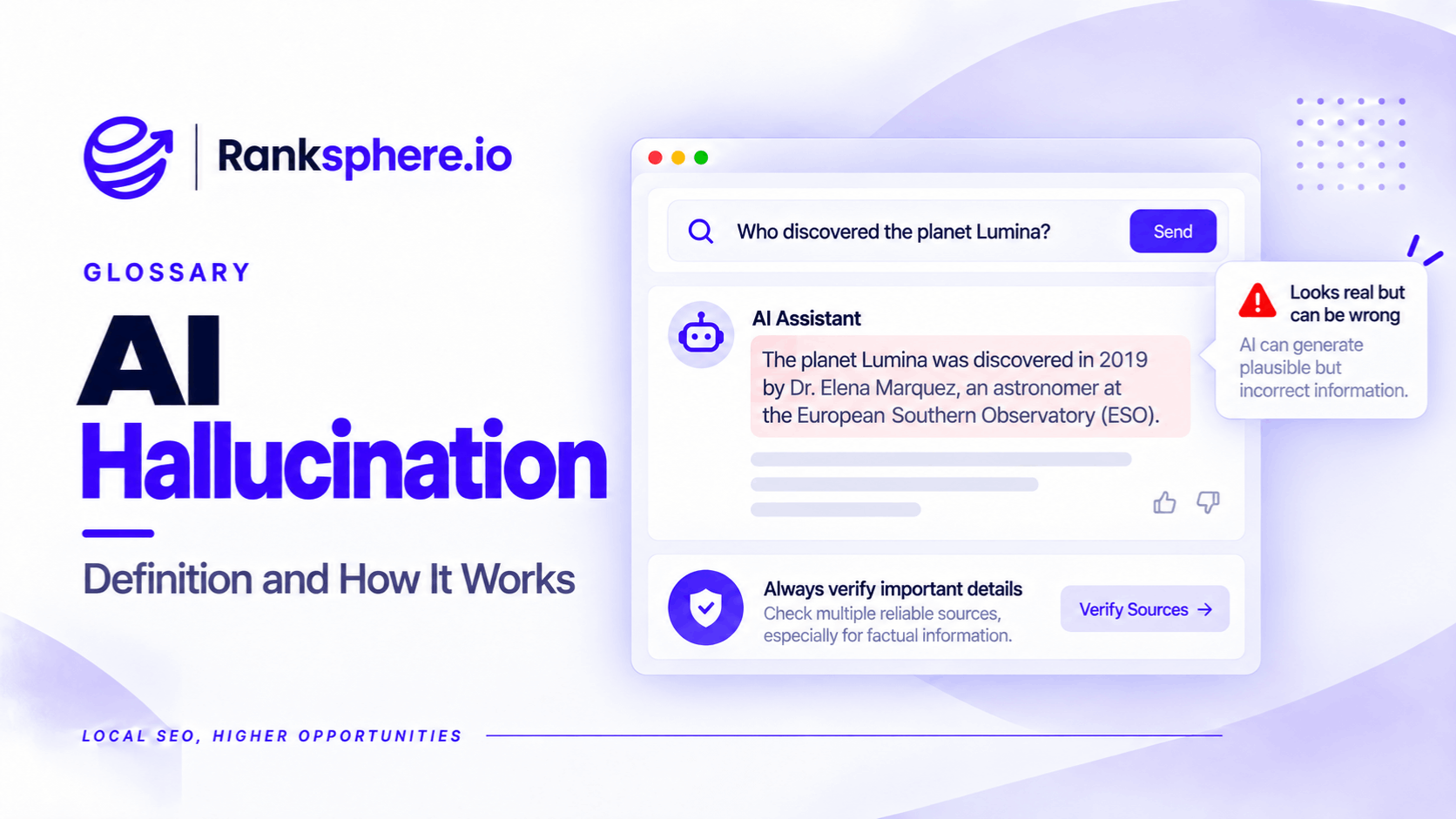
An AI hallucination occurs when an artificial intelligence system generates incorrect or fabricated information and presents it as fact.
For local businesses, this might mean an AI assistant providing the wrong opening hours, inventing a service, quoting an outdated address or confusing two businesses with similar names.
For example, a customer might ask whether a veterinary practice provides emergency appointments.
If the assistant incorrectly says no, that customer may choose another practice without ever contacting the business.
The problem isn't simply that AI makes mistakes. It's that customers may act on those mistakes without knowing the information is wrong.
For businesses appearing in AI-powered search and recommendation tools, checking the accuracy of generated answers is becoming an important part of managing their online information.
Why Do AI Hallucinations Happen?
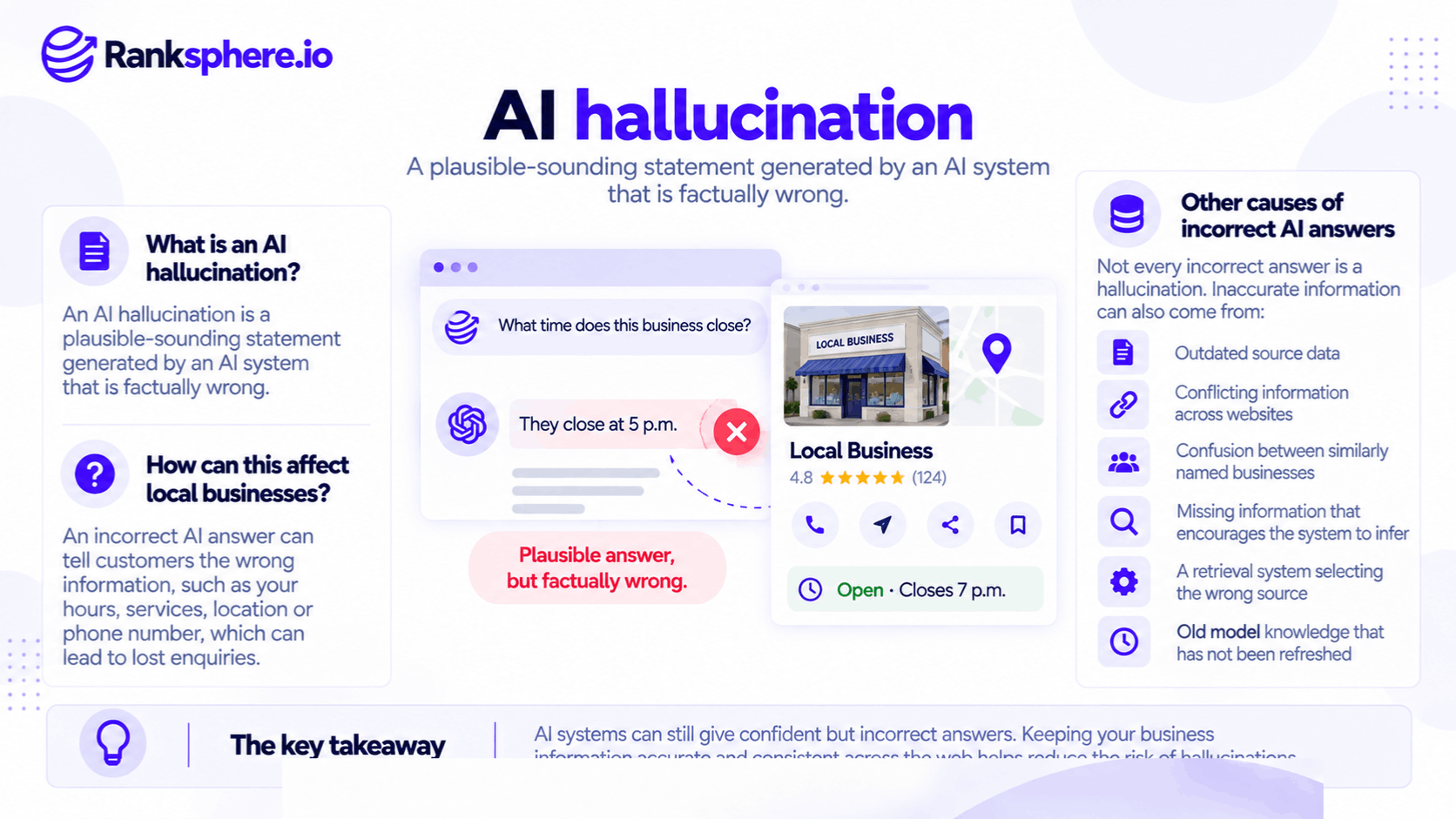
AI systems generate responses using patterns learned during training and, depending on the product and query, information retrieved from external sources.
They can produce answers that sound convincing even when the underlying information is incomplete, outdated or incorrect.
Several problems are particularly relevant to local businesses.
Incomplete Business Information
A business may offer a service without clearly describing it online.
For example, a veterinary practice might provide emergency appointments but have no dedicated emergency care page or relevant entry in its Google Business Profile services.
An AI assistant may fail to find confirmation and give an inaccurate answer.
However, missing information doesn't always cause a hallucination. A system may simply say it cannot verify the service.
Outdated Information
Old business details can remain online long after a company has changed them.
For example, a directory might display opening hours from three years ago.
An assistant that retrieves or relies on that record could repeat the outdated information.
A citation audit can help identify these inconsistencies.
Business Identity Confusion
AI systems can confuse businesses with similar names, particularly when they operate in the same industry.
A search for a particular roofing company might return information belonging to another company with a similar name.
This is an entity identification problem.
Consistent names, locations and official website details can make businesses easier to distinguish.
Conflicting Sources
A business website might say it closes at 6 pm, while its directory listings show 5 pm.
Different AI systems may rely on different sources and produce conflicting answers.
Errors in AI Generation
Sometimes, the system generates an incorrect statement even when accurate information is available.
This is a genuine model error rather than a problem with the business's listings.
It is important not to assume that all incorrect AI answers can be traced to inaccurate source data.
Why AI Hallucinations Matter for Local Businesses
Incorrect AI answers can affect customer decisions.
A wrong opening time may cause someone to visit when the shop is closed.
An invented service could lead to enquiries the business cannot fulfil.
An incorrect statement about treatment availability might discourage a patient from contacting a clinic.
These errors can also be difficult to detect.
Unlike an inaccurate directory listing, an AI-generated answer may appear only during an individual conversation. The business usually cannot see every question asked or every response generated.
The same business may also receive different answers across ChatGPT, Google, Claude and Perplexity.
This is why accuracy deserves attention alongside LLM visibility.
Appearing in an AI-generated answer is not necessarily helpful if the business is described incorrectly.
How to Check What AI Says About Your Business
Start with questions a real customer would ask.
For a local veterinary practice, these might include:
- What time does the practice close?
- Does it offer emergency appointments?
- Does it treat rabbits?
- Where is the practice located?
- How can I book an appointment?
- Does it provide weekend consultations?
Test a consistent set of questions across the AI assistants relevant to your customers.
For each response, record the date, question, assistant, answer and any cited sources.
Check the facts against the business's current information.
Distinguish between a correct answer, an incorrect answer and a statement that the assistant couldn't verify.
Repeat important checks periodically, particularly after changes to services, opening hours or business locations.
The results are a diagnostic sample, not a statistically reliable measurement of everything customers will see. AI answers can vary between sessions, locations and users.
How to Reduce Incorrect AI Answers
There is no method that guarantees an AI assistant will describe a business accurately.
However, several practical steps can improve the information available to search engines and AI systems.
Keep Google Business Profile Accurate
Review the business's Google Business Profile, including opening hours, services, categories and contact details.
Add relevant information where supported and correct anything outdated.
Google specifically recommends keeping Business Profile information current for its AI-powered search experiences.
Correct Outdated Citations
Check important local citations for old addresses, telephone numbers and opening hours.
Prioritise platforms that customers actually use and those appearing as sources in incorrect answers.
Correcting an outdated directory listing removes one possible source of misinformation, although AI systems may not reflect the correction immediately.
State Important Facts on Your Website
Don't make customers or AI systems guess which services you provide.
For example, if a veterinary practice offers out-of-hours appointments, explain the service clearly on its website.
Include the conditions under which it is available, how to contact the practice and any important limitations.
Where appropriate, add FAQs addressing common customer questions.
Ensure that structured data accurately represents the visible page content.
Make the Business Easy to Identify
Use consistent business names and contact information across important platforms.
Link to genuine official profiles where relevant.
Appropriate structured data, including sameAs references, may help describe relationships between a business and its verified online profiles.
However, structured data alone cannot eliminate entity confusion or force an AI assistant to use a particular source.
Review AI Crawler Access
Understand whether relevant AI crawlers can access public website information.
For example, OpenAI documents how OAI-SearchBot access can help website content become eligible for ChatGPT Search discovery.
Blocking that crawler may limit direct retrieval of current content, but allowing it doesn't guarantee accurate answers or citations.
Crawler settings should be a deliberate decision, taking into account visibility, privacy and content-use preferences.
Ranksphere's GBP Management Tool helps businesses manage supported profile information across locations, providing one way to keep important business details current.
Can You Remove an AI Hallucination?
There is no universal way to edit every AI-generated answer about your business.
Some services provide feedback or reporting mechanisms for incorrect responses.
You can use those where available, especially when an answer contains a serious factual error.
You should also correct any inaccurate source information you can identify.
However, changes may not appear immediately. Some systems retrieve current webpages, while others may rely partly on older information or different sources.
Even after a correction, an AI assistant may continue making the same mistake.
Check the answer again rather than assuming the issue is resolved.
Common AI Hallucination Mistakes
- Checking whether the business appears but not whether its details are correct.
- Assuming every incorrect answer is caused by missing business information.
- Leaving outdated addresses, hours or services on important platforms.
- Treating one AI response as representative of every user's experience.
- Assuming structured data guarantees correct AI answers.
- Blocking all AI crawlers without understanding the implications.
- Expecting source corrections to appear across every assistant immediately.
AI Hallucination Best Practices
Review important business facts across your website, Business Profile and relevant directories.
Test customer questions that could influence bookings, purchases or visits.
Record inaccurate AI answers and investigate the sources behind them where possible.
Correct information you control, use platform reporting tools when appropriate and check whether the response changes.
Keep the focus on accuracy rather than simply trying to increase AI mentions.
Example of an AI Hallucination Affecting a Veterinary Practice
Consider a hypothetical practice called Wilbury Veterinary.
The practice offers out-of-hours emergency appointments, which are an important part of its service.
During an AI accuracy review, the team discovers that one assistant incorrectly says the practice closes at 6 pm and does not offer emergency care.
What the Practice Finds
Its website mentions emergency appointments only briefly.
The service isn't clearly described in the relevant Business Profile information.
Several directory listings also contain outdated opening hours.
These inconsistencies could be contributing to the incorrect answers, although the practice cannot establish the exact cause without further evidence.
What the Practice Changes
The team updates its opening hours where necessary, corrects the outdated directory listings and publishes a clear emergency care page.
The new page explains when emergency appointments are available and how customers should contact the practice.
The team then repeats its AI accuracy checks over the following months.
Example
“Correcting source information gives customers and systems access to clearer facts about the practice.
It doesn't guarantee that every AI assistant will update its answers, but it addresses problems that are worth fixing regardless of AI visibility.
The goal isn't simply to make AI mention your business more often. It's to make accurate information easy to find, verify and use.”
See Also
- LLM Visibility — Measuring how businesses appear in AI-generated responses.
- Entity — Understanding how systems distinguish businesses and organisations.
- Ask Maps — AI-powered questions about businesses and places.
- Google Business Profile Services — Describing services accurately on Google.
- Citation Audit — Identifying and correcting outdated business information.
- AI Crawlers — Understanding how AI services access website content.