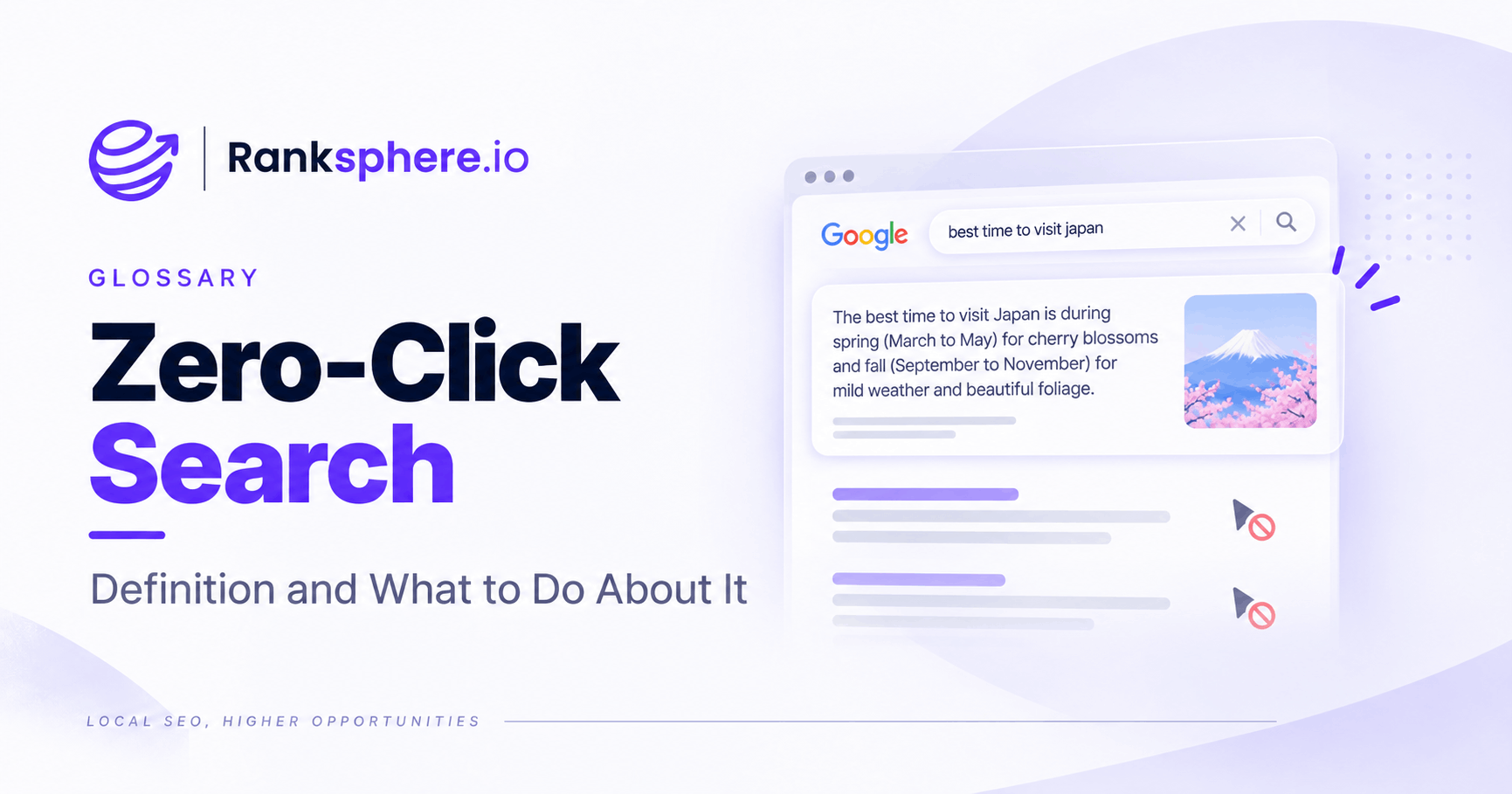
A zero-click search is a search that ends without the user clicking through to an external website.
Instead, the information or next action they need is available directly on the search results page.
This can happen through features such as:
- AI Overviews
- Featured snippets
- Knowledge panels
- Local packs
- Direct answers
- People Also Ask results
- Business information such as opening hours, phone numbers and directions
Zero-click searches are often discussed as a loss of organic traffic.
For publishers that depend heavily on pageviews, that can be a genuine concern.
For a local business, the picture is more complicated.
Someone may search for a nearby dentist, see the practice in the local pack, check its reviews, confirm the opening hours and tap the phone number without visiting the website.
That is technically a zero-click search.
It may still be commercially valuable.
What causes zero-click searches?
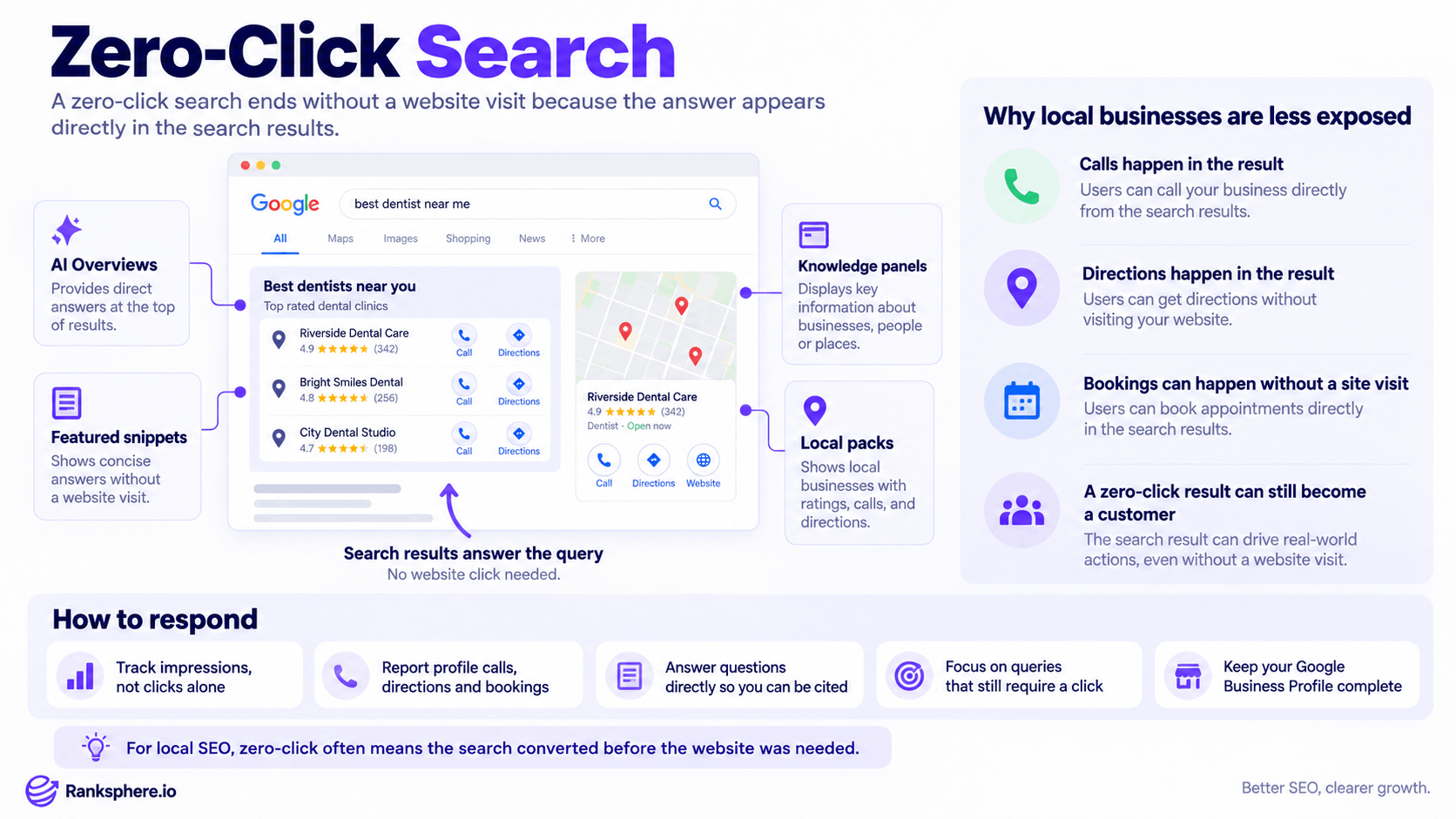
Google can answer many queries directly within the search results.
Different SERP features contribute in different ways.
AI Overviews
AI Overviews can generate a summary in response to a query and cite supporting sources.
They are particularly relevant to informational searches where someone wants an explanation, comparison or answer rather than a specific website.
The frequency of AI-generated answers changes over time and varies considerably by query type, so avoid relying on a fixed percentage unless you are using recent data from a clearly defined study.
Featured snippets
A featured snippet extracts information from a webpage and displays it prominently in the results.
For some simple questions, the snippet may provide enough information for the searcher to stop there.
For more complex searches, it can encourage a click because the user wants the full explanation.
Knowledge panels
Knowledge panels provide information about recognised entities such as:
- Businesses
- Organisations
- Places
- Public figures
- Brands
The user may find the information they need without visiting the entity's website.
Local packs
The local pack is particularly important for local SEO.
A local result can show information such as:
- Business name
- Rating
- Reviews
- Opening hours
- Address
- Phone options
- Directions
- Website link
Depending on the business and available Google features, customers may be able to take useful actions without visiting the website first.
Direct answers
Some queries have simple factual answers.
Examples include:
- Weather
- Currency conversion
- Calculations
- Time
- Basic measurements
There may be little reason for the user to open another website once the answer is displayed.
People Also Ask
People Also Ask results let users expand related questions directly in the SERP.
A searcher can sometimes answer several related questions without leaving Google.
Are zero-click searches bad for SEO?
Not necessarily.
A zero-click search can mean different things depending on the query.
For a publisher, a search that produces no visit may mean lost ad impressions or subscriptions.
For a local business, the same behaviour could lead to:
- A phone call
- A request for directions
- A booking action
- A later branded search
- A visit to the premises
So the absence of a website click does not automatically mean the search created no value.
The more useful question is:
Did the searcher complete a meaningful action, even if the website was not part of the journey?
Why zero-click search is different for local businesses
Local search often has a strong action-based intent.
Someone searching:
emergency plumber near me
may not want to read a 1,500-word service page.
They may want to know:
- Who is open
- Who serves their area
- Who has good reviews
- Who can be contacted immediately
If Google's local results provide enough information to make that decision, the person may call directly from the listing.
The website visit disappears.
The customer journey does not necessarily disappear with it.
That is why local SEO should not be measured through website sessions alone.
Google Business Profile and zero-click behaviour
A complete Google Business Profile becomes particularly important when customers make decisions directly in Google.
Depending on the business and available features, a profile can help people find:
- Opening hours
- Phone details
- Address
- Directions
- Reviews
- Photos
- Services
- Booking options
- Website information
If customers can make a decision without opening the site, the quality and accuracy of the profile itself become part of the conversion experience.
That does not make the website irrelevant.
It means the website and the Business Profile serve different parts of the journey.
Zero-click search and Google Analytics
Google Analytics begins measuring when someone reaches your website and the relevant analytics setup loads.
If someone:
- Searches on Google
- Finds your business
- Calls directly from the search result
there is no website session for GA4 to measure.
The same applies to other actions completed entirely within Google's interface.
This creates an important reporting gap.
Website analytics may remain flat even while Google Search and Business Profile visibility improve.
That is why local SEO reporting should combine website data with search and profile data where available.
What should local businesses measure?
Website traffic is still useful.
It just should not be the only metric.
Depending on the business, useful measurements may include:
- Organic website sessions
- Search impressions
- Organic clicks
- Click-through rate
- Calls or call clicks reported through relevant business-profile tools
- Direction interactions where available
- Booking actions where available
- Website conversions
- Enquiries
- Branded searches
- Local pack visibility
No single number gives the whole picture.
The purpose of measurement is to understand whether search visibility is generating useful business outcomes.
Zero-click search and informational content
Informational content is more exposed to zero-click behaviour than many commercial queries.
For example:
How long does wisdom tooth pain last?
may be answerable through:
- An AI-generated summary
- A featured snippet
- People Also Ask
- Other SERP features
The user may never need to open the source page.
That does not mean informational content should be abandoned.
Useful guides can still:
- Introduce the brand
- Build topical coverage
- Support service pages
- Earn links
- Create internal-link opportunities
- Appear as cited sources
- Reach people earlier in their decision process
The role of the content may simply be broader than generating a website session.
Zero-click search and commercial queries
Commercial and transactional searches often still create a stronger reason to click.
A customer may need information Google cannot fully provide, such as:
- Current availability
- Exact pricing
- Detailed service options
- Product specifications
- Appointment times
- Bespoke quotations
- Full terms
- Portfolio examples
This is why commercially valuable pages still need to give people a reason to visit.
The aim should not be to withhold basic information.
It should be to provide additional value that cannot be compressed into a one-line search result.
Should you withhold answers to encourage clicks?
Usually, no.
Deliberately making a page vague in the hope that someone has to click through often produces a worse result for both users and search visibility.
If someone asks:
How often should a boiler be serviced?
answer the question.
Then give them reasons to continue reading.
For example:
- What the service includes
- Warning signs
- Warranty considerations
- Costs
- Booking options
The short answer earns attention.
The deeper information earns the visit.
Zero-click search and featured snippets
Featured snippets are a clear example of how visibility and traffic can move in different directions.
If Google shows part of your answer directly in the results, the searcher may:
- Read the answer and leave
- Read the answer and click for more detail
- Remember the brand
- Search for the company later
That means featured snippet performance should not be judged solely by whether clicks increase.
Impressions, search visibility and downstream behaviour can matter as well.
Zero-click search and AI Overviews
AI Overviews add another layer to the same measurement problem.
An informational page may remain visible in Google but receive fewer clicks because part of the user's question is answered before they reach the traditional organic results.
If the page is cited, that can still create visibility.
But a citation should not automatically be treated as equivalent to a website visit or conversion.
The sensible approach is to separate:
Visibility
from:
Traffic
from:
Business outcomes
They are related, but they are not the same metric.
Is featured snippet optimisation the same as AI optimisation?
Not exactly.
Both benefit from content that is:
- Clear
- Accurate
- Well structured
- Easy to understand
- Direct where a direct answer is appropriate
But featured snippets and AI-generated search features are different systems.
Do not build content around the assumption that winning one automatically means appearing in the other.
The safer strategy is to write information that genuinely answers the query and makes its meaning easy to extract.
Zero-click search and click-through rate
A declining organic click-through rate does not always mean your title tag or meta description became worse.
The search results themselves may have changed.
For example, a query may gain:
- An AI Overview
- A featured snippet
- A larger local pack
- More video results
- Additional People Also Ask results
Your ranking may remain relatively stable while fewer people reach the traditional organic listings.
Before rewriting the page, compare the current SERP with what appeared previously.
CTR needs context.
Zero-click search and Search Console
Google Search Console remains useful because it shows:
- Impressions
- Clicks
- CTR
- Average position
- Queries
- Pages
Impressions become particularly useful when clicks decline.
Suppose a page's impressions stay stable while clicks fall.
That could indicate:
- A change in CTR
- A new SERP feature
- A change in search intent
- A stronger competing result
- A different search-result layout
Do not assume the page itself is automatically the cause.
Branded searches and zero-click visibility
Some users may see a brand in search without clicking immediately and return later through a branded search.
For example:
Someone reads an answer attributed to Marlow Dental but does not visit the website.
Two days later they search:
Marlow Dental whitening
That earlier visibility may have contributed to the later search.
It is difficult to attribute perfectly, so branded search should be treated as a useful supporting indicator rather than proof that one particular SERP exposure caused the behaviour.
How to respond to zero-click search
The goal is not to fight against the search-results page.
It is to adapt what you measure and what you publish.
A useful approach includes:
- Answer useful questions properly. Do not make content deliberately vague to manufacture clicks.
- Measure more than website sessions. Include local actions and conversions where available.
- Keep your Google Business Profile accurate. It may be where the customer's decision happens.
- Create pages worth visiting. Offer depth that cannot be reduced to a short answer.
- Monitor SERP changes. A CTR decline may come from the result layout rather than a ranking loss.
- Track impressions as well as clicks. Visibility can remain strong even when click behaviour changes.
- Protect commercial intent. Make booking, enquiries, pricing and next steps easy to reach.
Ranksphere's rank tracker separates pack and organic visibility across your service area, helping distinguish a genuine ranking change from a situation where the search-results page itself is affecting how users click.
Measuring SEO in a zero-click environment
Reporting should distinguish between several layers of performance.
Visibility
Measure:
- Search impressions
- Organic rankings
- Local pack visibility
- Branded search presence
Website traffic
Measure:
- Organic sessions
- Organic clicks
- CTR
- Landing pages
Business actions
Measure what actually matters to the organisation, such as:
- Calls
- Enquiries
- Bookings
- Purchases
- Direction interactions
- Appointment requests
A traffic decline and a business decline are not always the same thing.
Equally, increased impressions should not be celebrated as success if they never contribute to a useful business outcome.
Keep the full funnel in view.
Common zero-click search mistakes
- Judging local SEO by website sessions alone. Some useful actions may happen before the customer reaches the site.
- Assuming every zero-click search is lost traffic. The outcome depends on the query and business.
- Treating every profile action as a guaranteed conversion. A call or direction request is valuable behaviour, but it does not prove a sale.
- Withholding useful information to force clicks. Answer the searcher's question properly.
- Assuming a CTR drop means the page became worse. Check whether the SERP changed.
- Treating AI citations as equivalent to website traffic.
- Abandoning informational content. Its role can extend beyond direct sessions.
- Quoting zero-click percentages without checking the methodology and date.
- Ignoring the Google Business Profile. For many local searches, it is a major part of the customer journey.
- Looking at GA4 in isolation. It cannot measure actions that happen entirely before the website visit.
Zero-click search best practices
- Measure visibility, traffic and business outcomes separately.
- Include Google Business Profile activity in local SEO reporting where available.
- Keep profile information complete and current.
- Answer informational queries clearly rather than withholding the answer.
- Give users additional reasons to visit beyond the short answer.
- Monitor Search Console impressions alongside clicks and CTR.
- Investigate SERP changes before diagnosing a ranking or content problem.
- Prioritise commercial pages where a website visit adds genuine value.
- Continue producing useful informational content where it supports the wider customer journey.
- Avoid relying on a single zero-click statistic as a measure of the market.
Example
“Marlow Dental reviews its quarterly SEO report.
Organic website sessions are lower than the previous quarter.
At first glance, that appears negative.
But the wider data tells a more complicated story.
The practice has improved its visibility in local search, and more potential patients are interacting with its business information directly from Google.
At the same time, two informational articles about wisdom tooth recovery and whitening aftercare continue receiving strong search impressions but fewer website clicks as more information is displayed directly within the search experience.
The reporting is changed.
Instead of leading with website sessions alone, the practice looks at:
- Search visibility
- Organic clicks
- Business Profile interactions
- Website enquiries
- Appointment activity
The traffic decline remains real.
It simply no longer tells the whole story.
That is the important lesson behind zero-click search: a search does not have to produce a website visit to create value, but visibility alone is not enough either. Measure what happened after the search and whether it moved the customer closer to the business.”
See also
- Featured snippet — an answer displayed directly in the search results
- AI Overviews — Google's generative search experience
- Local pack — local business results that support actions directly from Google
- Google Business Profile — a major part of the local search journey
- Click-through rate — how often search impressions produce website clicks
- Google Analytics 4 — website analytics that begin once the user reaches your site