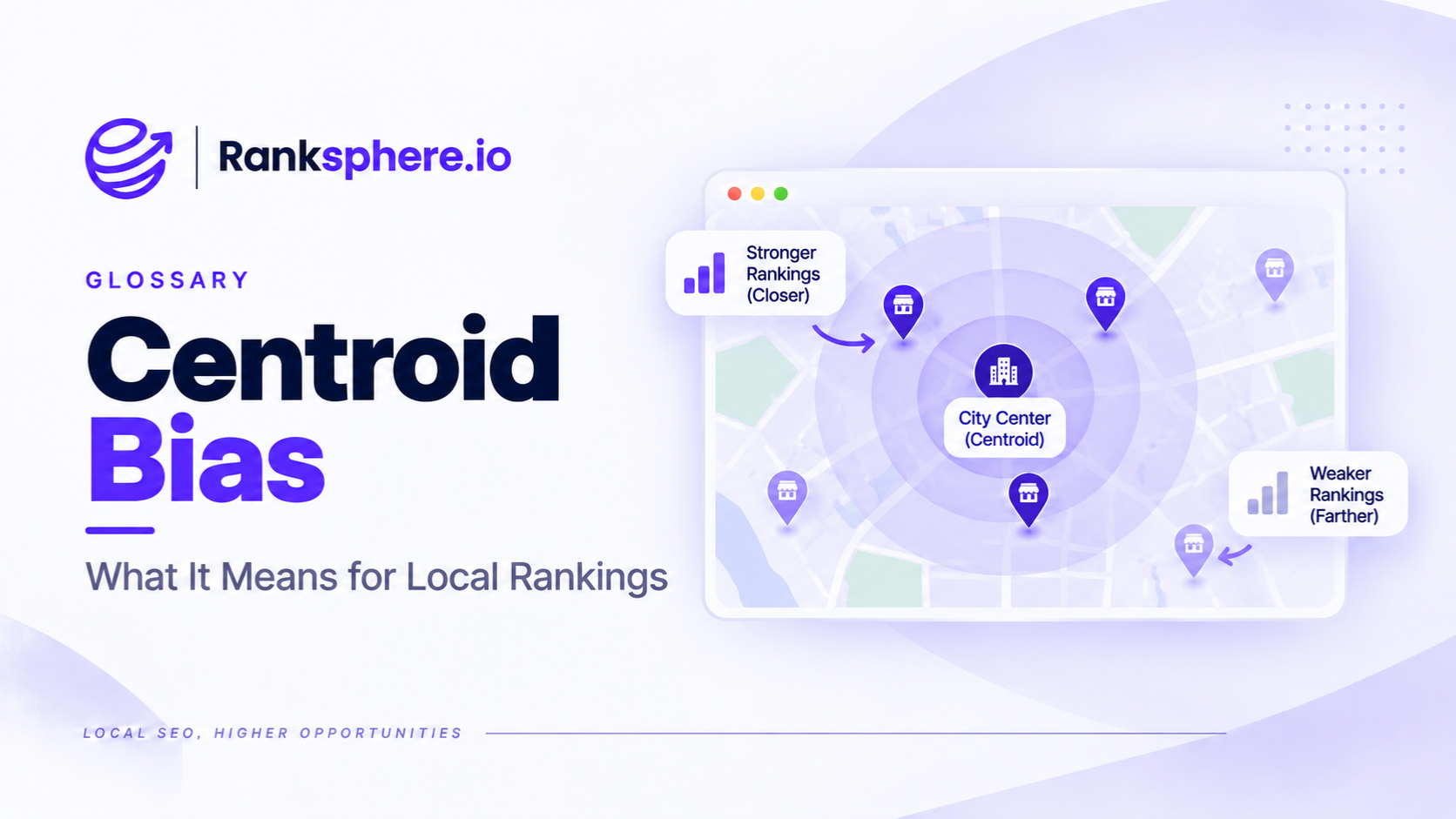
Centroid bias is a local SEO term used to describe the tendency for businesses closer to the geographic centre of a searched area to have an advantage in some local-search situations.
Historically, the idea was simple:
If someone searched for a service in a town, businesses closer to the centre of that town often appeared more prominently than businesses farther away.
Modern local search is more complicated.
Google officially says local rankings are mainly based on relevance, distance and prominence, and distance is calculated in relation to the person searching or the location Google associates with that search.
That makes proximity to the individual searcher much more useful for understanding modern local rankings than assuming every business is being measured from one fixed town-centre point.
The centroid concept has not disappeared completely, though. It still appears in local SEO research, particularly around explicit city searches and location-based rank tracking.
The important thing is to distinguish:
proximity to the searcher
from:
proximity to the centre of a named geographic area.
They are related ideas, but they are not the same ranking mechanism.
What does centroid mean in local SEO?
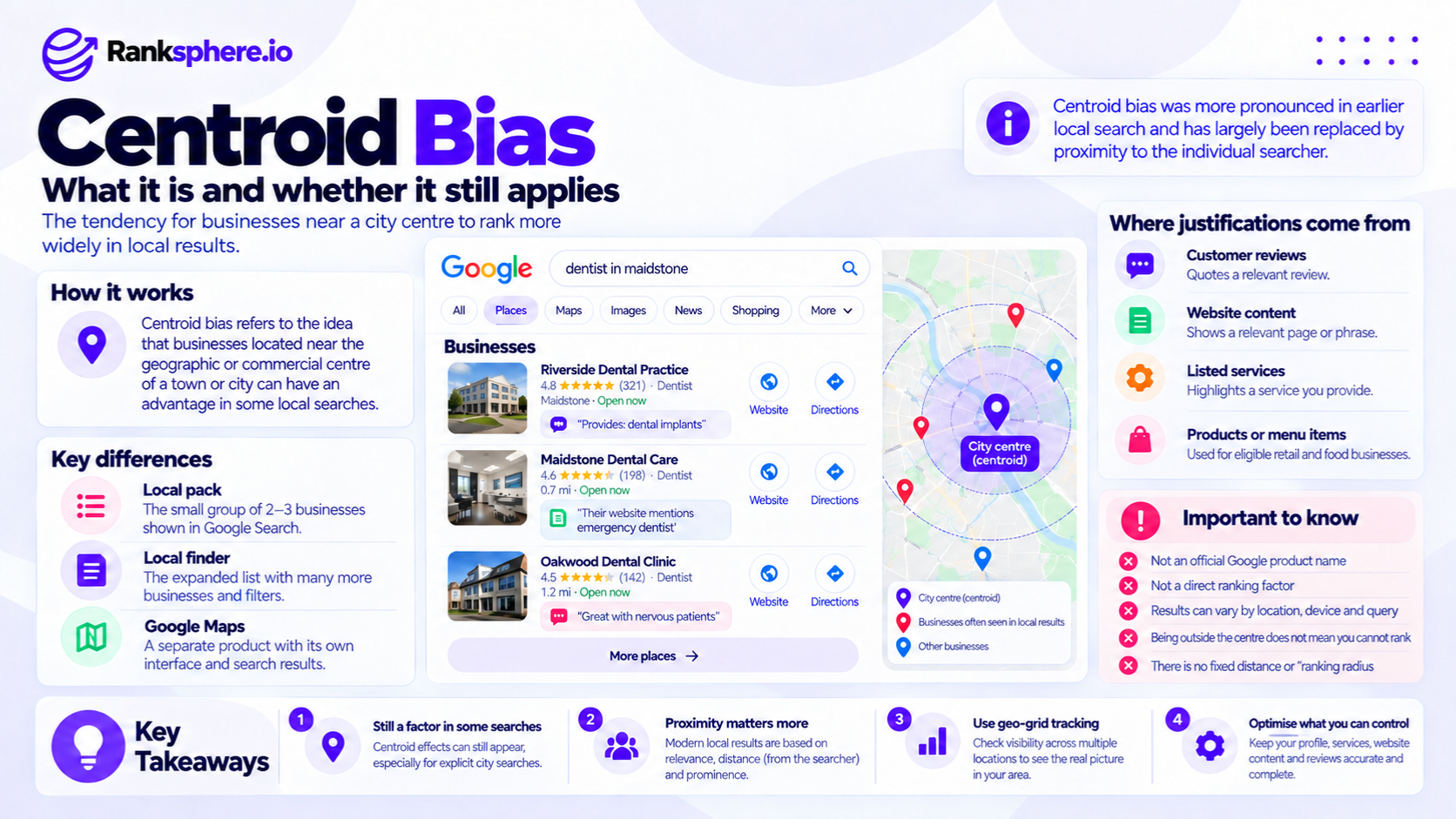
A centroid is essentially a reference point representing the centre of a geographic area.
That might be:
- The centre Google associates with a town or city
- The centre of a neighbourhood
- A central point used by a local rank-tracking tool
For example, when a rank tracker simulates a search from:
Maidstone
without using a precise street-level coordinate, it needs somewhere to place that simulated searcher.
BrightLocal explains that its traditional Local Rank Tracker uses the point Google considers the centre of the entered city, town or postcode as the search location. That point is commonly called the centroid.
This is useful for understanding how rank-tracking tools work.
It does not mean Google always calculates every local ranking from that point.
What centroid bias originally described
Older local SEO discussions often used centroid bias to explain why centrally located businesses appeared disproportionately often in local results.
The working theory was:
the closer a business was to the centre of the searched city, the stronger its geographic relevance.
That mattered more when local search was often discussed as though there were one relatively stable set of results for an entire town.
Modern local search is much more location-sensitive.
Someone standing in the north of a city can see a different local pack from someone performing the same search several miles south.
That geographic variation is one of the main reasons geo-grid rank tracking has become useful.
What matters now: distance from the searcher
Google's current documentation is clear that distance remains one of the main local ranking factors.
Google defines distance as how far each potential business result is from the customer searching.
If Google does not have an exact location from the user, it uses what it knows about their location.
This means a business does not have one permanent:
“rank in Maidstone.”
It may perform:
strongly near its premises
and:
more weakly several miles away.
That pattern is better described as proximity bias than classic centroid bias.
There is no fixed ranking radius
Another mistake is imagining Google drawing one fixed circle around every business.
For example:
“Every business can rank within five miles of its address.”
There is no such published rule.
Recent third-party research into Google's geographic retrieval systems found that the effective search area can vary substantially according to the query and the density of relevant businesses.
A query such as:
pharmacy
in a dense city may produce a relatively tight geographic set of candidates.
A query for something people are willing to travel farther for can draw from a wider area.
The same type of search may also cover a larger area in a sparsely populated location.
So think in terms of:
geographic patterns
rather than:
a fixed local ranking radius.
Search intent changes the geography
Not every local query implies the same acceptable distance.
Compare:
coffee
with:
sports stadium.
Someone searching for coffee will often expect something nearby.
Someone looking for a major stadium may reasonably travel much farther.
Search Engine Land's local-search analysis similarly notes that Google's effective geographic range can change according to the type of search and its local intent.
That means the ranking area for one keyword does not automatically apply to another.
A business may have strong geographic coverage for one service and much tighter coverage for another.
Named-location searches are different
A query such as:
dentist
contains no explicit place name.
Google therefore has to use the user's location and other context to determine what “local” means.
A query such as:
dentist in Maidstone
provides an additional geographic clue.
Google Search itself advises users that adding a location to a query can help retrieve information relevant to that location.
But do not oversimplify this into:
“When a town is named, Google measures every business from the town centre.”
Google does not publish such a rule.
The better interpretation is:
the named place becomes part of the search intent, while relevance, distance and prominence still contribute to the result.
Why centroid still appears in local SEO research
Although Google's official documentation does not identify centroid bias as a separate ranking factor, the concept has not disappeared from industry analysis.
For example, Whitespark's 2023 Local Search Ranking Factors survey reported a substantial increase in how local SEO practitioners rated proximity of address to centroid, particularly for explicit searches containing a city name.
That is useful industry evidence.
But it is important to label it correctly.
The Whitespark report is:
a survey of local SEO practitioners
not:
Google publishing its algorithm weights.
The distinction matters.
Centroid bias vs proximity bias
These terms are sometimes used interchangeably, but separating them makes diagnosis easier.
Centroid bias
Describes an apparent advantage connected with proximity to the centre of a named geographic area.
Proximity bias
Describes the much broader tendency for businesses closer to the search location to perform more strongly in local results.
For most day-to-day local SEO work, proximity bias is the more useful concept.
Google explicitly documents distance.
It does not publicly document a separate centroid score.
Market density also matters
A ranking map can behave very differently in a dense city centre from a suburban or rural area.
Suppose there are:
30 dentists within two miles
of one search point.
Distance may not separate those businesses very much because many are already nearby.
Google still has relevance and prominence to consider.
In another area, there may be only:
three relevant dentists within several miles.
The candidate set looks very different.
Recent analysis of Google's local geographic systems also suggests that candidate areas contract and expand according to business density and query type.
Do not turn that into:
“density makes prominence the main ranking factor.”
Google does not publish the weights.
The safer conclusion is that geography interacts with competition.
What does this mean for a business outside the town centre?
Being on the outskirts does not automatically mean poor local SEO.
The first thing to understand is the business's actual geographic visibility.
A manual search from the office tells you very little about what customers several streets or neighbourhoods away are seeing.
Use geo-grid rank tracking to see how rankings change across representative points.
Ranksphere' rank tracker runs grid scans across your service area, helping visualise where the business is strong, where visibility weakens and which competitors appear in different parts of the market.
The grid is still a sample.
It does not represent every searcher.
But it gives you much more useful information than a single ranking number.
Start with the area closest to the business
If visibility is poor even immediately around the verified business location, do not automatically blame centroid bias.
Check the fundamentals first.
That includes:
- Business relevance
- Categories
- Services
- Reviews
- Website relevance
- Profile accuracy
- Competitors
Google says complete and accurate business information helps it understand and match a Business Profile to relevant searches. It also says review quantity and positive ratings can contribute to prominence.
Weak nearby visibility may therefore have causes other than geography.
Reviews do not simply “extend your radius”
This common local SEO explanation is too neat.
Reviews contribute to prominence.
A stronger overall business may therefore outperform another business in some searches even when it is farther away.
Google explicitly says its systems can rank a more distant business above a closer one when it appears to be a better match.
But there is no published formula saying:
another 50 reviews = another mile of ranking coverage.
Use reviews because they:
- Help customers
- Contribute to reputation
- Can support local prominence
not because they supposedly buy geographic distance.
Profile completeness does not override geography
The same applies to Business Profile optimisation.
Accurate:
- Categories
- Services
- Hours
- Attributes
help Google understand the business and can improve relevance.
They do not remove the distance component of local search.
A perfectly completed profile does not give a business the same proximity as a competitor located next to the searcher.
Optimisation improves the factors you can influence.
It does not erase geography.
Citations and geographic relevance
Citations can help reinforce accurate information about a business across the web.
Google also says prominence can use information from across the web, including links, articles and directories.
But avoid claiming:
“citations tell Google you belong to a town and therefore overcome centroid bias.”
That is more specific than Google's documentation supports.
The main objective is consistent, accurate business information and genuine local prominence.
Location pages
A genuine location page can be useful when a business needs to explain its relationship with a particular place.
For example:
A company that genuinely serves Maidstone may have a page describing:
- Services available there
- Local projects
- Relevant service information
- How customers in that area are served
That can help the website address organic searches involving that location.
What the page does not do is move the Business Profile.
If the company's physical location is four miles away, creating:
/maidstone/
does not make Google calculate local-pack distance as though the business were physically in Maidstone town centre.
This distinction is essential.
Location pages and named-location queries
This is where location pages can be especially useful.
For a query such as:
roof repair Maidstone
a genuine Maidstone-focused page may provide relevant organic-search content for someone explicitly asking about that location.
But this should not be described as:
a way to beat Maps proximity.
Local organic results and Business Profile/map rankings are related parts of the search experience, but they are not identical systems.
A strong location page can improve website relevance.
It does not manufacture a new physical location.
Service-area businesses
The same principle matters for a service area business.
Setting a large service area in Google Business Profile does not mean the business will rank equally throughout that area.
Google's local-ranking documentation still includes distance as a main factor.
A plumber may legitimately serve customers 25 miles away.
That does not mean selecting those towns in the service area gives the plumber the same local visibility as a business physically much closer to those customers.
Service area describes where you operate.
It is not a ranking-radius control.
Do not assume the city centre is always stronger
A central business can have geographic advantages for some searches.
But being in the centre does not guarantee dominance across the city.
Someone searching from an outer neighbourhood may be considerably closer to another relevant business.
Google's own explanation allows a farther business to outperform a closer one based on the overall combination of relevance, distance and prominence.
So neither of these statements is safe:
“Town-centre businesses always win.”
or:
“The centroid no longer matters at all.”
Local search is more contextual than either rule suggests.
Do not relocate purely to chase a map ranking
Changing a genuine business location can obviously change the geographic relationship between the business and its customers.
But relocating a business is a commercial decision with consequences far beyond SEO.
Do not recommend moving premises simply because:
“Google likes the centroid.”
The expected value would need to justify:
- Rent
- Moving costs
- Customer disruption
- Staffing
- Operational effects
and there is still no guarantee of a particular ranking outcome.
SEO should inform the business decision.
It should not dictate it.
Compare geographically relevant competitors
When reviewing a grid, the number-one competitor in the town centre is not always the most useful comparison.
If your business is three miles away, compare it with businesses competing under similar geographic conditions.
Ask:
- Who consistently appears near us?
- Who performs strongly from similar distances?
- Where do they outperform us?
- Which differences are relevant and legitimate?
That produces a better competitor analysis than assuming every difference is caused by distance.
Measure coverage, not one ranking
A single ranking such as:
Position 5
hides the geographic picture.
Suppose a business is:
2nd close to its premises
7th one mile east
18th three miles away
There is no honest single position that summarises that distribution.
A metric such as share of local voice can help summarise visibility across a defined tracking grid, depending on how the tool calculates it.
Remember that Share of Local Voice is a third-party measurement.
It is not a Google metric or literal market share.
There is no universal “winnable radius”
Avoid dividing the map into:
winnable
and:
impossible
based solely on distance.
Some geographic disadvantages may be very difficult to overcome.
But Google's own guidance says distance operates alongside relevance and prominence, and a farther result can still outrank a closer one.
The more useful language is:
more or less competitive under the current conditions.
That leaves room for evidence rather than pretending the algorithm has a fixed geographic ceiling.
Common centroid-bias mistakes
The most common errors are treating centroid bias as an official Google metric, assuming every query is ranked from the city centre, blaming geography before checking basic relevance and prominence, expecting reviews or profile optimisation to create a predictable ranking radius, using location pages as though they change Business Profile proximity, assuming service areas expand map rankings, and treating one grid scan as proof that an area can never be reached.
Best practices
Use centroid bias as a diagnostic concept rather than a universal explanation. Establish geographic visibility with consistent grid data, compare competitors under similar location conditions, check relevance and prominence before blaming distance, treat explicit city searches separately from ordinary nearby searches, use genuine location pages to address real location intent rather than to fake proximity, and set expectations using measured geographic patterns rather than promising a fixed ranking radius.
Example
“Consider a hypothetical optician called Fernhill Opticians, located several miles from the centre of its town.
The owner has been told:
“You do not rank because you are too far from the centroid.”
That explanation may contain part of the truth.
But it is not enough to diagnose the problem.
The team runs a local search grid.
The results show two different patterns.
Close to the practice, visibility is inconsistent even though Fernhill is geographically competitive with the businesses appearing above it.
Farther towards the town centre, visibility declines much more sharply.
Those areas should not automatically receive the same diagnosis.
The nearby weakness leads the team to review:
- Categories
- Services
- Business information
- Reviews
- Website relevance
The more distant weakness is treated differently because geography is increasingly likely to be part of the competitive picture.
The team improves inaccurate or incomplete information because it genuinely needs correcting.
It does not promise:
“These changes will expand the ranking radius by two miles.”
It also does not build a town-centre location page and claim that the page will make the Business Profile geographically central.
Instead, the grid is repeated using the same locations and settings over time.
That gives the business something much more useful than a theory about the centroid:
a map of where it is currently competitive, where other SEO factors may be holding it back and where distance appears to be a more significant constraint.
That is the modern way to think about centroid bias.
The old idea of one city-centre point determining an entire town's rankings is too simplistic for modern local search. Proximity to the searcher is a documented factor, explicit place names can change geographic intent, and centroid effects may still appear in certain search and tracking contexts. Use grid data to identify the actual pattern before deciding which explanation fits.”
See also
Local ranking factors — relevance, distance and prominence Geo-grid rank tracking — mapping how visibility changes by search location Local pack — the local results being measured Location page — serving genuine place-specific search intent Service area business — why declared service areas are different from ranking coverage Share of local voice — summarising competitive visibility across a defined grid