Franchise SEO is local SEO for businesses operating across a franchise network, where individual locations share a brand but may be owned and managed by different franchisees.
The technical work is similar to multi-location SEO. Each location needs an accurate Google Business Profile, a useful location page, consistent business information, and visibility in its local market.
What makes franchise SEO more complicated is deciding who is responsible for that work.
The franchisor manages the wider brand. The franchisee runs the local business. Both have an interest in how the location appears in Google Search and Maps.
A franchisee may want to change their profile to attract more local customers, while the franchisor wants every location to follow the same brand standards.
Neither concern is unreasonable. The problems start when nobody has agreed who can make those decisions.
The Biggest Challenge in Franchise SEO Is Control
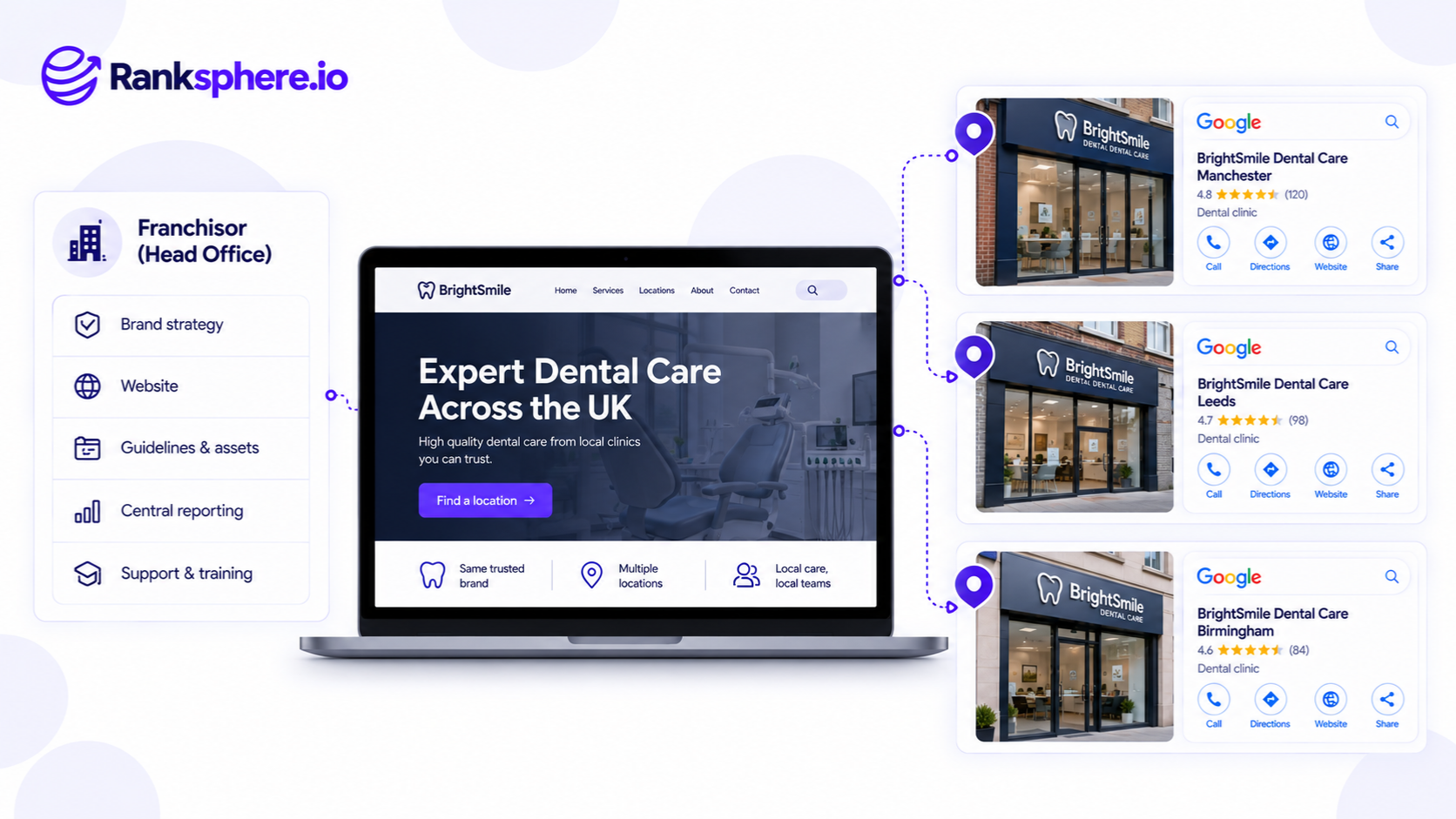
Most recurring franchise SEO problems are management problems before they become technical ones.
Consider a network with twenty locations, each operated by a different franchisee.
Who updates the opening hours? Who approves changes to the business name? Who responds when a customer leaves a negative review? What happens to the Google Business Profile when a franchisee sells the business or leaves the network?
Without clear responsibilities, every location develops its own approach.
That makes brand consistency difficult and can create unnecessary risks.
Who Owns the Google Business Profile?
Google Business Profile ownership needs to be agreed before a location starts operating.
Google provides primary owner, owner, and manager roles.
A franchisor may prefer to maintain ownership centrally so that profiles remain accessible when franchise operators change.
Alternatively, an individual franchisee may be the authorised primary owner under the network's operating arrangements.
There is no universal Google requirement that every franchise profile must be owned by the franchisor.
The important thing is to establish an authorised ownership structure and document it in the franchise agreement.
Who Can Edit the Profile?
Franchisees need to keep local information accurate.
For example, they may need to update opening hours, add photographs, or change service details.
However, changes to business names, categories, and addresses can affect how a location is represented.
A franchisee adding keywords to the business name solely to improve rankings may violate Google's guidelines and create Google Business Profile suspension risk.
The network should establish which changes require approval.
Google's manager role still permits edits to important profile information, so assigning manager access doesn't create field-level restrictions. Internal policies and regular monitoring remain necessary.
Who Responds to Customer Reviews?
A central team understands the brand's communication standards.
A franchisee understands what happened at their location.
Both are useful when responding to customer feedback.
For example, a negative review about a missed appointment may require the local manager to investigate before anyone prepares a response.
A practical arrangement is to establish a shared review policy while giving the local team responsibility for providing the facts.
What Happens When a Franchisee Leaves?
An operator change shouldn't leave the network uncertain about who can access the location's business information.
The franchise agreement should explain how profile ownership, website information, and other digital assets are handled during a transition.
Google Business Profile reviews don't automatically disappear or transfer to a different business simply because primary ownership changes.
Where the same eligible business continues operating, the existing profile and its review history may remain.
The immediate risk is usually losing administrative access, not losing the reviews themselves.
Franchise Territory Conflicts in Local Search
Franchise agreements often define the areas individual operators are allowed to serve.
Google doesn't use those commercial boundaries to determine local rankings.
For example, two franchisees may operate eight miles apart with separate territories.
A customer searching between those locations could see either business in the local pack.
Google considers factors such as relevance, distance, and prominence, not the territory boundaries written into a franchise agreement.
This can create tension when neighbouring franchisees compete for the same searches.
Measuring Territory Overlap
Geo-grid rank tracking can help the network understand where each location appears in Google Maps results.
For example, the franchisor could run scans for "emergency plumber" around two neighbouring locations.
The results might show that both businesses rank in overlapping geographic areas.
That information can be useful for reporting and planning, but geo-grid tracking cannot enforce exclusive territories.
Handling Overlapping Enquiries
The solution is usually commercial rather than technical.
The franchise agreement should establish how enquiries are assigned when service areas overlap.
For example, the network might use customer postcodes to route website enquiries to the appropriate franchisee.
It should also explain how customers who contact a location directly are handled.
Agreeing on these rules before disputes arise is easier than attempting to resolve them after franchisees begin competing for the same customers.
Brand Consistency vs Local Content
Franchise SEO needs consistent branding without making every location page identical.
That balance is particularly important for networks with centrally managed websites.
What Should Stay Consistent?
The franchisor can establish standards for:
- Business names and branding
- NAP accuracy
- Website navigation and design
- Core service descriptions
- Editorial guidelines
- LocalBusiness schema structure
- Review response policies
These standards help maintain a consistent experience across the network.
However, individual business details must still reflect each location accurately.
For example, a location's opening hours, address, and telephone number shouldn't be copied from another branch.
What Should Be Specific to Each Location?
Local content should explain what makes each branch relevant to its customers.
That may include:
- Genuine photographs
- Local team information
- Services available at the location
- Opening hours
- Completed projects or case studies
- Customer reviews
- Local contact information
Google Business Profile categories should accurately reflect the services provided. Locations within the same chain generally need consistent primary categories when they offer the same services, subject to Google's applicable exceptions.
Why Templated Franchise Location Pages Often Underperform
A common franchise SEO mistake is publishing the same page for every location and changing only the town name.
For example:
"Our expert electricians in Maidstone provide reliable electrical services."
"Our expert electricians in Rochester provide reliable electrical services."
If the rest of both pages is identical, neither gives customers much information about the actual local operation.
This can contribute to thin content problems.
However, using a shared template isn't itself a ranking violation, and duplicated wording doesn't automatically mean Google will refuse to index a page.
The issue is whether the page provides enough useful information to serve its intended audience.
A Better Approach to Franchise Location Pages
The franchisor supplies the approved structure.
The franchisee supplies the local information.
For example, each location page might include the same core sections:
- Services
- Team
- Service area
- Opening hours
- Customer information
- Contact details
However, the details within those sections should reflect the actual branch.
A plumbing franchise could include photographs from genuine local jobs, the team responsible for the area, and the services available at that location.
Someone at the network level should review the content before publication to ensure it is accurate and useful.
Managing Google Business Profiles Across a Franchise Network
Franchise SEO becomes harder as the number of locations grows.
A network with thirty locations may have several people updating profiles, responding to reviews, and maintaining location information.
Without coordination, inconsistencies can develop.
For example:
- One franchisee changes the business name.
- Another forgets to update holiday opening hours.
- A third uses an outdated telephone number.
- Several location pages contain old staff information.
The network needs a system for identifying these issues before they become widespread.
Ranksphere's GBP Management supports managing multiple Google Business Profiles and user access from one dashboard.
This can help franchisors and authorised teams manage business information across locations.
However, software doesn't decide who should own the profiles or which changes a franchisee is permitted to make.
Those responsibilities still need to be established by the network.
What Every Franchise SEO Agreement Should Cover
Before starting a franchise SEO programme, establish the following responsibilities.
| Area | What needs to be agreed |
|---|---|
| Profile ownership | Who holds primary ownership and who receives access |
| Profile changes | Which updates require approval |
| Reviews | Who monitors, investigates, and responds |
| Location pages | Who provides local content and photographs |
| Territories | How overlapping enquiries are assigned |
| Reporting | Which metrics the franchisor and franchisee receive |
| Costs | Which activities are centrally funded or paid for locally |
| Franchise transitions | How profiles and other digital assets are handed over |
These arrangements should be documented rather than left to informal discussions.
They also need to reflect Google's own rules on business eligibility, representation, and account access.
Common Franchise SEO Mistakes
- Unclear Google Business Profile ownership. Access becomes difficult when operators change.
- Allowing uncontrolled business name edits. Adding keywords that aren't part of the real-world name can violate Google's guidelines.
- Publishing identical location pages. Changing the town name alone rarely makes a page useful.
- Ignoring territory overlap. Google Maps rankings don't follow franchise contract boundaries.
- Responding to reviews without local information. A central team may not know what happened at the branch.
- Assuming manager access locks important fields. Managers can edit significant profile information.
- Failing to document franchise transitions. Ownership and access disputes become harder to resolve after an operator leaves.
- Treating every branch identically. Locations may have different services, teams, hours, or customer needs.
Franchise SEO Best Practices
- Agree on Google Business Profile ownership before onboarding locations.
- Document editing and approval responsibilities.
- Keep business names and contact information accurate.
- Establish consistent brand and content standards.
- Require genuine local information for location pages.
- Give local teams a role in reviewing customer feedback.
- Monitor local rankings separately for each location.
- Use geo-grid scans to understand territory overlap.
- Establish commercial rules for routing enquiries.
- Audit franchise profiles and location pages regularly.
- Plan ownership and access transfers before franchisees leave.
The aim is to make local SEO manageable across the network without preventing individual locations from providing accurate information about their businesses.
Example
“Consider a hypothetical home services franchise with twenty-two independently operated locations.
Each franchisee manages its own Google Business Profile.
The network has brand guidelines, but it hasn't established a consistent process for approving profile changes.
During an audit, the central marketing team discovers that six franchisees have added service keywords and town names to their business names.
The changes were made because the operators believed additional keywords would improve local rankings.
The team also finds several incorrect telephone numbers and outdated opening hours.
However, profile ownership is spread across individual accounts, making it difficult for the central team to coordinate corrections.
The franchisor reviews the relevant franchise agreements and works with operators to establish an authorised ownership and access arrangement.
It introduces:
- Approved business name standards
- A profile change approval process
- Regular location audits
- Clear review response responsibilities
- A central record of location details
- Procedures for ownership transfers
The network also provides guidance on which business information franchisees can update themselves and which changes require review.
The franchisor gains a clearer process for identifying inaccurate information and coordinating corrections.
Franchisees remain responsible for supplying local details, photographs, and operational updates.
The network also reviews its location pages to make sure the content reflects each branch rather than relying entirely on generic templates.
The outcome is a more manageable process, not a guaranteed increase in rankings.”
See Also
- Multi-Location SEO — Managing visibility across multiple business locations.
- Google Business Profile Ownership — Understanding profile access and ownership responsibilities.
- Location Page — Creating useful pages for individual locations.
- Geo-Grid Rank Tracking — Measuring local visibility and territory overlap.
- Google Business Profile Suspension — Understanding enforcement and profile restrictions.
- NAP — Maintaining accurate names, addresses, and telephone numbers.