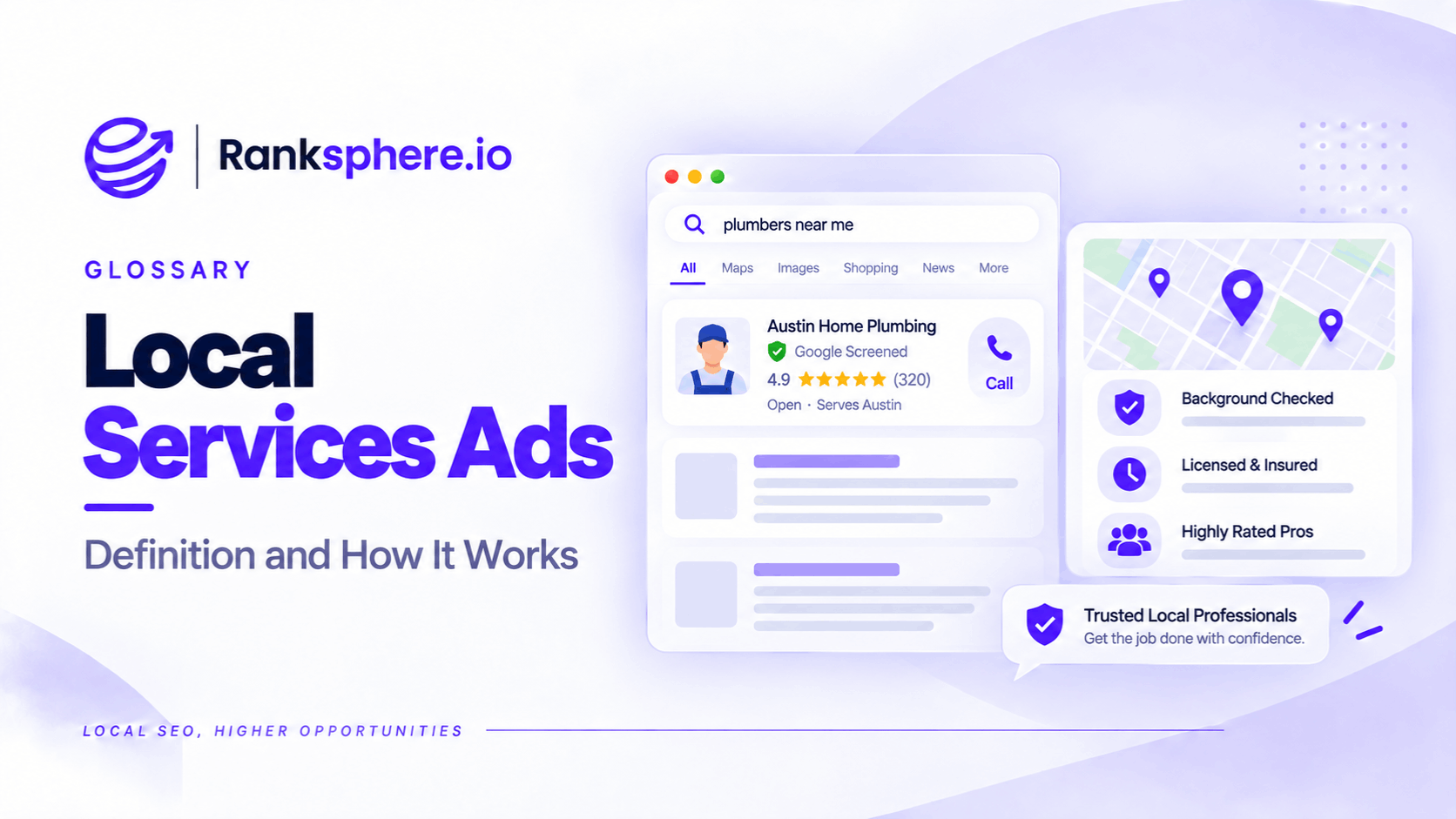
Local Services Ads (LSAs) are Google's pay-per-lead advertisements designed to connect customers with eligible local service businesses.
Unlike traditional search advertisements that typically charge for clicks, Local Services Ads charge for valid leads, such as qualifying phone calls or messages.
For example, someone searching for "emergency plumber near me" may see Local Services Ads featuring nearby plumbing businesses.
These advertisements can appear prominently in Google Search, sometimes above standard search ads and the local pack.
That makes them relevant to local SEO, even though they are a paid advertising product.
A plumbing company could rank first in the local pack but still appear below several paid listings.
Local Services Ads don't improve organic rankings. They provide another way for eligible businesses to reach customers who are already searching for their services.
Important: Google made significant changes to Local Services Ads in 2025 and 2026. Availability, billing, campaign management, and verification requirements may vary by location and account. Always check Google's current documentation before making advertising decisions.
How Do Google Local Services Ads Work?
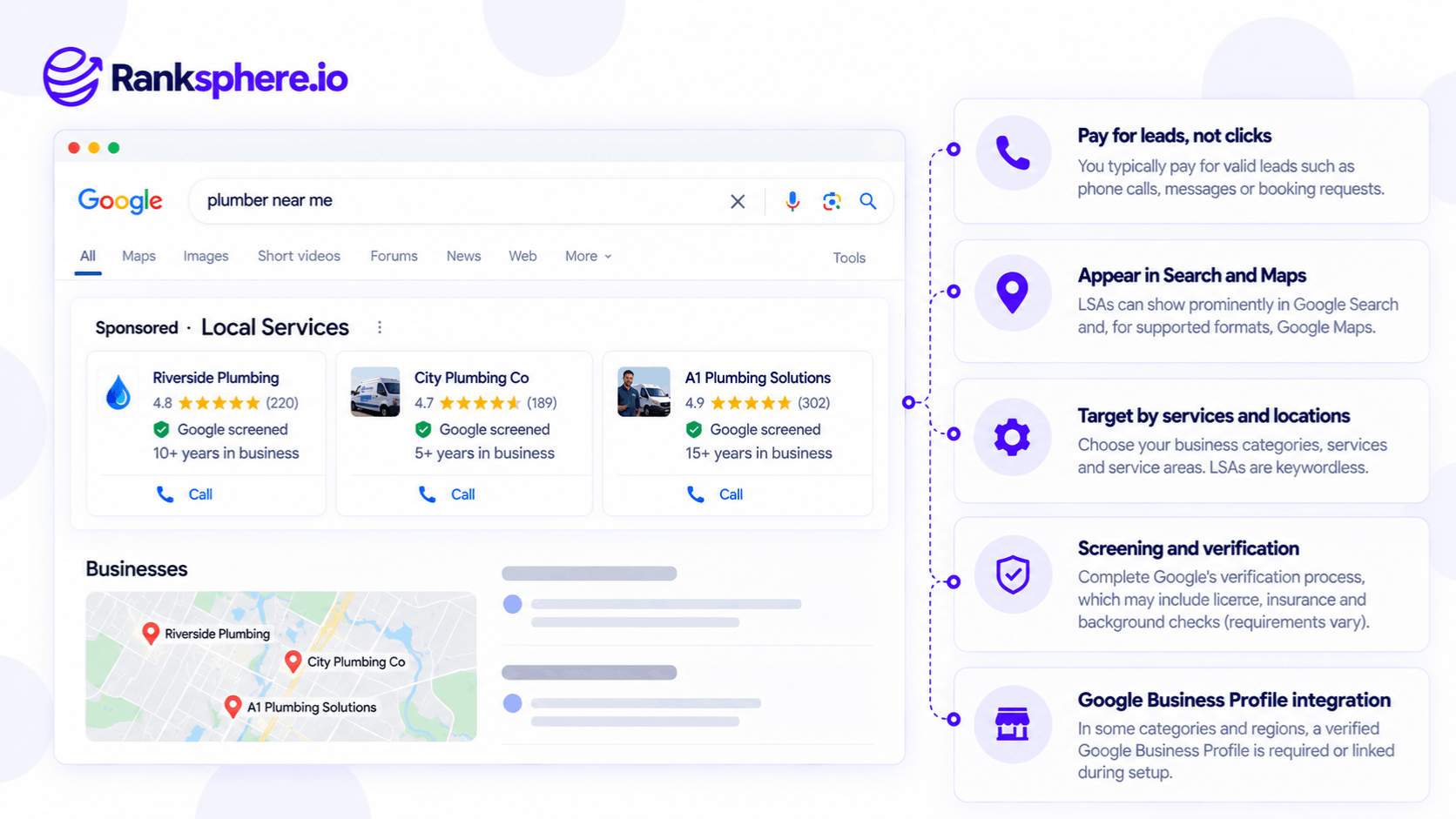
Local Services Ads connect customers with businesses offering relevant services in a particular geographic area.
For example, a homeowner searching for an electrician may see advertisements from eligible electrical contractors serving that location.
A customer can then contact an advertiser through supported options such as:
- Phone calls
- Messages
- Direct bookings, where available
Businesses generally pay when Google determines that an interaction qualifies as a valid lead.
The price can vary depending on the service, location, competition, and campaign settings.
Unlike conventional keyword-based search campaigns, Local Services Ads use service categories, job types, service areas, and other account settings to match businesses with relevant searches.
Advertisers don't need to build traditional keyword lists.
However, they must meet Google's eligibility and verification requirements.
Who Can Use Local Services Ads?
Local Services Ads are available to eligible businesses in supported industries and geographic markets.
Examples of service categories may include:
- Plumbing
- Electrical services
- Heating and air conditioning
- Roofing
- House cleaning
- Pest control
- Lawn care
- Moving services
Other professional and service categories may also qualify.
However, availability varies by country and business category.
A service offered in one market may not be available in another.
Before planning a campaign, check Google's current Local Services Ads eligibility requirements for your industry and location.
Screening and Verification
Google requires advertisers to complete relevant checks before participating.
Depending on the category and region, these may include:
- Business registration verification
- Licence checks
- Insurance verification
- Background checks
- Minimum review requirements
- Google Business Profile verification
Not every advertiser completes the same screening process.
For example, certain home services categories may require additional checks.
Google also requires directly participating Local Services advertisers to have an affiliated, public, verified Google Business Profile, subject to documented partner-program exceptions.
What Is the Google Verified Badge?
Google previously used several badges in Local Services Ads, including:
- Google Guaranteed
- Google Screened
- License Verified by Google
On October 20, 2025, Google introduced a consolidated Google Verified badge.
The change simplified how eligible advertisers display their verification status.
Businesses that meet the applicable screening requirements can receive the Google Verified badge.
The badge indicates that the advertiser has completed Google's relevant verification checks.
It doesn't mean Google guarantees every aspect of the business's services.
What Happened to Google Guaranteed?
The older Google Guaranteed badge was associated with a money-back guarantee for certain qualifying services.
Google discontinued that guarantee as part of the October 2025 badge changes.
Businesses should therefore avoid using outdated claims suggesting that newly booked services are covered by the former programme.
The Google Verified badge is part of Google's advertising product.
It is not an organic local SEO certification, and Google has stated that the badge change itself does not affect Local Services Ads rankings.
How Are Local Services Ads Ranked?
Google uses an advertising auction to determine which Local Services Ads appear.
The ranking isn't based on budget alone.
Google identifies several factors that may influence ad placement.
Bidding and Budget
An advertiser's bidding configuration affects how the business competes in the auction.
However, paying more doesn't guarantee the highest position.
Campaign management options also depend on whether the account has moved to Google's newer advertising system.
Customer Reviews
Google Business Profile reviews are an important part of Local Services Ads.
Google states that review ratings and review volume contribute to ad ranking.
For example, an electrical contractor with a strong record of genuine customer feedback may have an advantage over an otherwise comparable business with limited reviews.
However, review count alone doesn't determine placement.
Reviews also contribute to a business's wider reputation and can help customers decide which provider to contact.
Responsiveness
How quickly a business responds to enquiries can influence LSA performance.
For example, a plumbing company that regularly misses calls may lose opportunities to competitors who answer promptly.
Google considers responsiveness among the factors used to evaluate the likelihood that an ad will generate a lead.
Search Relevance and Location
Google considers the customer's search and whether the advertiser offers the relevant service.
The location associated with the search and the business's service coverage can also affect which ads are eligible and competitive.
Profile Quality
Google may consider information such as:
- Customer reviews
- Business photographs
- Services offered
- Verification checks
- Response times
- Relevant business details
A complete, accurate profile helps customers understand the advertiser's services.
However, no single change guarantees a particular ranking or cost per lead.
How Google Business Profile Connects to Local Services Ads
Google Business Profile is an important connection between paid local advertising and organic local search.
For directly participating advertisers, the LSA programme generally requires a linked, verified profile.
Google Business Profile reviews are also used within Local Services Ads.
That means customer feedback can support both channels.
However, the two ranking systems remain separate.
Google's organic local rankings are mainly based on relevance, distance, and prominence.
Local Services Ads use an advertising auction that includes bidding, relevance, responsiveness, and profile quality.
Ranksphere's Google Business Profile Management helps businesses manage and monitor profile information across locations.
Maintaining accurate information is useful for customers and both search experiences, but it doesn't guarantee LSA approval or improved advertising performance.
What's Changing With Local Services Ads in 2026?
Google announced a major change to Local Services Ads in August 2026.
Selected advertisers are being moved from the separate Local Services Ads management experience to Performance Max campaigns with pay-per-lead goals inside Google Ads.
This is a phased migration rather than an immediate change for every advertiser.
The Migration Timeline
According to Google's published rollout plan:
- August 2026: Migration begins for selected US home and storefront service advertisers.
- Late 2026: Additional US advertisers, including certain service-area businesses and accounts with more complex configurations, begin transitioning.
- 2027: Google plans to migrate non-US accounts and remaining categories.
Advertisers should check their account notifications rather than assume that migration has already occurred.
What Is Staying the Same?
Google says the migrated campaigns retain several important characteristics:
- Advertisers continue paying for valid leads rather than clicks.
- Ads continue appearing in Local Services placements on Google Search and Maps.
- Campaigns remain keywordless.
- Targeting continues to use relevant services, geographic coverage, and other settings.
The migration changes how campaigns are managed, not the fundamental pay-per-lead concept.
What Is Changing?
For migrated accounts, Google has announced:
- Campaign management moves into Google Ads.
- Average weekly budgets convert to average daily budgets.
- Manual maximum cost-per-lead bidding is discontinued.
- Campaigns use supported Google Ads bidding configurations.
- Lead management becomes part of the integrated Google Ads experience.
Advertisers should also review their historical reporting before migration.
Google warns that existing Local Services Ads performance reports won't transfer automatically into the new Google Ads reporting environment.
That makes exporting or preserving important historical information a sensible preparation step.
How Are Local Services Ads Leads Charged?
Advertisers pay for leads that Google considers valid under the applicable billing policy.
For example, a potential customer might call a plumbing company after viewing its Local Services Ad.
The interaction may become a billable lead if it meets Google's criteria.
However, paying for a lead doesn't mean the person will necessarily become a customer.
The business may provide a quotation that the customer declines, or the customer may choose another provider.
Google also uses systems to identify invalid or low-quality leads and may issue credits where eligible.
The exact credit rules and billing treatment vary by category, region, and account.
Businesses should review the current policies rather than assume every unwanted enquiry will be refunded.
Local Services Ads vs Local SEO
Local Services Ads and local SEO can target similar customers, but they work differently.
| Area | Local Services Ads | Local SEO |
|---|---|---|
| Placement | Paid Local Services placements | Organic results and Google Maps |
| Cost model | Pay per valid lead | Investment in SEO work; no Google charge per organic lead |
| Eligibility | Supported categories and screening | Businesses must meet the requirements of the relevant search features |
| Ranking | Advertising auction | Organic search and local ranking systems |
| Visibility | Dependent on ad eligibility and campaign settings | Dependent on search relevance and ranking systems |
| Performance | Paid leads, costs, bookings | Organic visits, rankings, profile interactions, enquiries |
For example, a roofing company may use Local Services Ads to reach potential customers through paid placements while investing in local SEO to improve organic visibility.
One doesn't replace the other.
Running LSAs doesn't improve Google Maps rankings.
Likewise, ranking well organically doesn't guarantee that the business will appear among the paid Local Services Ads.
Should Local Businesses Use Both?
That depends on the business.
A plumbing company operating in an eligible market might benefit from both approaches.
However, LSAs aren't automatically suitable for every service business.
Before investing, consider:
- Whether the business is eligible
- The cost of qualified leads
- How many leads become paying customers
- Average job value
- Profit margins
- Capacity to answer enquiries
- The performance of existing marketing channels
For example, an emergency plumbing company with staff available to answer calls may be better positioned to handle incoming LSA leads than a company that regularly misses enquiries.
Paid lead volume only creates value when the business can respond and convert suitable enquiries.
How to Measure Local Services Ads Performance
Cost per lead is an important metric, but it shouldn't be evaluated alone.
A business should also understand lead quality and commercial outcomes.
For example, a plumbing company might receive twenty paid enquiries but only book four jobs.
The cost per lead may look acceptable, but the cost per acquired customer could tell a different story.
Useful measurements include:
- Total advertising spend
- Number of charged leads
- Average cost per lead
- Qualified enquiries
- Booked jobs
- Cost per acquired customer
- Revenue from completed jobs
- Profitability of acquired work
Compare acquisition costs with realistic customer value.
For businesses with repeat customers, customer lifetime value may help inform that assessment.
However, projected lifetime value shouldn't justify consistently unprofitable campaigns without supporting evidence.
Common Local Services Ads Mistakes
- Using outdated badge terminology. Google replaced its earlier LSA badges with Google Verified in 2025.
- Assuming the old money-back guarantee still applies. The programme was discontinued.
- Treating LSAs as an organic ranking tactic. Paid advertising doesn't improve local pack rankings.
- Ignoring business verification. Screening and eligibility are required.
- Responding slowly to enquiries. Missed calls and delayed replies can affect performance.
- Focusing only on review count. Reviews matter, but they're one part of the auction.
- Increasing budgets without reviewing lead quality. More spending doesn't guarantee profitable jobs.
- Assuming every account has migrated to Google Ads. The rollout is phased.
- Failing to preserve historical reports. Existing LSA reporting data won't automatically transfer during migration.
- Assuming every unwanted lead qualifies for a refund. Billing and credit eligibility follow Google's policies.
Local Services Ads Best Practices
- Confirm category and country eligibility before applying.
- Complete the required screening and verification checks.
- Keep the linked Google Business Profile accurate.
- Encourage genuine customer reviews without incentives or selective solicitation.
- Maintain relevant services and geographic targeting.
- Use accurate photographs and business information.
- Respond to enquiries promptly.
- Review billed leads and available credit policies.
- Monitor cost per lead and actual booked jobs.
- Assess profitability rather than lead volume alone.
- Review account migration notifications.
- Preserve historical performance data before migration.
- Report paid advertising and organic local SEO separately.
The goal isn't simply to appear above competitors.
It's to generate enquiries that the business can serve profitably.
Example
“Consider a hypothetical plumbing company using two marketing agencies.
One manages its Local Services Ads.
The other handles local SEO and Google Business Profile optimisation.
The advertising agency notices that the cost per lead has been increasing.
Meanwhile, the SEO agency reports improving visibility across several local search locations.
During a joint review, they notice that the business hasn't had a consistent process for requesting customer reviews.
Recent customer feedback is limited, even though the company continues completing jobs.
Google confirms that reviews contribute to LSA ad ranking and can also help local rankings.
This makes review management relevant to both teams.
However, the agencies can't conclude that limited review activity caused the increase in advertising costs.
Bidding, competition, responsiveness, and other factors may also be involved.
The company introduces a straightforward review request process after completed jobs.
Customers receive a neutral invitation to share their genuine experience on Google.
The business also reviews how quickly staff answer LSA calls and respond to messages.
The SEO agency continues monitoring organic local visibility.
The advertising agency tracks:
- Charged leads
- Cost per lead
- Response times
- Booked jobs
The SEO agency tracks:
- Google Business Profile performance
- Local search rankings
- Organic enquiries
- Review activity
The company compares the results without assuming that every improvement comes from the new review process.”
See Also
- Local Pack — The organic local business results that may appear beneath LSAs.
- Google Business Profile — Business information and reviews used across Google's local experiences.
- Online Review — Customer feedback that can influence reputation and local search performance.
- Cost Per Lead — Measuring advertising spend against the number of leads generated.
- SERP — Understanding where paid advertisements and organic results appear.
- Customer Lifetime Value — Assessing acquisition costs against longer-term customer value.