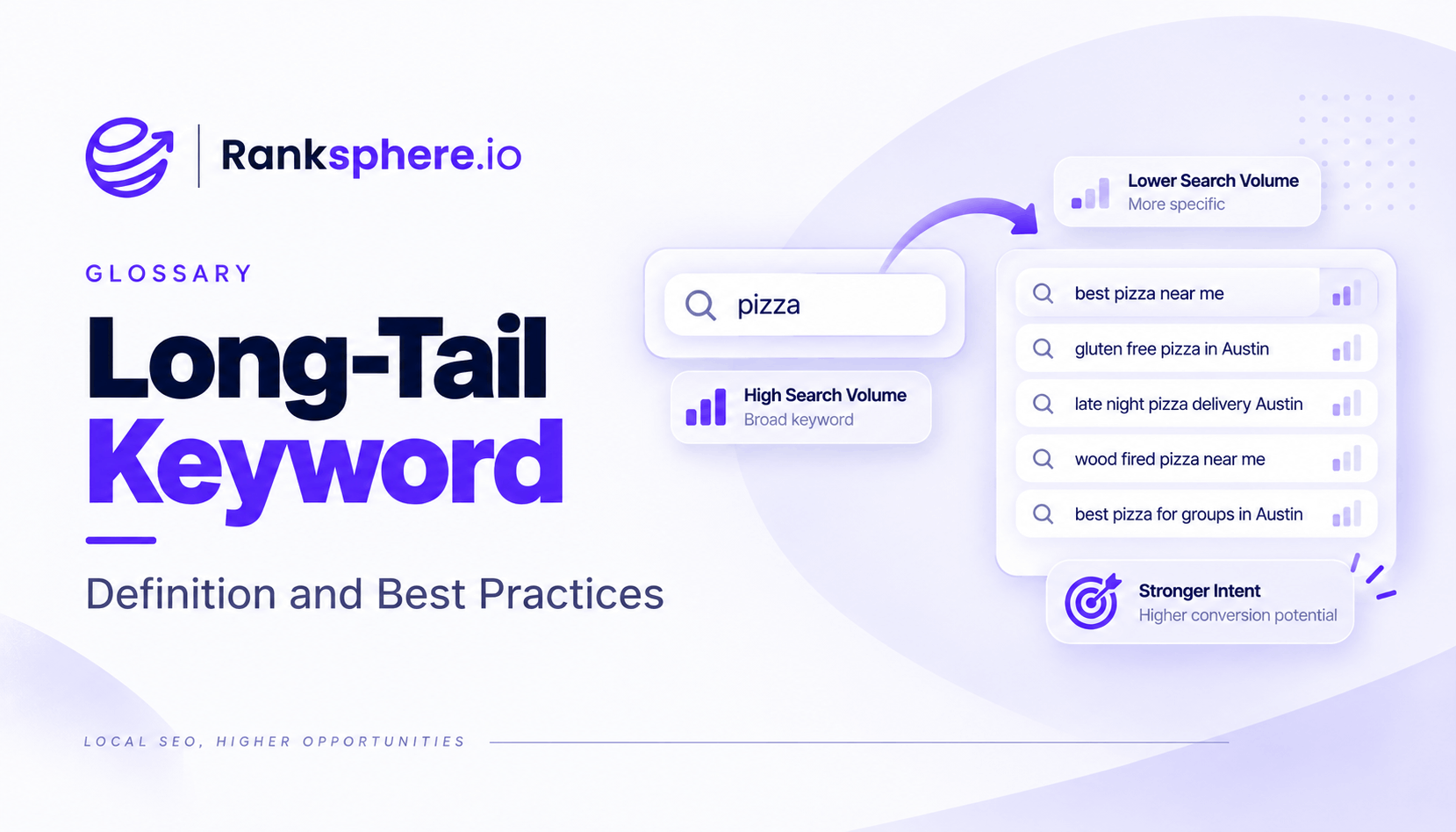
A long-tail keyword is a specific search query that usually has lower individual search volume than a broad, highly competitive keyword. Long-tail searches often reveal more about what the person wants, which can make them particularly useful for businesses trying to reach people with a clear need.
Despite the name, a long-tail keyword does not have to contain a certain number of words. What matters more is specificity.
For example, “plumber” is broad. “emergency plumber open Sunday in Hackney” tells you far more about the person's location, urgency and likely next step.
For local businesses, these more specific searches can be valuable because they often match real customer problems more closely than large, generic keywords.
Why long-tail keywords matter
Broad keywords can attract a large variety of searchers.
Someone searching “accountant,” “plumber” or “dentist” could be looking for a service, researching a career, comparing options or simply trying to understand the term.
A more specific query usually gives you more context.
Someone searching:
“emergency plumber open Sunday near Hackney”
is much easier to understand than someone searching simply:
“plumber.”
That clearer search intent can make it easier to create a page that genuinely answers what the person needs.
Long-tail keywords can help you:
- Understand exactly what the searcher is looking for
- Find specific customer problems worth addressing
- Target commercially relevant searches that broader keyword research may miss
- Create content around real questions customers ask
- Reach searches that may have less competition than broad head terms
- Build traffic across many related queries rather than depending on one large keyword
A single long-tail keyword may not generate much traffic by itself. The opportunity often comes from covering a topic well enough to rank for many related searches.
Long-tail keywords and search intent
The real value of long-tail keywords is usually not their length. It is the level of intent they reveal.
Compare:
“garden design”
with:
“small courtyard garden designer near me.”
The first query is broad. The second gives you much more information about the service, type of project and local requirement.
The same applies to informational searches.
Someone searching:
“boiler problems”
could want almost anything.
Someone searching:
“why does my boiler lose pressure overnight”
has a specific problem that can be answered directly.
This is why long-tail keyword research should focus on what the search tells you about the person, not simply how many words the query contains.
How to find long-tail keywords
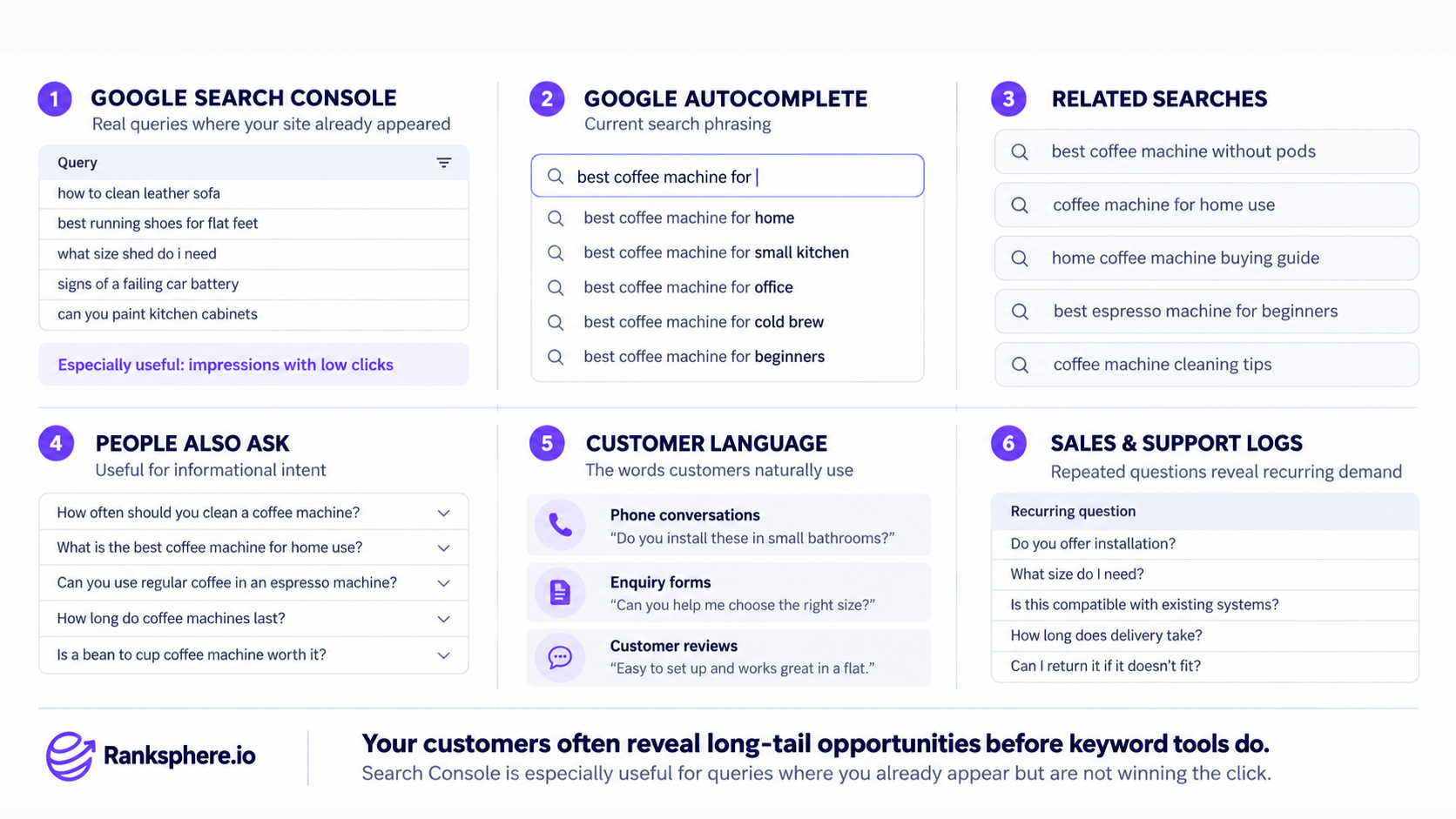
Some of the best long-tail keyword ideas come from customers rather than keyword tools.
Low-volume searches can be difficult for SEO platforms to estimate accurately, and new variations appear all the time.
Useful sources include:
Google Search Console
The Google Search Console Performance report is particularly useful because it shows real queries where your website has already appeared.
Look for:
- Searches receiving impressions but few clicks
- Queries where the site ranks just outside the top positions
- Questions you did not intentionally target
- Different ways customers describe the same service
- Specific service and location combinations
These queries can reveal topics your existing pages are already close to covering.
Google autocomplete
Start typing a relevant service or question into Google and look at the suggestions.
Autocomplete can uncover:
- Specific customer problems
- Service variations
- Location-based searches
- Question formats
- Searches around cost, urgency or availability
Related searches and People Also Ask
These can help you understand the questions and related topics surrounding a broader keyword.
Do not automatically create a page for every suggestion. Use them to understand the wider topic and group similar searches together.
Customer conversations
Listen to the language customers actually use.
Useful sources include:
- Phone enquiries
- Contact forms
- Live chat
- Emails
- Sales calls
- Support tickets
- Customer reviews
Customers often describe a service very differently from the business providing it.
Those phrases can become excellent content ideas.
Reviews
Review text can be especially useful for local SEO.
Customers naturally mention:
- Specific services
- Problems they needed solved
- Locations
- Urgency
- Features they valued
- Questions they had before choosing the business
This language can help you understand how future customers may search for the same thing.
Long-tail keywords in local SEO
Local search naturally creates more specific queries because location, service and urgency often combine.
A customer might search:
- “emergency electrician open now”
- “wedding florist near Chelsea”
- “accountant for small limited company”
- “same day boiler repair”
- “dentist taking new patients near me”
Not every customer includes a town or city in the query. Google can also use the searcher's location to interpret local intent.
That means a local SEO strategy should consider both explicit location keywords and searches where the location is implied.
For transactional searches, your Google Business Profile and service pages may both be important.
For informational long-tail queries, useful website content can answer the specific questions customers have before they are ready to make contact.
Ranksphere's rank tracker lets you track specific long-tail terms across your service area alongside broader keywords, helping you see how visibility changes for different services, search terms and locations.
How to use long-tail keywords in content
Do not build a separate page for every slight keyword variation.
For example:
- “emergency boiler repair”
- “urgent boiler repair”
- “same day boiler repair”
- “boiler repair urgently needed”
may all belong naturally on the same strong service page if the search intent is essentially the same.
The better approach is to group related terms into a topic.
A page should answer the broader need rather than attempting to repeat every keyword variation.
Use long-tail keywords to understand:
- Which questions need answering
- Which services need more detail
- What terminology customers use
- What concerns appear before someone converts
- Whether an existing page needs improving or a genuinely new page is required
This creates better content and reduces the risk of unnecessary keyword cannibalisation.
Common long-tail keyword mistakes
- Ignoring a term because its search volume is small. A low-volume search can still be commercially valuable.
- Creating a separate page for every keyword variation. Related queries are usually better grouped around one strong topic.
- Stuffing multiple long-tail phrases into the copy. Write naturally around the subject rather than forcing exact-match keywords.
- Assuming every long phrase is a long-tail keyword. Specificity and intent matter more than word count.
- Depending entirely on keyword tools. Tools can miss very specific searches and new query variations.
- Ignoring Search Console data. Your own query data can reveal opportunities that generic tools do not show.
- Creating thin content for tiny keywords. A weak page will not become useful simply because the keyword has little competition.
- Judging success only by traffic. A low-traffic page that generates qualified enquiries may be more valuable than a high-traffic informational page.
Long-tail keyword best practices
- Start with customer problems. Think about what people need rather than simply searching for long phrases.
- Use Search Console regularly. Look for specific queries your site is already appearing for.
- Group related searches into clusters. One useful page can often satisfy many variations.
- Write in customer language. Avoid unnecessary industry terminology when people search in simpler terms.
- Answer specific questions clearly. Give the useful answer without making readers dig through unnecessary copy.
- Consider intent before volume. A small number of highly relevant searches may still be worth targeting.
- Support service pages with related informational content. Customers often research before they are ready to contact a business.
- Measure leads and conversions alongside traffic. Long-tail SEO is often more valuable for the quality of visits than the size of the audience.
Example
“Thornbury Veterinary tracks broad searches such as “vet” and “veterinary clinic.”
Those terms matter, but when the practice reviews its Search Console data, it finds hundreds of more specific queries that never appeared in the original keyword research.
Many follow a similar pattern:
- “dog ate grapes what should I do”
- “is my cat's limp an emergency”
- “how much is an out of hours vet visit”
- “when does a kitten need vaccinations”
- “dog vomiting when to call vet”
Instead of creating a separate page for every query, the practice groups related questions into a handful of useful topics.
One guide covers common pet emergencies. Another explains out-of-hours veterinary care. A separate vaccination guide answers the recurring questions new pet owners ask.
Each page can now appear for a range of related long-tail searches rather than relying on one exact phrase.
More importantly, the content reaches people at the moment they actually need veterinary advice.
That is where long-tail keyword research becomes useful: not in collecting hundreds of tiny keywords, but in understanding the specific problems customers are searching for and building content that answers them properly.”
See also
- Keyword research — finding and evaluating search terms worth targeting
- Search volume — estimating how often a keyword is searched
- Search intent — understanding what the searcher is trying to accomplish
- Google Search Console — finding real queries where your website already appears
- Topic cluster — organising related searches around a broader subject
- Keyword cannibalisation — what can happen when too many pages target the same topic