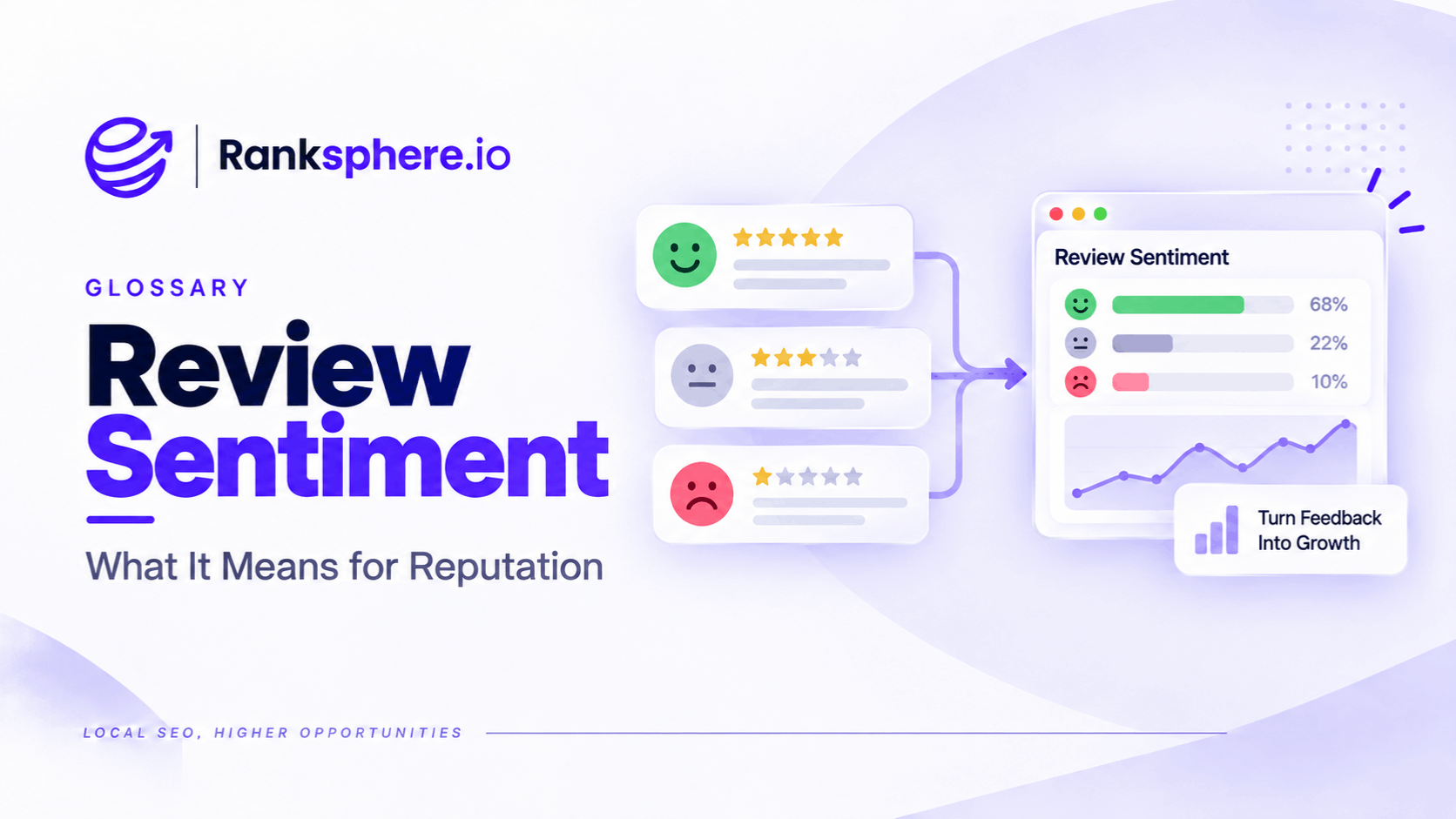
Review sentiment is the meaning, opinion and tone expressed in the words customers use when reviewing a business.
It is different from the star rating.
A star rating tells you how a customer scored the experience.
The written review helps explain why.
For example, a dental practice with a 4.2-star average may learn very little from that number alone. But if several recent reviews mention:
- Long waiting times
- Clear explanations from dentists
- Difficulty reaching reception
there is something the business can investigate.
That is the real value of review sentiment analysis.
It turns a collection of individual reviews into recurring themes that can inform:
- Customer service
- Operations
- Marketing
- Website content
- Business Profile information
- Reputation management
What is review sentiment analysis?
Review sentiment analysis is the process of examining review text to identify:
- Positive feedback
- Negative feedback
- Neutral or mixed feedback
- Recurring subjects
- Changes in those subjects over time
A basic system might classify each review as:
Positive
Neutral
or:
Negative
But useful review analysis goes further.
A review such as:
“The treatment was excellent, but I waited almost forty minutes.”
contains both positive and negative sentiment.
A simple score can easily miss that.
The useful information is:
Treatment
Positive.
Waiting time
Negative.
That is why theme-level analysis is usually more actionable than reducing every review to one sentiment number.
Star rating vs review sentiment
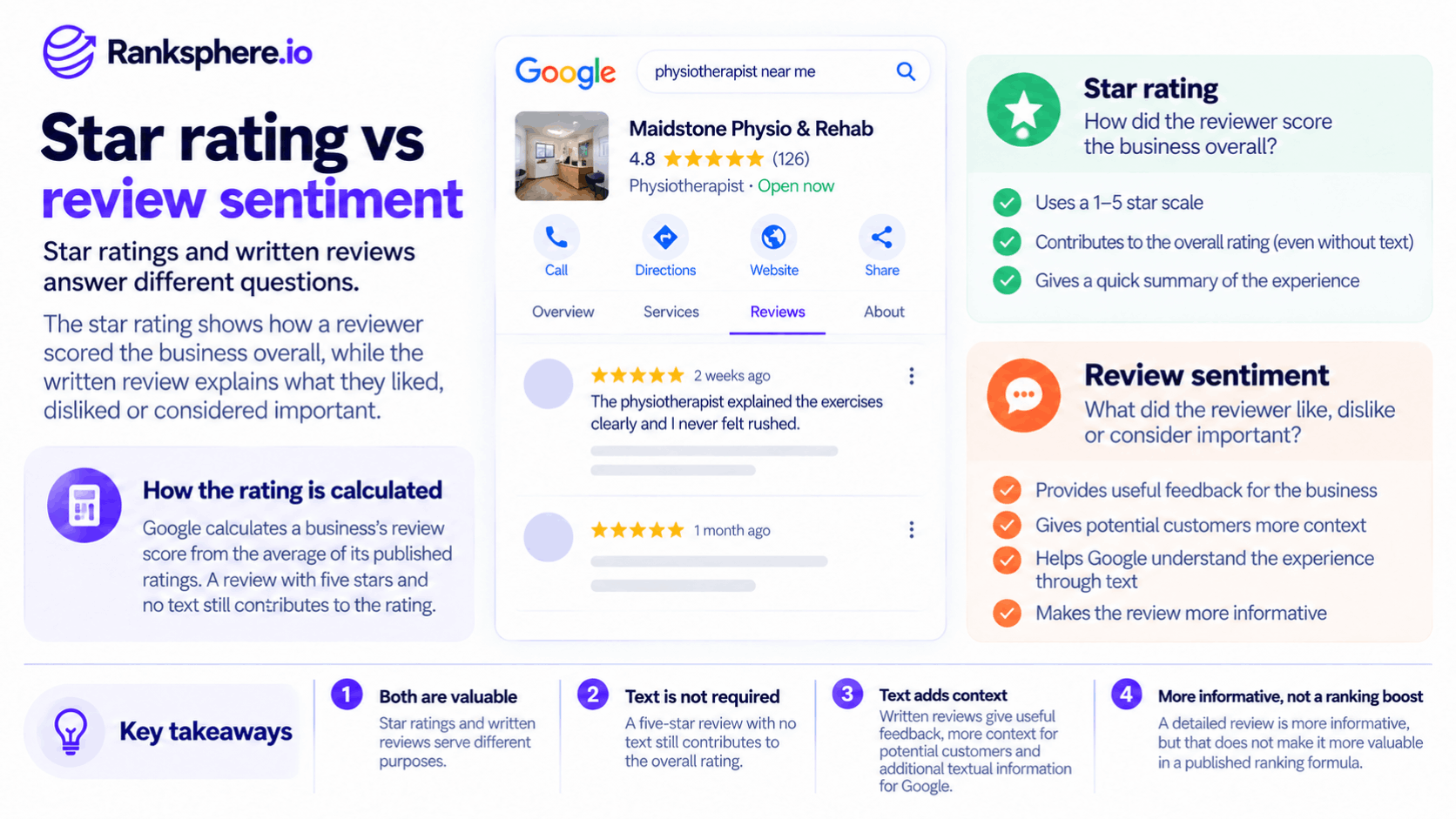
The star rating and the written review answer different questions.
Star rating
How did the reviewer score the business overall?
Review sentiment
What did the reviewer like, dislike or consider important?
Google calculates a business's review score from the average of its published ratings.
That means a review with:
five stars and no text
still contributes to the rating.
But it does not provide the same qualitative detail as:
“The physiotherapist explained the exercises clearly and I never felt rushed.”
The second review gives:
- The business useful feedback
- Potential customers more context
- Google more textual information about the experience
That does not make it more valuable in a published ranking formula.
It makes it more informative.
Why review text matters
Review text now has several uses beyond traditional social proof.
Google can identify themes in reviews
Google says it uses review data to generate Place Topics for businesses with enough quality reviews.
These topics represent common themes customers mention.
Google may also display a prevailing sentiment for a Place Topic based on the underlying reviews.
For example, restaurant reviews might repeatedly mention:
- Service
- Atmosphere
- Portions
- Parking
A customer can use those themes to explore relevant reviews without reading every review individually.
Google can surface review snippets
Google also generates review snippets algorithmically.
Its documentation says snippets can highlight frequently mentioned words and phrases from Google reviewers.
That means recurring review language can become more visible elsewhere in the Business Profile experience.
This is closely related to the ideas covered under local justifications.
But keep the distinction clear:
businesses do not choose which review phrases Google displays.
Google's systems make that decision.
Ask Maps can use review information
Review text has become particularly relevant as Google expands AI-powered local discovery.
Google launched Ask Maps in March 2026 as a Gemini-powered conversational experience for asking questions about places.
Google says Maps analyses information from more than 300 million places, including reviews from a global community of more than 500 million contributors, to generate useful answers and recommendations.
That means customer reviews can contribute to the information available when someone asks questions such as:
- Is this restaurant quiet enough for a meeting?
- Is this place suitable for children?
- Do customers like the service?
- What do people think of a particular experience?
That does not mean every review becomes an Ask Maps answer.
It means review content is part of the broader information Google can analyse.
Google can also summarise review themes for businesses
In 2026, Google began rolling out Business Profile management inside Gemini.
Google says Gemini can:
- Retrieve customer reviews
- Summarise recent reviews
- Synthesise customer-feedback themes
- Help draft review replies
for eligible Business Profile users.
This reinforces an important point:
review analysis is increasingly about understanding themes, not merely counting stars.
Review sentiment is not a documented ranking factor
Do not turn this into:
“Positive words in reviews improve rankings.”
Google's official local-ranking guidance says local results are mainly based on:
- Relevance
- Distance
- Prominence
Google explicitly says more reviews and positive ratings can help local ranking, but it does not publish a separate review sentiment score as a ranking factor.
So avoid claims such as:
“Get customers to mention your services in reviews to rank for those keywords.”
That is both unsupported as a ranking formula and problematic from a review-policy perspective.
What to look for in review sentiment
The purpose is not to read every review and label it:
good
or:
bad.
Look for patterns.
Recurring complaints
One negative review may describe an isolated problem.
Ten reviews mentioning the same issue deserve attention.
For example:
- Long waiting times
- Missed phone calls
- Delayed delivery
- Confusing billing
- Poor communication
Google itself advises businesses that negative reviews can highlight opportunities to improve and should not automatically be treated as something to remove.
When a theme repeats, investigate it operationally.
Recurring praise
Positive themes matter too.
Customers might repeatedly mention:
- Friendly staff
- Fast turnaround
- Clear explanations
- Clean premises
- Good communication
Those themes can tell the business what customers genuinely value.
That can inform:
- Positioning
- Website messaging
- Staff training
- Customer experience
But avoid immediately turning review phrases into marketing claims.
A handful of reviews mentioning something does not automatically justify:
“Known as the fastest plumber in Kent.”
Use review feedback as research, then substantiate any public claim separately.
Service mentions
Reviews can show which parts of the business customers actually talk about.
For example, a physiotherapy clinic may offer:
- Sports injury treatment
- Post-operative rehabilitation
- Back pain treatment
- Running assessments
but reviews may overwhelmingly discuss only two of those.
That observation can lead to useful questions.
Is the service:
- Less frequently purchased?
- Poorly explained?
- New?
- Not memorable enough to mention?
- Simply irrelevant to most reviewers?
Do not jump straight from:
“Nobody mentions this service”
to:
“Nobody wants this service.”
Review absence does not establish demand.
It creates something worth investigating.
Customer language
Reviews can be an excellent source of natural customer vocabulary.
Customers may use phrases the business itself does not use.
For example:
The business says:
“domestic drain remediation.”
Customers consistently say:
“blocked drain.”
That language can provide useful input for keyword research and content planning.
It can also reveal whether your Google Business Profile services use terminology customers understand.
But use that information as research.
Do not simply copy customer phrases repeatedly into SEO fields.
Staff mentions
Review text may also mention individual team members.
Repeated positive mentions can highlight:
- Strong customer service
- Clear communication
- Specialist expertise
Repeated complaints involving the same part of the customer journey can also deserve investigation.
Handle staff-related review analysis carefully.
Avoid turning public review comments into definitive employee-performance scores without context.
Reviews represent customer perceptions, not a complete performance-management system.
Changes over time
Sentiment becomes particularly useful when compared over time.
Suppose complaints about:
waiting times
were rare until March.
Then they appear in:
- April
- May
- June
The next question is:
what changed?
Perhaps the business:
- Changed its booking system
- Lost staff
- Increased customer volume
- Changed opening hours
That is more actionable than simply reporting:
negative sentiment increased by 8%.
Mixed reviews matter
Do not assume star rating and text always tell exactly the same story.
A four-star review can be extremely positive with one small criticism.
A five-star review may still mention an inconvenience.
A three-star review may praise the quality of the service but complain about communication.
That is normal.
Human experiences are often mixed.
Sentiment analysis should preserve that nuance rather than force every review into one simplistic category.
Automated sentiment analysis has limitations
AI can make large review sets much easier to analyse.
Ranksphere's review management surfaces themes across reviews with AI insights, helping businesses identify patterns without manually reading hundreds of reviews individually.
But AI sentiment analysis is not infallible.
Systems can struggle with:
- Sarcasm
- Mixed sentiment
- Industry-specific language
- Ambiguous wording
- Reviews discussing several subjects
For example:
“Fantastic treatment. Only waited an hour.”
could be sincere praise followed by a complaint.
Or the first sentence could be sarcastic.
For important decisions, review the underlying comments rather than relying solely on an automated score.
Turn themes into action
The useful output of review sentiment analysis is not:
Sentiment score: 82/100
unless that metric genuinely helps your reporting.
The useful output is more like:
Issue
Customers frequently mention difficulty getting through by phone.
Evidence
Appears repeatedly in recent reviews.
Owner
Reception or operations team.
Action
Review call handling and missed-call process.
Follow-up
Check whether the theme continues appearing in future reviews.
That creates a feedback loop.
Operational issues belong with operations
Not every reputation problem is a marketing problem.
If customers repeatedly complain about:
- Late appointments
- Incorrect orders
- Billing errors
- Failed callbacks
the answer is not:
write better review responses.
The underlying process needs attention.
Marketing can help:
- Identify the pattern
- Report it
- Monitor whether it improves
But the operational team usually owns the underlying fix.
Positive themes can inform marketing
Positive sentiment also deserves action.
If customers repeatedly praise:
clear communication
that may reveal a genuine strength.
If patients consistently mention:
feeling comfortable despite being nervous
that could be useful insight for a dental practice's positioning.
The marketing team can use those themes to investigate what differentiates the business.
Again, avoid transforming review comments directly into unsupported superlatives.
Review responses
Review responses can show customers that the business pays attention to feedback.
Google recommends responding professionally and making replies useful rather than posting generic responses to everything.
A good response can:
- Acknowledge feedback
- Clarify useful information
- Address a legitimate concern
- Move private matters offline
Do not reveal confidential customer information when replying.
And do not use responses as an excuse to argue publicly with every criticism.
Asking customers for reviews
Businesses are allowed to ask genuine customers for reviews.
Google provides review links and QR codes specifically for this purpose.
But there is an important boundary.
Google's Maps policy says merchants must not request that reviewers include specific content.
That means you should not ask:
Please mention which treatment you received.
or:
Please mention Sarah by name.
or:
Please mention that we repaired your boiler the same day.
Those requests steer the content of the review.
A safer review request
Ask for an honest review without directing what the customer should say.
For example:
We'd appreciate an honest Google review if you'd like to share your experience with us.
That leaves the reviewer free to decide:
- Whether to write
- How many stars to give
- What details to mention
- Whether the experience was positive or negative
That is the correct principle.
Do not review-gate
You should also never condition the review request on sentiment.
For example:
Happy customer
Send them to Google.
Unhappy customer
Send them to a private feedback form.
That is review gating.
Google prohibits discouraging negative reviews or selectively soliciting positive reviews.
The review programme should be neutral.
Do not offer incentives
Never offer:
- Discounts
- Vouchers
- Free products
- Competition entries
in exchange for a review.
Google classifies incentivised reviews as prohibited fake engagement.
See fake reviews.
The purpose is genuine customer feedback.
Not manufactured sentiment.
Rating-only reviews are still useful
Do not dismiss a five-star rating simply because the customer wrote nothing.
It still contributes to the overall review score.
The distinction is:
Rating only
Provides quantitative feedback.
Rating plus written review
Provides quantitative and qualitative feedback.
Both have value.
The written version simply gives the business and potential customers more information to work with.
Google may ask reviewers additional questions itself
For some service businesses, Google can ask reviewers about particular aspects of their experience.
Google says eligible reviewers may be asked:
- What tasks the business performed
- How particular aspects of the experience went
Those possible tasks can come from the merchant's service list, website, Google's standard business-type information or other authoritative sources.
That is another reason businesses do not need to coach customers about what to include in their reviews.
Keep the underlying service information accurate and let Google and the reviewer handle the review itself.
Review sentiment and local justifications
Review text can sometimes appear prominently in local-search experiences.
Google officially documents algorithmically selected review snippets and Place Topics derived from customer reviews.
Local SEO practitioners often discuss similar query-specific snippets under local justifications.
The useful takeaway is simple:
Google can analyse and surface themes from genuine customer language.
The wrong takeaway is:
“Tell customers which keywords to put in their reviews.”
Do not do that.
Review sentiment and keyword research
Customer reviews can be useful qualitative input for keyword research.
They can reveal:
- Customer terminology
- Problems customers are trying to solve
- Questions they had before buying
- Features they care about
- Language the business itself may overlook
But review language does not prove search demand.
If customers repeatedly say:
“same-day boiler repair”
that phrase is worth investigating.
It does not automatically mean:
same-day boiler repair has high search volume.
Validate it with proper keyword research.
Review sentiment is not the same as reputation management
Reputation management includes:
- Monitoring reviews
- Responding appropriately
- Handling policy violations
- Encouraging genuine feedback
- Understanding public perception
Sentiment analysis is one part of that process.
Its particular value is diagnosis.
Instead of asking:
“Are people happy?”
you can ask:
“What are customers repeatedly happy or unhappy about?”
That produces much more useful information.
What to report
A useful review-sentiment report might include:
- Top positive themes
- Top negative themes
- Newly emerging themes
- Themes improving
- Themes getting worse
- Relevant example reviews
- Operational actions assigned
- Changes since the previous period
You can still include:
positive sentiment percentage
or another summary metric if it is useful.
But do not let one score hide what customers are actually saying.
Do not benchmark sentiment scores blindly
One tool may classify a review as:
positive
while another calls it:
mixed.
Different systems use different:
- Models
- Rules
- Confidence thresholds
So a sentiment score from one platform should not be treated as a universal standard.
It is generally more useful to compare:
the same business using the same methodology over time
than to say:
our sentiment score is 81 and the competitor's is 77.
Common review sentiment mistakes
- Tracking only the star rating and ignoring what customers actually write.
- Treating every negative theme as a marketing problem rather than checking operations.
- Assuming a rating-only review has no value.
- Treating positive words in reviews as a documented ranking factor.
- Asking customers to mention particular services, employees or keywords.
- Using review gating to influence the review mix.
- Offering incentives for reviews.
- Reading only negative reviews and ignoring repeated positive themes.
- Assuming an absent service mention proves low demand.
- Using customer language as keyword-volume evidence without further research.
- Taking automated sentiment classifications as infallible.
- Reducing hundreds of customer comments to one sentiment score and stopping there.
Review sentiment best practices
- Analyse review text systematically rather than relying on whichever reviews someone remembers.
- Group feedback into themes such as communication, service quality, waiting time and pricing.
- Separate positive, negative and mixed sentiment within each theme.
- Track how themes change over time.
- Route recurring operational problems to the team capable of fixing them.
- Use customer language as qualitative input for keyword research, content and service descriptions.
- Keep Google Business Profile services accurate rather than copying words from reviews blindly.
- Ask customers for honest reviews without suggesting what they should write.
- Never incentivise reviews or selectively ask only satisfied customers.
- Use AI to identify patterns at scale, but check the underlying reviews before making important decisions.
- Report themes and actions alongside any sentiment score.
Example
“Consider a hypothetical garage called Kestrel Auto Repair.
Its Google Business Profile has a relatively low average rating.
The first instinct is:
“We need more positive reviews.”
Instead, the garage analyses the review text.
A repeated theme appears.
Customers generally praise:
- Repair quality
- Pricing
- Staff knowledge
But several reviews complain that vehicles are kept longer than expected and customers are not told when completion times change.
That distinction matters.
The main problem is not:
poor mechanical work.
It is:
communication when a job is delayed.
The business does not hire someone simply to bury the complaints with more reviews.
It changes the process.
When a repair is likely to run later than quoted, the customer receives an update explaining:
- That there is a delay
- Why
- The revised expected completion time
The garage also introduces a neutral review request after completed jobs.
Every eligible customer receives the same invitation.
Nobody is:
- Screened by satisfaction
- Asked for five stars
- Told what to mention
- Offered an incentive
That keeps the review process aligned with Google's Maps policies.
Over time, the business watches whether complaints about communication become less common.
The useful outcome is not an invented claim such as:
“the rating rose from 3.4 to 4.4 in eighteen months.”
It is something more actionable:
the reviews identified a repeated customer-experience problem, the business changed the process, and future reviews provide a way to see whether customers notice the difference.
That is what review sentiment analysis is good for.
The star rating gives you a summary.
The review text gives you the explanation.
And increasingly, that text can also feed Google's own review themes, snippets and AI-powered Maps experiences.
For a business, the goal should not be to manufacture more positive sentiment. It should be to understand what genuine customers are saying, fix recurring problems, preserve what they value and make better decisions from the feedback already being produced.”
See also
- Online review — the wider customer-feedback topic
- Star rating — the numerical score review sentiment sits behind
- Local justifications — where review-derived wording can become visible in local results
- Ask Maps — Google's conversational Maps experience, which can analyse review information
- Reputation management — monitoring and acting on public customer feedback
- Review response — responding appropriately to the feedback customers leave