A star rating is the average score created from the ratings customers leave for a business.
On Google Search and Maps, businesses are rated on a scale from one to five stars, with five being the highest.
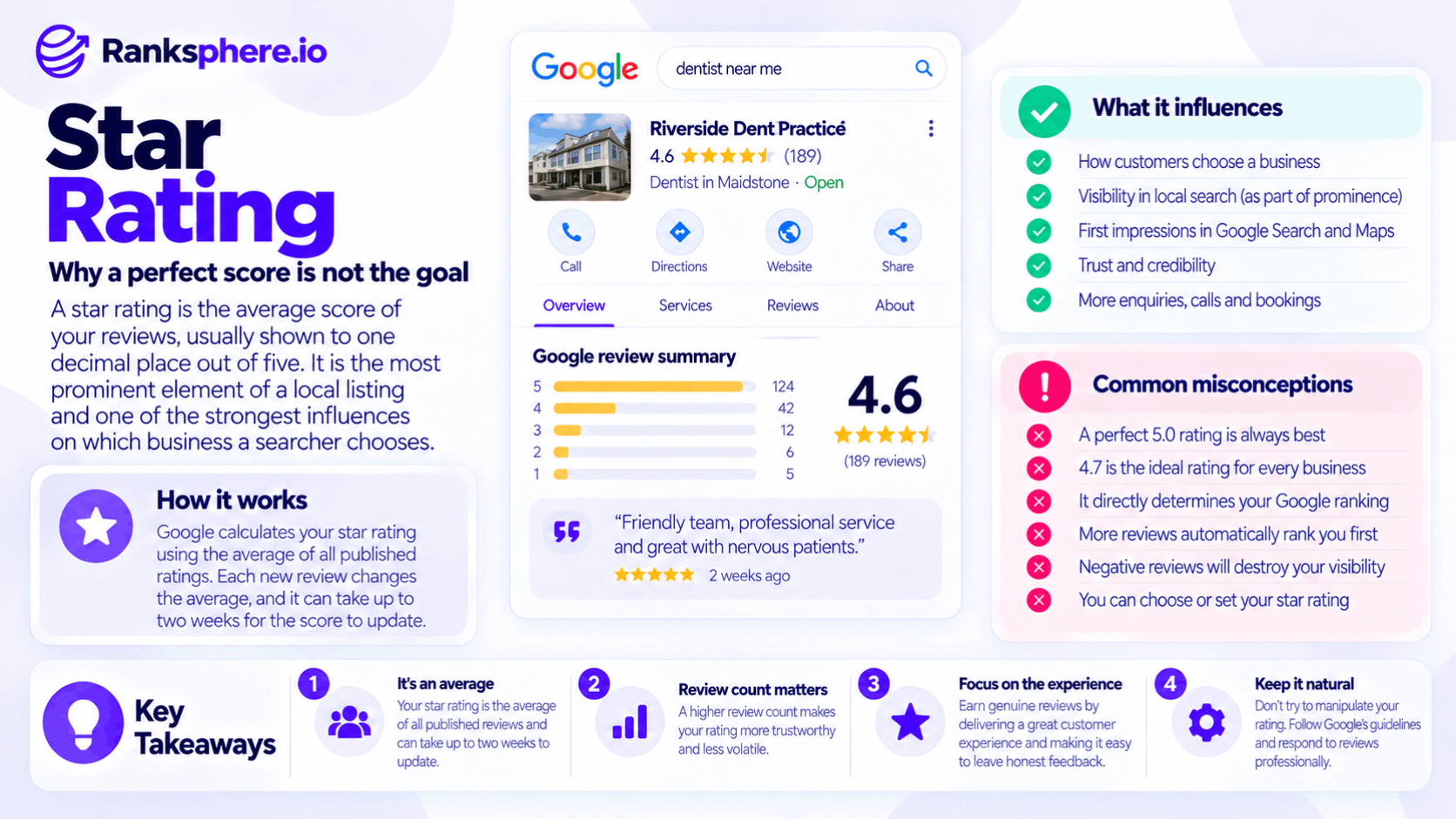
Google calculates the review score using the average of all ratings currently published for that business. Google also notes that after a new review is posted, the displayed score can take up to two weeks to update.
The number looks simple.
What sits behind it is not.
A business with:
4.8 stars from 12 reviews
has a very different review profile from one with:
4.8 stars from 600 reviews.
The average rating is therefore best understood alongside:
- Review count
- Recent review activity
- Written feedback
- Review responses
- Patterns in positive and negative sentiment
The star rating is an output.
The business cannot legitimately choose the number it wants.
What it can influence is the customer experience, how consistently genuine customers are invited to review it, and how it responds to the feedback those customers provide.
How Google calculates a star rating
Google's calculation is straightforward:
Average rating = Total value of published ratings ÷ Number of published ratings
For example, if five customers leave:
5, 5, 4, 5, 3
the average is:
22 ÷ 5 = 4.4
As more ratings accumulate, each individual review has less effect on the overall average.
That is why ratings move quickly when a business has only a handful of reviews and much more slowly once hundreds have accumulated.
Google ratings may not update immediately
Do not panic if a new review appears but the displayed average does not move straight away.
Google says it can take up to two weeks for a new review to be reflected in the review score.
That means:
new review appeared today
does not necessarily equal:
rating recalculates immediately today.
Allow for processing time before assuming the score is wrong.
Why review count matters
An average becomes more stable as the number of ratings increases.
Imagine:
Business A
5.0 from 4 reviews.
Business B
4.8 from 250 reviews.
You cannot conclude from the average alone that Business A provides the better customer experience.
The second score represents a much larger sample.
Consumers also pay attention to review count. BrightLocal's 2026 consumer survey found that review count, recency, star rating and consistency of sentiment all influenced how respondents assessed local businesses.
That is why the correct goal is not:
get the highest decimal possible.
It is:
build a genuine, representative review profile over time.
Is a perfect five-star rating bad?
No.
A genuine 5.0 rating is not something a business needs to avoid.
The claim that:
4.7 is always more trustworthy than 5.0
goes too far.
Google itself says a mixture of positive and negative feedback can sometimes feel more trustworthy to potential customers.
But that does not establish a universal ideal rating.
BrightLocal's 2026 survey found that only 10% of respondents required a perfect five-star rating, while 31% would only use businesses with at least 4.5 stars.
The more useful lesson is:
a perfect rating is not necessary for trust, and a less-than-perfect rating is not automatically a problem.
Customers look beyond the decimal.
Do not target 4.7
There is no evidence that:
4.7
is the ideal Google rating for every business.
The right objective is not:
“We need to reduce our 5.0 to look believable.”
Nor is it:
“We must protect 5.0 at any cost.”
The objective should be:
- Genuine reviews
- Representative feedback
- Strong customer experience
- A healthy number of recent reviews
- Professional responses
Let the rating reflect the underlying customer experience.
Written reviews matter too
A star score tells a customer:
how reviewers rated the business overall.
The written reviews explain:
why.
For example, a dental practice might repeatedly receive praise for:
- Nervous-patient care
- Clear explanations
- Appointment availability
or repeated complaints about:
- Waiting times
- Billing
- Communication
Those patterns provide much more useful information than the average alone.
BrightLocal's 2026 research found that consistency of sentiment across multiple reviews was one of the most important review signals for respondents, ahead of simply looking at one isolated review.
Review recency
Older reviews are still legitimate reviews.
But customers may place more weight on recent experiences when deciding whether the business is still performing well.
BrightLocal's 2026 survey found increased consumer attention to recent reviews, with many respondents looking particularly at feedback from the previous few months.
That makes ongoing review collection useful from a reputation perspective.
But keep the SEO language accurate.
Google's official local-ranking guidance does not specifically identify:
review recency
as a separate local ranking factor.
Google does explicitly say that:
more reviews and positive ratings can help local ranking.
Those are not the same claim.
Review velocity
Review velocity is an SEO-industry term describing the rate at which a business receives new reviews.
For example:
Business A
Receives roughly 10 genuine reviews each month.
Business B
Received 70 reviews two years ago and almost none since.
Velocity can be useful as an operational reporting metric because it shows whether fresh customer feedback continues to arrive.
It is not an official Google metric and there is no published formula saying:
10 reviews per month = ranking improvement.
Google's policies actually warn that unusual volumes or patterns of review activity can be associated with attempts to manipulate ratings.
So do not chase a manufactured review velocity.
Ask real customers consistently and let the pace reflect real business activity.
The mathematics of changing a rating
The average becomes harder to move as the number of ratings increases.
If a business has:
N reviews
with an average rating of:
A
and then receives:
X new five-star ratings
the approximate new average is:
(N × A + 5X) ÷ (N + X)
This explains why businesses with hundreds of reviews cannot repair a low average overnight.
Example: 20 reviews at 3.5
Suppose a business has:
20 reviews at an average of 3.5.
The approximate existing rating total is:
20 × 3.5 = 70
If it then legitimately receives ten additional five-star reviews:
70 + 50 = 120
across:
30 reviews
the new average becomes:
4.0.
Example: 400 reviews at 3.5
Now take a business with:
400 reviews at 3.5.
Existing rating total:
1,400
To reach an average of approximately 4.0 using only new five-star ratings would require around:
200 additional five-star ratings.
That is why high-volume profiles move more slowly.
It is mathematics.
Not an algorithm penalty.
Early reviews have a larger mathematical effect
When a business has only a few reviews, each additional rating has a much larger influence on the average.
For example, one one-star rating among:
five reviews
has a far greater numerical effect than one one-star rating among:
500 reviews.
That does not mean businesses should obsess over the first 20 reviews.
It means small samples are naturally volatile.
As the sample grows, the average becomes more stable.
You cannot legitimately “fix” the rating by selecting reviewers
This is where review management can cross into review gating.
Google allows businesses to ask customers for reviews.
Google even provides a direct review link and QR code businesses can share through:
- Receipts
- Emails
- Messages
But Google's policy prohibits businesses from:
- Offering incentives for reviews
- Discouraging negative reviews
- Selectively soliciting positive reviews
- Asking customers to include specific content
So a business with a low rating should not respond by asking only its happiest customers to review it.
That does not measure improved service.
It manipulates the sample.
Fake reviews
Buying reviews is also prohibited.
Google defines ratings or reviews that are:
- Paid for
- Incentivised
- Not based on genuine experiences
as fake engagement.
Google also says it detects and removes policy-violating reviews and can impose restrictions where it finds suspicious review behaviour. In 2026, Google said it had blocked or removed more than 292 million policy-violating reviews during 2025.
See fake reviews.
The correct way to improve a rating is therefore not:
manufacture more five-star reviews.
It is:
improve the customer experience and continue asking genuine customers for honest feedback.
What star ratings affect
Customer choice
Ratings are highly visible when customers compare local businesses.
Recent third-party consumer research supports their importance.
BrightLocal's 2026 survey found that star rating was one of several important factors consumers considered alongside:
- Location
- Review count
- Recent reviews
- Written feedback
Another 2026 BrightLocal study found star rating among the more frequently considered pieces of information when consumers research local businesses.
That does not mean:
the highest-rated business always gets the click.
Customers consider several factors.
Local ranking
Google explicitly confirms that:
more reviews and positive ratings can help a business's local ranking
as part of prominence.
But avoid turning that into a formula.
Google does not publish:
4.8 ranks above 4.6
or:
100 reviews outrank 50.
Local ranking also considers:
- Relevance
- Distance
- Prominence
and those factors work together.
Review recency is not the same as a documented ranking factor
It is tempting to write:
rating + count + recency determine review rankings.
Google has not published that formula.
We have good evidence that recent reviews matter to consumers.
We do not have an official Google statement assigning review recency a specific local-ranking weight.
Keep those claims separate.
Ratings and AI-powered local recommendations
Ratings and reviews are also increasingly relevant as Google expands AI-powered local discovery.
Google's Ask Maps experience analyses information from more than 300 million places, including reviews from its community of contributors.
Google has also previously described Maps-based generative AI as using information including:
- Photos
- Ratings
- Reviews
when generating local recommendations.
That makes accurate, genuine reviews useful beyond the traditional listing.
But there is no published formula telling us:
4.8 stars receives more AI recommendations than 4.6.
Do not optimise around an invented threshold.
A low rating is usually a service question first
If a business has:
3.2 stars
the first question should not be:
“How do we push this to 4.5?”
Read the reviews.
Look for repeated themes.
For example:
- Long waiting times
- Missed calls
- Poor communication
- Unexpected charges
- Late appointments
- Product-quality issues
If the same complaint appears repeatedly, the review profile may be revealing an operational problem.
SEO cannot solve:
customers consistently receiving poor service.
The business needs to fix the cause first.
Negative reviews are not automatically bad
Google itself says negative reviews do not necessarily mean poor business practices and can provide an opportunity to understand customer expectations and improve the experience.
A legitimate critical review can therefore be useful.
It can:
- Reveal a problem
- Give the business an opportunity to respond
- Give future customers additional context
That is different from intentionally wanting negative reviews.
Do not aim for:
“a few one-stars for credibility.”
Simply accept genuine feedback rather than trying to engineer a perfect-looking profile.
Review responses
A thoughtful review response can show customers that the business pays attention to feedback.
Google recommends replies that are:
- Professional
- Relevant
- Helpful
- Conversational
It also recommends responding promptly where useful.
But Google does not say that every positive review needs:
“Thanks for the five stars!”
Google explicitly notes that businesses do not have to publicly thank every reviewer and should focus on responses where there is something useful to say.
Quality matters more than mechanically reaching a 100% reply rate.
Respond carefully to negative reviews
When responding to a negative review:
- Stay professional
- Do not reveal private customer information
- Acknowledge legitimate problems
- Explain useful context
- Move complicated disputes offline where appropriate
If the review violates Google's policies, it can be reported.
But Google says a review is not eligible for removal merely because the business disagrees with it.
That distinction is important.
Negative feedback and policy-violating content are not the same thing.
Reporting a review does not guarantee removal
If a review:
- Contains spam
- Violates policy
- Contains prohibited content
Google can review it for removal.
If Google finds no policy violation, the review remains.
Businesses can currently submit a one-time appeal for eligible rejected removal requests.
Do not promise clients:
“We can remove your bad reviews.”
Review removal depends on policy eligibility.
What to do about a low star rating
Start with the customer experience.
Then build a legitimate review programme.
A sound process is:
- Read negative and neutral reviews for recurring problems.
- Fix genuine operational issues.
- Ask customers broadly for honest reviews.
- Never offer an incentive.
- Never suppress unhappy customers.
- Respond thoughtfully where a response adds value.
- Monitor the average, review count and recent feedback over time.
That creates a review profile that reflects the actual business.
Do not run a “five-star campaign”
A campaign whose goal is:
“Get us 100 five-star reviews this month.”
creates several problems.
It encourages staff to:
- Select happy customers
- Pressure customers
- Focus on rating rather than feedback
and can create unnatural patterns.
Google explicitly lists unusual volumes or patterns of review contributions among the signals associated with rating manipulation.
Instead, build review requests into the normal customer journey.
For example:
- After a completed appointment
- In a follow-up email
- On a receipt
- Through Google's review QR code
without conditioning the request on whether the customer was happy.
Review velocity should reflect real business volume
A restaurant serving hundreds of customers each week may naturally receive many more reviews than a specialist solicitor serving ten clients a month.
Those businesses should not target the same:
“reviews per month.”
Review velocity should be interpreted in the context of:
- Customer volume
- Industry
- Transaction frequency
- Existing review process
Do not chase a competitor's exact monthly number.
The objective is steady, legitimate feedback from real customers.
Review count is not a target copied from competitors
Suppose:
you have 80 reviews
and:
the competitor has 400.
That does not mean the strategy is:
get another 320 reviews.
The competitor may be:
- Older
- Larger
- Serving more customers
- Operating in several market segments
Review count is useful competitive context.
It is not a quota.
Ranksphere and review reporting
Ranksphere's review management tracks rating alongside volume, velocity and reply rate, which makes it possible to view the average rating alongside the activity underneath it rather than treating the star score as the entire reputation picture.
Those measures should still be interpreted separately:
Rating shows the average score.
Volume shows how much feedback exists.
Velocity shows how frequently new reviews are arriving.
Reply rate shows how consistently the business is responding.
None tells the whole story alone.
Common star-rating mistakes
- Treating 5.0 as suspicious by definition.
- Claiming 4.7 is universally more persuasive than 5.0.
- Trying to preserve a perfect rating instead of collecting representative feedback.
- Treating review velocity as an official Google ranking factor.
- Assuming review recency has a documented Google ranking weight.
- Comparing ratings without considering review count.
- Ignoring what written reviews actually say.
- Asking only satisfied customers to review the business.
- Buying or incentivising reviews.
- Pressuring customers to leave five stars.
- Running short artificial review bursts to move the average.
- Promising that one negative review will destroy rankings.
- Reporting every legitimate negative review for removal.
- Posting identical replies to every review simply to reach a 100% response rate.
- Treating the rating as the only reputation KPI.
Star-rating best practices
- Focus on delivering an experience that earns positive reviews naturally.
- Ask real customers for honest reviews without filtering them first.
- Use Google's official review link or QR code to make the process easier.
- Never offer incentives for ratings or reviews.
- Never use review gating to protect the score.
- Track rating alongside review count and recent review activity.
- Treat review velocity as an operational metric rather than a published ranking signal.
- Read written reviews for recurring operational themes.
- Use thoughtful review responses where you can add useful context.
- Report reviews only when they genuinely violate Google's content policies.
- Do not set an arbitrary target such as 4.7 simply because it looks believable.
- Let the rating reflect genuine customer experience rather than manipulating the sample.
Example
“Consider a hypothetical dental practice called Larkspur Dental.
Its Google Business Profile shows:
4.9 stars from 41 reviews.
Most of those reviews were collected during a short period several years ago.
A nearby competitor has:
4.6 stars from 310 reviews
with new feedback appearing regularly.
It would be wrong to conclude automatically that:
the competitor is more trustworthy because 4.6 looks more realistic.
The 4.9 rating is genuinely strong.
But the two profiles communicate different information.
Larkspur has:
- Higher average rating
- Smaller sample
- Little recent feedback
The competitor has:
- Lower average rating
- Much larger sample
- More current customer experiences
Recent consumer research suggests shoppers look at all of those elements rather than relying on the star average alone.
Larkspur therefore does not try to:
lower its rating to 4.7
or:
generate a burst of five-star reviews.
Instead, it introduces a neutral review process.
After appointments, patients are given Google's review link and invited to leave an honest review if they wish.
The practice:
- Does not screen customers first
- Does not offer discounts
- Does not ask for five stars
- Does not tell patients what to write
Those rules keep the process within Google's policies.
At the same time, the team reads older negative feedback and notices recurring comments about appointment delays.
That becomes the operational priority.
As genuine new reviews arrive, Larkspur's rating may:
- Stay at 4.9
- Rise
- Fall slightly
Any of those can happen.
The goal is not to defend a decimal.
It is to build a larger, more current and more representative body of customer feedback.
No fabricated result such as:
218 reviews after fourteen months
or:
more conversions despite falling to 4.7
is needed.
The lesson is stronger without it:
a star rating is useful, but it is only the average sitting on top of a much richer review profile.
Google itself calculates the score from all published ratings, and Google confirms that more reviews and positive ratings can contribute to local prominence. Customers, meanwhile, also look at review count, recency, written experiences and how businesses respond.
So the right objective is not:
“How do we get to the perfect rating?”
It is:
“How do we consistently give customers an experience worth reviewing, make it easy for every genuine customer to leave honest feedback, and use that feedback to improve the business?””
See also
- Online review — the wider customer-feedback picture
- Review velocity — the rate at which genuine new reviews arrive
- Review response — how the business responds publicly to customer feedback
- Review gating — prohibited selective review solicitation
- Local ranking factors — where Google confirms more reviews and positive ratings can contribute to prominence
- Fake review — prohibited ratings or reviews that do not reflect genuine experience