Rank tracking is the process of monitoring where a website or business appears in search results for selected keywords over time.
For traditional organic SEO, this often means recording the position of a webpage for a keyword from a set location and device. For local SEO, the picture is more complicated because rankings can change significantly depending on where the searcher is located.
That is why good rank tracking is less about checking one number on one day and more about understanding how search visibility changes over time.
A single ranking can be useful, but the trend is usually more valuable.
What rank tracking measures
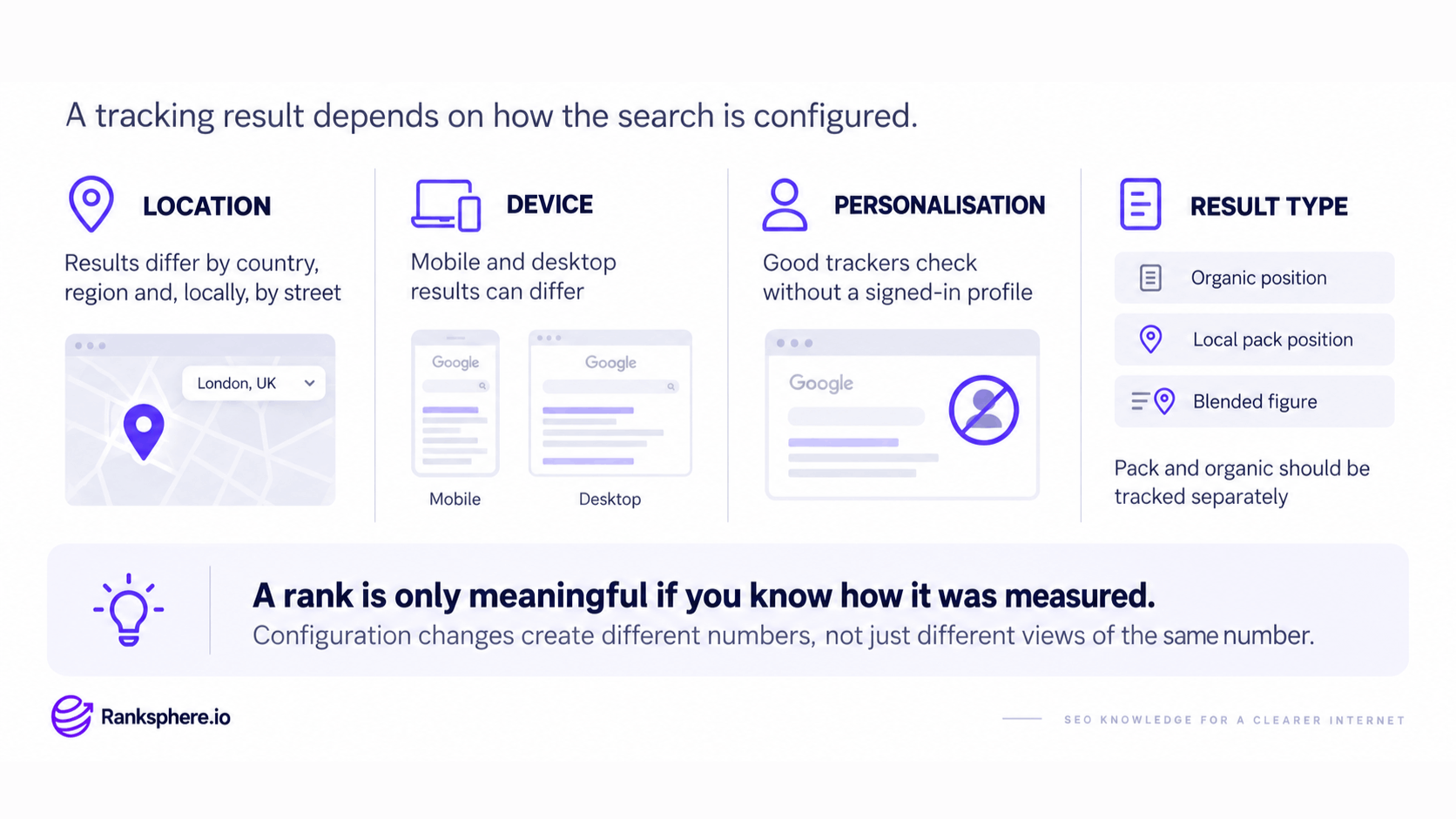
A rank tracking tool searches for a keyword using a defined set of conditions, records where the business or website appears, and stores that result so it can be compared with future scans.
Several settings can change the number you see.
Location
Search results vary by location.
For national campaigns, this may mean choosing a country or region. For local businesses, results can change from one neighbourhood or street to another.
The location used by the tracker should reflect the market you actually want to measure.
Device
Mobile and desktop search results are not always identical.
If most of your customers search on mobile, make sure your tracking setup reflects that rather than relying only on desktop results.
Personalisation
Reliable rank trackers generally try to reduce personalisation by running searches without an individual user's normal search history or signed-in profile.
This gives you a more consistent basis for comparison.
Result type
It is important to distinguish between:
- Organic rankings
- Local pack rankings
- Map results
- Other SERP features
Organic and local pack visibility should usually be reported separately because they are influenced by different factors.
Combining them into one position can make it harder to understand what is actually improving.
Why local rank tracking is different
Local rankings are heavily influenced by where the search takes place.
A plumber might appear in the top three results close to the business address and be much less visible several miles away.
That does not mean one result is right and the other is wrong. Both can accurately reflect what different customers see.
This is one of the main limitations of single-location tracking.
If you only check rankings from the business address, you may get a very narrow view of local visibility. The business could perform strongly nearby while having much weaker coverage across the wider service area.
That is where geo-grid rank tracking becomes useful.
Instead of checking one point, a geo-grid measures rankings from multiple locations across an area. This gives you a clearer picture of where the business is visible and where rankings begin to drop.
For local SEO, this can help you understand:
- Top-three coverage across an area
- Areas where the business is barely visible
- Differences between nearby locations
- Competitor strength in different parts of the market
- How visibility changes after SEO work
Ranksphere's rank tracker runs grid scans from 5×5 to 12×12 with recurring schedules, reporting coverage, average position and share of voice while keeping local pack and organic visibility separate.
Rank tracking and search visibility
Rank tracking is most useful when you treat rankings as a visibility metric rather than the final business outcome.
A keyword moving from position 14 to position 7 is useful progress, but that movement only matters commercially if people see the result, click it and eventually become customers.
That is why ranking data should be read alongside:
- Search impressions
- Website clicks
- Click-through rate
- Leads and enquiries
- Calls
- Bookings
- Google Business Profile actions
Google Search Console is particularly useful for connecting rankings with impressions and clicks from organic search.
For local businesses, you should also review Business Profile activity because many customers can call or request directions without visiting the website.
How often should you track rankings?
There is no single schedule that suits every campaign.
The right frequency depends on how quickly the market changes and how closely you need to monitor performance.
For many local businesses, weekly or fortnightly scans provide enough information to see meaningful trends without overreacting to normal daily movement.
More frequent tracking can still be useful when:
- Monitoring a major website migration
- Watching the impact of a large SEO change
- Tracking a highly competitive market
- Investigating sudden ranking movement
- Monitoring an active algorithm update
Whatever schedule you use, consistency matters.
Changing the tracking location, device or grid configuration midway through a campaign can make historical comparisons much less useful.
How to track rankings properly
Start with a focused set of keywords that matter commercially.
You do not need to track every phrase found during keyword research.
A useful keyword set might include:
- Main services
- High-value commercial searches
- Important location terms
- A selection of broader and long-tail keywords
- Branded searches where relevant
Then keep the tracking setup consistent.
A good process is to:
- Choose the keywords that matter to the business
- Set the correct target location
- Choose the relevant device
- Separate organic and local pack tracking
- Set a consistent scan schedule
- Add key competitors for comparison
- Review trends rather than isolated movements
- Compare rankings with traffic and conversions
The point is not to collect as many ranking numbers as possible.
It is to understand whether search visibility is improving in the markets and for the services that matter.
Rank tracking for local SEO
For local businesses, one average ranking often hides more than it reveals.
Imagine a business ranking:
- Position 2 near its premises
- Position 4 one mile away
- Position 9 three miles away
- Position 18 at the edge of its service area
Reporting an average position alone would flatten those differences into one number.
A coverage-based view is often more useful.
You might report:
- Percentage of grid points in the top three
- Percentage in the top ten
- Average grid position
- Share of local voice
- Competitor coverage
This gives a much more practical view of whether the business is visible across the area where customers actually search.
Common rank tracking mistakes
- Relying on one local search point. A single location does not show how visibility changes across the wider market.
- Reacting to every small movement. Search results naturally fluctuate, so focus on patterns rather than individual daily changes.
- Changing tracking settings midway through reporting. This makes comparisons less reliable.
- Tracking too many irrelevant keywords. Large keyword lists can hide the terms that actually matter commercially.
- Combining local pack and organic rankings. They are different search surfaces and should be measured separately.
- Reporting rankings without business outcomes. A ranking increase matters more when it leads to additional visibility, traffic or enquiries.
- Checking only the business location. This may not represent what customers see elsewhere in the service area.
- Ignoring competitors. Your ranking becomes more meaningful when you understand what is happening around it.
Rank tracking best practices
- Track keywords tied to real services and commercial goals.
- Use geo-grid tracking for important local searches.
- Keep organic and local pack rankings separate.
- Measure coverage as well as average position.
- Use the same tracking settings over time.
- Review ranking trends rather than single-day changes.
- Track relevant competitors for context.
- Compare ranking data with impressions, clicks and conversions.
- Adjust the keyword set when services or priorities change.
Example
“Stonegate Vets receives an SEO report showing that most of its tracked keywords rank in position one.
On paper, that sounds excellent.
But the practice is not seeing the level of enquiries it would expect from such strong rankings.
When the tracking setup is reviewed, the reason becomes clear. Every keyword is being checked from a location very close to the clinic.
A geo-grid scan tells a different story.
Stonegate performs well around the practice itself, but visibility falls away quickly as the search moves further across the service area.
The original position-one rankings were not incorrect. They simply represented one small part of the market.
The business changes its reporting to focus on local coverage instead.
Over time, the team can now see whether visibility is expanding across the area, which competitors dominate particular neighbourhoods, and whether stronger rankings are leading to more calls and appointments.
That is the real value of rank tracking: not proving that a keyword holds a particular position, but showing how search visibility is changing in the places that matter to the business.”
See also
- Geo-grid rank tracking — measuring local rankings from multiple points across an area
- Local pack — the local search results that should be tracked separately from organic rankings
- Google Search Console — search impression and click data to compare with ranking trends
- Click-through rate — whether search visibility turns into website clicks
- Share of local voice — a competitive view of local search coverage
- Google algorithm update — one possible cause of wider ranking movement