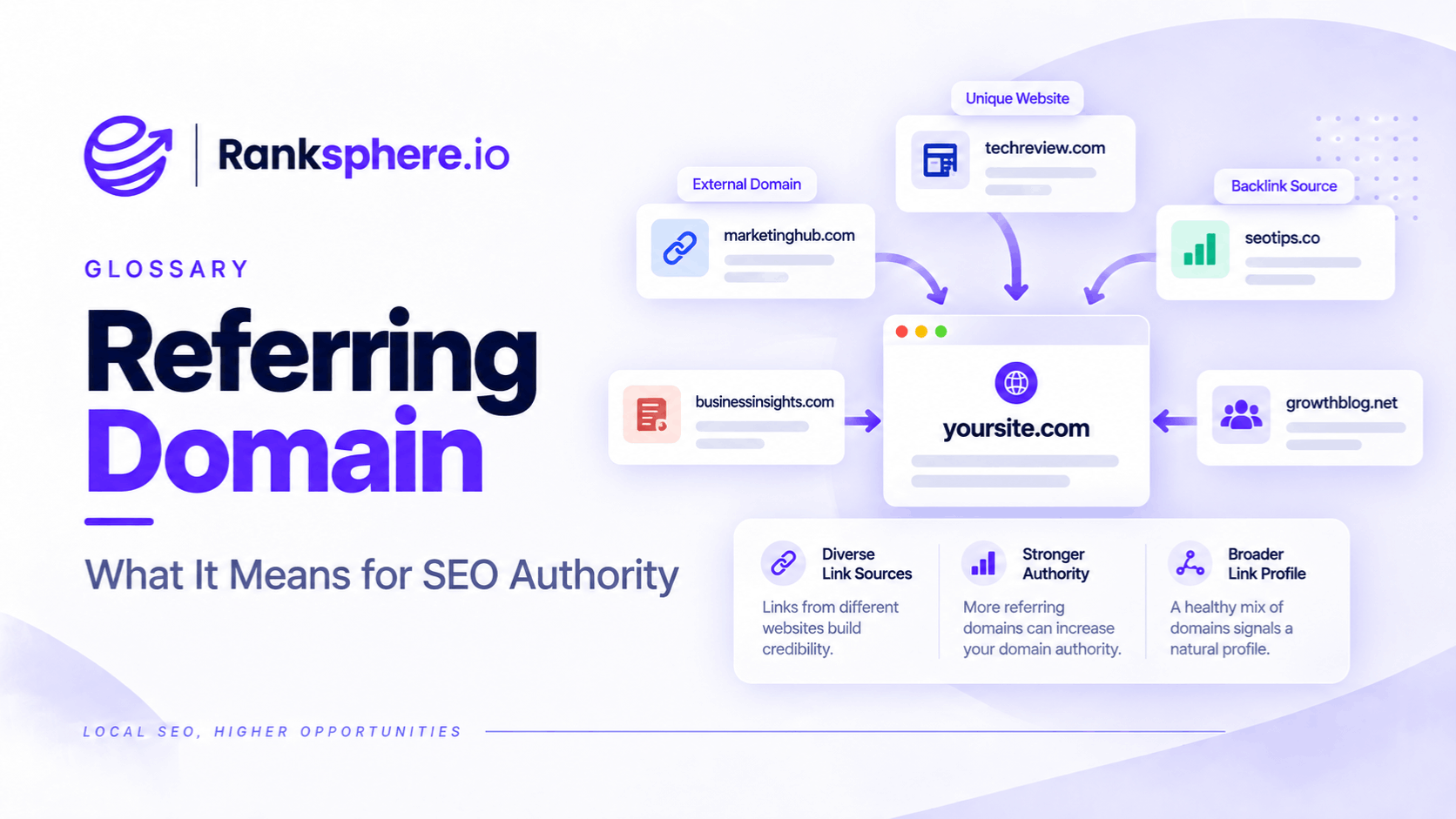
A referring domain is a website that contains one or more backlinks pointing to your website.
If one website links to you 50 times, that may represent:
50 backlinks
but only:
1 referring domain
That distinction is useful because raw backlink totals can become inflated very quickly.
A link placed in a sitewide footer, for example, might appear across hundreds or thousands of pages on the same website. The backlink count may rise dramatically even though the number of websites linking to you has barely changed.
Referring-domain data therefore helps answer a different question:
How many different websites link to us?
That makes it a useful part of link profile analysis.
It should not, however, be treated as a standalone Google ranking score.
What is a referring domain?
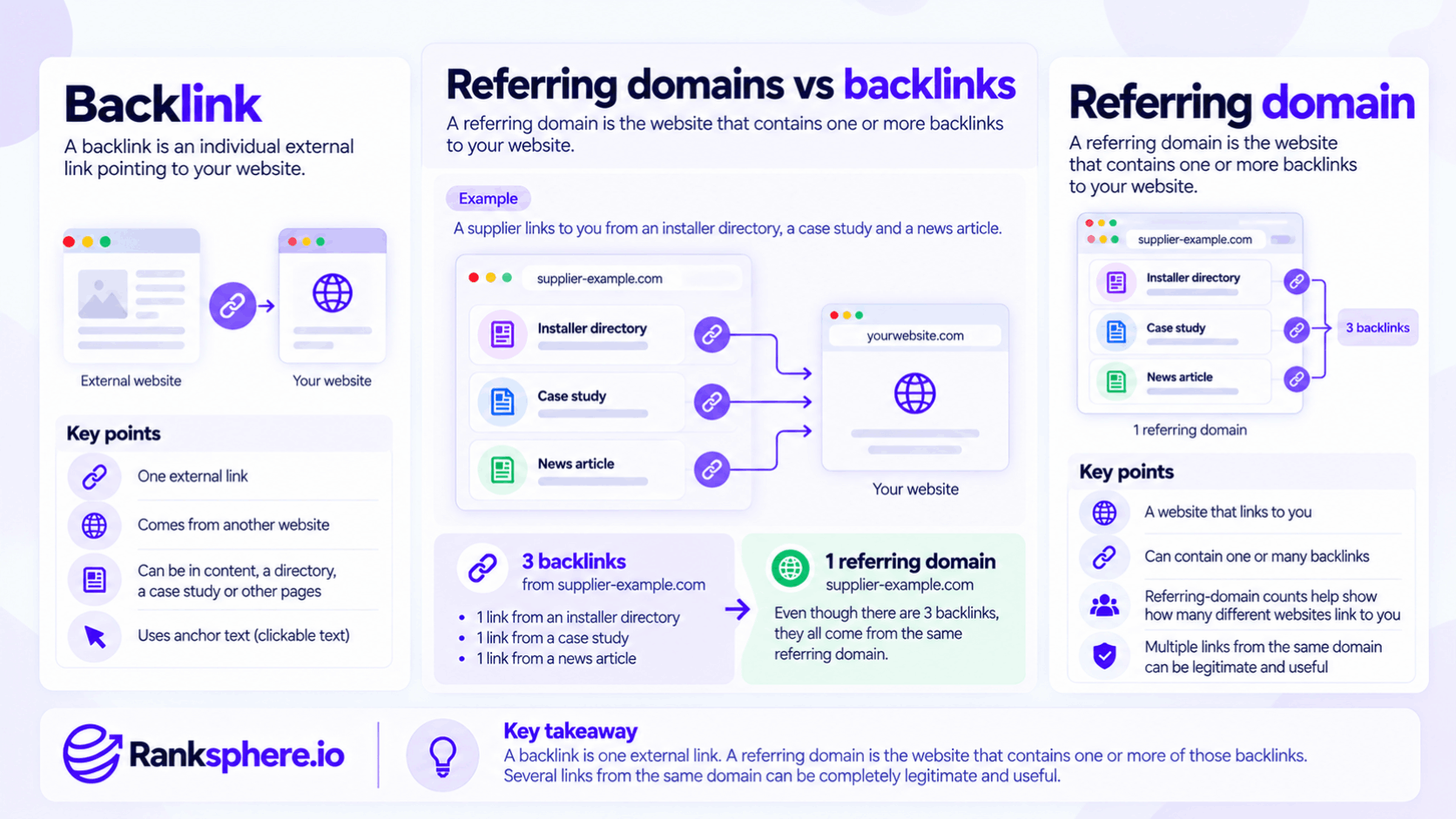
Suppose:
localnews.example
contains three articles linking to your business.
That gives you:
- 3 backlinks
- 1 referring domain
Now suppose:
tradeassociation.example
also links to you.
Your totals become:
- 4 backlinks
- 2 referring domains
The backlink total tells you how many individual links have been found.
The referring-domain count tells you how many different websites those links come from.
Both can be useful.
They simply measure different things.
Referring domains vs backlinks
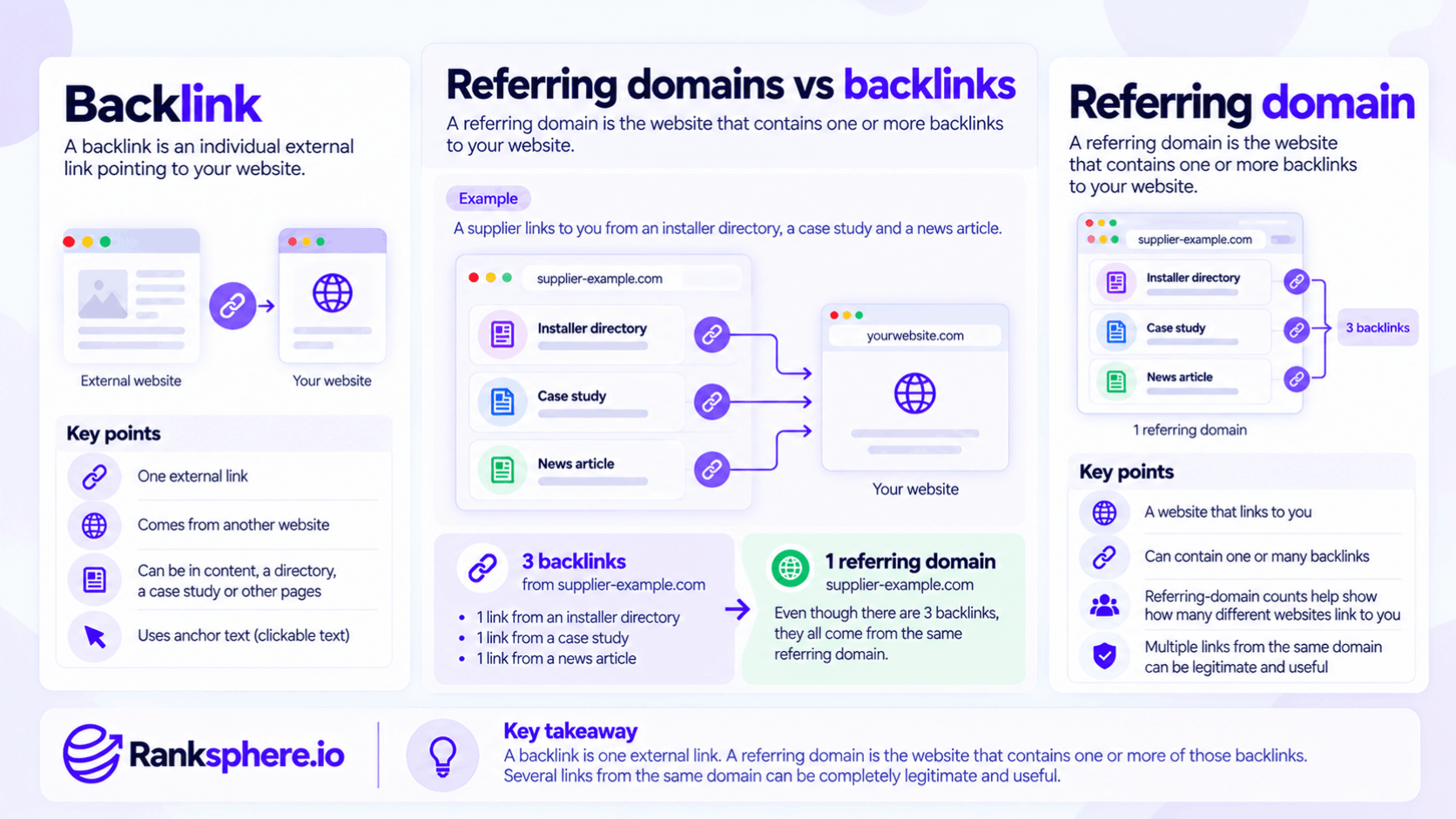
This distinction is one of the first things to understand when analysing backlinks.
Backlink
An individual external link pointing to your website.
Referring domain
The website that contains one or more of those backlinks.
For example, a supplier might link to you from:
- An installer directory
- A case study
- A news article
That would be:
3 backlinks from 1 referring domain.
There is nothing wrong with that.
Several links from the same domain can be completely legitimate and useful.
Why backlink totals can be misleading
Imagine two businesses.
Business A
Has:
8,000 backlinks
from:
45 websites
Business B
Has:
450 backlinks
from:
180 websites
The first business has far more individual links.
The second has links from a much broader range of websites.
That does not automatically make Business B's backlink profile stronger.
But it tells you something the total backlink number alone hides.
That is why both figures should be examined together.
Sitewide links can inflate backlink totals
A sitewide link is a link that appears across many pages of the same website.
Common examples include:
- Footers
- Sidebars
- Templates
- Partner badges
Suppose a partner adds your business to the footer of a 2,000-page website.
A backlink tool may discover thousands of backlinks.
But they all originate from the same domain.
Reporting:
“We gained 2,000 backlinks.”
without explaining that they all came from one site gives a distorted impression of what happened.
A better report would show:
1 new referring domain generating approximately 2,000 backlinks.
That provides the necessary context.
Google Search Console groups linking sites by root domain
Google Search Console's Links report includes a Top linking sites section.
Google groups these sites by root domain.
For example:
www.example.com
blog.example.com
and:
https://example.com
are grouped under:
example.com
in the report.
That makes the report useful for understanding which websites Google has found linking to you.
However, Google also says the Links report is not a comprehensive list of every backlink it knows about. It provides samples and can be truncated on larger sites.
Different SEO tools may report different numbers
It is normal for backlink tools to disagree.
One platform might report:
120 referring domains
while another reports:
147
and Search Console shows something different again.
That does not necessarily mean one is wrong.
Different tools have:
- Different crawlers
- Different link indexes
- Different discovery dates
- Different rules for grouping domains
Use the figures for analysis and trend monitoring.
Do not treat one provider's total as an exact count of everything Google knows.
Are referring domains a ranking factor?
Google does not publish a rule saying:
“More referring domains = higher rankings.”
Links are part of Google's wider search systems, but the value and treatment of links depend on much more than simply how many domains exist.
Google's spam policies also explicitly target attempts to manufacture ranking links through:
- Paid links
- Automated linking
- Excessive link exchanges
- Low-quality directory links
- Manipulative guest-post campaigns
So increasing the referring-domain count for its own sake is not a sensible SEO objective.
The source and reason for the link matter.
Referring-domain count measures breadth
The best way to use the metric is as a measure of link-source diversity.
For example:
60 referring domains
tells you that links have been found from approximately 60 different root domains.
It does not tell you:
- Whether those links are relevant
- Whether they are paid
- Whether anyone clicks them
- Whether Google values them
- Whether they help rankings
You need additional analysis for that.
Does the first link from a domain matter more?
SEO discussions often claim that:
“The first link from a domain is valuable and every later link has diminishing returns.”
There is no published Google formula confirming that.
It is reasonable to avoid treating 500 links from one website as equivalent to 500 independent relationships.
But that does not mean the second or tenth backlink from the same domain has almost no value.
Consider a national newspaper linking to:
- Your original research
- A useful guide
- A later expert interview
Those links serve different pages and exist for different editorial reasons.
There is no reason to dismiss them simply because the publication has linked before.
Multiple links from one website can still be useful
Additional backlinks from an existing referring domain can contribute to:
- Referral traffic
- Discovery of deeper pages
- Brand visibility
- Context around specific resources
For example, a trade publication might initially link to your homepage.
Six months later it links to an original report on your site.
That second link may be more commercially useful than the first.
Do not reduce link evaluation to:
new domain = valuable
existing domain = worthless.
Quality matters more than counting alone
Referring-domain count is still only a count.
It becomes more useful when combined with context.
Important questions include:
- Why is the website linking?
- Is the source relevant?
- Does the publication have a real purpose?
- Does the link help users?
- Was it earned or manufactured?
- Where does the link point?
Those questions are usually more informative than the raw number.
Relevance
Relevance can take several forms.
Topical relevance
A roofing supplier linking to a roofing contractor.
Geographic relevance
A local newspaper linking to a business in the area it covers.
Professional relevance
A trade association linking to one of its members.
Contextual relevance
A national newspaper quoting an accountant on a tax story.
The linking site does not need to operate in exactly the same industry.
The relationship simply needs to make sense.
Geographic relevance for local businesses
Local sources can be particularly useful for businesses serving a defined area.
Examples include:
- Local newspapers
- Chambers of commerce
- Community organisations
- Regional business groups
- Local charities
- Event websites
These sources can provide both:
- Customer exposure
- Local context
But do not assume:
local link = automatically powerful SEO link.
A poor-quality local directory does not become valuable simply because it contains the town name.
Google's local prominence guidance
Google says local results are mainly based on:
- Relevance
- Distance
- Prominence
Google defines prominence broadly as how well-known a business is and says that it can be informed by factors such as how many websites link to the business and how many reviews it has.
That makes legitimate third-party links relevant to local SEO.
It does not establish a target referring-domain count.
How many referring domains should a local business have?
There is no universal answer.
Avoid targets such as:
50 referring domains is healthy
or:
a local business needs 10 new domains per year.
A dentist in a small town and a personal-injury solicitor in a major city face very different competitive environments.
Useful context includes:
- Industry
- Location
- Competitor visibility
- Business age
- PR activity
- Existing partnerships
A small referring-domain count is not automatically weak.
A large one is not automatically strong.
Benchmark carefully
Competitor comparisons can be useful.
If businesses competing for the same customers have links from:
- Local press
- Industry bodies
- Suppliers
- Community organisations
that can reveal genuine opportunities.
But avoid reducing the comparison to:
Competitor A has 92 referring domains, therefore we need 93.
Their links may have been accumulated through:
- Years of trading
- National media coverage
- Acquisition
- Old SEO campaigns
- Different services
Use competitors to understand the environment, not to set an arbitrary quota.
Relevant competitors matter
For a local company, compare primarily against businesses operating in the same realistic market.
A single-location plumber does not need to reproduce the backlink profile of:
a national home-services marketplace.
The national company may have:
- Thousands of pages
- National PR
- Large content teams
- Partnerships across the country
Its link profile reflects a completely different business model.
Benchmark against genuinely comparable sites.
Do not chase referring domains for the sake of the number
Once referring-domain counts become an SEO target, teams can start looking for the cheapest way to increase them.
That often leads to:
- Poor directories
- Guest-post marketplaces
- Link exchanges
- Paid placements
Google's spam policies explicitly prohibit several forms of link manipulation designed primarily to influence rankings.
A better objective is:
earn references from websites with a legitimate reason to mention the business.
The referring-domain count will grow as a consequence.
Authority metrics and referring domains
Backlink tools often show referring domains alongside metrics such as:
- Domain Authority
- Domain Rating
- Authority Score
Those are third-party estimates.
They are not Google metrics.
A new community organisation might have a modest authority score but still provide a completely legitimate and locally relevant link.
Do not evaluate referring domains entirely through another SEO-tool metric.
Real audience
A useful question is:
Does this website actually exist for people?
A trade publication with genuine readers offers something beyond a backlink.
It can produce:
- Referral traffic
- Awareness
- Credibility
A website created primarily to sell backlinks may offer none of those.
That is a useful distinction for marketing.
It should not be turned into a claim that Google directly measures “real audience” as a referring-domain ranking factor.
Editorial links
Links placed naturally within useful editorial content can be valuable because they provide context.
For example:
Ashgate Roofing analysed storm-damage call-outs across the county.
with a link to the underlying data.
That makes sense for the reader.
However, do not assume every directory, footer or non-editorial link is worthless.
Some legitimate relationships naturally appear in:
- Membership directories
- Supplier listings
- Business profiles
Evaluate the context rather than applying a blanket placement rule.
Link permanence
It can be useful to earn references likely to remain useful over time.
But no backlink is guaranteed to be permanent.
Publishers:
- Redesign sites
- Remove articles
- Update content
- Close businesses
Do not choose links based on a promise such as:
“permanent backlink guaranteed.”
That language is particularly common in link-selling marketplaces.
A genuine editorial relationship is more important than an artificial permanence guarantee.
Referring domains and link building
Good link building should not start with:
“How do we increase the referring-domain count?”
Start with:
“Why would another website reasonably reference us?”
Possible reasons include:
- Original research
- Useful resources
- Professional membership
- Genuine partnerships
- Community involvement
- Expert commentary
- Digital PR
These create links because a relationship or piece of information exists.
That is much more sustainable than purchasing domains simply to move a metric.
Referring domains and brand mentions
An unlinked brand mention can sometimes become a new referring domain if the publisher decides a link would genuinely help readers.
For example, a regional article may already say:
Ashgate Roofing helped repair the local community centre.
but provide no link.
A polite request could ask whether linking the company name would help readers find the business.
If the publisher agrees, the site gains:
- A backlink
- Potentially a new referring domain
But not every unlinked mention needs to be converted.
The mention can still have brand value without a link.
New vs existing referring domains
When analysing backlink growth, separate:
New referring domains
Websites that have not previously been seen linking to you.
New backlinks from existing domains
Additional links from websites already in the profile.
Both can matter.
They simply tell you different things.
A useful monthly report might say:
7 new referring domains
and:
23 additional backlinks from existing linking sites
rather than collapsing everything into one large backlink total.
Lost referring domains
Referring domains can disappear too.
A domain may stop linking because:
- An article was removed
- The site closed
- A redesign deleted the link
- Your URL changed
Do not automatically launch a reclamation campaign every time the number falls.
Investigate important losses first.
If a respected industry publication used to link to a resource that moved, fixing the redirect may be worthwhile.
If a scraper vanished, it probably does not need attention.
Referring-domain growth is not always smooth
Real link acquisition often happens irregularly.
A business might gain:
- No new domains for two months
- Six after a local news story
- Fifteen after publishing useful research
That is normal.
There is no need to engineer:
“three new referring domains every month”
to create a natural-looking graph.
Likewise, steady growth is not suspicious by itself.
A company running continuous PR may genuinely earn links regularly.
Do not treat link velocity as a quota
Tracking when referring domains appear can help explain changes.
For example:
Why did we gain 20 domains in one week?
Perhaps a study received press coverage.
Or perhaps an old link-building vendor launched a campaign.
Investigate the cause.
Do not create a fixed safe-growth threshold.
Google publishes no recommended number of new referring domains per:
- Day
- Month
- Year
Referring domains and spam
A website may eventually receive links from strange domains it never contacted.
Examples include:
- Scrapers
- Automated directories
- Copied articles
Their presence does not automatically mean the business has done something wrong.
Google's own link documentation and manual-action processes focus particularly on manipulative link practices rather than expecting businesses to maintain a perfectly clean backlink graph.
Do not chase every strange new referring domain simply because it exists.
Search Console vs backlink tools
Search Console can show:
- Top linking sites
- Top linked pages
- Top linking text
and lets users export backlink samples.
Commercial backlink tools may provide:
- Larger proprietary indexes
- Discovery dates
- Link-status history
- Authority metrics
Use both where useful.
Just remember that neither should be treated as a perfect copy of Google's entire link graph.
Reporting referring domains
Referring domains can be a useful supporting SEO metric.
For example:
Referring domains increased from 61 to 68.
Then explain what actually changed:
- 2 local editorial sources
- 1 supplier
- 4 directories
That is far more useful than showing only:
Backlinks increased 214%.
Context turns the metric into information.
Referring domains are not a business outcome
Clients ultimately care about outcomes such as:
- Enquiries
- Sales
- Bookings
- Revenue
- Visibility
Referring domains are an input or supporting indicator.
Do not report:
“We gained ten referring domains, therefore the campaign was successful.”
Ask:
- Were the sites relevant?
- Did anyone click?
- Did valuable pages earn links?
- Did brand visibility improve?
The count alone cannot answer those questions.
Common referring-domain mistakes
- Treating referring domains as an official Google ranking score.
- Reporting raw backlink counts without explaining how many websites produced them.
- Claiming the first link from a domain has a known value and later links have almost none.
- Setting arbitrary targets such as 50 domains or 10 new domains per year.
- Assuming every new referring domain is more valuable than every additional link from an existing source.
- Buying links simply to increase referring-domain count.
- Judging domains entirely through third-party authority metrics.
- Treating every directory or footer link as worthless.
- Assuming every local link is automatically better than a non-local relevant source.
- Comparing a small local business against national publishers or marketplaces.
- Treating smooth or irregular link growth as proof of manipulation.
- Using referring-domain growth as the main client success metric.
Referring-domain best practices
- Track both backlinks and referring domains rather than relying on one count.
- Use referring-domain data to understand the breadth of the link profile.
- Inspect why important domains link to the business.
- Prioritise relevant sources with a genuine reason to reference you.
- Compare against realistic competitors rather than arbitrary industry targets.
- Do not manufacture links simply to increase the domain count.
- Separate new referring domains from additional links on existing domains in reporting.
- Investigate important lost domains rather than trying to reclaim every disappearing link.
- Look for relevant unlinked brand mentions where a link would genuinely help readers.
- Measure referral traffic, enquiries and search performance alongside backlink metrics.
- Treat third-party authority scores as context rather than Google's judgement.
Example
“Ashgate Roofing receives a six-month SEO report.
It says:
Backlinks increased from 1,240 to 3,890.
On the surface, that looks like substantial link growth.
The team looks deeper.
The referring-domain count moved from:
61 to 68.
Most of the additional backlinks came from one partner website.
That partner added Ashgate Roofing to a sitewide template, so the same link now appears across thousands of pages.
The business therefore did not suddenly earn more than 2,000 independent editorial endorsements.
It gained:
one additional linking website that happens to link many times.
The seven genuinely new referring domains are then reviewed individually.
Some are generic directories.
Others have clearer relevance, including:
- A supplier listing
- A local trade organisation
The report is changed.
Instead of:
“2,650 new backlinks acquired”
it now shows:
“7 new referring domains, plus a large increase in repeated links from an existing partner placement.”
That graph looks less dramatic.
It is also much more informative.
The lesson is not that backlink totals are useless or that every new referring domain is equally valuable.
It is:
backlinks tell you how many links exist; referring domains tell you how many different websites those links come from. Understanding both gives you a much clearer picture of what is actually happening in a backlink profile.”
See also
- Backlink — an individual external link pointing to a website
- Link profile — the wider pattern of backlinks and linking sites
- Link building — earning and acquiring legitimate external links
- Domain authority — a third-party authority metric rather than a Google score
- Local link building — earning relevant links within a local market
- Brand mention — an unlinked reference that may sometimes become a genuine link opportunity