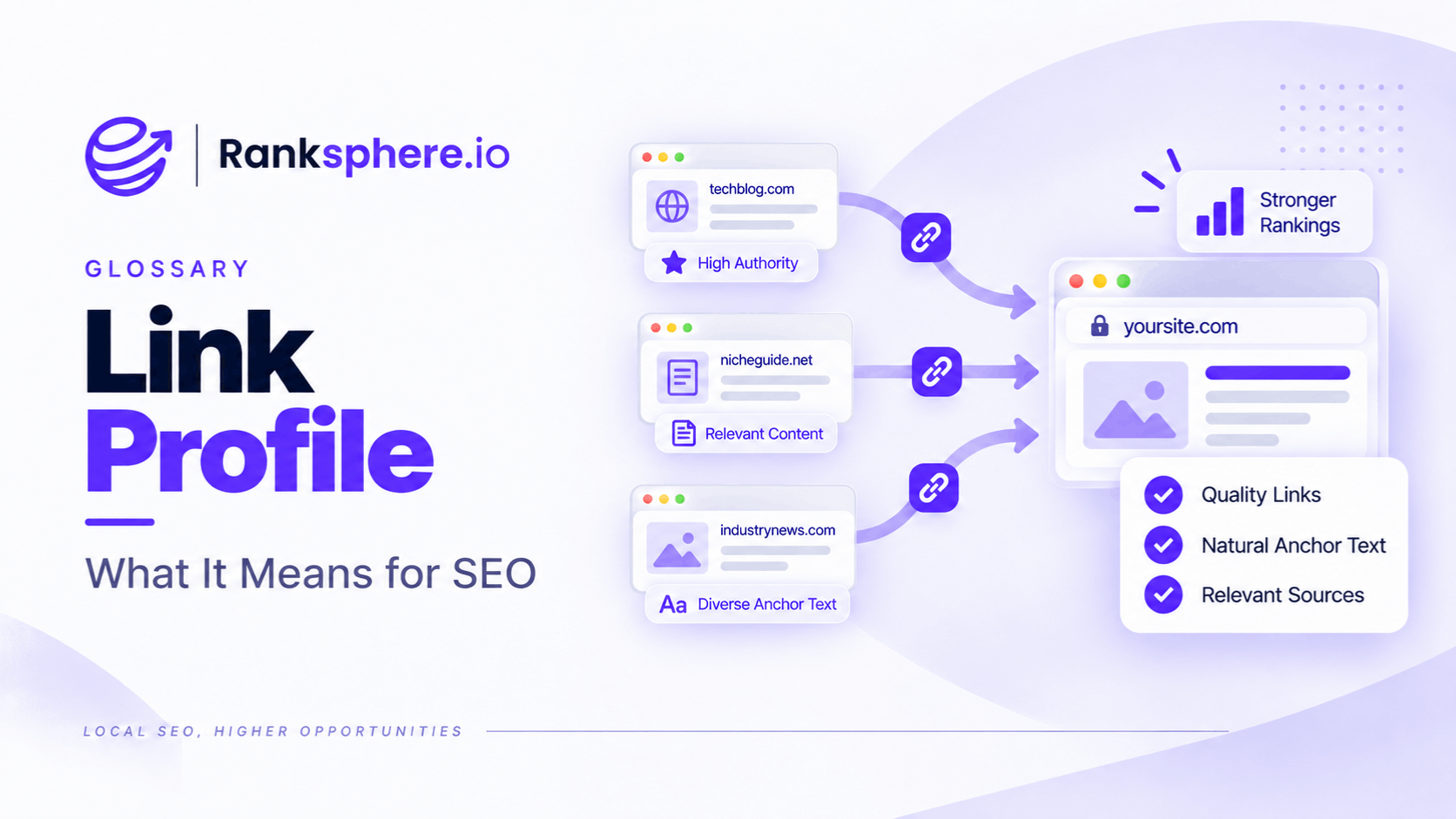
A link profile is the overall pattern of backlinks pointing to a website.
It includes more than the number of links.
A useful link-profile analysis looks at things such as:
- Which websites link to you
- Which pages they link to
- The anchor text they use
- Whether links are editorial, sponsored or user-generated
- Where the links appear
- How relevant the linking sites are
- How the profile has developed over time
A single backlink rarely tells the whole story.
The wider pattern matters because search engines evaluate links in context.
For example, one keyword-rich link from an unrelated website may mean very little on its own.
Hundreds of paid, optimised links placed across unrelated sites as part of a deliberate ranking scheme are a different situation.
Google's current spam policies focus on link creation intended primarily to manipulate search rankings, rather than on hitting a particular backlink ratio or profile shape.
What is a link profile?
A link profile is the collection of external links search engines can discover pointing towards a website or page, together with the characteristics of those links.
For example, a roofing company might have backlinks from:
- Local newspapers
- Suppliers
- Trade associations
- Community organisations
- Business directories
- Customers' websites
- Random automated sites
All of those become part of the site's wider backlink environment.
Some are useful.
Some may be irrelevant.
Some may be spam.
The job of link-profile analysis is not to label every unfamiliar link as good or bad.
It is to understand the pattern.
A link profile is not one score
SEO tools often summarise backlinks using metrics such as:
- Domain Authority
- Domain Rating
- Authority Score
- Toxicity scores
Those can be useful for sorting and comparison.
They are not Google's own link-profile scores.
Google does not publish a:
Link Profile Score: 82/100
that SEOs can optimise directly.
See domain authority for the wider distinction between third-party metrics and Google's own systems.
Backlink vs link profile
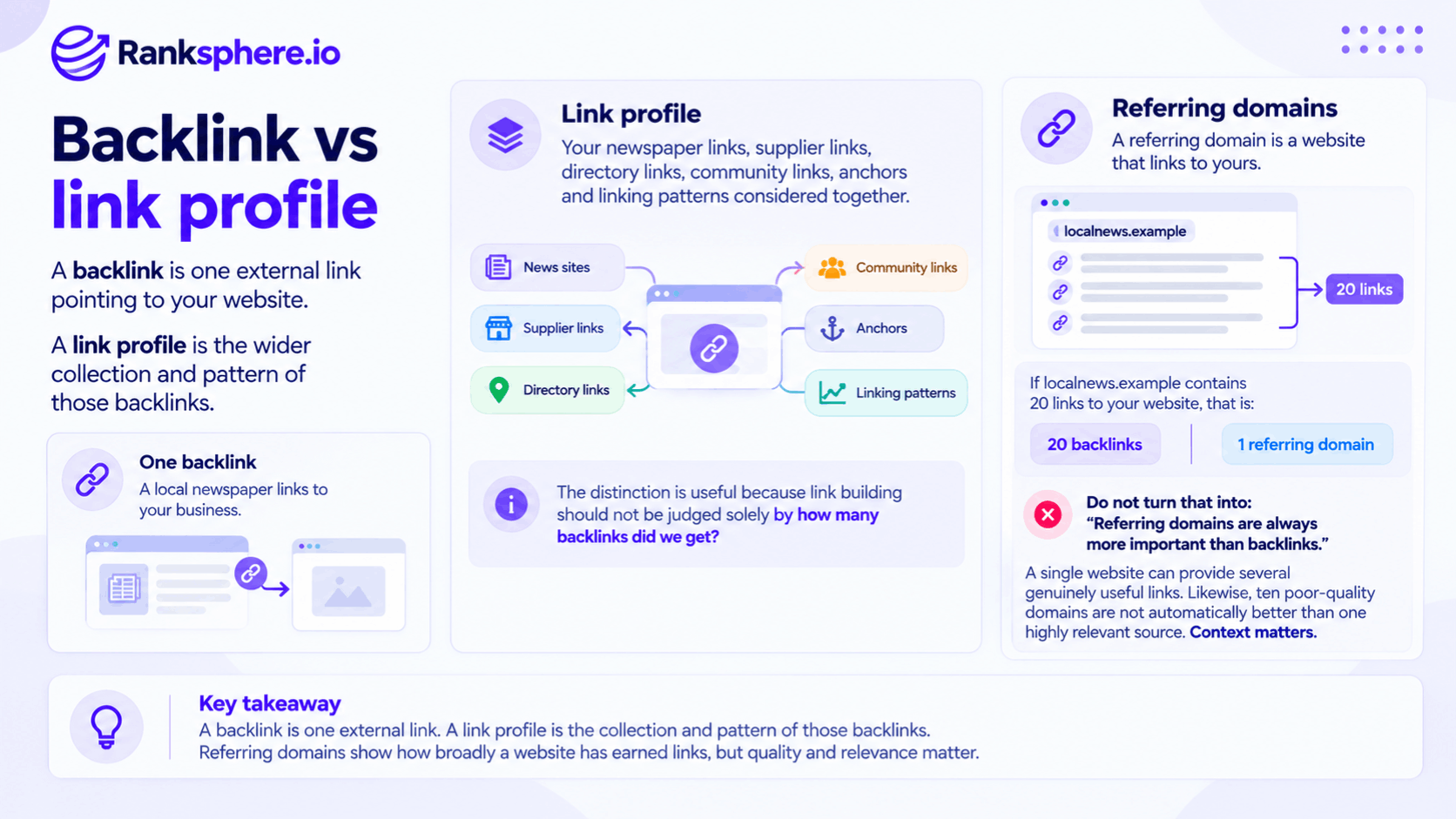
A backlink is one external link pointing to your website.
A link profile is the wider collection and pattern of those backlinks.
For example:
One backlink
A local newspaper links to your business.
Link profile
Your newspaper links, supplier links, directory links, community links, anchors, destinations and linking patterns considered together.
The distinction is useful because link building should not be judged solely by:
How many backlinks did we get?
Referring domains
A referring domain is a website that links to yours.
If:
localnews.example
contains 20 links to your website, that is:
- 20 backlinks
- 1 referring domain
This makes referring-domain counts useful for understanding how broadly a website has earned links.
But do not turn that into:
“Referring domains are always more important than backlinks.”
A single website can provide several genuinely useful links.
Likewise, ten poor-quality domains are not automatically better than one highly relevant source.
Context matters.
Why raw backlink totals can mislead
Imagine two sites.
Site A
Has:
12,000 backlinks
from:
25 domains
because several footer links appear on every page of those websites.
Site B
Has:
180 backlinks
from:
110 genuinely different organisations.
The total-backlink figure makes Site A look much larger.
The referring-domain picture tells a different story.
Neither number alone tells you which site deserves to rank.
But comparing both helps you understand what the backlink total actually represents.
Search Console link data
Google Search Console has a Links report showing information such as:
- Top linked pages
- Top linking sites
- Top linking text
Google groups external linking sites by root domain.
However, Google explicitly says the report is not a complete list of every backlink. It is a sample intended to help site owners understand their overall link profile.
So do not panic because:
Ahrefs says 500 domains and Search Console says 320.
Different tools have different crawlers, indexes and reporting methods.
No backlink tool has a perfect view of the web
Every commercial backlink platform builds its own link index.
That means tools can disagree about:
- Link count
- Referring domains
- Anchor text
- Lost links
- Discovery date
Even Search Console does not expose Google's complete link graph.
Use tools diagnostically.
Do not treat any one export as an exact map of everything Google knows.
Anchor text
Anchor text is the visible text used in a link.
For example:
<a href="https://example.com/">Holbeck Roofing</a>
has the anchor:
Holbeck Roofing
Anchor text can help users and search engines understand what the destination is about.
Google itself recommends anchor text that is:
- Descriptive
- Concise
- Relevant
and warns against unnaturally stuffing keywords into links.
Anchor text categories
SEO audits often group anchor text into categories such as:
Branded
Holbeck Roofing
URL
Descriptive
roof repair guide
Partial-match
roof repairs in Leeds
Exact-match
roofer Leeds
Generic
click here
These categories are useful for analysis.
They are not official Google classifications.
There is no ideal anchor-text percentage
Avoid rules such as:
70% branded
10% exact-match
20% generic
Google publishes no safe anchor-text ratio.
A legitimate profile depends on how people naturally refer to the business.
A widely known brand may attract many brand-name links.
A research article may attract descriptive anchors referring to the study.
A local directory may simply link the business name.
Do not manipulate the profile simply to make a pie chart look “natural”.
Exact-match anchor text
Exact-match anchor text is not automatically a problem.
For example:
A journalist writing:
We spoke to a Leeds roofing contractor about storm damage.
could naturally use those words as the anchor.
The concern begins when optimised anchor text is deliberately created at scale to manipulate rankings.
Google specifically lists things such as:
- Optimised anchors in paid or distributed articles
- Keyword-rich links in widgets
- Optimised forum links
among examples of link spam.
Intent and pattern matter more than one phrase.
Link attributes
Links may carry attributes such as:
- nofollow
- sponsored
- ugc
A normal link may contain no qualifying attribute.
For example:
<a href="https://example.com/">Example</a>
A sponsored link might use:
<a href="https://example.com/" rel="sponsored">Example</a>
See nofollow for the wider topic.
Followed vs nofollow links
Do not try to engineer a fixed:
follow:nofollow ratio
for a website.
There is no published Google target.
A legitimate business may naturally receive nofollow links from:
- Social sites
- Forums
- News platforms
- Directories
and normal editorial links from others.
The correct attributes depend on the nature of the link.
Not on an SEO quota.
Sponsored links
Paid and sponsored placements are allowed.
The issue is whether the link is being used to pass ranking credit deceptively.
Google says buying and selling links is a normal part of online advertising, but paid links should be qualified appropriately, normally with:
- rel="sponsored"
- or nofollow
so that they are not treated as ordinary ranking links.
UGC links
rel="ugc" is commonly used for links inside user-generated content such as:
- Forums
- Comments
- Community posts
Again, do not judge profile health by whether the site has:
the right percentage of UGC links.
The attribute describes the relationship.
It is not a target distribution.
Relevance
Relevance is useful when evaluating backlinks.
A local veterinary practice being mentioned by:
a local animal rescue charity
makes obvious contextual sense.
A backlink from:
an unrelated overseas gambling directory
does not.
But avoid reducing relevance to:
same industry only.
Real businesses interact with many organisations.
A veterinary practice might legitimately earn links from:
- Local press
- Council websites
- Schools
- Charities
- Events
- Suppliers
They do not need to be veterinary websites to be useful or legitimate.
Geographic relevance
For local businesses, geographic context can be particularly valuable.
Examples include:
- Local newspapers
- Chambers of commerce
- Community groups
- Local charities
- Business associations
- Event websites
These sources connect the business with the community it actually serves.
That makes them attractive local link building opportunities.
It does not mean every local link automatically improves local rankings.
Google and local prominence
Google says local results are mainly based on:
- Relevance
- Distance
- Prominence
Prominence reflects how well known a business is.
Google specifically mentions information such as how many websites link to the business and the number and quality of reviews when explaining prominence.
That makes links part of local search.
But they are one part of a broader system.
Links vs reviews vs citations
Avoid statements such as:
“Reviews matter more than backlinks.”
or:
“Citations are cheaper and therefore should come first.”
Google does not publish a universal weighting that lets us rank these inputs cleanly.
For a real business, the appropriate priority depends on what is missing.
A company with:
- No accurate listings
- Five reviews
- Strong local press coverage
has a different problem from one with:
- Hundreds of reviews
- Accurate business information
- Almost no useful third-party links
Diagnose the bottleneck.
Link placement
The location of a link can provide context.
For example:
A contextual editorial link inside an article explaining why the business is relevant is different from:
- A sitewide footer
- A random widget
- A list of hundreds of unrelated businesses
That does not mean every footer link is bad.
Many legitimate sites use footer links for:
- Designers
- Parent companies
- Legal partners
The problem is using widely distributed footer or template links primarily to manipulate rankings.
Google explicitly lists widely distributed links in site footers and templates among link-spam examples when used manipulatively.
Sitewide backlinks
One referring domain can create thousands of backlinks if the link sits inside a template.
For example:
A web-development agency may historically have placed:
SEO company London
in the footer of every client's website.
Fifty clients with 200 pages each could create:
10,000 backlinks.
That is why raw link totals require interpretation.
A large number of links may represent one placement decision.
Link velocity
Link velocity generally means how quickly new backlinks or referring domains appear.
It can be useful for:
- Monitoring PR
- Diagnosing sudden spam
- Understanding campaigns
It is not a known ranking factor with an ideal rate.
Avoid rules such as:
five links per month is safe
or:
a sudden spike causes penalties.
Sudden link growth can be completely legitimate
Suppose a business publishes original research picked up by:
- BBC
- Local press
- Trade publications
- Bloggers
It could earn hundreds of links in a few days.
That is not inherently suspicious.
Likewise, a small business may receive no new links for several months.
Real link acquisition is often irregular.
Do not manufacture artificial regularity to make a profile look natural.
Artificially smooth growth is not automatically spam either
A company might legitimately earn links consistently through:
- Weekly journalism
- Partnerships
- Continuous PR
So a graph showing:
eight referring domains every month
is not evidence of manipulation by itself.
Patterns only become meaningful when considered alongside:
- Source quality
- Placement
- Anchor text
- Commercial arrangements
- Content
Do not reverse-engineer a “natural” graph
A common mistake is:
“Google expects irregular links, so let's deliberately build 3 this month, 12 next month and 0 the month after.”
That is still artificial.
The better approach is simpler:
earn links for legitimate reasons and let the resulting profile look however it looks.
Brand anchors
Many genuine business links naturally use the brand name.
For example:
Holbeck Roofing
That makes branded anchors common in many commercial backlink profiles.
But there is no rule saying:
most anchors must be branded.
A data study, software product or informational site may naturally attract a different mix.
Judge the context.
URL anchors
People also link by pasting the URL.
For example:
https://example.com/roof-repair-guide/
Again, this is normal.
Do not manipulate URL anchors simply because an SEO tool says the profile requires more of them.
Generic anchors
Anchors such as:
- Read more
- Here
- Website
also happen naturally.
They are not especially descriptive, but their presence does not make a profile healthier merely because they increase anchor-text diversity.
Google recommends descriptive link text where practical.
Link diversity
“Link diversity” is useful when it means:
do our links come from a reasonable variety of legitimate places?
It becomes less useful when it means:
we need exactly five directories, three blogs, two newspapers and four forums this month.
Diversity should be a consequence of real visibility.
Not a recipe.
Random low-quality backlinks
Most established websites eventually attract links they never requested.
Examples include:
- Scrapers
- Automated directories
- Spam sites
- Copied articles
This is normal.
Google specifically says that in most cases it can assess which links to trust without site-owner intervention.
Do not start a cleanup project every time a backlink tool finds an unfamiliar domain.
A clean profile is not suspicious
Avoid claims such as:
“A profile with no junk links looks unnatural.”
There is no reason to manufacture junk or worry because a new site has a relatively clean backlink profile.
Spam often appears naturally over time.
Its absence is not a problem that needs correcting.
Toxic links
The phrase toxic link is mostly an SEO-tool classification rather than a Google metric.
See toxic link.
A tool may label a domain toxic because of:
- Site patterns
- Low metrics
- Unusual anchors
That can help prioritise manual inspection.
It does not mean Google has independently penalised your website because the tool's toxicity score crossed a threshold.
Spam links you did not create
Google says it works to prevent actions taken on third-party sites from negatively affecting website owners and that most websites do not need to use its Disavow Links tool.
So if your backlink report suddenly shows:
- Random casino domains
- Scraper sites
- Foreign spam directories
do not automatically assume:
negative SEO attack.
Investigate before acting.
When bad links genuinely matter
The situation changes if:
- You bought links
- An SEO deliberately built artificial links
- The site participated in link schemes
- Google issued an unnatural-links manual action
Google's spam policies prohibit links created primarily to manipulate rankings.
That is a different situation from passive spam appearing without your involvement.
Manual actions
Search Console includes a Manual Actions report.
If Google has manually determined that unnatural links violate its policies, the report can show an:
Unnatural links to your site
action.
Google's documented remediation process includes:
- Identifying violating links
- Attempting to remove or appropriately qualify them
- Disavowing those you cannot remove where necessary
- Requesting reconsideration
That is much more serious than an SEO tool displaying:
Toxicity: High.
The Disavow Links tool
Google's Disavow Links tool is an advanced feature.
Google says most sites should not use it.
Its guidance says disavow should normally be considered only where both of these apply:
- There is a considerable number of spammy, artificial or low-quality links.
- Those links caused a manual action or are likely to cause one.
Using the tool incorrectly can harm Search performance.
Do not disavow every suspicious-looking domain
A common workflow is:
SEO tool says toxic → export → disavow.
That is too mechanical.
A legitimate website can have:
- Low authority
- Few pages
- Strange design
and still contain a perfectly genuine editorial link.
Review context before taking action.
Paid link campaigns
If a business knowingly participated in link manipulation, the right conclusion is not:
“Google will definitely ignore all of it anyway.”
Google's systems may neutralise certain spam, but its policies also allow ranking demotion and manual actions for violations.
The safe approach is:
- Stop the manipulative activity
- Remove or qualify problematic placements where appropriate
- Follow Google's documented process if a manual action exists
Exact-match anchor clusters
Suppose a roofing company has 80 links using:
roofer Leeds
from:
- Generic blogs
- Unrelated directories
- Guest posts
all purchased through the same link package.
The issue is not that:
80 exact-match anchors automatically trigger a penalty.
The issue is that the overall evidence may show a deliberate link scheme.
The commercial relationship and placement pattern matter.
Repeated anchors can also be legitimate
Imagine a trade association listing businesses using their official category:
Roofing contractor
Hundreds of legitimate members may receive similar anchors.
Again, context prevents simplistic diagnosis.
Do not label a profile manipulative using anchor percentages alone.
Link building
Link building is legitimate when it helps earn real references and links.
Google does not say:
never actively earn links.
Its own Search guidance encourages site owners to tell people about their websites and participate in relevant communities.
The line is manipulation.
Legitimate link acquisition
Examples can include:
- Digital PR
- Original research
- Useful resources
- Professional memberships
- Supplier case studies
- Genuine community involvement
The resulting link should make sense because of the relationship or content.
Not because someone bought:
DA 50 placement – £120
from a spreadsheet.
Local link building
For a local business, useful opportunities may include:
- Local newspapers
- Community organisations
- Professional associations
- Suppliers
- Charities
- Events
These links can provide:
- Referral traffic
- Reputation
- Local context
They may also contribute to Google's understanding of prominence.
But do not turn local link building into:
submit to every website containing the town name.
Relevance still matters.
Directories
Directories are not automatically good or bad.
Useful directories may include:
- Professional bodies
- Major business platforms
- Relevant local directories
Low-quality directory link schemes are specifically included in Google's examples of link spam.
Ask:
Would a customer reasonably use or trust this directory?
That is more useful than:
Does this directory have DA 55?
Citations and links
A citation and a backlink can overlap.
A business directory may contain:
- Business name
- Address
- Phone
- Website link
That makes it both:
- A structured citation
- A source of a backlink
Do not count them as unrelated marketing assets simply because different SEO reports use different labels.
Brand mentions
An unlinked brand mention can sometimes be a straightforward link-reclamation opportunity.
For example:
A local newspaper writes:
Holbeck Roofing helped repair the community centre roof.
but does not link the brand.
A polite request asking whether a website link would help readers find the business can make sense.
The publisher is not obligated to add it.
Link reclamation
Before chasing completely new sites, look for:
- Unlinked mentions
- Broken links
- Outdated URLs
- Old PR coverage
These often come from organisations that already know the business.
That can make them more practical opportunities than cold outreach.
Internal links are different
Internal linking is important, but internal links are not part of the site's external backlink profile.
They deserve their own analysis.
Internal links help search engines understand:
- Relationships between pages
- Site hierarchy
- Context
They are also entirely under your control.
So it often makes sense to fix internal linking before spending heavily on external acquisition.
But do not call internal links:
half of the backlink profile.
They are different systems.
How many backlinks does a local business need?
There is no universal number.
Avoid claims such as:
“A local business needs 30 referring domains.”
The answer depends on:
- Competition
- Market
- Industry
- Existing prominence
- Search intent
A rural dentist and a solicitor in central London operate in completely different competitive environments.
Competitor comparison
Competitor link analysis can provide useful context.
For example:
If several visible competitors consistently have links from:
- Local associations
- Industry bodies
- Local press
that may reveal opportunities.
But do not simply copy their backlinks.
A competitor may have:
- Paid placements
- Legacy links
- Partnerships you cannot replicate
Use the analysis to understand the market.
Not to clone another site's profile.
Quality vs quantity
Avoid the cliché:
“One good backlink is worth 100 bad backlinks.”
There is no fixed conversion rate between links.
A better principle is:
focus on links that have a genuine reason to exist.
Useful links tend to come from sources that are:
- Relevant
- Real
- Contextual
and potentially valuable beyond SEO.
Referral traffic
A backlink can be valuable even without measurable ranking effects.
For example, a local newspaper article might send:
- 50 visitors
- 5 enquiries
That is real commercial value.
Do not judge every link solely through third-party authority scores.
Link profile and traffic
A growing link profile does not automatically cause organic traffic to grow.
Traffic can also change because of:
- Search demand
- Content
- Competition
- Technical issues
- Algorithm updates
Avoid reports that say:
“We added 12 links, therefore traffic rose 18%.”
unless there is evidence supporting that causal claim.
Auditing a link profile
A useful link-profile audit can look at several dimensions.
1. Referring domains
Which websites link to us?
2. Linking pages
Where exactly are the links?
3. Destination pages
Which pages receive the links?
4. Anchor text
How are those pages described?
5. Link relationship
Are links:
- Editorial
- Sponsored
- UGC
- Directory-based
6. Context
Why does the link exist?
The last question is often the most useful.
Start with context, not scores
Suppose an SEO tool finds:
with very low authority.
Before dismissing it, open the page.
If it says:
Holbeck Roofing donated materials to repair our clubhouse roof
that may be a perfectly relevant local reference.
A high third-party metric is not required for a link to make sense.
Look at target pages
A healthy analysis should also ask:
Which pages are earning backlinks?
If every external link points to:
the homepage
while useful research or service resources have none, that tells you something about what other websites find worth referencing.
Do not manufacture links directly to every commercial page just to create balance.
Deep links
A deep link points to an internal page rather than the homepage.
For example:
/storm-damage-guide/
Deep links often appear naturally when another site references:
- Research
- Guide
- Tool
- Case study
They can help individual resources receive external recognition.
Again, there is no ideal homepage-to-deep-link ratio.
Lost backlinks
Backlinks disappear naturally.
Reasons include:
- Page deleted
- Site redesigned
- Article updated
- Publisher closed
- URL changed
Not every lost link needs reclaiming.
Prioritise links where:
- The source remains valuable
- The old destination has changed
- Reinstatement genuinely helps readers
New backlinks
Likewise, investigate unusual new links when they appear.
But avoid interpreting every change as an SEO event.
One scraped article may produce dozens of links.
That does not necessarily mean:
the site's authority just surged.
Historic link building
When auditing an older domain, ask:
What was done previously?
You may discover:
- Old directory campaigns
- Guest-post packages
- Paid links
- Widget links
Understanding history helps explain patterns much better than merely looking at current metrics.
Link-profile audits after buying a website
This is particularly important after:
- Acquisition
- Merger
- Domain purchase
A new owner may inherit backlinks generated years earlier.
Review:
- Manual actions
- Previous SEO work
- Redirect history
- Major linking patterns
before assuming the current team created everything.
Link-profile audits after a migration
Domain migrations can also change how backlink value reaches pages.
Check that strong external links pointing to old URLs eventually reach the correct new pages through clean permanent redirects.
Otherwise, an apparently weaker profile may actually be a redirect-management problem.
Search Console manual actions
Before launching a panic-driven backlink cleanup, check:
Search Console → Manual Actions
If there is no unnatural-links action, that does not prove every past tactic was acceptable.
But it does provide important context.
A third-party:
Toxic Backlink Warning
is not the same thing as a Google manual action.
Do not optimise for a clean-looking chart
A surprisingly common SEO task is:
“Make the backlink profile look natural.”
That is backwards.
If you are deliberately deciding:
- How many exact-match anchors
- How many nofollow links
- How many links per month
to make a manufactured campaign look organic, the strategy is still manufactured.
Earn legitimate links instead.
There is no perfect link profile
A real backlink profile may contain:
- High-quality links
- Weak links
- Broken links
- No-follow links
- Strange scraper links
The goal is not visual perfection.
The goal is to avoid manipulative link practices while earning genuine references that make sense for the business.
Ranksphere and link-profile analysis
A useful SEO platform should help surface link-related issues in context rather than presenting every unusual domain as an emergency.
Link data is most valuable when it supports questions such as:
- Who links to us?
- Which pages earn links?
- Are there clear manipulative patterns?
- Are there legitimate opportunities we have missed?
The report should lead to decisions.
Not fear.
Common link profile mistakes
- Treating referring-domain count as the only backlink metric that matters.
- Counting every backlink equally.
- Trying to achieve a fixed branded/exact-match anchor ratio.
- Believing a profile needs a particular percentage of nofollow links.
- Assuming sudden link growth is automatically suspicious.
- Deliberately smoothing link acquisition to make it look “natural”.
- Believing the absence of junk backlinks is suspicious.
- Treating every low-authority site as a bad link.
- Using third-party toxicity scores as though they were Google penalties.
- Running a disavow project simply because a tool found spam domains.
- Assuming all manipulative links are harmless because Google will always ignore them.
- Choosing links purely by Domain Authority or similar third-party metrics.
- Ignoring the destination pages receiving the links.
- Calling internal links part of the external backlink profile.
- Reporting backlink growth as a business outcome by itself.
Link profile best practices
- Analyse both backlinks and referring domains.
- Look at the source and context of a link rather than judging it from one metric.
- Review anchor text for manipulative patterns without chasing arbitrary ratios.
- Use appropriate sponsored, nofollow and ugc attributes according to the relationship, not according to a target mix.
- Prioritise legitimate local, industry and editorial relationships.
- Treat link velocity as diagnostic information, not a ranking target.
- Expect some unsolicited spam links and investigate before reacting.
- Check Search Console before assuming a third-party toxicity warning means Google has taken action.
- Use the Disavow Links tool only when there is a genuine reason consistent with Google's guidance.
- Look for unlinked brand mentions and broken-link opportunities before starting cold link campaigns.
- Improve internal linking independently of backlink acquisition.
- Measure referral traffic, enquiries and search performance alongside backlink metrics.
Example
“Holbeck Roofing hires an agency to audit its backlink profile.
The report identifies:
240 referring domains
and labels a large proportion of them:
toxic.
There is also an unusually high number of anchors containing:
roofer Leeds
At first glance, the recommendation seems obvious:
disavow everything suspicious.
But the team investigates the history first.
For two years, the company had paid for a monthly backlink package.
The links include:
- Generic directories
- Low-value guest posts
- Unrelated sites
- Repeated optimised anchors
So there is a genuine historical link-building issue.
However, the team does not assume every unfamiliar link is actively harming the website.
First, it checks Search Console.
There is no unnatural-links manual action.
Google's own guidance says most sites do not need to use the Disavow Links tool and that Google can generally assess which links to trust.
The company therefore stops the paid link programme rather than immediately uploading a blanket disavow file.
Future link acquisition changes completely.
Over the following year, Holbeck earns several legitimate references:
- A local newspaper quotes the company about storm damage
- A trade association lists the business as a member
- A supplier publishes a project case study
- A junior football club mentions its sponsorship
Those links were not selected because they:
- Had a particular Domain Authority
- Used the perfect anchor
- Filled a monthly quota
They existed because Holbeck had a genuine relationship or contribution worth referencing.
At the same time, the business improves its internal linking so important service and guidance pages are connected properly within the website.
The lesson is not:
four links are always better than 240.
Nor is it:
bad links can never cause problems.
It is:
a link profile should be evaluated by why its links exist, how they were obtained and whether the overall pattern reflects genuine recognition or deliberate ranking manipulation.
That is the right way to think about link profiles.
The goal is not to manufacture a backlink profile that looks natural in an SEO tool. It is to earn legitimate links for real reasons, understand the links you already have and intervene only when there is an actual problem worth solving.”
See also
- Backlink — the individual external link
- Referring domain — the websites those backlinks come from
- Anchor text — how linking pages describe the destination
- Toxic link — why third-party toxicity labels need context
- Link building — earning and acquiring backlinks appropriately
- Local link building — earning relevant links within a local market