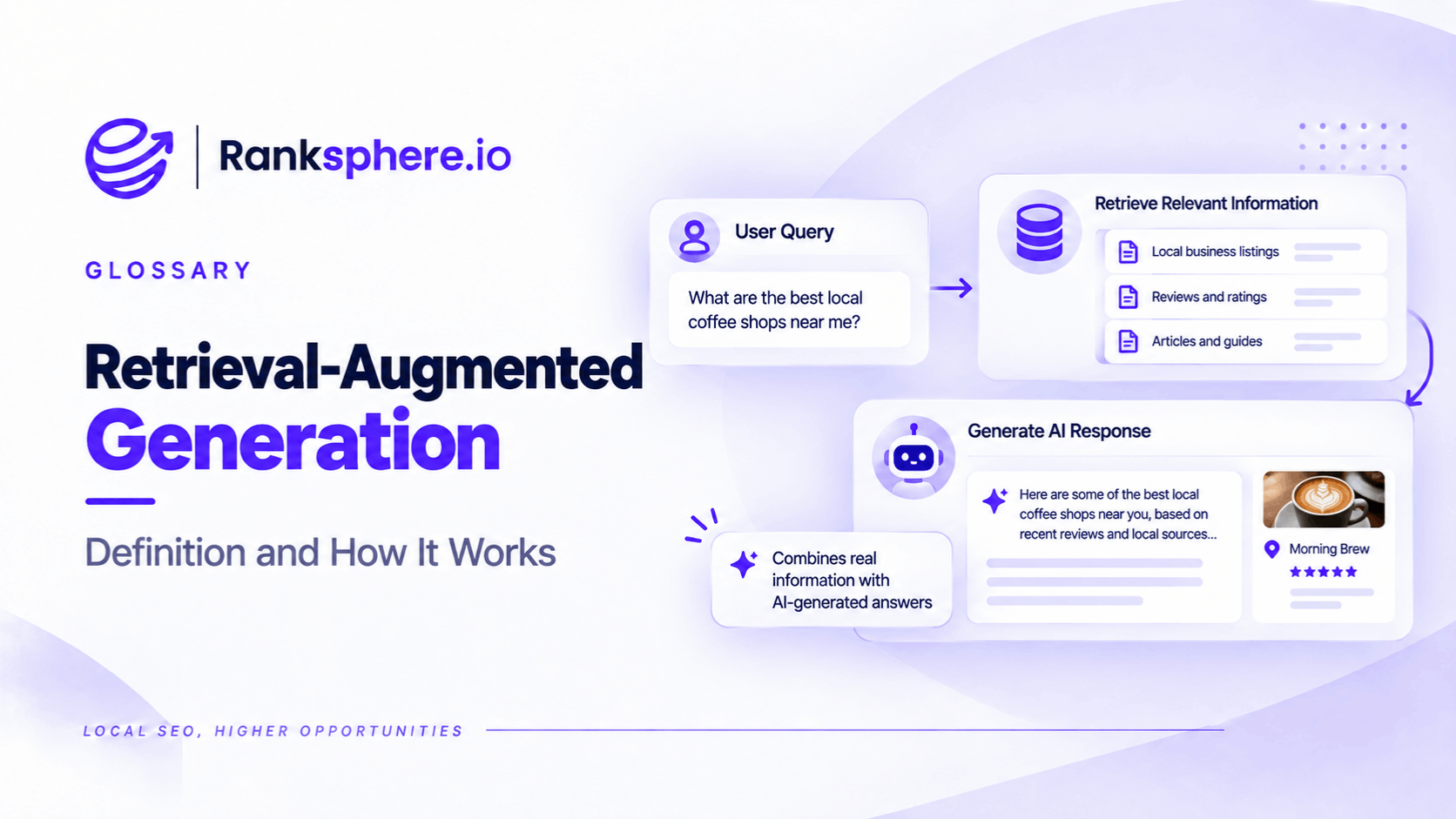
Retrieval-augmented generation (RAG) is an AI technique that combines information retrieval with text generation. Instead of relying only on information learned during training, an AI system retrieves relevant information from an external source and uses it as context when generating an answer.
For example, an AI assistant answering a question about a product may retrieve information from the manufacturer's documentation before responding.
That information could include product specifications, pricing, instructions, or other details that weren't available when the AI model was trained.
RAG allows AI systems to work with information from sources such as websites, databases, research documents, and internal knowledge bases.
It is particularly relevant to SEO because Google uses retrieval and grounding techniques in AI-powered search experiences, including AI Overviews and AI Mode.
However, RAG isn't a universal architecture used identically by every AI search system.
Different platforms may use different retrieval methods, ranking systems, data sources, and approaches to displaying citations.
For website owners, the important point is that AI-generated answers often depend on information that a system can discover, retrieve, and interpret.
This is one reason traditional SEO remains relevant as AI search develops.
How Does Retrieval-Augmented Generation Work?
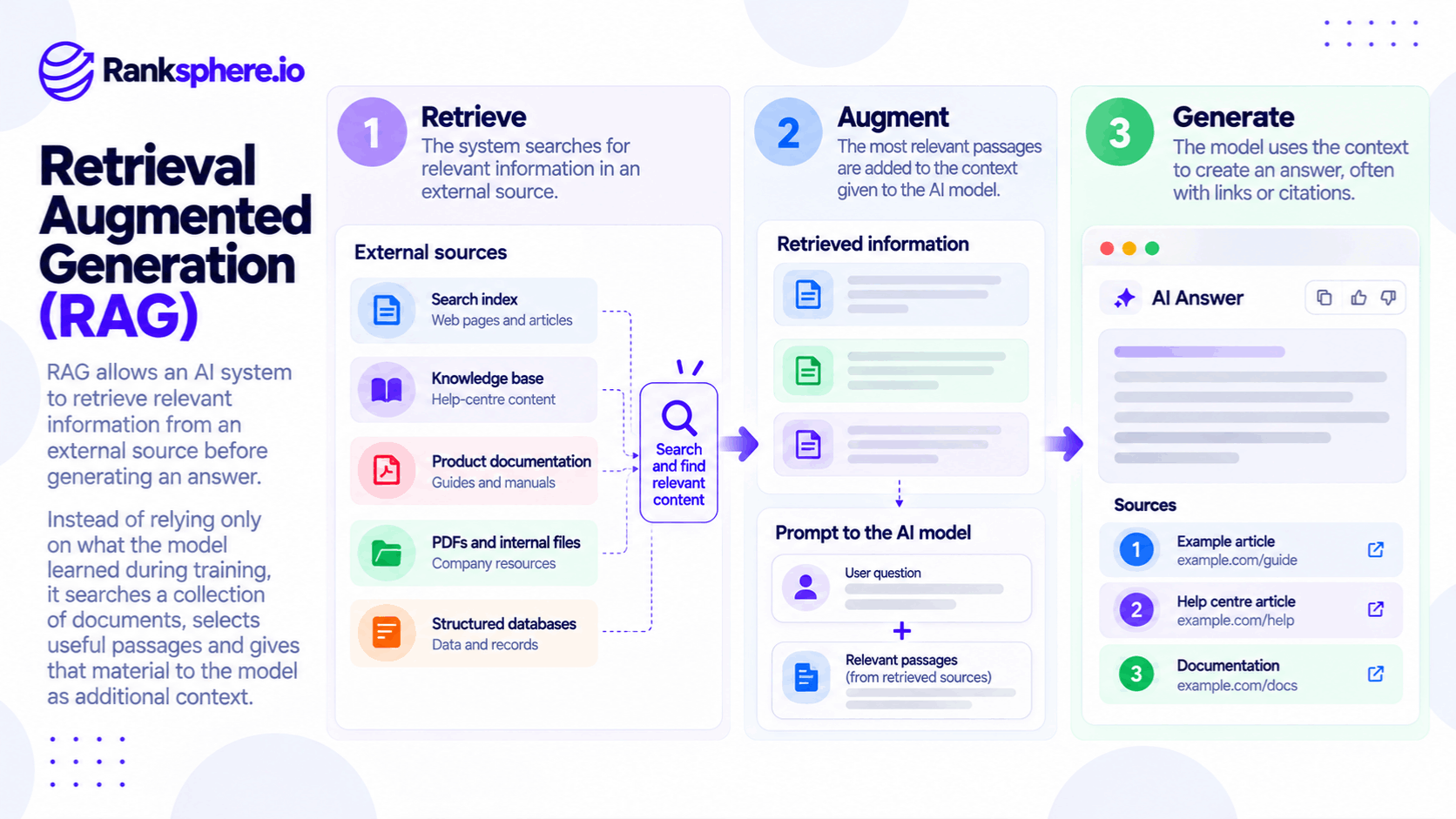
RAG typically involves three main steps: retrieval, augmentation, and generation.
The exact process varies by system, but the basic approach is straightforward.
1. Retrieval
The AI system searches an available information source for material related to the user's question.
For example, someone might ask:
"What's the difference between repairing and replacing a flat roof?"
A retrieval system could identify relevant information from roofing guides, technical documents, and other available sources.
Depending on the system, retrieval may use keyword matching, semantic similarity, ranking algorithms, or a combination of methods.
The objective is to find information relevant to the question.
However, the system doesn't necessarily retrieve the highest-ranking page from a conventional search results page.
AI retrieval and traditional search rankings can overlap without producing identical results.
2. Augmentation
The retrieved information is provided to the AI model as additional context.
For example, the system might retrieve passages covering:
- Common flat roof problems
- Conditions that make repairs suitable
- Circumstances requiring replacement
- Relevant material specifications
- Factors affecting cost
The AI model can then use that information alongside the user's question.
This is the augmentation stage.
Instead of generating an answer entirely from its training knowledge, the model has access to relevant external material.
However, the presence of retrieved information doesn't guarantee that the resulting answer will be correct.
The retrieved source may be outdated, incomplete, misleading, or misunderstood by the model.
3. Generation
The AI model produces a response using the question and the available context.
For example, it might explain that a localised repair can be appropriate for certain types of damage, while widespread deterioration may require replacement.
Some RAG systems also provide citations or links to supporting sources.
However, citations aren't an automatic requirement of RAG.
A private company chatbot may use internal documents without displaying public links, while an AI search feature may display sources that readers can visit.
The important distinction is that retrieval supplies information and generation turns that information into a response.
How Is RAG Different From a Traditional AI Model?
A language model can generate responses using patterns and information learned during training.
However, its training knowledge may not contain recent developments or private information.
For example, a model may understand how appointment scheduling software generally works but not know the latest features of a particular platform.
RAG gives the system an opportunity to retrieve current or organisation-specific information.
This can help with questions involving:
- Recently updated documentation
- Product specifications
- Internal business policies
- Technical support instructions
- Research documents
- Information that changes frequently
However, RAG doesn't completely eliminate inaccurate answers.
Its reliability still depends on the information retrieved and how the model uses it.
A system can retrieve a relevant source and still interpret it incorrectly.
How Does RAG Relate to SEO?
The connection between RAG and SEO comes from information retrieval.
If an AI system uses external content to answer a question, that content must first be available through the system's retrieval process.
For Google Search, this makes traditional SEO particularly important.
Google has explained that its generative AI search features rely on established Search ranking and quality systems and use retrieval techniques to identify relevant supporting content.
Google also confirms that eligible webpages must be indexed and available for snippets to appear as supporting links in AI Overviews or AI Mode.
That means there is no entirely separate technical SEO process required just to become eligible for these Google features.
However, other AI platforms may have different retrieval systems and access requirements.
1. Make Important Pages Crawlable
Search engines need to access webpages before they can process their content.
For example, a page blocked from Googlebot through robots.txt may not be available for normal crawling and indexing.
Similarly, security rules that incorrectly block legitimate crawlers can prevent important content from being accessed.
Website owners should review:
- Robots.txt rules
- Indexing directives
- Server responses
- CDN and firewall settings
- Internal linking
- JavaScript rendering
For Google AI Overviews and AI Mode, the normal Google Search technical requirements remain relevant.
2. Make Sure Pages Are Indexed
For a webpage to appear as a supporting link in Google's AI Overviews or AI Mode, Google says it must be indexed and eligible to appear in Search with a snippet.
This makes indexing an important prerequisite.
However, being indexed doesn't guarantee that the page will appear in an AI-generated answer.
The system still needs to determine whether the content is relevant and useful for the particular query.
For other AI systems, retrieval may involve external search tools, independent indexes, or different data sources.
Therefore, Google indexing shouldn't be presented as a universal requirement for every AI assistant.
3. Continue Improving Search Visibility
Traditional SEO remains important because Google's AI search features use its existing Search infrastructure and ranking systems.
For example, a well-structured guide containing useful information may be eligible to appear in both traditional search results and AI-generated responses.
However, ranking number one in ordinary search doesn't guarantee an AI citation.
AI systems may retrieve documents for several related questions, use different ranking methods, or select sources that don't appear at the top of a conventional results page.
The practical goal should be to make content relevant, accessible, accurate, and useful rather than treating a particular organic position as a guaranteed citation threshold.
4. Make the Business Easy to Identify
AI systems may need to identify which business, person, product, or organisation a piece of information refers to.
For example, someone might ask:
"Does this physiotherapy clinic offer sports injury treatment?"
The system needs enough reliable information to associate the question with the correct clinic and its services.
Clear business information can help reduce ambiguity.
Relevant details may include:
- Business name
- Website
- Service descriptions
- Physical location or service area
- Contact details
- Relevant business profiles
- Accurate structured data, where appropriate
This relates to the concept of an entity.
However, entity clarity doesn't guarantee retrieval or inclusion in an AI-generated response.
What Makes Content Useful for AI Retrieval?
Different retrieval systems use different techniques.
Some retrieve entire documents, while others work with passages or smaller sections of text.
There is no universal content format that guarantees selection.
However, several established writing practices can help make content easier to interpret and useful to readers.
Write Sections That Make Sense on Their Own
A section should clearly explain its topic without depending too heavily on information several paragraphs earlier.
For example, consider this sentence:
"This is usually the best option because of the factors discussed above."
It provides little context when read independently.
A clearer version would be:
"Flat roof repair may be appropriate when damage is localised and the underlying roof structure remains sound."
The second sentence communicates a complete idea.
This helps human readers who arrive at a specific section, and it can also make the passage easier for retrieval systems to interpret.
Use Clear, Descriptive Headings
Good heading tags help organise content into understandable sections.
For example:
How Much Does Flat Roof Replacement Cost?
This is more descriptive than:
Additional Information
A direct answer beneath the heading can help readers find what they need.
This structure is also useful for content that may be considered for featured snippets.
However, question-based headings aren't mandatory, and using them doesn't guarantee featured snippets or AI citations.
Use them when they naturally reflect the questions your readers are asking.
Include Specific, Verifiable Information
General statements are often less useful than details that answer a real question.
For example:
"We offer affordable roof repairs completed to a high standard."
This tells readers little about what the service involves.
A more useful explanation might include genuine information about:
- Typical repair costs
- Factors affecting pricing
- Materials used
- Project duration
- Common complications
- Circumstances where replacement is preferable
Specific information can make content more valuable.
However, figures should come from reliable records or appropriately cited sources.
Don't invent statistics or publish unsupported pricing merely to make a page appear more authoritative.
Add First-Hand Experience
A business may have practical knowledge that competing websites don't.
For example, a roofing contractor could document a completed repair involving damaged decking beneath a flat roof.
A genuine case study could explain what caused the problem, how it was identified, what work was completed, and what the homeowner should know.
That information provides more direct evidence of experience than a generic summary of roofing advice.
It may also give readers and publishers a reason to reference the page.
However, original experience doesn't guarantee an AI citation.
Keep Information Accurate and Current
AI systems may use retrieved content when answering questions involving changing information.
For example:
- Software pricing
- Product availability
- Business opening hours
- Regulations
- Service fees
- Technical specifications
Outdated information can make a page less reliable.
Review important factual claims and update them when necessary.
However, not every article needs frequent changes.
An evergreen explanation may remain accurate for years.
Make Authorship and Sources Clear
When appropriate, identify who created or reviewed the content.
For example, a technical article written by an engineer may benefit from a clear author profile explaining their relevant experience.
A medical article may need suitable clinical review.
Citing authoritative sources also helps readers verify factual claims.
However, named authorship isn't a guaranteed AI retrieval signal.
Its main purpose is to help people understand who is responsible for the information and why it is credible.
Does RAG Mean AI Search Uses the Same Rankings as Google?
Not necessarily.
This is an important distinction.
Google has confirmed that its AI search experiences use core Search systems and retrieval techniques.
However, AI Overviews and AI Mode may use query fan-out, issuing multiple related searches to explore different aspects of a question.
For example, someone asking about the cost of replacing a flat roof may trigger retrieval related to:
- Replacement costs
- Roofing materials
- Labour requirements
- Roof size
- Repair alternatives
The sources shown in the AI-generated response may therefore differ from the pages ranked for the original query alone.
Other AI search platforms can also use different retrieval methods.
This means traditional ranking visibility is relevant, but it isn't identical to AI citation visibility.
There is no reliable rule stating that a page must rank in a particular organic position to be cited.
Do You Need llms.txt for RAG?
The proposed llms.txt file is intended to provide AI systems with a curated description of a website and links to important resources.
However, it isn't a standard requirement for appearing in Google's AI search features.
Google explicitly states that websites don't need special AI-specific text files or markup to appear in AI Overviews or AI Mode.
That doesn't mean every possible AI tool ignores such files.
A custom retrieval application could be designed to read a curated index or text file.
However, that is different from proving that a public search engine uses llms.txt as a ranking, retrieval, or citation signal.
For most website owners, the priority should remain:
- Accessible webpages
- Correct indexing
- Clear internal links
- Useful content
- Accurate business information
- Appropriate structured data where relevant
Creating a special AI-focused file shouldn't replace those foundations.
Where Can Businesses Use RAG Themselves?
RAG isn't limited to public search engines.
Businesses can also use it in internal tools, customer support systems, and document search applications.
Customer Support Assistants
A software company might use RAG to build a support assistant that answers questions from its knowledge base.
For example, a customer asks:
"How do I connect my Google Business Profile?"
The assistant retrieves the relevant help documentation and uses it to prepare an answer.
This can help the system provide instructions based on the software's actual features.
However, documentation needs to be kept accurate, and the assistant should be tested for incorrect or incomplete answers.
Internal Knowledge Search
A company might use RAG to help employees search policies, standard operating procedures, or technical documentation.
For example, a team member asks:
"What is our onboarding process for new clients?"
The system retrieves relevant internal documents rather than relying only on general training knowledge.
This can make internal information easier to access.
Access controls are important so employees don't receive information they aren't authorised to view.
Product Documentation
A manufacturer could use RAG to answer technical questions about equipment.
For example, a customer asks about the installation requirements for a particular product.
The system retrieves relevant specifications and instructions before responding.
This may help provide more accurate product-specific information.
However, high-risk instructions and technical specifications should still be verified against authoritative documentation.
Common RAG and AI Search SEO Mistakes
Several misconceptions can lead businesses to invest in unnecessary work.
Assuming AI Search Makes Traditional SEO Obsolete
Google's generative AI search features still depend on established Search systems.
Crawling, indexing, content quality, and relevance remain important.
AI search introduces new experiences, but doesn't eliminate the need for SEO.
Assuming Rankings Guarantee AI Citations
A page can rank well in traditional search without appearing as a supporting link in a particular AI-generated answer.
The systems may select different sources or retrieve information for related queries.
Measure search visibility and AI citations separately where appropriate.
Paying for AI Optimisation Without Clear Deliverables
Some agencies offer AI-focused content services using unfamiliar terminology.
That doesn't automatically make the service unnecessary.
However, businesses should ask what the work involves.
For example:
- Is the agency fixing crawling or indexing issues?
- Is it improving content accuracy?
- Is it adding original research?
- Is it restructuring confusing pages?
- Is it measuring citations or business outcomes?
- Is there evidence that a proposed technical change affects the targeted platform?
These questions help distinguish meaningful work from claims that can't be substantiated.
Blocking Relevant Crawlers
Website owners should understand which crawlers access their content and why.
For Google AI Overviews and AI Mode, Googlebot access and normal Search indexing requirements matter.
Other AI services may use different bots or retrieval methods.
Blocking a crawler can affect access to content, but crawler controls don't operate identically across all AI systems.
Review official documentation before changing permissions.
Writing Only for Passage Extraction
Short, self-contained explanations can be useful.
However, breaking every article into disconnected answer blocks may make it harder for readers to follow a complete topic.
Content should still have a logical structure and provide enough context.
Write for the reader first.
Assuming Structured Data Guarantees AI Visibility
Structured data can help search engines understand certain information.
However, Google doesn't require special AI-specific schema markup for AI Overviews or AI Mode.
Adding markup alone doesn't guarantee retrieval or citation.
Publishing Unsupported Facts
A page containing specific figures may look informative, but inaccurate details make it less useful.
For example, an article should not invent local roofing prices simply because specific numerical answers might be easier to quote.
Use genuine information and provide appropriate context.
RAG and AI Search Best Practices
For website owners who want content to remain useful and discoverable as AI search develops:
- Follow established technical SEO practices.
- Ensure important pages are crawlable and eligible for indexing.
- Keep internal links clear and functional.
- Understand the crawler controls used by relevant AI platforms.
- Research actual search intent before writing.
- Answer important questions directly.
- Use descriptive headings and logical content structure.
- Make individual sections understandable without excessive surrounding context.
- Include original, verifiable information where available.
- Use first-hand examples and genuine case studies.
- Keep changing information accurate.
- Identify authors and sources where appropriate.
- Avoid relying on unsupported AI-specific markup claims.
- Measure AI visibility separately from traditional rankings.
- Evaluate whether visibility produces useful business outcomes.
The objective isn't to create content for an imagined universal AI retrieval algorithm.
It's to publish accurate, accessible, useful information that both readers and relevant retrieval systems can understand.
Example of RAG and AI Search for a Manufacturing Business
Consider a hypothetical manufacturing company that produces specialist industrial equipment.
The company has a large collection of technical documentation.
However, much of the information is difficult to find.
Product specifications are spread across several pages, technical articles lack clear headings, and older documents contain outdated information.
An agency proposes a service described as "RAG optimisation."
What the Agency Recommends
The proposal includes:
- Restructuring technical pages
- Adding descriptive headings
- Making product specifications easier to find
- Identifying content authors
- Updating outdated documentation
These improvements are worthwhile.
However, they largely involve existing content quality, website structure, and technical SEO practices.
The agency hasn't demonstrated that the proposed changes require a separate AI-specific optimisation system.
How the Company Improves Its Website
The manufacturer reviews its most important technical pages.
It reorganises information around customer questions and adds clear explanations of product specifications.
Named engineers review the technical information for accuracy.
Where possible, pages include genuine product data, diagrams, and relevant documentation.
The company also checks crawling, indexing, and internal linking.
These changes make the information easier for customers to find and understand.
They may also improve its suitability for relevant search and retrieval systems.
However, appearing in AI-generated answers isn't guaranteed.
Where RAG Becomes a Separate Technical Project
The company also wants an internal assistant that can answer employee questions about its products.
This requires a different kind of work.
The development team connects an AI application to a curated collection of current product documentation.
When an employee asks a technical question, the system retrieves relevant documents and uses them to generate a response.
The company can control which documents are available and test whether the assistant uses the correct sources.
This is a direct application of RAG.
It is separate from optimising the public website for Google Search.
Example Shows
“The manufacturer benefits from improving its public documentation and building an internal retrieval system.
However, those are two different projects.
The first involves making website content easier to discover, interpret, and use.
The second involves building an application that retrieves information from a controlled document collection.
RAG helps explain why information retrieval matters in AI search, but it doesn't replace the foundations of good SEO.
For businesses, the most practical approach remains publishing accurate, useful content that search engines can access while treating AI citation visibility as a related, but distinct, outcome.”
See Also
- AI Overviews — Google's AI-generated search summaries and supporting links.
- Generative Engine Optimisation — The emerging practice of improving content visibility in generative AI experiences.
- llms.txt — A proposed format for providing AI systems with website information.
- Featured Snippet — How Google may display selected passages from webpages.
- Entity — Understanding identifiable people, places, businesses, and concepts.
- Semantic Search — How search systems interpret meaning and context.