A featured snippet is a prominent Google Search result that displays an extract from a webpage to answer a search query directly.
It usually includes content taken from the source page together with a link back to that page.
Google selects featured snippets automatically. Website owners cannot buy the position, apply for it or add markup that guarantees a page will appear there.
Featured snippets are often associated with informational searches where a relatively concise answer can help the searcher quickly understand the topic.
They have sometimes been called position zero because they traditionally appeared above the standard organic results. That nickname is less useful now because modern search-result pages can contain AI features, local results, videos, shopping results and other elements in different combinations.
The important principle has not changed:
make the answer easy to find, easy to understand and genuinely useful.
How featured snippets work
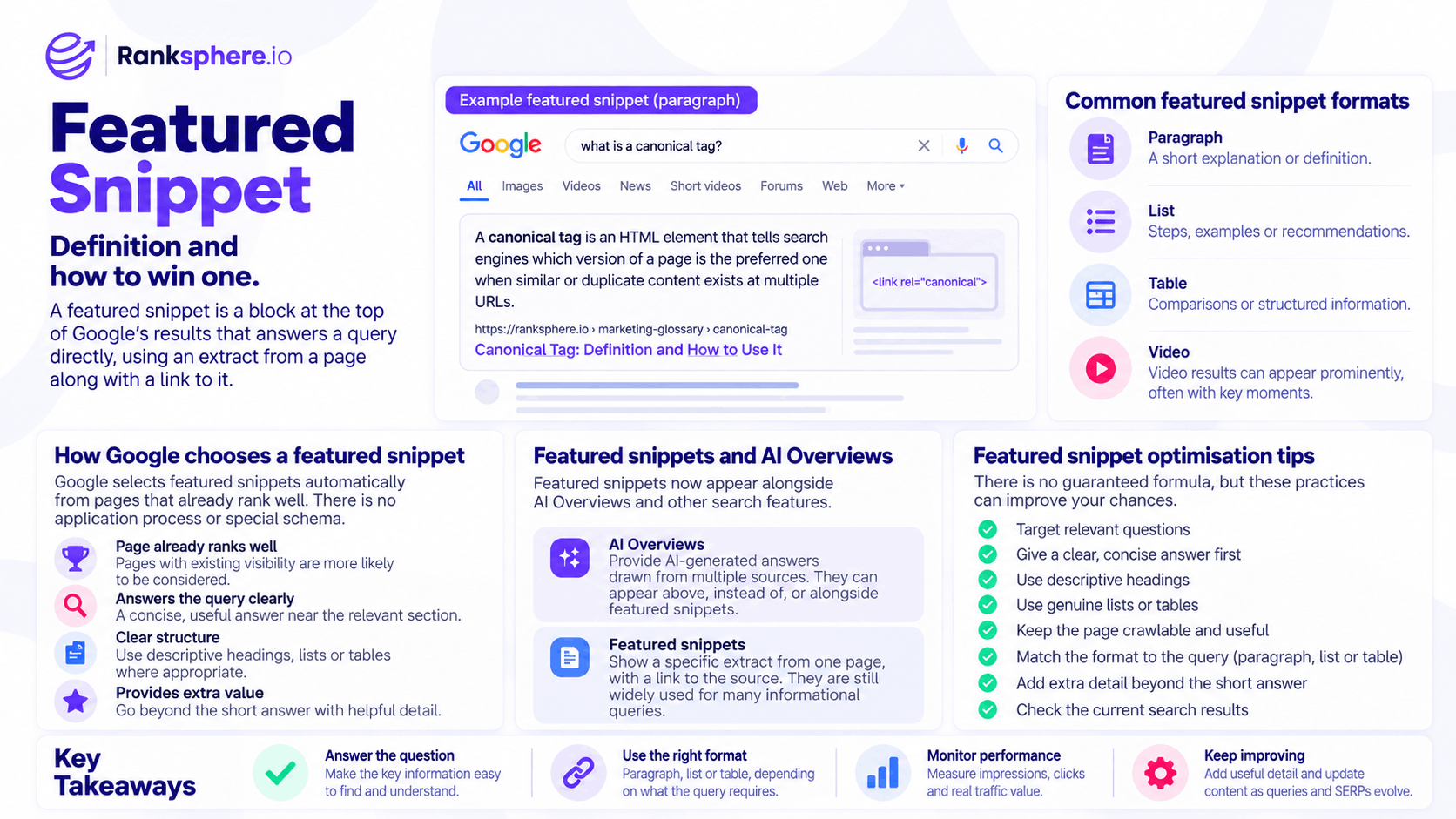
Google's systems decide when a query would benefit from a featured snippet and which page provides a suitable answer.
Google describes featured snippets as content taken from a webpage and displayed prominently in Search. They can appear at the top of results and in other search features such as related-question sections.
There is no:
- Featured snippet schema
- Submission form
- Special meta tag that opts a page in
- Guaranteed formula for winning one
Google's systems make the selection algorithmically.
That means featured snippet optimisation is less about triggering a special feature and more about making your page easy for Google to extract a useful answer from.
Common featured snippet formats
Featured snippets can present information in different ways depending on the query.
Common patterns include:
Paragraph answers
These provide a short explanation or definition.
For example:
What is a canonical tag?
A concise paragraph immediately below that heading may provide the answer Google needs.
There is no official word count you must hit.
Aim for the shortest answer that explains the point clearly rather than forcing the copy into an arbitrary 40- or 50-word limit.
Lists
Lists are useful when the searcher wants:
- Steps
- Requirements
- Examples
- Types
- Ingredients
- Recommendations
Use a numbered list when order matters.
Use bullets when it does not.
Tables
Tables are useful when the information is genuinely comparative or structured.
For example:
| Redirect | Meaning | Typical use |
| 301 | Permanent | A page moved for good |
| 302 | Temporary | The original URL will return |
Do not convert normal prose into a table simply because you hope Google will extract it.
Use the format that makes the content easier to understand.
What about video featured snippets?
Video results can appear prominently in Google Search, including results with key moments or timestamps.
These are better treated as part of Google's wider video search features rather than assuming every prominent video result is the same feature as a traditional text featured snippet. Google documents video results separately from featured snippets.
If video is important to the query, optimise the video itself rather than trying to force a written featured-snippet strategy onto it.
How does Google choose a featured snippet?
Google says its systems determine whether a page would make a useful featured snippet for a particular search.
There is no published checklist guaranteeing selection.
However, pages that are easy to extract answers from often share useful characteristics.
They tend to:
- Answer the query clearly
- Put the relevant answer near the relevant section
- Use descriptive headings
- Organise steps as real lists
- Present comparisons as genuine tables
- Cover the topic beyond one short answer
- Be crawlable and indexable
- Already have sufficient relevance for the query
The main goal is clarity.
Do not make the reader work through several paragraphs of company background before reaching the answer they searched for.
Does a page need to rank in the top ten?
Pages that already perform well for a query are usually more realistic featured snippet opportunities, because Google already considers them relevant.
But avoid treating “top ten” as a hard eligibility requirement.
Google does not publish a rule stating that only URLs in positions 1–10 can become featured snippets.
From a practical SEO perspective, however, improving pages that already have meaningful visibility is usually more productive than trying to win a snippet with a page Google barely ranks.
How to optimise for featured snippets
The best approach is to improve pages that already answer real informational queries.
Find suitable questions
Look for queries where people want a concise answer.
Examples include:
- What is a 301 redirect?
- How often should a boiler be serviced?
- What does NAP mean in SEO?
- How long does roof repair take?
- What is a canonical tag?
Use Google Search Console to identify queries already generating impressions.
Then check the live search results to see what type of result Google currently shows.
SERPs change, so do not assume a featured snippet exists simply because an SEO tool reported one previously.
Use clear headings
A descriptive heading can make the structure easier for readers and search engines to understand.
For example:
How often should a boiler be serviced?
is clearer than:
Servicing Information
You do not have to phrase every heading as a question.
Use question headings where they naturally match the information people are searching for.
Answer the question quickly
When a heading raises a clear question, answer it immediately.
For example:
Most domestic boilers should be serviced once a year. Regular servicing helps identify faults, maintain efficiency and may also be required under the terms of some manufacturer warranties.
Then expand underneath with more detail.
This gives the reader the answer first without turning the rest of the page into shallow content.
Match the natural format of the answer
If the query asks:
How do I submit an XML sitemap?
a numbered process makes sense.
If it asks:
What is an XML sitemap?
a concise paragraph may work better.
If it asks:
301 vs 302 redirect
a comparison table may be useful.
Structure the information according to what the question requires rather than copying whatever format happens to be fashionable.
Direct answer first, detail second
Featured snippet optimisation often improves writing even when no snippet appears.
A useful structure is:
Question
Direct answer
Explanation
Examples
Related details
This avoids one of the most common weaknesses in SEO content: taking several paragraphs to reach the point.
For example:
What is duplicate content?
Duplicate content is substantially similar content available at more than one URL. It does not automatically trigger a Google penalty, but search engines may need to choose which version to treat as canonical.
The article can then explain:
- Technical duplication
- Canonicalisation
- URL parameters
- Location pages
- Syndication
The concise answer helps the reader immediately.
The detailed content gives them a reason to stay.
Do you need special schema for a featured snippet?
No.
Google explicitly says you cannot mark a page as a featured snippet. Its systems decide whether a page is suitable automatically.
Do not confuse featured snippets with rich results.
Rich results can rely on supported structured data such as:
- Product
- Breadcrumb
- LocalBusiness
- Event
Featured snippets do not have their own schema type.
Use structured data when it accurately describes the page, not as an attempt to trigger a featured snippet.
Featured snippets and Search Console
Featured snippet clicks and impressions are included in Search Console's normal performance reporting. Google explains that clicking the source link counts as a click and standard impression rules apply.
Search Console is useful for finding opportunities through:
- Queries
- Impressions
- Clicks
- CTR
- Average position
But Search Console does not give you a simple report saying:
“These are all the featured snippets you currently own.”
You generally need to combine query data with live SERP checking or an appropriate rank-tracking tool.
Ranksphere's rank tracker separates pack and organic position across your service area, helping distinguish normal organic movement from wider changes in the search-results page.
Featured snippets and click-through rate
A featured snippet can increase visibility, but higher visibility does not automatically mean more clicks.
Sometimes the displayed answer gives the searcher enough information without requiring them to visit the source.
For other queries, the snippet encourages the user to click because they need:
- More detail
- Full instructions
- A service
- Supporting examples
- A complete comparison
This is why featured snippets should not be evaluated using rankings alone.
Monitor:
- Impressions
- Clicks
- Click-through rate
- Organic traffic
- Conversions
- Visibility for the query
The value depends heavily on the search intent.
Featured snippets and zero-click search
Featured snippets are closely connected to zero-click search.
A searcher may get the answer directly from Google without visiting any result.
For example:
How many millimetres are in a centimetre?
does not require a detailed article visit for most people.
A query such as:
How do I fix low boiler pressure?
may still produce a click because the searcher wants instructions, safety information or professional help.
So do not assume that winning a featured snippet guarantees additional traffic.
Consider whether the query naturally creates a reason to visit the page.
Featured snippets and AI Overviews
Featured snippets now exist alongside AI Overviews and other generative search experiences.
That makes the search-results page more complex than it was when “position zero” became common SEO terminology.
Google's current guidance for generative AI features emphasises that established SEO fundamentals remain relevant. It does not require a separate technical optimisation system simply to appear in AI features.
Some of the qualities that make a page useful for a featured snippet can also make it easier for other search experiences to understand:
- Clear explanations
- Logical headings
- Useful structure
- Specific information
- Original supporting detail
- Accessible content
But do not assume:
Featured snippet optimisation = AI Overview optimisation.
They are separate search features with different systems.
Write the page so it is genuinely useful first.
Why originality still matters
A concise answer does not mean every page should repeat the same definition found across hundreds of websites.
If the page only gives a generic definition, there may be little reason for someone to continue reading.
After the direct answer, add something useful.
That might include:
- Practical examples
- First-hand experience
- Original data
- Screenshots
- Local information
- Expert explanation
- Comparisons
- Common mistakes
- Step-by-step guidance
The snippet-sized answer gets to the point.
The rest of the page earns the visit.
Can you stop Google using your page as a featured snippet?
Yes.
Google provides snippet controls for website owners.
The nosnippet directive can prevent Google from showing text snippets from the page, including featured snippets.
The data-nosnippet attribute can exclude specific sections of text from appearing in snippets.
Google also documents max-snippet, although there is no fixed minimum length that guarantees a page will or will not appear as a featured snippet.
Most sites will not need to block featured snippets, but the controls exist if there is a genuine reason.
Common featured snippet mistakes
- Treating a top-ten ranking as a hard eligibility rule. Existing visibility helps, but Google publishes no fixed top-ten requirement.
- Writing to an exact word count. There is no official 40–60-word rule.
- Burying the answer. Give readers the useful information without unnecessary preamble.
- Forcing every heading into a question. Use question headings only when they make sense.
- Using fake lists or tables. Structure the content according to what it genuinely represents.
- Creating a tiny page consisting only of a snippet-sized answer. The page still needs to satisfy the wider intent.
- Adding schema specifically to win a featured snippet. There is no featured snippet structured-data type.
- Assuming a featured snippet guarantees more clicks.
- Treating featured snippets and AI Overviews as the same feature.
- Optimising around yesterday's SERP. Search-result layouts can change.
Featured snippet best practices
- Target questions your page can answer properly.
- Start with queries where you already have meaningful visibility.
- Use descriptive headings.
- Answer clear questions promptly.
- Keep the answer concise without forcing a specific word count.
- Use genuine lists for steps and tables for real comparisons.
- Expand beneath the short answer with useful detail.
- Keep the page crawlable, indexable and easy to understand.
- Check the current SERP before choosing a format.
- Measure clicks, impressions and conversions rather than treating the snippet itself as the objective.
- Keep improving the page even if you already hold the featured snippet.
Example
“Calverton Heating has a page ranking well for:
How often should a boiler be serviced?
The page contains the correct information, but the answer does not appear until several paragraphs into the article.
The opening discusses the company, its engineers and its experience before eventually explaining the recommended servicing frequency.
The page is restructured.
An H2 is added:
How often should a boiler be serviced?
The answer follows immediately:
Most domestic boilers should be serviced once a year. Regular servicing can help identify faults early and may also be required to maintain certain manufacturer warranties, depending on their terms.
The existing detail about boiler types, servicing schedules, warranties and what happens during an appointment remains underneath.
Nothing is artificially shortened.
The useful information is simply placed where the reader expects to find it.
Whether Google chooses that section for a featured snippet remains Google's decision.
But the page is better either way: the searcher's question is answered immediately, and the deeper information is still there when they want it.
That is the right way to approach featured snippet SEO.”
See also
- Zero-click search — when a search is completed without a website visit
- Heading tags — structuring questions and supporting information clearly
- Search intent — understanding what the searcher actually wants
- Click-through rate — measuring how often impressions turn into clicks
- AI Overviews — Google's generative search experience
- Long-tail keyword — specific queries that often take question form