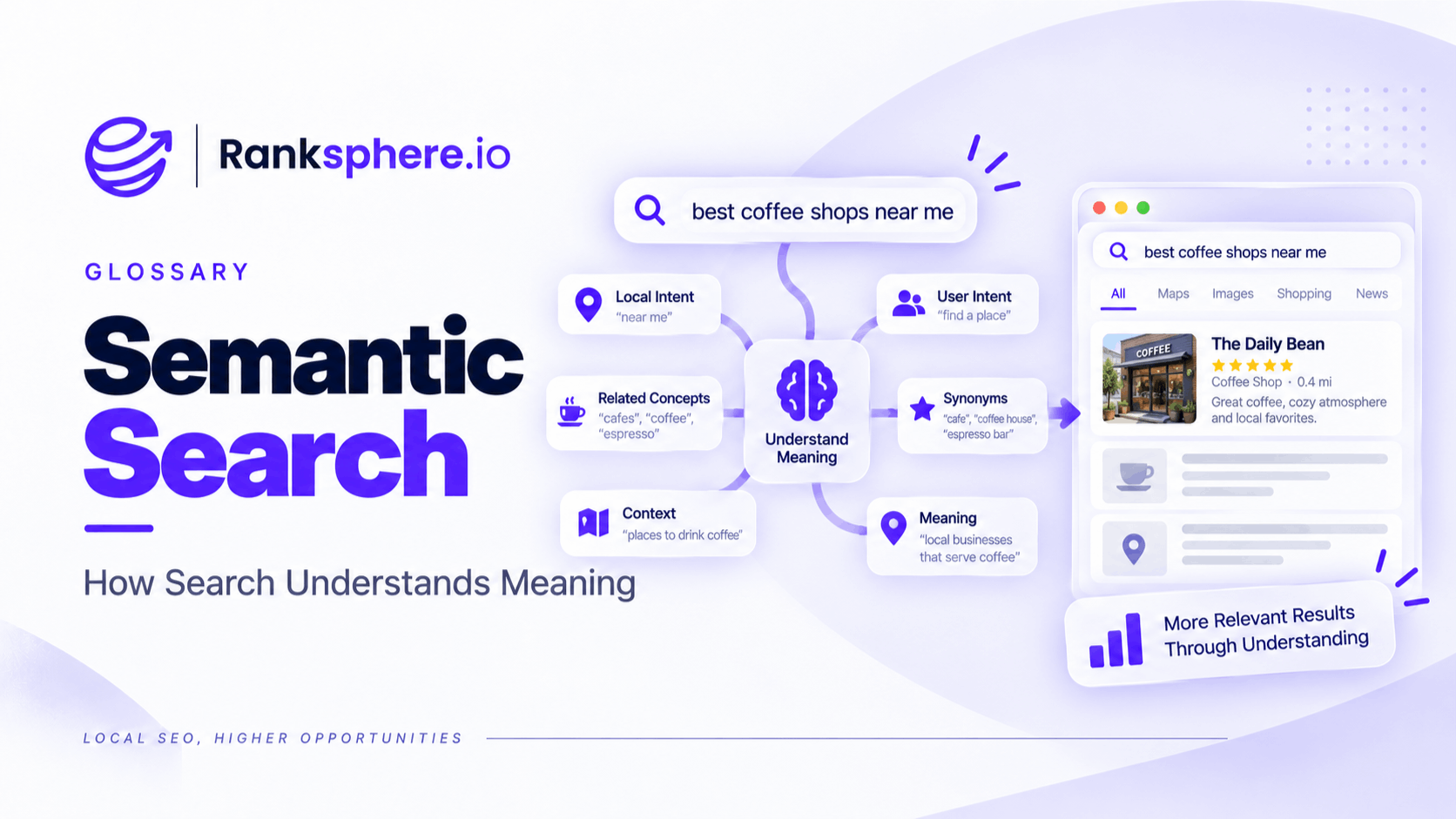
Semantic search is the process of interpreting the meaning, context and intent behind a search rather than relying only on exact keyword matches.
Instead of asking:
“Does this page contain the same words as the query?”
a modern search engine can also consider:
“What is this person actually trying to find?”
That means a page can be relevant even when it uses different wording from the searcher.
For example, someone searching:
how to fix a leaking flat roof
does not necessarily need a page repeating that exact phrase several times.
A useful page about flat roof leaks, common causes, repair options, materials and when replacement is necessary may satisfy the query without mirroring every word.
Semantic search does not make keywords irrelevant.
It makes meaning more important than exact repetition.
What is semantic search?
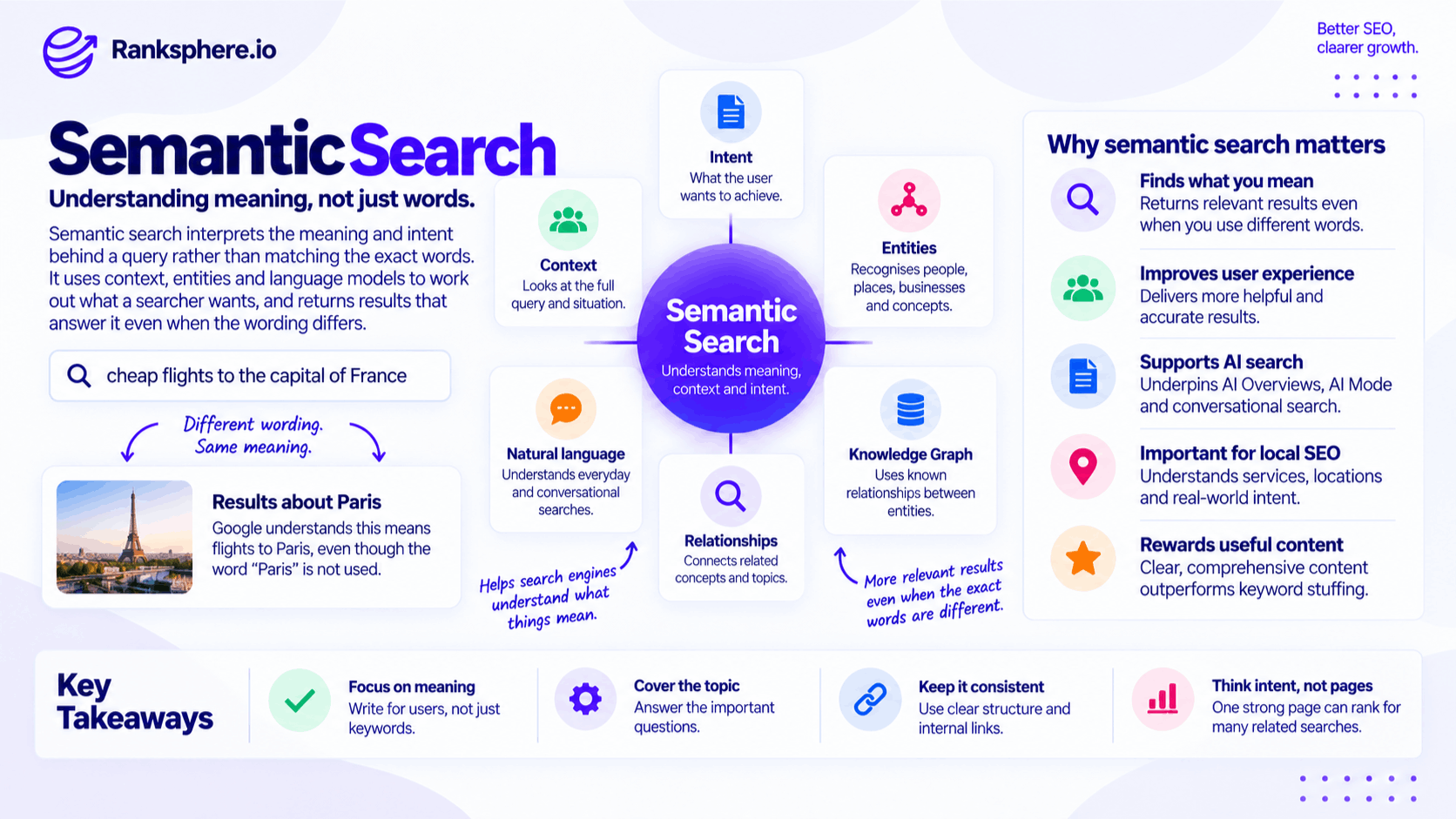
Semantic search aims to understand the meaning of a query and the relationships between the concepts inside it.
It can use signals such as:
- Query context
- Search intent
- Entity recognition
- Word relationships
- Natural language understanding
- Previous parts of a longer query or conversation
This makes search better at handling:
- Synonyms
- Ambiguous words
- Natural questions
- Long-tail searches
- Conversational phrasing
For SEO, the practical result is that you usually do not need separate pages for minor wording variations when those searches represent the same intent.
Semantic search vs keyword matching
Traditional keyword matching looks mainly at whether words from the query appear in a document.
Semantic search adds another layer.
Consider:
cheap flights to the capital of France
The query does not contain:
Paris
but a search system can understand the relationship:
France → capital → Paris
and return relevant results.
That is semantic understanding.
At the same time, the actual words still matter.
Modern search does not operate as:
keywords OR semantics
It uses both.
Exact terms can provide useful context, while semantic systems help interpret what those terms mean.
Why semantic search matters for SEO
Semantic search changed the value of many old SEO habits.
Years ago, optimisation often focused heavily on repeating a target phrase.
For example:
emergency plumber Manchester
might be inserted repeatedly into:
- Title
- H1
- H2s
- Body copy
- Footer
Modern search is better at understanding that phrases such as:
- emergency plumbing in Manchester
- urgent plumber
- 24-hour plumbing repairs
- plumber for a burst pipe
can be related depending on context.
That makes clear, useful writing more valuable than mechanically repeating the same wording.
Keywords still matter
Semantic search does not mean:
“Keywords no longer matter.”
People still search using words.
Those words still help explain:
- Topic
- Intent
- Location
- Product
- Service
Keyword research is useful because it shows how real people describe their needs.
The mistake is assuming that every variation requires:
- A separate page
- An exact-match heading
- A fixed number of repetitions
Use keywords to understand demand and language.
Do not treat them as a mathematical writing formula.
Entities and semantic search
Entities help search engines distinguish between different things that may share similar words.
Take:
Jaguar
It could refer to:
- The animal
- The car manufacturer
Context helps determine which entity the user means.
A query such as:
Jaguar electric SUV
clearly points towards the automotive company.
A query such as:
where do jaguars live
points towards the animal.
This ability to distinguish entities is one important part of semantic search.
The Knowledge Graph and semantic search
Google's Knowledge Graph helps organise information about recognised entities and their relationships.
For example:
Company → founded by → Person
Business → located in → City
City → located in → Country
These relationships help Google answer searches where the user may not explicitly state every piece of information.
But semantic search should not be reduced entirely to the Knowledge Graph.
Search engines also use:
- Page content
- Links
- Language models
- Query context
- Ranking systems
Entity relationships are one piece of a much larger system.
Search intent and semantics
Search intent is central to semantic search.
The same word can represent very different intentions.
Take:
boiler
Someone searching:
what is a combi boiler
is probably looking for information.
Someone searching:
boiler repair near me
is looking for a service.
Someone searching:
best combi boiler 2026
may be comparing products.
The topic is related.
The intent is different.
That is why one page should not automatically target every keyword containing the same main term.
Semantic search and synonyms
Search engines can often understand closely related wording.
That means you generally do not need separate pages such as:
/emergency-plumber/
and:
/plumber-emergency/
simply because the word order changes.
Likewise, pages do not need to contain every imaginable synonym.
Write naturally.
If several phrases refer to the same concept and intent, one well-written page can often cover them together.
Semantic search and keyword variations
Consider these searches:
- boiler repair cost
- cost of boiler repair
- how much does boiler repair cost?
- boiler repair prices
They may represent essentially the same intent.
Creating four pages for them could create unnecessary overlap.
One strong page could answer the pricing question properly.
That is usually more useful than trying to create a separate URL for every variation.
Topic coverage
Semantic search makes it useful to cover the important aspects of a subject rather than simply repeating its main keyword.
For example, a good page about roof repair might naturally discuss:
- Common problems
- Repair methods
- Materials
- Costs
- Timescales
- When replacement is necessary
Those subjects belong there because they help answer the user's questions.
But do not confuse topical depth with adding every related term you can find in an SEO tool.
A page should cover what the user needs, not every semantic association available.
Semantic SEO
The term semantic SEO is often used to describe optimisation focused on meaning, topics, entities and relationships rather than exact-match keywords alone.
Useful semantic SEO usually includes:
- Understanding search intent
- Grouping related queries
- Covering meaningful subtopics
- Using clear internal links
- Describing entities accurately
- Connecting related pages
It should not become another mechanical checklist.
If someone gives you a list of 80 “semantic keywords” and tells you every one must appear in the article, that is simply keyword stuffing with different terminology.
What are LSI keywords?
“LSI keywords” is an old SEO phrase that still appears in content tools and marketing advice.
LSI stands for Latent Semantic Indexing, an older information-retrieval technique.
Google does not use “LSI keywords” as an SEO concept where publishers need to insert a particular list of related terms.
You do not need to find:
LSI keywords
and force them into a page.
Use normal language and cover the subject accurately.
Related terminology will usually appear naturally when the content is genuinely useful.
Keyword density
Keyword density measures how frequently a word or phrase appears relative to the total amount of text.
For example:
10 uses of a keyword in 1,000 words = 1% keyword density
There is no useful universal SEO target such as:
Use the primary keyword at 2.5% density.
Writing to a fixed density can easily make copy repetitive and unnatural.
Use the main term where it helps readers understand the page:
- Title
- Main heading
- Introduction
- Relevant sections
Then write naturally.
Natural language and SEO
Modern search systems are much better at interpreting natural language than older search engines were.
That means content can be written in the way customers actually speak.
Instead of:
Emergency plumber Manchester services from our Manchester emergency plumber team.
write:
Need an emergency plumber in Manchester? We handle burst pipes, serious leaks and other urgent plumbing problems across the area.
The topic remains clear.
The writing becomes much easier to read.
Long-tail queries
Long-tail keywords are often more specific than broad head terms.
For example:
roof repair
is broad.
how much does it cost to repair a leaking flat roof
is much more specific.
Semantic search systems are better able to interpret these longer natural-language questions.
That does not mean semantic search alone caused people to start using longer queries.
Search interfaces, voice search and conversational AI have also changed how people search.
The practical point is that content should answer specific questions naturally rather than relying only on short keyword phrases.
Conversational search
Conversational search has become more prominent with interfaces such as AI Mode.
Instead of searching:
dental implants cost
someone might ask:
I need two dental implants and live in Bristol. What affects the price, how long does treatment take and what should I compare between clinics?
That single query contains several related questions.
Semantic systems can interpret those relationships.
For publishers, that makes genuine subject coverage more useful than building one page for every possible wording.
Semantic search and AI Overviews
AI Overviews extend semantic search into generated answers.
Google can retrieve information from relevant sources and then synthesise a response.
That process can involve understanding:
- Entities
- Intent
- Relationships
- Subtopics
But AI Overviews do not simply replace retrieval.
Google still needs relevant sources from which to gather information.
That means traditional SEO fundamentals remain relevant even when the final interface is generative.
Semantic search and AI Mode
Google AI Mode goes further by allowing longer questions and follow-ups.
For example:
Which type of heat pump would suit a poorly insulated Victorian terrace, and should I improve the insulation first?
requires the system to understand several related concepts.
This is a natural extension of semantic search.
The user is not supplying a neatly formatted keyword.
They are describing a problem.
The system tries to understand the problem rather than simply matching the phrase.
Related concepts do not need to be forced
SEO tools often suggest related words such as:
- Materials
- Prices
- Installation
- Maintenance
because top-ranking pages frequently mention them.
These can be useful clues.
They are not compulsory terms.
For example, a page about:
roof repair
may reasonably discuss materials and costs.
But if a particular related concept does not help answer the query, there is no reason to insert it solely because a content tool recommends it.
Write for completeness, not keyword coverage percentages.
One page per intent, not per phrase
Semantic search makes page boundaries especially important.
Suppose these queries all reflect the same intent:
flat roof repair
flat roof repairs
repairing a flat roof
flat roofing repair
You probably do not need four pages.
One page can cover the subject.
By contrast:
flat roof repair cost
may or may not deserve its own page depending on how much distinct information and search intent exists around pricing.
Use intent to determine page boundaries.
Not wording alone.
Semantic search and keyword cannibalisation
Creating separate pages for near-identical query variations can contribute to keyword cannibalisation.
The problem is not that multiple pages use the same keyword.
The problem occurs when several URLs compete to satisfy essentially the same intent.
A better structure gives each page a clear role.
For example:
Flat Roof Repair
Flat Roof Replacement
Flat Roof Repair Costs
may each be justified if they serve genuinely different needs.
Topic clusters and semantic search
Topic clusters can help organise related information when a subject is too broad for one page.
For example, a dental implant cluster might contain:
Pillar
Dental Implant Guide
Supporting content
- Cost
- Recovery
- Suitability
- Implants vs dentures
The pages share a broader topic but serve different intents.
That is more useful than publishing several pages targeting different phrasings of:
dental implants
Internal linking and semantic relationships
Internal links can also help clarify how subjects relate.
For example:
A guide about:
Dental Implant Recovery
might link to:
- Dental Implant Guide
- Implant Costs
- Dental Implant Treatment
Those connections help users move through the subject.
They also give search engines additional context about how the site's pages relate.
The goal is not to create links around every possible semantic keyword.
Link pages when the relationship genuinely helps.
Semantic search for local SEO
Semantic understanding matters in local search too.
A query such as:
someone to fix a leaking boiler near me
can be understood even though the user never types:
heating engineer
or:
boiler repair company
Google can interpret:
- The problem
- The service required
- The local intent
For local businesses, this is another reason to describe services clearly rather than targeting only rigid keyword formulations.
Entity clarity for local businesses
Clear business information can also support semantic understanding.
Keep important facts accurate:
- Business name
- Location
- Services
- Contact details
This helps both users and search systems understand what the business represents.
Do not turn this into an exercise in repeating the same description everywhere.
The facts should agree.
The wording can remain natural.
Search results and intent
Search results can provide useful evidence about how Google currently interprets a query.
For example, if a search returns mostly:
- Product pages
the query may have strong commercial intent.
If it returns:
- Guides
- Tutorials
- Definitions
the dominant intent may be informational.
But SERPs are not a perfect definition of intent.
They can contain:
- Mixed intents
- Personalised results
- Localised results
- Changing SERP features
Use the search results as evidence, not as an unquestionable rule.
Rank tracking semantic keyword groups
A single useful page may rank for many different queries that express the same underlying need.
That makes it helpful to track groups of related terms rather than judging performance by one exact phrase.
Ranksphere's rank tracker tracks a set of related terms together across your service area, helping show how one page performs across different local search variations.
The important metric is not whether every exact keyword occupies the same position.
It is whether the relevant page is becoming visible for the wider set of searches it is meant to satisfy.
What semantic search changed in SEO
Semantic search has made several older SEO habits much less useful.
Exact-match repetition
Repeating the same phrase again and again does not add meaning.
It usually just makes the writing worse.
One page per keyword variation
Minor wording differences rarely justify separate pages when the intent is the same.
Fixed keyword-density targets
There is no useful universal density percentage to aim for.
LSI keyword lists
Google does not require a set of “LSI keywords” to understand a topic.
Mechanical synonym stuffing
Replacing:
plumber
with:
plumbing specialist
plumbing engineer
water-system expert
simply to create variation does not improve a page.
Use whichever words make sense naturally.
What semantic search did not make obsolete
Some traditional SEO fundamentals remain important.
You still need:
- Clear titles
- Descriptive headings
- Relevant keywords
- Search intent research
- Internal links
- Useful content
Semantic search did not remove these.
It changed how mechanically they should be approached.
A title should still make the page topic clear.
It just does not need to contain every possible variation of the keyword.
Common semantic search mistakes
- Thinking keywords no longer matter. Words remain an important part of search.
- Creating separate pages for simple wording variations.
- Following keyword-density targets.
- Stuffing synonym lists into content.
- Treating “LSI keywords” as a Google requirement.
- Adding unrelated sections purely to increase topical coverage.
- Ignoring search intent.
- Assuming every related query belongs on one page. Different intents may still need different URLs.
- Treating a SERP as an absolute definition of intent.
- Writing vague copy because you assume Google will understand everything semantically. Clarity still matters.
- Believing AI search has replaced normal retrieval.
Semantic search best practices
- Start with search intent rather than exact-match repetition.
- Use the words customers naturally use.
- Group closely related query variations when they serve the same intent.
- Create separate pages when the intent genuinely differs.
- Cover the important parts of a subject without adding filler.
- Use clear headings and natural language.
- Keep entity and business information accurate.
- Connect related pages through useful internal links.
- Use keyword research to understand demand, not dictate every sentence.
- Track groups of related queries rather than one phrase in isolation.
- Write clearly enough that people do not need an algorithm to interpret what you mean.
Example
“Bellweather Roofing receives eleven separate pages from its previous SEO agency.
They target variations such as:
flat roof repair
flat roof repairs
repair flat roof
flat roofing repair
and several similar phrases.
The pages are short and nearly identical.
The main difference is which keyword appears in the title and opening paragraph.
Instead of continuing to maintain eleven overlapping URLs, the business reviews the intent behind them.
They all answer the same basic need:
Someone has a damaged flat roof and wants to understand the repair service.
The useful information from the pages is consolidated into one comprehensive flat-roof-repair page.
It covers:
- Common problems
- Repair methods
- Materials
- Pricing considerations
- Timescales
- When replacement may be more appropriate
- Examples of completed work
Where appropriate, the retired URLs are 301 redirected to the surviving page.
The page is now capable of satisfying many different phrasings without creating a new URL for each one.
That is the practical value of semantic search for SEO:
you still need to understand the language people use, but you optimise around meaning and intent rather than treating every variation as a separate keyword target.”
See also
- Entity — a distinct thing search systems can recognise and disambiguate
- Knowledge graph — relationships between recognised entities
- Search intent — what the user is trying to accomplish
- Topic cluster — organising related subjects across several pages
- Keyword cannibalisation — overlapping pages competing for the same intent
- AI Overviews — generative Search built on top of retrieval and semantic understanding