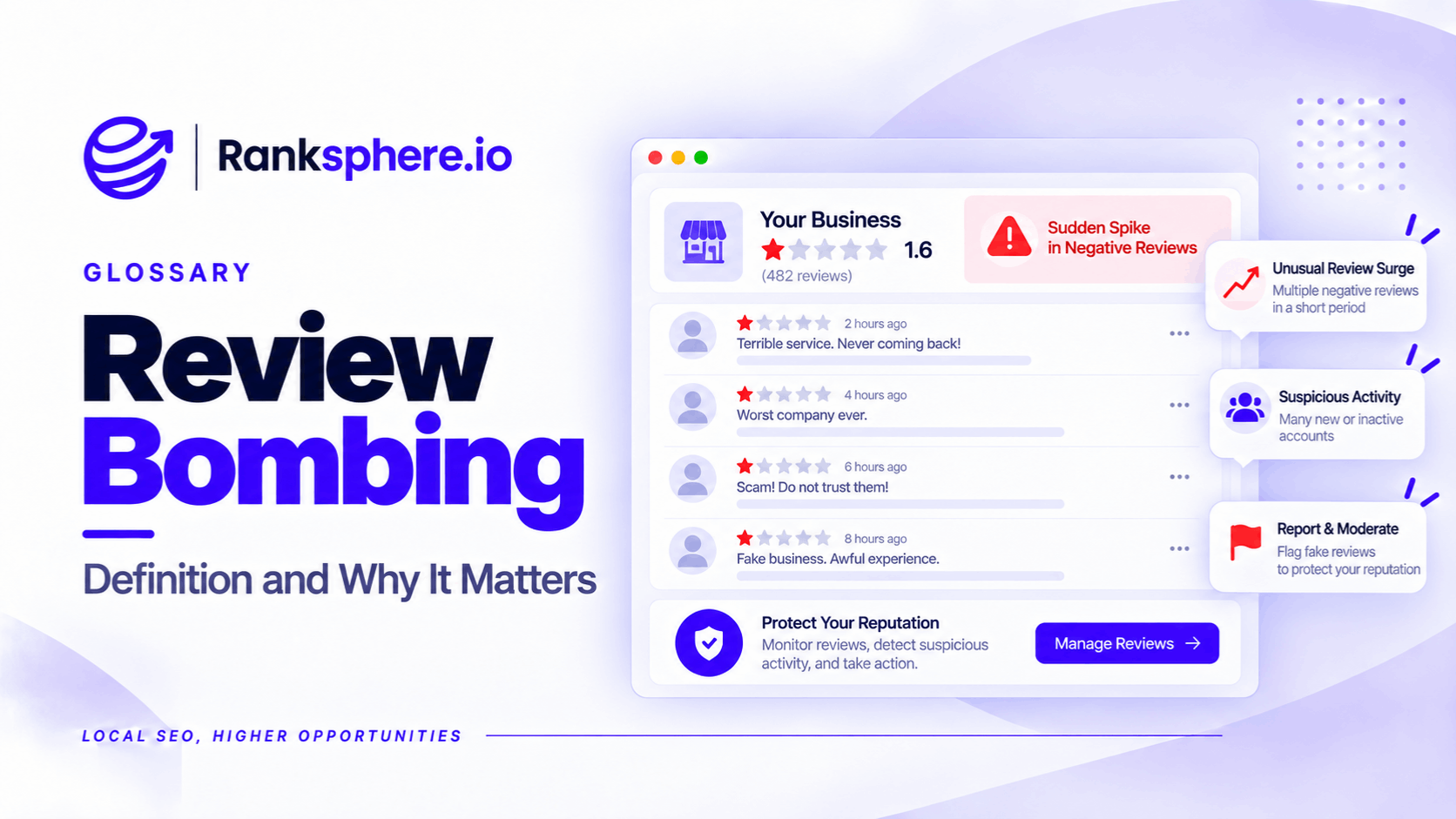
Review bombing is a coordinated wave of negative reviews intended to damage a business's online reputation, often following a controversy, social media post or organised campaign.
It can involve people who have never genuinely interacted with the business, posting one-star ratings or negative comments to lower its overall score.
For local businesses, review bombing can affect how potential customers perceive them on Google Search and Maps.
However, a sudden increase in negative reviews does not automatically mean the business is being attacked.
Sometimes, several customers complain at once because something genuinely went wrong.
The first task is to establish whether the reviews represent real customer experiences or an attempt to manipulate the business's rating.
Those situations require different responses.
How Can You Identify Review Bombing?
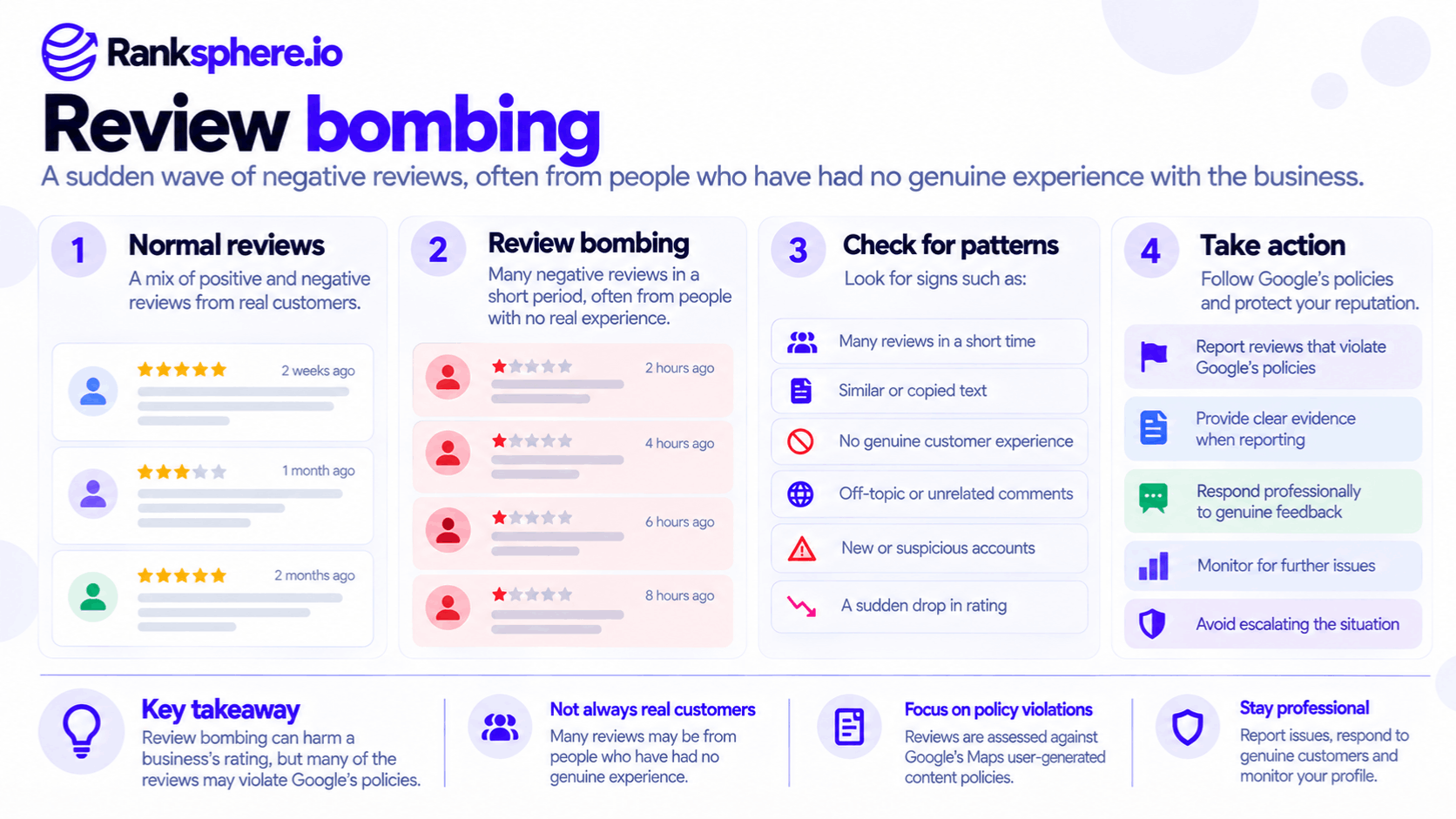
Review bombing often produces patterns that differ from ordinary customer feedback.
A Sudden Increase in Negative Reviews
A business that normally receives a handful of reviews each month might suddenly receive dozens of one-star ratings over a weekend.
An unusual spike is worth investigating, although timing alone doesn't prove manipulation.
Repeated Wording
Coordinated reviews sometimes use identical phrases or repeat claims circulating on social media.
For example, multiple reviewers might copy a sentence from a viral post without describing any personal experience.
Reviews Unrelated to Customer Experiences
Google requires reviews to reflect genuine experiences with a business or place.
Reviews that consist entirely of unrelated political commentary, personal attacks or statements about an online controversy may violate its off-topic content policies.
However, someone does not necessarily need a completed transaction to have a genuine experience. A legitimate complaint about an enquiry, appointment or visit may still be relevant.
Suspicious Account Activity
Several new accounts posting similar reviews within a short period may suggest coordination.
But account age, location and review history are supporting clues, not proof.
A genuine customer may have created a Google Account specifically to leave their first review.
Review Bombing vs Genuine Negative Reviews
The distinction matters because removing legitimate criticism is not an appropriate reputation management strategy.
| Potential review bombing | Genuine customer criticism |
|---|---|
| Repeated comments copied from an external campaign | Specific descriptions of actual experiences |
| Reviews unrelated to the business's services | Complaints about real service failures |
| Unusual coordinated posting patterns | Multiple customers affected by the same incident |
| Possible fake engagement or off-topic content | Feedback that may be negative but policy-compliant |
Review patterns should be investigated rather than treated as conclusive evidence.
If several customers report the same operational problem, examine the issue through review sentiment and customer service records.
An organised campaign and genuine complaints can also occur at the same time.
What Should You Do in the First 48 Hours?
Start by documenting the situation and establishing what triggered the reviews.
Avoid publishing an emotional response before understanding the facts.
A practical response involves:
- Record the evidence. Save review links, screenshots, dates and repeated wording.
- Investigate the trigger. Check whether a complaint, news story or social media discussion preceded the reviews.
- Separate genuine complaints from suspected violations. Do not assume every negative review belongs to the campaign.
- Report eligible reviews. Use Google's reporting process and select the relevant policy reason.
- Prepare an appropriate public response. Address legitimate concerns without arguing with reviewers or disclosing private customer information.
- Brief customer-facing staff. Make sure employees know how to handle enquiries about the situation.
One general statement may be useful during a public controversy, but it doesn't replace individual responses to genuine customer complaints where those responses are appropriate.
How to Report Review Bombing to Google
Google allows businesses to report reviews that violate its content policies.
Relevant grounds may include fake engagement, off-topic content, harassment or repetitive content.
You can submit reports through Google's Business Profile review management tools.
Google then assesses whether the content violates its policies.
A review won't be removed simply because it is negative or the business disputes what the reviewer says.
If Google finds no violation, an eligible review decision can be challenged through its one-time appeal process.
See review removal.
Google may also temporarily restrict review posting when a location experiences a spike in irrelevant or abusive content. These protections are applied by Google and are not guaranteed for every incident.
If someone demands payment, goods or services in exchange for removing negative reviews, Google provides a separate reporting process for review extortion scams. Do not pay the individuals involved; preserve the messages and report the incident.
Ranksphere's Review Management Tool helps businesses review customer feedback and organise responses, which can make sudden changes in review activity easier to investigate.
How Should a Business Respond Publicly?
A useful response is calm, factual and limited to information the business can appropriately disclose.
Avoid accusing individual reviewers of being fake in public, particularly when you cannot verify their identity or experience.
If the controversy concerns a genuine service failure, acknowledge the concern and explain what the business is doing to address it.
If the reviews appear to be coordinated, a general statement can clarify the business's policies without escalating the dispute.
For healthcare providers and other businesses handling sensitive information, confidentiality is especially important.
A public review response should never disclose private patient or customer details simply to defend the business.
Can More Positive Reviews Help a Business Recover?
A strong history of genuine reviews can make an isolated wave of negative ratings less influential on the overall average.
However, there is no guaranteed recovery period or rating target.
Businesses should maintain an ongoing process for requesting authentic customer feedback.
Monitoring review velocity can help identify unusual changes.
Do not purchase reviews, offer incentives or selectively request positive feedback to offset an attack.
These practices can violate Google's fake engagement policies and create further problems.
The better long-term approach is to provide good service and request honest feedback consistently.
Common Review Bombing Mistakes
- Assuming every negative review is fake. Genuine complaints can arrive in clusters.
- Reporting reviews simply because they are critical. Google removes policy violations, not ordinary disagreement.
- Responding angrily to individual reviewers. This can escalate the situation.
- Disclosing confidential customer information. Reputation management does not override privacy obligations.
- Buying positive reviews to compensate. This violates Google's policies.
- Ignoring the underlying controversy. Removal requests cannot resolve a genuine service problem.
- Expecting every reported review to disappear. Google evaluates reports individually.
Review Bombing Best Practices
Monitor review activity regularly so unusual patterns are noticed early.
Investigate the cause before deciding how to respond.
Report clear policy violations and retain relevant evidence.
Treat legitimate feedback as an opportunity to identify problems.
Maintain a steady process for requesting genuine customer reviews, and avoid promising that a business's rating will recover within a particular timeframe.
Example of Review Bombing Against a Veterinary Practice
Consider a hypothetical veterinary practice that receives more than thirty one-star reviews over three days.
The spike follows a widely shared social media post alleging that the practice refused treatment to an injured animal.
Many of the reviews repeat wording from the post without describing a direct experience.
What the Practice Finds
The management team reviews the comments and separates potentially genuine complaints from reviews that appear unrelated to customer experiences.
Because the controversy concerns a specific animal and its owner, the practice cannot publicly discuss confidential case details.
What the Practice Does
The practice publishes a short factual statement explaining its general out-of-hours care policy and how people can raise concerns.
It reports reviews that appear to breach Google's policies, preserving evidence of the coordinated activity.
The team also investigates whether the original complaint reveals a genuine service issue that needs attention.
Example
“The practice doesn't assume that every negative reviewer is acting dishonestly.
It addresses the substance of the controversy while using Google's reporting process for suspected policy violations.
Some reviews may be removed, while others may remain.
The goal is not to eliminate criticism. It is to protect the integrity of the review record while responding properly to genuine customer concerns.”
See Also
- Review Removal — Reporting reviews that violate platform policies.
- Fake Review — Understanding reviews that do not reflect genuine experiences.
- Review Response — Handling negative feedback professionally.
- Review Velocity — Monitoring the pace of new customer reviews.
- Reputation Management — Protecting and maintaining a business's public reputation.
- Negative SEO — Understanding attempts to damage a business's search visibility.