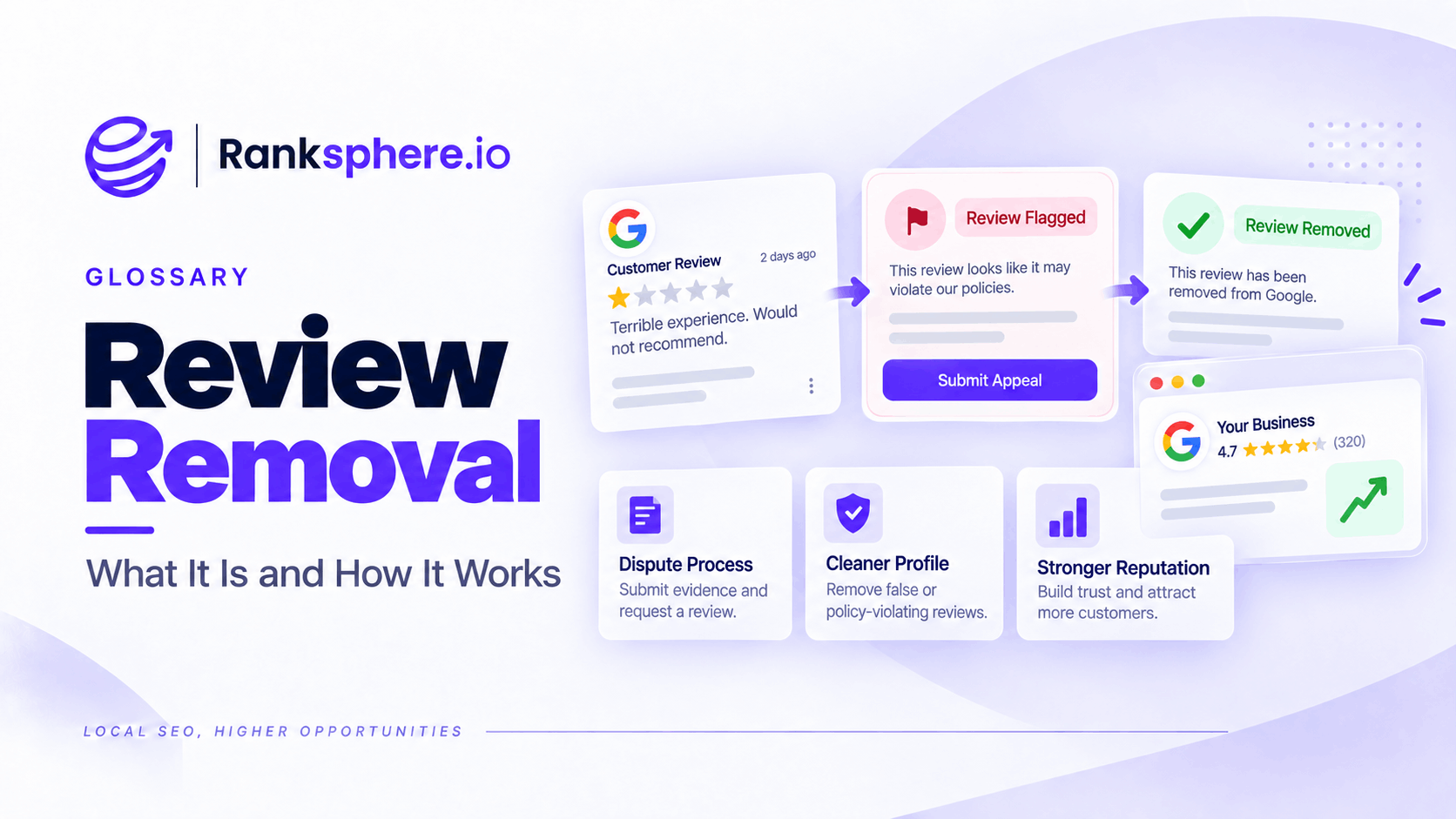
Review removal is the process of asking a review platform to remove customer feedback that breaches its content policies.
That distinction matters.
A negative review is not automatically removable.
Neither is a review a business considers:
- Unfair
- Inaccurate
- Unreasonable
- Damaging
Platforms generally remove reviews because they violate a specific policy, not because the business dislikes what was written.
For Google Business Profile, Google states this explicitly: reviews are eligible for removal only when they violate its policies, and businesses should not report a review simply because they disagree with it.
Understanding that difference saves time.
It also helps a business decide whether the right response is:
report the review
or:
respond to the review.
What is review removal?
Review removal means requesting that a platform take down a review because it breaches that platform's rules.
Examples may include content involving:
- Fake engagement
- Conflicts of interest
- Spam
- Harassment
- Personal information
- Off-topic commentary
- Impersonation
The exact rules vary by platform.
A complaint that is valid on Google may not be handled exactly the same way on:
- Yelp
- Tripadvisor
- Another review platform
Always check the specific platform policy before reporting.
Negative does not mean removable
This is the most important principle.
A review can be:
- Angry
- Harsh
- One-sided
- Embarrassing
- Commercially damaging
and still remain within platform policy.
For Google, the company states that it does not become involved simply because a business and customer disagree.
That means:
“This review is unfair.”
is not normally a removal reason.
The relevant question is:
Which specific policy does this review breach?
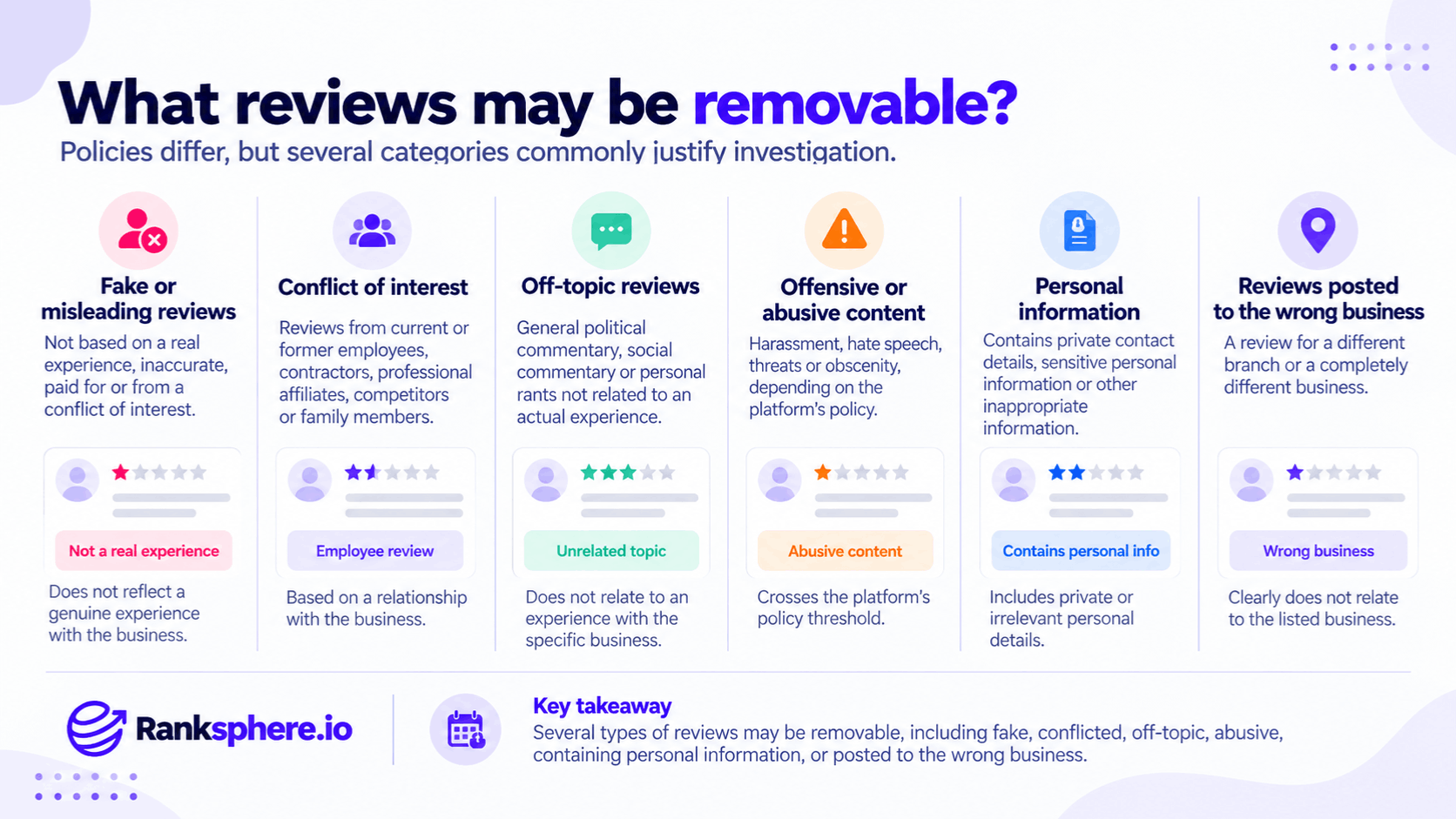
What reviews may be removable?
Policies differ, but several categories commonly justify investigation.
Fake or misleading reviews
Reviews should reflect a genuine experience.
Google's Maps policy prohibits fake engagement, including content that:
- Is not based on a real experience
- Does not accurately represent the business
- Has been paid for
- Comes from conflicts of interest
(fake review covers this in more detail.)
If there is credible evidence that somebody never had the experience they describe, reporting the review may be appropriate.
But be careful.
Not recognising the reviewer's display name does not prove they were never a customer.
Conflict of interest
Google prohibits reviews based on conflicts of interest.
Its current policy says this can include relationships such as:
- Current employment
- Former employment
- Contractual relationships
- Professional affiliations
- Competitors
- Family relationships
So a competitor posting a review specifically to undermine another business can be a legitimate policy issue.
Likewise, an employee reviewing their own employer may create a conflict.
Off-topic reviews
Google requires contributions to relate to an experience with the specific place or business.
Its policy prohibits general:
- Political commentary
- Social commentary
- Personal rants
that are not based on the relevant experience.
For example:
A review of a physiotherapy clinic that consists entirely of a political complaint about local council policy may have little to do with the business itself.
That is different from a customer complaining about something they encountered during their visit.
Offensive or abusive content
Review platforms may remove material involving prohibited:
- Harassment
- Hate speech
- Threats
- Obscenity
depending on the platform's policy.
Do not confuse:
an angry review
with:
prohibited abusive content.
A strongly worded criticism may still be allowed.
The content needs to cross the platform's actual policy threshold.
Personal information
Reviews containing inappropriate personal or private information may qualify for reporting.
For example, a reviewer might publish:
- Private contact information
- Sensitive personal details
- Information unrelated to the public business interaction
Google provides reporting routes for privacy concerns and other inappropriate user content.
Businesses should also avoid creating the same privacy problem when replying.
Impersonation
A review posted while falsely pretending to be:
- Another customer
- A business owner
- A staff member
- Another identifiable person
may breach platform rules.
Again, document what makes the content misleading rather than simply asserting:
“This person is fake.”
Reviews posted to the wrong business
A customer can occasionally review:
- The wrong branch
- A business with a similar name
- A different company entirely
That can create a legitimate removal argument if the review clearly does not relate to the listed business.
For example:
A review complains about:
hotel check-in
on the profile of:
a plumbing company
That is much easier to identify as irrelevant than a disputed account from a possible customer.
What reviews are usually not removable?
Some reviews frustrate businesses but still do not clearly violate policy.
Negative reviews
A one-star review is allowed merely because it is negative.
Google specifically tells businesses not to report a review just because they dislike or disagree with it.
Respond instead.
Reviews you disagree with
Suppose a customer says:
“The appointment started 30 minutes late.”
and the business believes it was only 15 minutes.
That disagreement does not automatically create a policy violation.
Platforms are generally not courts for routine disputes over customer recollection.
A calm response may be more useful.
Reviews from customers you cannot identify
This is an important distinction.
A business may search its CRM and find nobody with the reviewer's Google display name.
That does not prove the person was never a customer.
They may have:
- Used a nickname
- Booked under a partner's name
- Purchased through another person
- Used an account that does not match the booking name
Investigate before accusing somebody publicly of posting a fake review.
Old reviews
Age alone is not normally a removal reason.
A five-year-old review may still represent a genuine customer experience from five years ago.
If circumstances have changed, a business can demonstrate that through:
- Recent reviews
- Updated information
- A professional response
rather than trying to remove historical criticism solely because it is old.
Ratings with no written text
A one-star rating without commentary can be frustrating because there is nothing to respond to substantively.
But the lack of text alone does not necessarily make the rating a policy violation.
If there is evidence of:
- Fake engagement
- Conflict of interest
- Coordinated manipulation
that is different.
Report the policy problem, not the absence of an explanation.
Reviews about third parties
This requires judgement.
Suppose someone visits a restaurant and complains that:
parking nearby was difficult.
The business may not control the car park.
But the reviewer may still be describing part of their experience visiting the location.
That does not automatically make the review removable.
By contrast, a review that is entirely about an unrelated third party may have a stronger off-topic argument.
Avoid assuming:
“We do not control it, therefore Google must remove it.”
Google Business Profile review removal
For Google Business Profile, Google provides a formal reporting process.
Businesses can flag reviews either from the profile itself or through Google's Reviews Management Tool.
The process is based on policy.
Not persuasion.
How to report a Google review
Google's current process is broadly:
- Open the Business Profile or Reviews Management Tool.
- Find the review.
- Select the reporting option.
- Choose the reason that best describes the policy issue.
- Submit the report.
Google says review evaluation typically takes several days.
Do not assume removal will be immediate.
Use the Reviews Management Tool
For Google reviews, the Reviews Management Tool is particularly useful because it lets eligible profile managers:
- Report a review
- Check the decision
- See whether the review remains under evaluation
Google currently shows statuses such as:
- Decision pending
- Report reviewed — no policy violation
- Escalated
This is much more useful than repeatedly checking whether the review disappeared.
Appeal when Google finds no violation
Google currently provides a one-time appeal when a reported review is found not to violate policy and the review is eligible for appeal.
That means the correct workflow is not:
keep reporting the same review repeatedly.
It is:
report → check the decision → use the available appeal process where appropriate.
Report the actual policy problem
Weak report:
This review is completely unfair and hurting our reputation.
Stronger policy analysis:
This reviewer states that they are an employee of a competing company and the review criticises our business, which appears relevant to the conflict-of-interest policy.
The second explains why the review may violate a rule.
That is the issue the platform can evaluate.
Keep the report factual
Avoid loading the report with:
- Emotional language
- Threats
- Long arguments about customer behaviour
The platform needs enough information to understand the alleged policy violation.
Document:
- What happened
- What policy appears relevant
- What evidence supports it
Then stop.
Keep evidence
If a review appears fake or misleading, preserve relevant evidence where lawful and appropriate.
That might include:
- Booking records
- Correspondence
- Screenshots
- Dates
- Transaction history
You may need the information during an appeal or support process.
Do not publish private evidence in the public review response simply because you possess it.
Reporting a reviewer profile
Google also allows users to report a reviewer's profile where their broader contributions appear inappropriate.
Google's Business Profile guidance documents this separately from reporting an individual review.
This can matter when there appears to be a wider pattern of:
- Spam
- Abuse
- Fraudulent contributions
Use it only when there is a legitimate reason to report the user account itself.
Review extortion
Google has a specific process for negative-review extortion scams.
If someone demands:
- Money
- Goods
- Services
in exchange for removing or preventing negative reviews, preserve the evidence and use the appropriate reporting process.
Google specifically highlights extortion scams within its review-removal guidance.
Do not pay an extortion demand simply to make a review problem disappear.
Reply while the removal process is pending
Removal and response are two separate tasks.
A review may remain visible while the platform evaluates it.
If a public reply is appropriate, do not necessarily wait.
The review response is also written for future customers who read the exchange.
A calm response can provide context even if the review is later removed.
The reply is not a courtroom argument
A public review response rarely benefits from:
- Point-by-point rebuttals
- Sarcasm
- Accusations
- Screenshots of correspondence
Your goal is not necessarily to convince the reviewer.
It is to show future readers that the business handles criticism professionally.
Protect customer confidentiality
This is especially important for:
- Healthcare
- Legal services
- Financial services
Even saying:
“You attended our clinic on 14 March”
may disclose information the business should not make public.
In regulated or sensitive industries, consider whether replying at all could confirm a relationship that should remain private.
Use general wording and follow applicable professional requirements.
A safe response when identity is unclear
Something like:
We have not been able to identify the experience described from the information available here. We would like to understand what happened, so please contact us directly so we can investigate.
This avoids declaring:
“You were never a customer.”
unless the business can establish that confidently.
Do not publicly accuse reviewers of lying
Even where a business suspects the review is fake, avoid:
“This is a fake review and this person is a liar.”
That can escalate the dispute and may create separate legal or reputational problems.
Report the suspected policy violation privately.
Keep the public response measured.
Review removal and FTC review suppression rules
For US businesses, removal efforts also need to be considered in light of the FTC's Consumer Review Rule.
The rule prohibits certain forms of review suppression, including using:
- Unfounded legal threats
- Physical threats
- Intimidation
- Knowingly false accusations
to prevent or force the removal or alteration of reviews.
This does not mean businesses must accept every false review without challenge.
It means the method used to challenge criticism matters.
Legitimate legal action is different
The FTC specifically explains that the rule does not prohibit a legitimate legal threat when there is a proper legal basis for it.
What it prohibits is using unfounded or groundless legal threats to silence reviewers.
Businesses considering legal action should obtain proper legal advice.
Review-management guidance is not a substitute for that.
You may contact dissatisfied customers
The FTC rule does not prohibit a business from contacting customers who leave negative reviews to try to resolve the underlying problem.
That can be entirely reasonable.
For example:
We are sorry this happened. We'd like to understand the issue and see whether we can resolve it.
The line is crossed when the goal becomes coercion or deceptive suppression.
Do not make removal conditional on compensation
The position here is more nuanced than:
“Offering anything for deletion is automatically illegal.”
The FTC says its Consumer Review Rule does not itself categorically prohibit compensation for removing or changing a review, but paying to suppress truthful negative reviews may still constitute an unfair or deceptive practice under the FTC Act.
For practical reputation management, do not use money or benefits as a way to manufacture a cleaner public review profile.
Resolve the customer problem.
Do not buy the criticism away.
When Google rejects the report
A Google decision of:
no policy violation
means Google did not find grounds for removal under its policies based on that review and report.
If eligible, use the documented one-time appeal.
If the review ultimately remains live, the business should shift attention to:
- A professional response
- Fixing any genuine operational issue
- Continuing a compliant review programme
Do not spend unlimited time trying to remove criticism that does not clearly violate policy.
Review response often matters more than removal
A well-handled critical review can actually give future customers useful information.
Suppose someone complains:
“They could not attend the same day.”
A response might explain:
We are sorry we could not offer a same-day appointment. Emergency slots depend on availability, and our team offered the earliest appointment we had at the time.
That does not erase the complaint.
It gives it context.
Building genuine reviews
When a negative review remains, the long-term solution is not to manufacture enough positive reviews to hide it.
Continue asking genuine customers for feedback in line with the platform's rules.
Over time, a broader sample of authentic customer experiences gives potential customers more context.
See review velocity for the wider topic.
Avoid calling this “dilution”
It can be tempting to describe more positive reviews as:
diluting the negative one.
That framing encourages businesses to chase ratings rather than feedback.
The healthier objective is:
build a representative body of genuine recent reviews.
If the customer experience is strong, the overall reputation should reflect that naturally.
Reviews can disappear from your profile too
Review removal is not only about reviews the business wants removed.
Businesses may also notice genuine positive reviews:
- Disappearing
- Failing to appear
- Being delayed
Google says missing or delayed reviews can occur for several reasons, most commonly because its systems believe the content violates policy.
That is worth monitoring.
Google's automated review systems
Google uses automated spam detection to identify reviews it believes should be removed.
Google also acknowledges that its system can occasionally remove legitimate reviews by mistake.
That means a missing review does not automatically prove:
- Manipulation
- A penalty
- Misconduct by the business
Investigate before drawing conclusions.
Delayed reviews
Some customer reviews may not appear immediately.
Google says reviews are checked against its policies and that this process can sometimes delay publication for several days.
So if a genuine customer says:
“I posted my review this morning and it isn't showing.”
do not immediately assume it was permanently removed.
Give the platform time to process it.
Reviews removed for confirmed policy violations
Google's current guidance states that reviews removed for policy violations will not be restored.
That is different from a review that appears to have been removed incorrectly.
Keep those situations separate.
What if a legitimate review was removed by mistake?
Google explicitly acknowledges that automated systems can mistakenly remove legitimate reviews and says businesses can contact support for assistance.
So avoid telling clients:
“Once Google removes a review, nothing can be done.”
That is too absolute.
There may be an investigation route where a genuine review appears to have been incorrectly filtered.
Track review count over time
For active local businesses, monitor:
- Total review count
- Average rating
- New reviews
This helps identify unexpected changes.
For example:
214 reviews → 211
may deserve checking.
A larger sudden drop certainly deserves investigation.
But do not automatically diagnose the cause.
Sudden review loss can have several explanations
A review-count change might be related to:
- Policy enforcement
- Automated spam filtering
- Review-account issues
- Profile changes
- A display or technical issue
Google has also experienced situations where review visibility changes unexpectedly.
Do not conclude:
“Google penalised us.”
without evidence.
Reviewers can remove their own reviews
A customer may also:
- Delete their review
- Change their review
That does not necessarily indicate platform enforcement.
If one review disappears, there may be no meaningful pattern at all.
Monitor patterns, not isolated changes
A single missing review may not warrant a major investigation.
A large sudden change does.
For example:
Three reviews disappear over several months
and:
60 reviews disappear in 24 hours
are very different situations.
The second deserves prompt investigation.
But even then, do not assume the cause before checking the evidence.
Check recent review-generation practices
If a large group of reviews disappears, review what changed operationally.
Ask whether the business recently:
- Started offering incentives
- Used a new review vendor
- Changed its request process
- Asked staff to generate reviews
Those practices can violate Google policies.
But this is part of the diagnosis.
It is not proof that those practices caused a particular removal event.
Review vendors
If a reputation company promises:
guaranteed removals
be cautious.
No legitimate agency controls Google's moderation decisions.
A provider may help with:
- Policy analysis
- Reporting
- Appeals
- Response drafting
It cannot guarantee that a platform will remove a review that complies with policy.
Legal removal requests
Some content may raise genuine legal issues rather than ordinary platform-policy issues.
Google provides separate processes for certain:
- Legal concerns
- Privacy concerns
These are different from standard:
“This review is negative.”
requests.
Where serious legal questions exist, use qualified legal advice rather than trying to turn a routine policy report into a legal claim.
Review removal and reputation management
Reputation management should not be reduced to:
delete bad reviews.
A stronger process includes:
- Monitoring feedback
- Reporting genuine policy violations
- Responding appropriately
- Fixing recurring problems
- Encouraging legitimate reviews
Some criticism should be removed.
Some criticism should be answered.
Some criticism should change how the business operates.
Knowing which is which is the real skill.
Ranksphere and review removal monitoring
Ranksphere's review management tracks removed reviews alongside new ones, with team approvals and drafted replies.
That can help teams see changes in review activity without relying solely on noticing that the average rating has moved.
It also keeps two different processes visible:
- Reviews you are trying to have removed
- Reviews that disappear from the profile unexpectedly
Those should not be treated as the same problem.
Common review removal mistakes
- Reporting a review simply because it is negative.
- Writing a long argument about unfairness instead of identifying a policy issue.
- Assuming somebody was never a customer because their display name is unfamiliar.
- Expecting a review about something outside the business's direct control to be automatically removable.
- Repeatedly flagging a Google review instead of following the documented status and appeal process.
- Waiting indefinitely for removal before deciding whether to reply.
- Accusing a reviewer publicly of lying or working for a competitor without evidence.
- Disclosing customer or patient information while defending the business.
- Using unfounded legal threats to force criticism offline.
- Paying customers simply to make truthful negative reviews disappear.
- Assuming every missing positive review was correctly removed.
- Assuming every missing review can never be restored.
- Interpreting a sudden review-count drop as proof of a penalty without investigation.
- Hiring a company that guarantees review removal.
Review removal best practices
- Read the relevant platform policy before reporting anything.
- Identify the specific rule the review appears to breach.
- Keep reports factual and concise.
- Preserve evidence where appropriate.
- For Google, use the Reviews Management Tool to track the decision.
- Use the one-time appeal where Google makes it available and the review still appears to violate policy.
- Consider a professional public reply while the report is pending.
- Never reveal sensitive customer information in the reply.
- Do not make unsupported public accusations against reviewers.
- Continue building a genuine online review profile rather than trying to bury criticism artificially.
- Monitor reviews that disappear as well as reviews you want removed.
- Investigate sudden changes before assuming the cause.
- Follow the appropriate legal route where genuine legal issues exist.
Example
“Marlow Physiotherapy receives a one-star Google review.
The review says:
“Terrible place. The shopping centre car park charges too much and there were no spaces.”
The clinic does not own or operate the car park.
Its first instinct is to report the review because:
“The reviewer was not complaining about our treatment.”
Before reporting it, the team checks Google's content policies.
That matters because a complaint about parking encountered during a genuine visit may still form part of a customer's experience.
The clinic therefore avoids claiming automatically that:
“Anything outside our control must be removed.”
Instead, it looks at the review carefully.
If the entire post is unrelated general commentary and does not describe an experience with the clinic, the business can report it under the most relevant off-topic policy.
While Google reviews the report, the clinic posts a short public reply:
We're sorry the parking caused frustration. The car park is managed by the shopping centre rather than the clinic. There is also alternative parking on Market Street, around a three-minute walk from our entrance.
The response does not:
- Attack the reviewer
- Reveal private information
- Argue about whether they attended
It simply gives future patients useful information.
If Google later decides the review violates policy, it is removed.
If Google determines that it complies with policy, the clinic can use the available appeal process if there is a genuine policy basis to challenge the decision. Otherwise, the professional reply remains.
That is the point of review removal.
The objective is not to erase criticism. It is to remove content that genuinely breaches platform rules while handling legitimate criticism well enough that future customers can judge the business fairly.”
See also
- Review response — responding professionally when a review remains live
- Fake review — reviews that misrepresent a genuine customer experience
- Online review — building and managing legitimate customer feedback
- Review velocity — understanding how genuine review activity develops over time
- Reputation management — the wider process of monitoring and responding to customer sentiment
- Review gating — selectively requesting public reviews based on expected sentiment