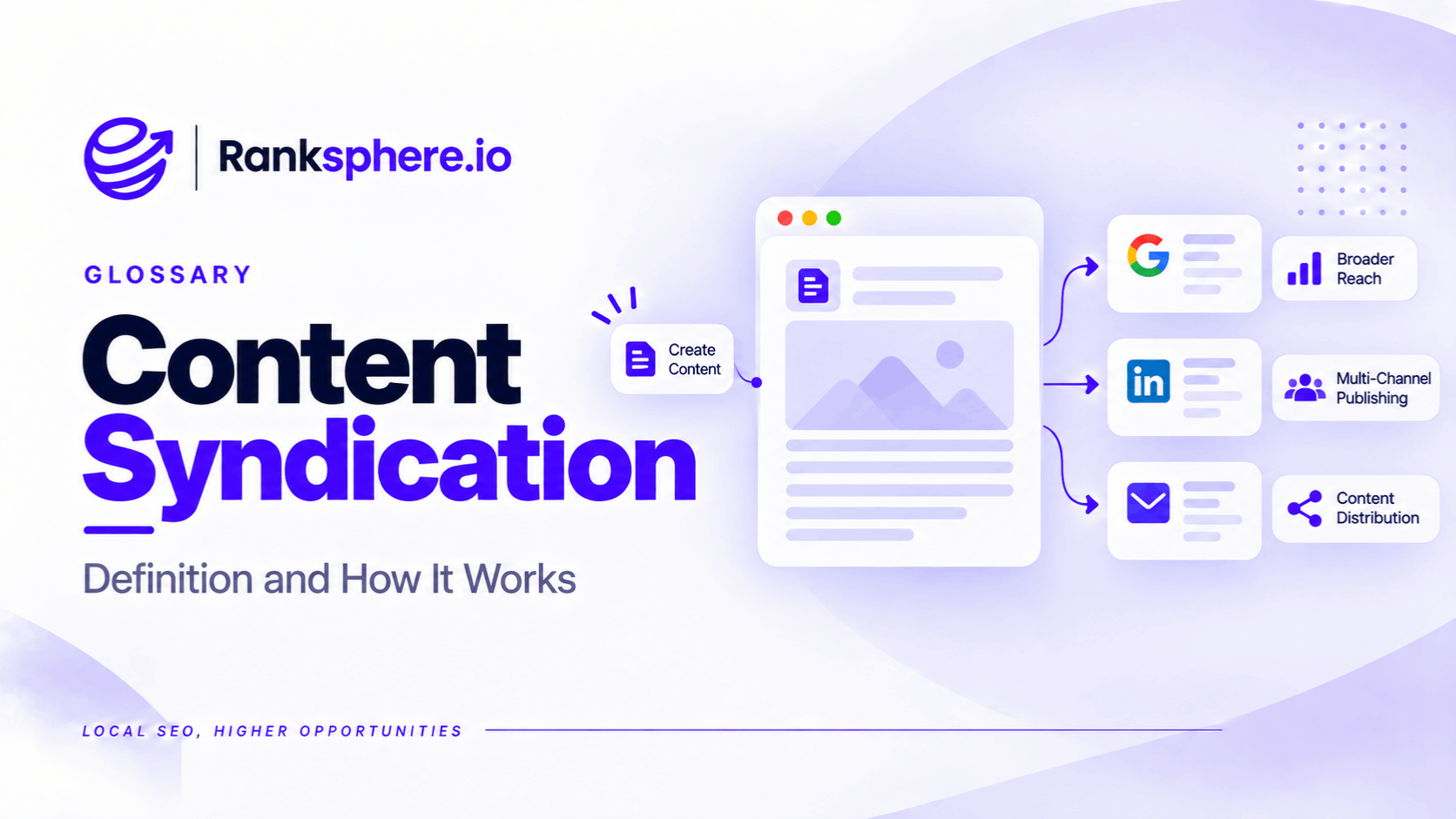
Content syndication is the practice of republishing an existing article, guide, or other piece of content on another website with permission from the original publisher.
For example, a veterinary practice might publish a guide about caring for rabbits. A national animal welfare organisation could then republish the guide to share it with its own audience.
The practice gains exposure, while the organisation provides useful information to its readers.
However, syndication creates an SEO consideration: the same content is now available on more than one website.
If the syndicated copy appears above the original in Google Search, the original publisher may lose organic traffic.
The important question isn't whether content syndication is allowed. It's whether the additional audience is worth the potential competition in search results.
How Does Content Syndication Work?
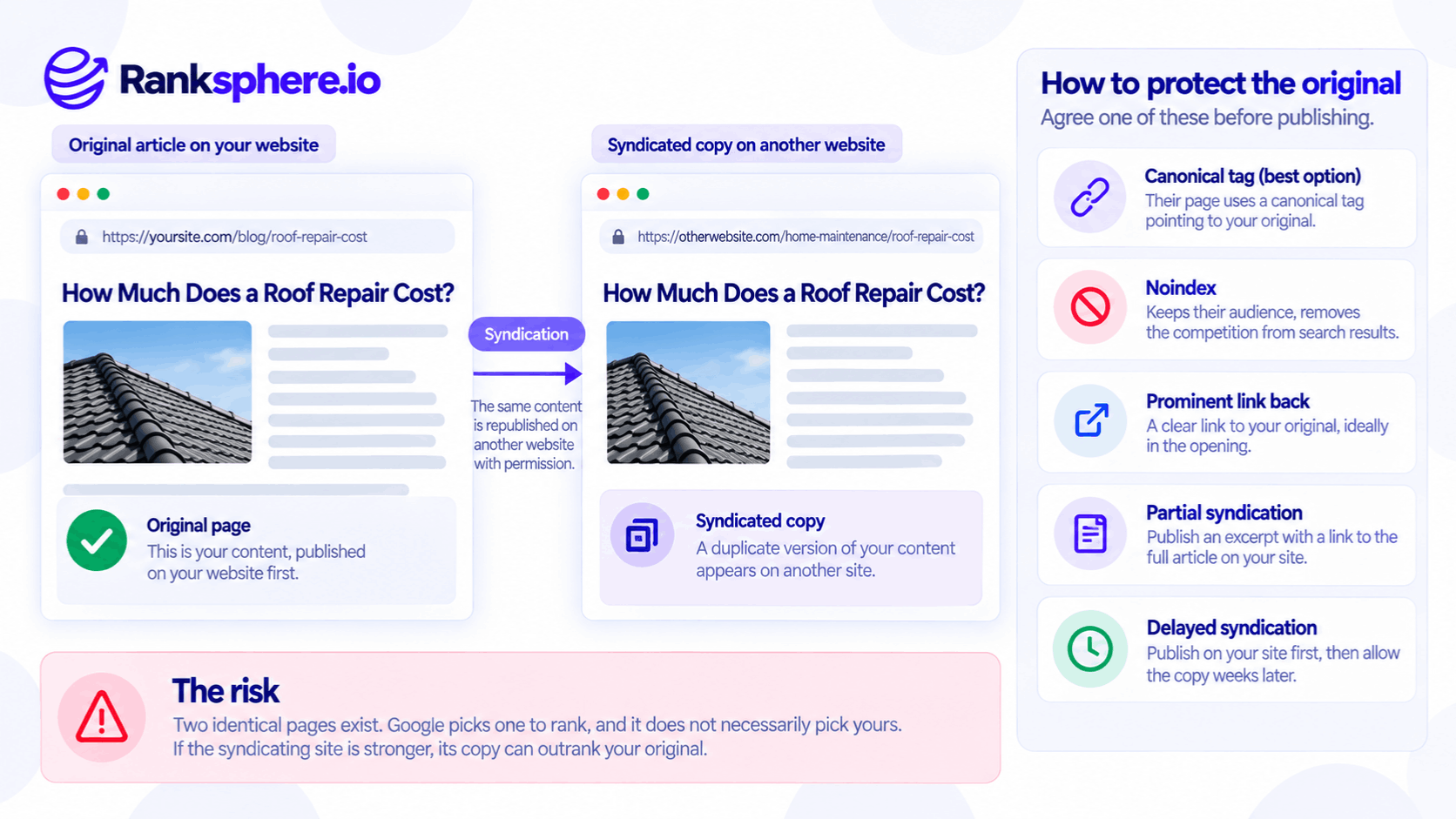
Content syndication usually involves three parties or elements: the original publisher, the syndication partner, and an agreement about how the content can be reused.
A typical arrangement works like this:
- A business publishes an original article on its website.
- Another publisher requests permission to republish it.
- Both parties agree on attribution, links, and indexing preferences.
- The second website publishes the full article or an agreed excerpt.
- Readers discover the content through the partner's website.
For example, a local business association might republish a financial adviser's guide to managing business expenses.
The association benefits from relevant information, while the adviser gains exposure to local business owners.
Syndication is different from guest posting, where someone creates original content specifically for another publication.
With syndication, the content already exists.
Does Content Syndication Hurt SEO?
Not automatically.
Google doesn't treat ordinary duplicate content as a spam violation simply because substantially similar information appears at different URLs.
However, Google generally tries to identify a representative version of duplicate or very similar content.
This process is called canonicalisation.
The URL Google selects may not be the original publisher's preferred version.
For example, a small dental practice might publish a detailed guide about dental implants.
A larger healthcare publication republishes it with permission.
When someone searches for the topic, Google's systems may select the larger publication's version for display.
The dental practice may still benefit from reaching that publication's readers, but it could receive fewer organic visits to its original article.
This is why syndication agreements should address SEO before republication.
How to Protect Your Original Content
Several approaches can reduce unwanted competition between the original and syndicated copies.
1. Ask the Partner to Use Noindex
If the objective is to reach the syndication partner's existing audience without competing in Google Search, noindex is the clearest solution.
The partner adds a noindex directive to the republished page.
The content remains accessible through direct links and the publisher's website, but Google is instructed not to include that page in its search index.
This aligns with Google's recommendation for avoiding duplication caused by syndication partners.
However, the partner must be comfortable giving up organic search visibility for that article.
2. Discuss Canonical Tags
A canonical tag can indicate a preferred URL for duplicate or very similar content.
For example, a syndicated page might reference the original article:
<link rel="canonical" href="https://example.com/blog/original-guide">However, there is an important limitation.
Google treats canonical tags as signals rather than binding instructions.
More specifically, Google does not recommend relying on canonical tags to prevent syndication partners' copies from appearing in search, because the pages may differ substantially.
A canonical is therefore not a guaranteed solution for content syndication.
Some platforms still support cross-domain canonical links, and they can be useful in appropriate circumstances. Just don't assume Google will always select your original URL.
3. Request Clear Attribution and a Link
A syndicated article should clearly identify its original source.
For example:
"Originally published by Example Veterinary Practice. Read the original guide."
The attribution should link to the original article.
Placing it near the beginning helps readers identify where the content came from.
However, a source link doesn't guarantee that Google will rank the original above the syndicated version.
Its primary value is accurate attribution and providing readers with a route to the original publisher.
4. Consider Partial Syndication
Instead of republishing an entire article, a partner might publish an excerpt.
For example, a local chamber of commerce could share the introduction and key findings of a business guide, followed by a link to the complete article.
This allows the association to introduce useful content without duplicating the full page.
For local businesses, this is often a practical arrangement.
5. Publish the Original First
Publishing on your own website before syndicating gives Google an opportunity to discover the original page.
However, publishing first doesn't guarantee canonical selection.
Waiting several weeks before republication is not an official Google requirement or a reliable way to protect rankings.
If indexing competition matters, agree on an appropriate indexing arrangement rather than depending on the publication date.
Where Content Syndication Commonly Happens
Businesses may syndicate content without treating it as a formal SEO activity.
Common examples include:
- LinkedIn articles and Medium
- Industry association websites
- Local publications and newsletters
- Franchise and multi-location business networks
- Supplier and partner websites
Medium supports importing articles from another website with a canonical reference to the original. Authors can also configure canonical links in supported publishing settings.
LinkedIn articles are different, and businesses shouldn't assume they can apply an equivalent cross-domain canonical control.
For example, rather than copying a full blog article to LinkedIn, a business might publish a shorter version containing its main points and link to the original guide.
The choice should depend on the audience and purpose of the content.
Is Content Syndication Worth It for Local Businesses?
Usually, syndication makes the most sense when the partner reaches people the business genuinely wants to reach.
For example, a local veterinary practice might benefit from appearing in an animal rescue charity's newsletter.
A roofing company might contribute practical maintenance guidance to a relevant community publication.
These opportunities can introduce the business to potential customers.
They may also generate a useful brand mention and referral visits.
However, publishing the same article across numerous unrelated websites rarely offers the same value.
Google also warns against large-scale article campaigns primarily intended to manipulate rankings through links.
For most local businesses, content syndication should be viewed primarily as an audience distribution opportunity, not a mass link-building strategy.
Content Syndication vs Content Scraping
Content syndication and scraping aren't the same thing.
Content syndication involves authorised republication.
Content scraping involves copying content, often automatically, without the original publisher's permission.
However, not every instance of similar content is unauthorised. Quotation, licensed material, or other legitimate reuse may explain some duplication.
If another website republishes your article without permission, investigate whether the copy is causing a real problem.
Google usually attempts to identify a representative source, but its systems don't always select the original publication.
If necessary, contact the website owner to request correction or removal.
For copyright infringement, appropriate hosting-provider or copyright reporting procedures may also be available.
Don't assume every scraper requires immediate action.
Common Content Syndication Mistakes
- Republishing without an agreement. Discuss attribution and indexing before the content goes live.
- Treating canonical tags as guarantees. Google may choose a different canonical.
- Assuming publishing first protects the original. Publication order alone isn't sufficient.
- Using full syndication when an excerpt would work. Partial republication may better serve the original publisher.
- Accepting unclear attribution. Readers should know where the article originated.
- Syndicating to irrelevant websites. Additional exposure has limited value when the audience isn't relevant.
- Treating syndication as a bulk link-building tactic. Manipulative link campaigns can violate Google's spam policies.
- Ignoring genuinely competing copies. Monitor important articles after syndication.
Content Syndication Best Practices
- Choose partners with relevant audiences.
- Agree on indexing and attribution before publication.
- Prefer partner-side noindex when preventing search competition is essential.
- Don't rely on cross-domain canonical tags alone.
- Consider excerpts with links to the original article.
- Publish original content on your own website first.
- Monitor important pages in Google Search Console.
- Evaluate referral traffic and business outcomes.
- Keep a record of where your content has been republished.
Ranksphere's Website Audit Tool can help identify relevant on-site duplicate content and technical issues. Detecting syndicated copies across unrelated external websites requires additional monitoring.
Example of Content Syndication for a Veterinary Practice
Consider a hypothetical veterinary practice that publishes a detailed guide about caring for rabbits.
The article performs well in search and regularly brings visitors to the practice's website.
A national animal welfare charity contacts the practice and asks permission to republish the guide.
What the Practice Agrees To
The practice grants permission because the charity serves a relevant audience.
However, the original agreement only specifies a short credit at the bottom of the article.
There is no discussion about indexing.
What Happens After Publication?
The charity publishes the full guide.
Over time, its version begins appearing prominently for some of the same queries as the original article.
The practice notices that its own page is receiving fewer search clicks.
That doesn't automatically prove syndication caused the entire decline, but the competing copy is worth investigating.
How the Issue Is Addressed
The practice contacts the charity and explains the concern.
Both organisations review the original arrangement.
Because the charity mainly wants to share the article with its existing readers, it agrees to add a noindex directive to its syndicated page.
The charity also places a clear attribution link near the beginning.
The practice then monitors Search Console to assess what happens after Google processes the change.
There is no guaranteed timeframe for indexing changes or traffic recovery.
Example
“The syndication opportunity wasn't necessarily a mistake.
The problem was failing to agree on how the republished article should be handled in search.
By discussing indexing and attribution before publication, both organisations could have avoided unnecessary uncertainty.
Content syndication works best when the additional audience is valuable and the original publisher understands the search visibility trade-offs.
For local businesses, carefully chosen syndication partnerships can be useful. Republishing content everywhere simply to gain exposure is rarely a sound strategy.”
See Also
- Duplicate Content — How search engines handle similar content across URLs.
- Canonical Tag — Signalling a preferred URL for duplicate pages.
- Guest Posting — Creating original content for another publication.
- Brand Mention — References to a business across the web.
- Backlink — A link from another website to your content.
- Content Strategy — Planning content creation, distribution, and maintenance.