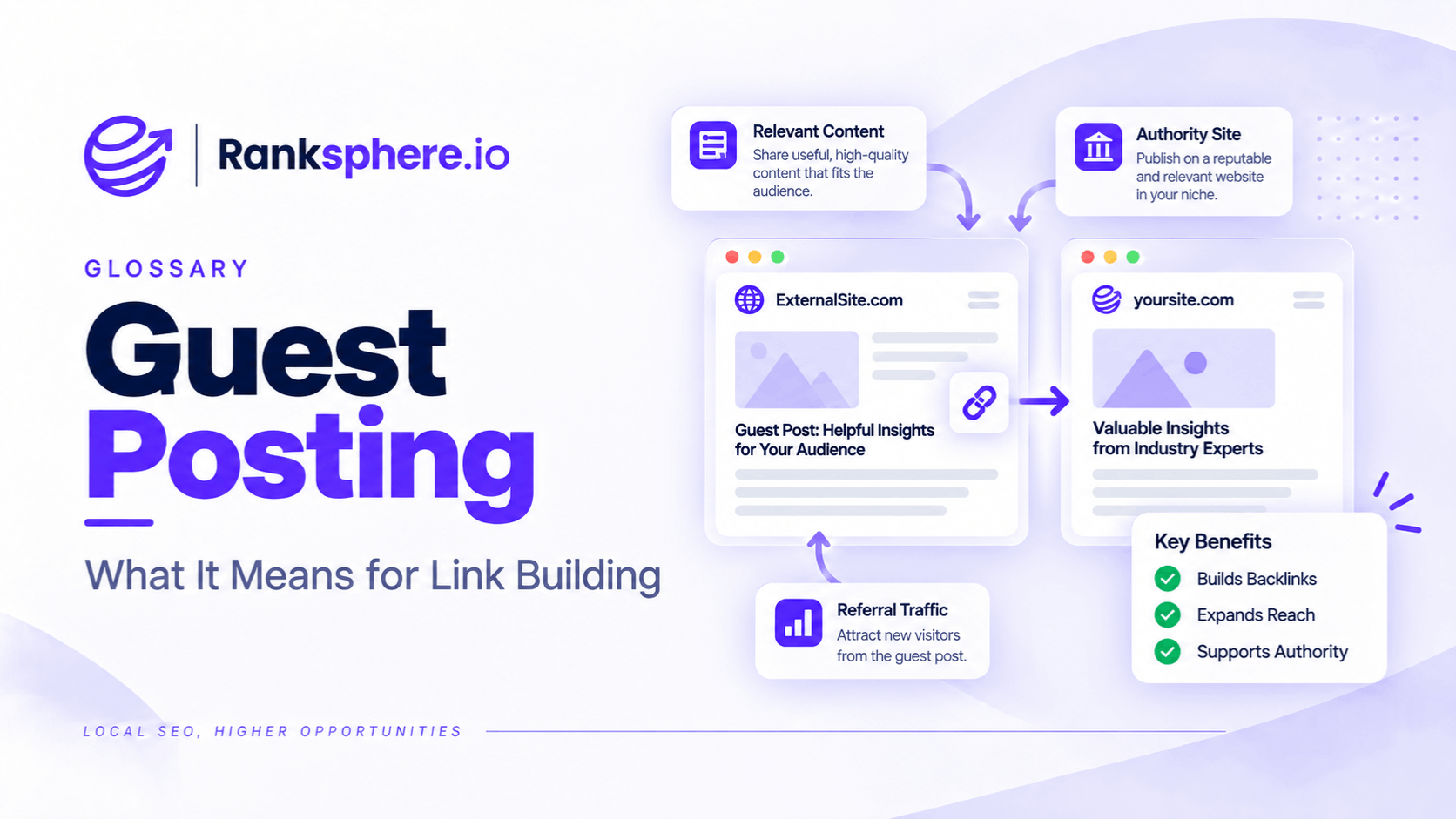
Guest posting, sometimes called guest blogging, is the practice of writing content for another website or publication.
A guest article may include:
- An author bio
- A brand mention
- A link to the author's website
- Relevant references to supporting resources
Guest posting is not inherently against Google's guidelines.
The issue is why the article and links exist.
A genuine expert contribution written for a relevant audience is very different from buying dozens of articles across unrelated websites purely to create backlinks.
That distinction is at the heart of guest post SEO.
Is guest posting good for SEO?
It can be.
A legitimate guest contribution may produce:
- Referral traffic
- Brand awareness
- Editorial backlinks
- Brand mentions
- Industry credibility
- New professional relationships
But guest posting becomes risky when the content exists mainly as a vehicle for manipulating links.
Google's current spam policies specifically identify practices such as:
- Paying for links that pass ranking credit
- Paying for posts containing ranking links
- Optimised anchor text in guest posts distributed across other websites
- Creating low-value content mainly to manipulate linking and ranking signals
as examples of link spam.
The important question is therefore not:
“Is this a guest post?”
It is:
“Would this article deserve to exist if there were no SEO backlink attached to it?”
Guest posting vs link building
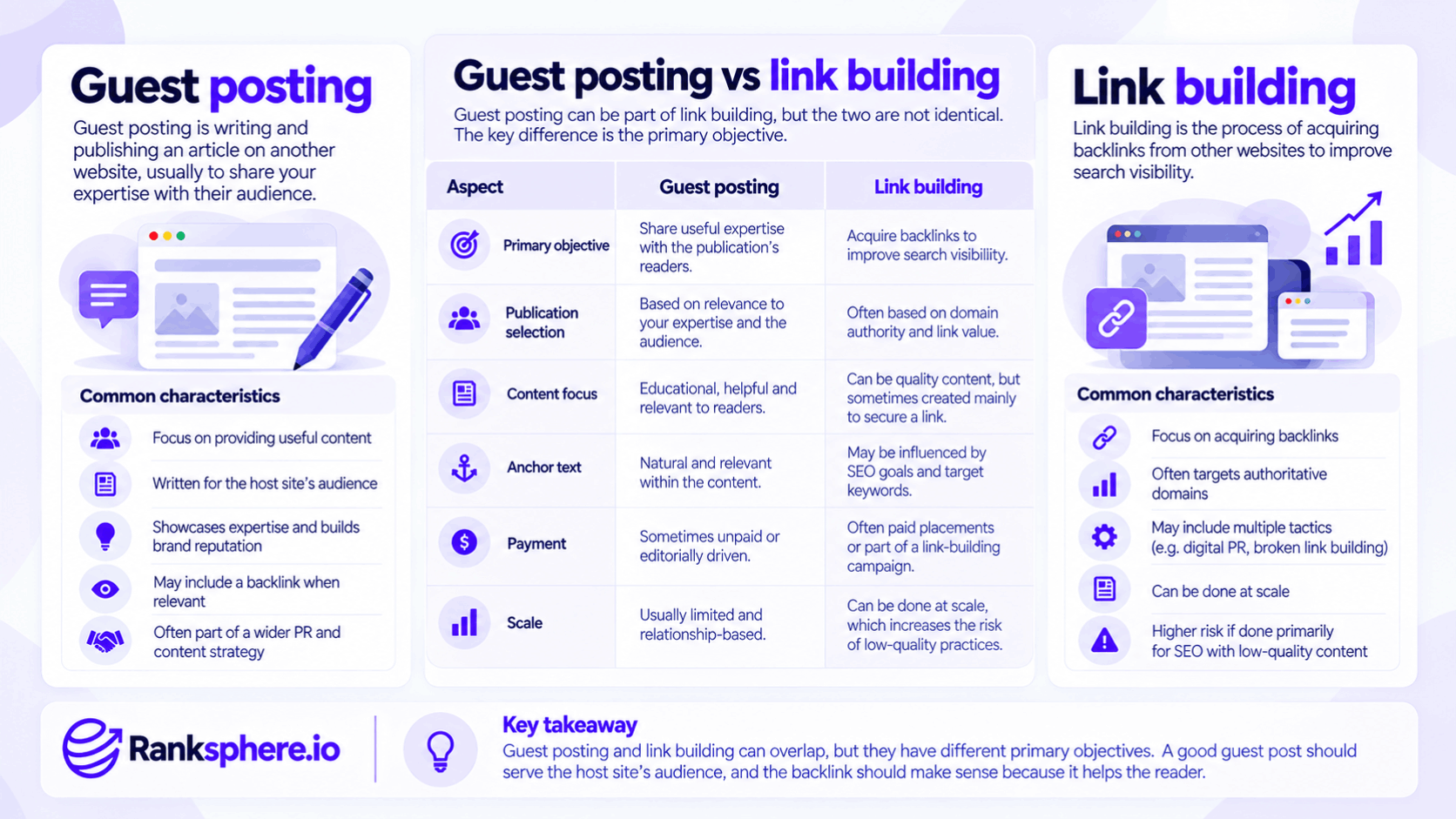
Guest posting can overlap with link building, but the two are not identical.
A legitimate guest contribution may begin with:
“I have useful expertise for this publication's readers.”
A manipulative guest-post campaign often begins with:
“I need a backlink from this domain.”
That change in objective affects everything else:
- Publication selection
- Content quality
- Anchor text
- Payment
- Scale
A good article should primarily serve the host site's audience.
The backlink should make sense because it helps the reader understand the source, author or referenced material.
What legitimate guest posting looks like
A useful guest post usually has a clear editorial reason to exist.
For example, a specialist may contribute to:
- A trade publication
- Professional association
- Relevant business publication
- Local organisation
- Supplier or partner site
because they have knowledge that publication's audience genuinely wants.
Signs of a legitimate contribution can include:
- Genuine expertise
- A relevant readership
- Original content
- Editorial oversight
- Natural references
- A clear author
- A real reason for the article to appear on that site
None of those requires the article to be a one-off.
A professional could write a regular column for an industry publication without that becoming a link scheme.
The relationship matters more than an arbitrary posting frequency.
Guest posting does not need to be unpaid
Payment by itself does not make an article illegitimate.
Publishers may charge for:
- Sponsored articles
- Advertorials
- Native advertising
- Commercial partnerships
Google recognises that buying and selling advertising and sponsorship is a normal part of the web.
The SEO issue is whether a paid link is being allowed to pass ranking credit as though it were independent editorial endorsement.
Paid guest posts
If money, products or another commercial benefit are exchanged for coverage containing a link, the link relationship should normally be qualified.
Google recommends:
rel="sponsored"
for paid links.
nofollow is also accepted.
For example:
<a href="https://example.com/" rel="sponsored">
Example Company
</a>
That allows the publication to provide:
- Exposure
- Referral traffic
- Brand recognition
without presenting the paid link as an ordinary editorial ranking signal.
See nofollow for the wider distinction between link attributes.
Sponsored does not mean worthless
Some businesses assume:
“If the link is sponsored, there is no point paying for the article.”
That only makes sense if the sole reason for the placement was to manipulate rankings.
A good sponsored article can still produce:
- Qualified visitors
- Brand discovery
- Sales
- Leads
- Brand mentions
If the placement has no value once ranking credit is removed, that is a useful warning about why it was being purchased.
Free guest posts can still be spam
The opposite is also important.
An article does not become safe merely because no money changed hands.
Suppose an agency publishes 100 low-value guest posts across unrelated websites using the same commercial anchor text.
That can still fall within manipulative link-building behaviour.
Google's policies focus on how links are being used.
Not simply whether an invoice exists.
Anchor text and guest posting
Anchor text is the clickable text in a link.
For example:
<a href="https://example.com/dental-implants/">
dental implant guide
</a>
uses:
dental implant guide
as the anchor.
Anchor text helps provide context about the linked page.
The problem begins when guest-post campaigns deliberately specify optimised commercial anchors at scale.
Keyword-rich anchors are not automatically spam
This distinction matters.
Suppose a publication naturally writes:
The practice has published a useful guide to dental implants.
and links those words to a relevant guide.
That can be perfectly natural.
The same phrase appearing across dozens of purchased guest posts because an SEO agency specified:
Anchor: dental implants London
is a different situation.
Google specifically calls out optimised anchor text in articles, guest posts and press releases when used manipulatively.
The problem is not simply:
keywords appeared in the anchor.
It is the acquisition pattern.
Do not prescribe anchors unnecessarily
A legitimate publisher should normally have editorial control over how it links.
Avoid outreach instructions such as:
Please use “best cosmetic dentist Manchester” as the anchor text.
If the article genuinely needs a link, sensible options might include:
- The business name
- The author's name
- The resource title
- A naturally descriptive phrase
The best anchor is the one that makes sense to the reader.
Not the one that maximises keyword density.
Guest post packages
Packages such as:
10 guest posts – DA 50+ – dofollow links – choose your anchors
should be treated with caution.
The product being sold is clearly not just publishing exposure.
It is usually:
- Domain metric
- Followed backlink
- Anchor control
- Quantity
That is much closer to link manipulation than editorial contribution.
Google's link spam policies explicitly cover exchanging money for links or posts containing links when those links are intended to pass ranking credit.
“Dofollow guaranteed” is a warning sign
There is no actual dofollow HTML attribute.
SEO marketers normally use the phrase to mean:
a normal link without nofollow or sponsored qualification.
If a paid guest-post service guarantees:
- Followed links
- Exact anchor text
- Minimum domain metrics
the commercial product is clearly the ranking link itself.
That is a different proposition from:
pay to reach this publication's audience.
Domain Authority is not the reason to choose a publisher
A guest-post vendor may sell:
DA 70 placement
but Domain Authority is a third-party metric.
Google does not use Moz's DA score as its ranking metric.
A smaller specialist publication with:
- Real readers
- Strong editorial standards
- Relevant subject matter
may be far more useful to a business than a high-scoring generic website selling articles on every topic imaginable.
Relevance matters
A guest article should belong on the publication.
For example, a dentist contributing to:
- A dental trade publication
- Health publication
- Local business journal
may make sense.
The same dentist writing:
“Five Dental Tips for Cryptocurrency Investors”
on an unrelated finance site purely to acquire a backlink probably does not.
Ask:
Would a reader of this publication reasonably expect this author and subject here?
That is a useful relevance test.
Scale needs context
Large-scale guest posting can become problematic, but volume by itself is not proof of spam.
A recognised expert might write:
- Monthly columns
- Industry commentary
- Regular professional advice
for legitimate publications.
That can be completely normal.
The issue is large-scale article distribution where the main purpose is generating ranking links, especially where:
- Content is low value
- Anchors are optimised
- Sites are unrelated
- Placement is paid
- Articles are produced mainly to carry links
Google specifically describes large-scale article campaigns with optimised links as problematic.
There is no safe number of guest posts
Avoid rules such as:
one guest post per month is safe
or:
more than ten a year looks unnatural.
Google publishes no threshold.
One manipulative campaign could involve five posts.
A legitimate columnist could publish fifty useful articles.
Evaluate:
- Purpose
- Quality
- Relevance
- Payment
- Link treatment
rather than counting posts.
Guest posting for local businesses
Guest posting can work for local businesses, but it should not automatically become the first local SEO priority.
Google says local rankings are mainly influenced by:
- Relevance
- Distance
- Prominence
and notes that prominence can be informed by information such as links and reviews.
That means a guest post can potentially contribute to a wider online presence.
But it cannot manufacture:
- Physical proximity
- Relevance to every query
- Guaranteed local-pack rankings
Local relevance can be particularly useful
Potentially sensible opportunities include:
- Chamber of commerce publications
- Local business groups
- Regional newspapers
- Supplier websites
- Professional associations
- Community organisations
These can overlap naturally with local link building.
The article should still provide genuine value.
Do not write:
“Top Ten Reasons Our Plumbing Company Is Great”
for the chamber website simply because the domain looks authoritative.
National publications are not automatically irrelevant
The original draft goes too far in suggesting that national industry sites have little value for a local business.
Suppose a Manchester veterinary practice contributes specialist commentary to a national veterinary publication.
That may provide:
- Professional credibility
- Referral traffic
- A legitimate editorial link
- Brand exposure
even though the publication is national.
Geographic relevance is useful.
It is not the only type of relevance.
Guest posts do not replace Google Business Profile work
For a local business, Google Business Profile still deserves proper attention.
So do:
- Reviews
- Accurate business information
- Website optimisation
- Relevant third-party references
- Citations
But do not turn those into a fixed hierarchy such as:
reviews > citations > guest posts
Google does not publish a formula like that.
Priority should depend on what the business currently lacks.
Guest posting vs digital PR
Digital PR and guest posting can both produce editorial exposure, but the mechanics are different.
Guest posting
You normally write the article.
Digital PR
A journalist or publisher normally creates the coverage based on:
- Your research
- Commentary
- Data
- Story
Digital PR can therefore produce more genuinely independent coverage.
That often makes it attractive when the goal is:
- Brand recognition
- Media relationships
- Earned links
But guest posting can still be useful where the business genuinely has expertise worth publishing.
One tactic does not automatically replace the other.
Guest posting and site reputation abuse
There is another Google policy worth understanding if you publish guest content on your own site.
Google introduced its site reputation abuse policy to address situations where third-party content is published on an established site primarily to exploit that site's existing ranking signals. Google updated how it applies the policy in August 2026, particularly around enforcement in the European Economic Area.
This does not mean:
third-party content is banned.
Google's current policy examples indicate that third-party material can be acceptable when it has genuine:
- Editorial oversight
- Integration with the host site
- Clear responsibility
- Value for the host site's users
while content published mainly to exploit the host domain's reputation can attract enforcement.
Accepting guest posts on your own site
Do not automatically accept every pitch because:
“free content is good.”
Review:
- Author expertise
- Originality
- Subject relevance
- Outbound links
- Commercial relationships
- Editorial quality
A contributor should not be allowed to turn your website into a backlink-placement service.
Review outbound links
If a contributed article contains links, ask why each one is present.
Useful:
Link to a study supporting a claim.
Potentially problematic:
Link to an unrelated commercial site because the author was paid to insert it.
The host publisher also has responsibility for what appears on its site.
Author bios
A normal author bio link is not inherently problematic.
For example:
Dr Jane Smith is a consultant orthodontist at Smith Dental.
with a link to the practice may be perfectly reasonable.
Avoid turning the author bio into:
Jane Smith is the best orthodontist London affordable braces specialist.
with an aggressively commercial anchor.
Write for people.
Guest posting and referral traffic
A backlink does not need to influence rankings to have value.
Suppose an article sends:
- Relevant readers
- Enquiries
- Newsletter subscribers
to the business.
That is useful marketing.
When evaluating a potential publication, ask:
Could the right customer realistically discover us here?
That question often filters out low-quality guest-post marketplaces quickly.
Guest posting and brand mentions
Guest contributions can also create brand mentions.
For example:
Written by Dr Jane Smith of Bellweather Dental.
Even if the link is:
rel="nofollow"
or:
rel="sponsored"
the brand still receives:
- Exposure
- Attribution
- Potential referral traffic
A qualified link does not erase the brand.
Should you ask for a backlink?
It is reasonable for an author bio or source citation to include a relevant website link.
What matters is how the request is framed.
Reasonable:
Could you link my practice name to the website so readers can find my professional details?
Less reasonable:
Please use “best emergency dentist Birmingham” as a followed anchor because that's our target keyword.
The first helps users.
The second exposes the SEO motive.
The “would you do it without the SEO link?” test
A useful internal test is:
Would we still want this placement if the link were nofollowed or sponsored?
If the answer is:
yes, because the audience matters
that is encouraging.
If the answer is:
absolutely not, the only reason we want this is the followed backlink
then reconsider the strategy.
This is a useful marketing heuristic.
It is not an official Google rule.
What guest posting should achieve
Depending on the publication, useful outcomes may include:
- Referral traffic
- Relevant backlinks
- Brand exposure
- Leads
- Professional credibility
- Partnerships
Do not evaluate success solely through:
number of guest-post links built.
That encourages volume over quality.
Common guest posting mistakes
- Buying packages that guarantee followed links and chosen anchor text.
- Treating every paid article as ordinary editorial coverage.
- Failing to qualify paid links appropriately.
- Believing every keyword in an anchor automatically makes a link spammy.
- Specifying commercial exact-match anchors across multiple placements.
- Publishing across unrelated sites simply because their third-party authority metrics are high.
- Assuming guest posting must be occasional to be legitimate.
- Treating a large-scale contribution programme as safe merely because the articles are well written.
- Judging sites only by Domain Authority rather than readership and relevance.
- Ignoring referral traffic and brand exposure.
- Assuming national industry publications have no value for local businesses.
- Accepting third-party content indiscriminately on your own website.
- Confusing genuine guest contributions with content published primarily to exploit a host site's search reputation.
Guest posting best practices
- Choose publications whose audience genuinely overlaps with your expertise or customers.
- Write useful, original material rather than content created simply to carry a backlink.
- Let anchor text arise naturally from the editorial context.
- Do not insist on keyword-rich followed anchors.
- Qualify paid or sponsored links appropriately using rel="sponsored" or, where appropriate, nofollow.
- Do not use fixed posting quotas to imitate a “natural” backlink pattern.
- Prioritise publication relevance and readership over third-party authority scores.
- Measure referral traffic, visibility and enquiries alongside backlinks.
- For local businesses, consider regional, community, supplier and industry publications where the relationship makes sense.
- Use digital PR and local link building alongside guest contributions rather than treating guest posting as the entire strategy.
- If you accept guest articles yourself, maintain real editorial oversight and review outbound links carefully.
Example
“Consider a hypothetical practice called Bellweather Dental.
An SEO provider offers:
12 guest posts over six months for £2,400.
The package includes:
- Sites selected primarily by authority metrics
- Followed backlinks
- Anchor text chosen by Bellweather
- Guaranteed publication
The proposed anchors include phrases such as:
cosmetic dentist Birmingham
and:
dental implants Birmingham
The articles would appear across a mixture of:
- Health blogs
- Lifestyle websites
- General publishing sites
The problem is not simply that:
guest posting is bad.
The problem is the structure of the offer.
The commercial product is clearly:
paid followed links + controlled anchors + volume.
That closely resembles the kind of behaviour Google's link-spam policy warns about.
Bellweather chooses a different approach.
A dentist from the practice contributes an original article to a professional association publication about managing patient communication during a clinic refurbishment.
The association's editor:
- Reviews the article
- Chooses the headline
- Edits the copy
- Includes a straightforward author attribution
Later, the practice provides expert commentary to a regional journalist covering children's dental health.
It also contributes to a genuine local business publication when a relevant subject arises.
Some coverage links.
Some may not.
The practice does not demand:
- Followed links
- Exact-match anchor text
- A fixed number of placements
The point is not that:
three editorial placements are always better than twelve guest posts.
Nor is every paid guest article automatically spam.
The lesson is simpler:
a guest article should primarily exist because the host publication has a reason to publish it for its readers. When the article exists mainly to manufacture ranking links, guest posting stops being publishing and starts becoming a link scheme.
That is the right distinction to make.”
See also
- Link building — the wider practice of earning and acquiring backlinks
- Digital PR — earning editorial coverage through stories, expertise and data
- Anchor text — how link wording provides context and can become manipulative when engineered
- Nofollow — including how sponsored and other link relationships are qualified
- Backlink — an external link pointing to a website
- Local link building — earning relevant links within a local market