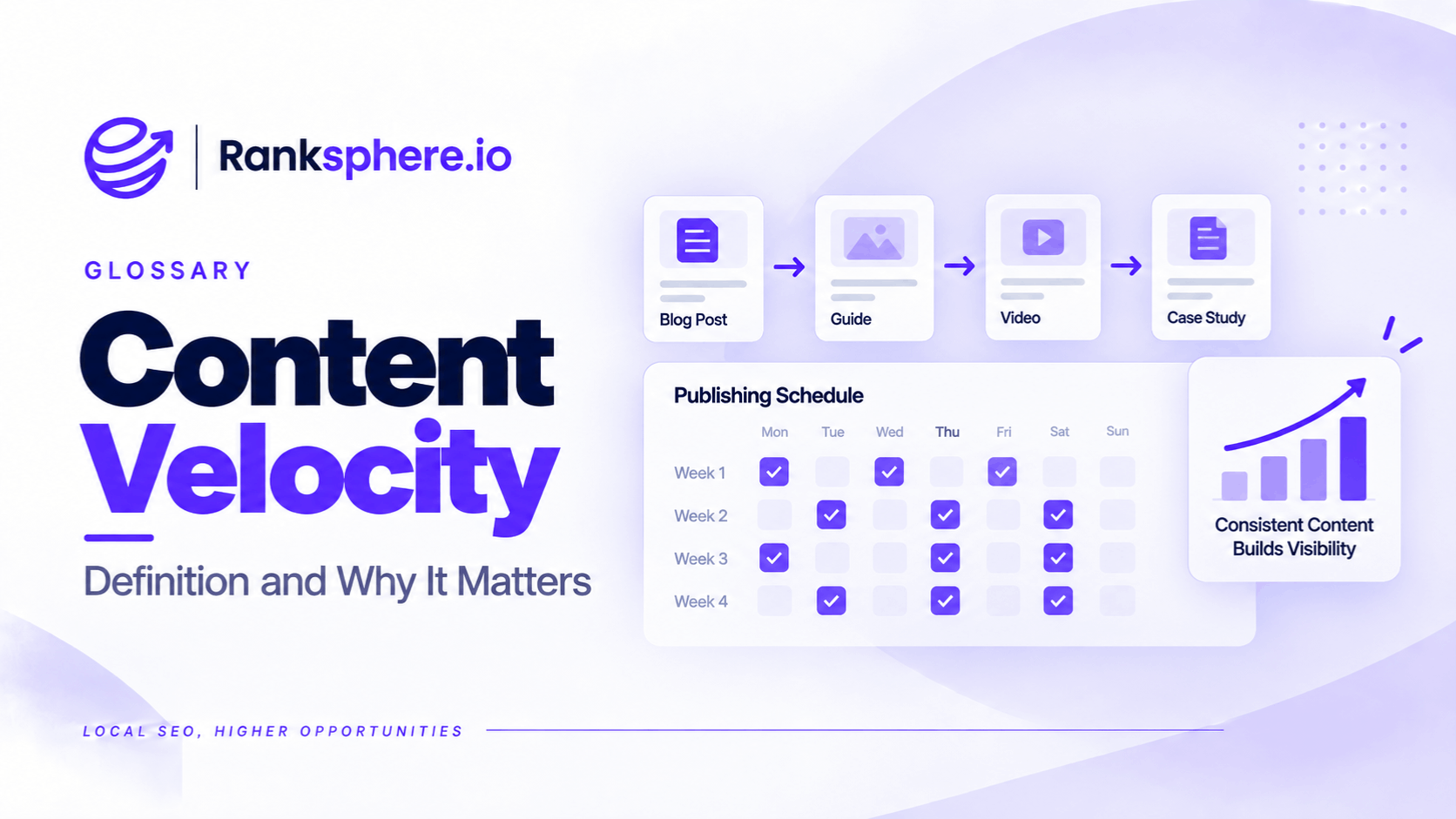
Content velocity is the rate at which a website publishes new content over a given period. It is usually measured by the number of blog posts, articles, service pages, or other webpages published each week or month.
For example, a local roofing company publishing two blog posts per month has a content velocity of approximately 24 posts per year.
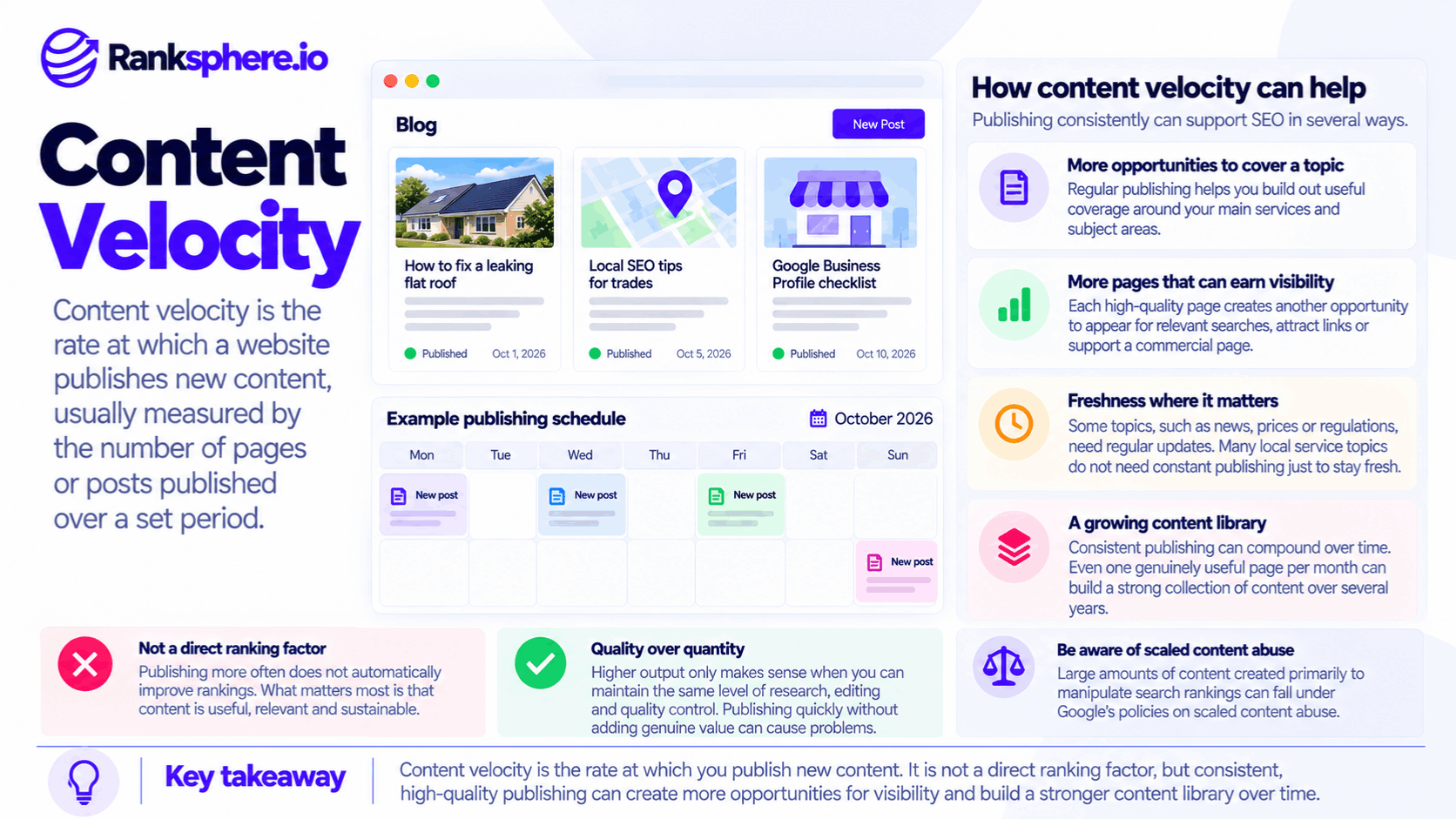
Publishing more frequently can help a business build a larger collection of useful resources, but content velocity is not a direct Google ranking factor.
Google doesn't automatically reward websites for publishing weekly or penalise businesses that publish less often.
What matters is whether the content serves a clear purpose, provides useful information, and meets the needs of its intended audience.
For local businesses, a realistic publishing schedule is often more valuable than trying to produce large amounts of content without enough time for research, writing, and review.
Is Content Velocity a Google Ranking Factor?
Content Velocity in SEO and Consistent Publishing Benefits
Google doesn't have a publicly documented ranking signal that rewards websites simply for publishing more frequently.
A business producing four articles a week won't necessarily outrank a competitor publishing one article a month.
The number of pages published doesn't establish their quality or relevance.
However, publishing new content can support SEO in several ways when the content is useful and addresses genuine search demand.
Content Discovery and Crawling
Search engines need to discover and crawl new pages before they can consider them for indexing.
Websites that regularly publish or update useful content may give search engines more URLs and changes to discover.
However, publishing frequently doesn't guarantee that Googlebot will crawl a website more often.
Crawling depends on factors such as Google's assessment of crawl demand, server availability, and the importance of individual URLs.
A new article may be discovered quickly, while another may take longer.
Publishing more pages doesn't automatically make discovery or indexing faster.
Building Topic Coverage
A website can become a more useful resource by covering important questions within a subject.
For example, a roofing company might publish content about:
- Common causes of roof leaks
- Flat roof repairs
- Roof replacement costs
- Damaged roof flashing
- Roof maintenance
- Choosing suitable roofing materials
These pages can help customers understand different aspects of roofing services.
They may also form part of a broader topic cluster, where related articles support a central subject.
This connects with the idea of topical authority.
However, topical authority isn't a single Google ranking score, and publishing more articles doesn't automatically establish it.
The pages still need to be accurate, useful, relevant, and sufficiently distinct from one another.
Keeping Time-Sensitive Information Current
Some searches benefit from recent information.
For example, an article about a newly introduced regulation or a recent software update may need frequent revisions.
Other topics change much less often.
A plumbing company's explanation of how to recognise a leaking pipe may remain useful for years with only occasional updates.
Publishing frequency should therefore reflect the subject.
Not every page needs to be replaced or rewritten simply because it has been online for several months.
Building a Useful Content Library
Publishing regularly can help a business develop a collection of resources over time.
A company publishing one useful article each month will have twelve articles after a year.
After three years, that could become 36 articles, assuming the publishing schedule continues.
However, the value of those pages depends on whether they answer relevant questions and remain accurate.
A library of 36 useful articles may be more valuable than a collection of 100 repetitive pages created mainly to increase publishing volume.
Why Publishing Too Much Content Can Hurt SEO
Increasing content velocity isn't automatically harmful.
A website with an experienced editorial team may be able to publish several useful articles each week.
Problems arise when businesses increase output without maintaining research, writing, and quality control.
Publishing Thin Content
Thin content provides little original or useful information.
For example, a roofing company might publish separate articles targeting:
- Best roof repair company
- Top roof repair specialists
- Reliable roof repair services
- Professional roof repair contractors
If all four pages repeat nearly identical advice, creating separate URLs may add little value.
Publishing more pages doesn't compensate for weak content.
Google may decide not to index some of those pages, or they may simply fail to perform well in search.
However, low traffic or a lack of indexing doesn't automatically prove that a page is thin.
Content performance needs to be assessed in context.
Creating Overlapping Pages
Publishing several pages that answer the same question can create unnecessary overlap.
For example, a business might write three separate articles about the cost of replacing a roof.
If they all target substantially the same search intent, they may compete for similar queries or divide useful information across multiple pages.
This is often discussed as keyword cannibalisation.
The solution isn't always to publish fewer articles.
It's to identify whether each page serves a distinct purpose.
Closely related keyword variations can often be covered naturally within one comprehensive page.
Different questions may justify separate supporting articles.
Creating More Content Than You Can Maintain
Publishing is only part of content management.
Articles may need updates when:
- Prices change
- Services change
- Regulations are updated
- Products become unavailable
- Links stop working
- Information becomes inaccurate
A business publishing large amounts of content may struggle to keep older articles accurate.
For example, a local business could have dozens of articles containing outdated prices or references to services it no longer provides.
A sustainable content strategy needs to account for maintenance as well as new production.
Publishing at Scale Without Adding Value
Google's spam policies address scaled content abuse, which involves producing many pages primarily to manipulate search rankings rather than help users.
This can involve content created using automation, generative AI, human writers, or a combination of methods.
The issue isn't simply publishing a large number of pages.
It's the purpose and value of the content being produced.
For example, publishing hundreds of near-identical location pages with little useful information may raise concerns.
By contrast, a website publishing substantial original research across many pages isn't automatically engaging in spam because its publishing volume is high.
Google's policies focus on abusive practices, not a particular number of articles per month.
For more context, see AI-generated content.
How Much Content Should a Local Business Publish?
There isn't a universal publishing frequency that works for every local business.
The right schedule depends on the available resources, competition, existing website content, and the questions customers need answered.
For many small businesses, quality and consistency are easier to maintain with a modest publishing schedule.
One Useful Article Per Month
Publishing one well-researched article per month can be a reasonable starting point.
For example, a roofing company might publish:
- January — How to Identify a Roof Leak
- February — Flat Roof Repair Costs
- March — Common Causes of Damaged Roof Flashing
- April — When to Repair or Replace a Roof
Each article addresses a distinct customer question.
This approach gives the business time to collect photographs, provide accurate information, and review the content before publication.
It also leaves time for updating existing pages.
However, one article per month isn't an SEO requirement or a guaranteed route to rankings.
Two Articles Per Month
Two articles per month may be manageable when a business has an established content process.
For example, a dental practice might publish one treatment guide and one supporting article each month.
The key is having someone responsible for:
- Selecting topics
- Gathering information
- Preparing content briefs
- Reviewing accuracy
- Publishing
- Monitoring performance
Without clear ownership, even a modest publishing schedule can become difficult to maintain.
Weekly Publishing
Weekly publishing can work for businesses with enough resources to support it.
However, more frequent publishing requires additional research, editing, and subject-matter review.
If the business owner needs to approve every article, provide photographs, or verify technical details, the workload can become substantial.
Publishing weekly only makes sense when the business can maintain the quality of each article.
Finish Important Topics Before Starting New Ones
A content strategy should identify which subjects matter most to the business.
For example, a roofing company might decide to build a comprehensive group of pages around flat roof repairs.
That could include:
- A main flat roof repair service page
- An article about common flat roof problems
- A guide to repair costs
- A comparison of repair and replacement
- A case study documenting a completed repair
Completing this group may be more useful than publishing unrelated articles simply to maintain a weekly schedule.
The priority should be covering relevant topics well, not increasing the number of published URLs.
Why a Sustainable Publishing Schedule Matters
A publishing schedule is useful because it helps teams plan work and allocate resources.
However, consistency isn't automatically a search ranking signal.
Its value is operational.
A realistic schedule makes it easier to maintain quality over time.
For example, compare two hypothetical approaches.
Business A
Publishes one article per month for three years.
At the end of that period, it has 36 articles.
Business B
Publishes one article per week for four months, then stops.
At the end of the period, it has approximately 17 articles.
Business A has published more content over the longer period because it maintained its process.
However, that doesn't prove Business A will receive more organic traffic or enquiries.
The performance of each article still depends on its relevance, quality, competition, and search demand.
The practical lesson is that a schedule a business can maintain is often more useful than an ambitious plan that quickly becomes unsustainable.
How to Manage Content Velocity Without Sacrificing Quality
A sustainable content process helps businesses avoid publishing just to meet a deadline.
Start With Search Intent
Before writing, identify what the reader wants to know.
For example, someone searching for "how much does roof repair cost?" is likely looking for pricing information and the factors affecting the final quote.
An article targeting that query should answer those questions clearly.
Publishing a general article about the importance of roof maintenance may not satisfy the same search intent.
Research the topic first, then decide whether a new page is necessary.
Build a Content Calendar Around Relevant Topics
A content calendar helps teams plan which pages to create.
It should identify:
- The target topic
- Intended audience
- Search intent
- Content type
- Responsible writer
- Subject-matter reviewer
- Expected publication date
The calendar should support the business's priorities rather than exist simply to fill available dates.
Gather First-Hand Information
Local businesses often have useful information that generic articles cannot provide.
Examples include:
- Photographs from completed projects
- Common customer questions
- Practical explanations from experienced staff
- Details from actual service visits
- Lessons from unusual jobs
This material can make articles more specific and useful.
For example, a roofing contractor's explanation of why a particular repair failed may offer more practical value than another generic article about roof maintenance.
Allow Time for Review
Content about technical services, healthcare, legal matters, or financial topics may require specialist review.
Publishing more frequently shouldn't mean skipping accuracy checks.
A draft that isn't ready should be improved before publication.
There is no SEO benefit in publishing inaccurate information simply to meet an internal deadline.
Include Content Updates in the Schedule
Not every content task needs to create a new URL.
Some months may be better spent updating existing articles.
For example, a business might need to:
- Correct outdated information
- Improve weak explanations
- Replace broken links
- Add useful photographs
- Update prices
- Consolidate overlapping pages
Content maintenance should be part of the plan rather than an occasional task.
Assign Clear Responsibilities
Publishing can stall when nobody knows who should provide the next piece of information.
A content process should identify who is responsible for research, writing, reviewing, and publication.
Ranksphere's Smart Tasks helps teams organise and assign work, which can support content planning and follow-up tasks.
This can make it easier to maintain a consistent process without relying on last-minute decisions.
How to Measure Content Velocity
Content velocity itself is straightforward to calculate.
For example:
Content velocity = Number of pages published ÷ Reporting period
If a business publishes six articles in three months, its average content velocity is two articles per month.
However, this number only measures publishing activity.
It doesn't tell you whether the content is performing well.
To evaluate the value of a content strategy, review additional metrics.
Organic Search Performance
Use Google Search Console to understand whether new and existing pages are receiving search impressions and clicks.
Review performance by page and query rather than looking only at total website traffic.
A newly published page may take time to establish visibility, depending on the topic and competition.
Relevant Keyword Visibility
Track whether the content appears for queries that match its intended purpose.
For example, a roof repair cost guide should be evaluated against relevant searches about repair pricing.
Ranking for unrelated queries may not contribute much to the business.
Enquiries and Conversions
For local businesses, the most important question is often whether content helps generate useful customer actions.
These may include:
- Quote requests
- Appointment bookings
- Contact form submissions
- Tracked phone enquiries
- Other qualified leads
However, not every article is intended to generate immediate conversions.
Some content helps people understand a service before they're ready to enquire.
Its performance should be evaluated according to its purpose.
Content Maintenance
Review whether published articles remain accurate and useful.
A content strategy that continually produces new pages while leaving outdated content untouched may become harder to manage.
A regular content audit can help identify pages that need updating, consolidating, improving, or removing.
However, don't delete content solely because it receives little traffic.
Some pages may serve important customer questions even when search demand is limited.
Common Content Velocity Mistakes
Several mistakes can turn content production into a costly process with limited value.
- Treating publishing volume as the goal. More pages don't automatically produce better SEO results.
- Matching a competitor's publishing frequency. Another business's output doesn't necessarily reflect your resources or needs.
- Publishing before content is ready. Deadlines shouldn't take priority over accuracy and usefulness.
- Creating several pages for the same search intent. Overlapping articles can make content harder to manage.
- Measuring only the number of posts published. Output matters operationally, but it isn't a substitute for performance KPIs.
- Using AI to increase output without proper review. Faster drafting doesn't remove the need to verify information.
- Ignoring older articles. Existing content may become outdated or lose relevance.
- Assuming consistency guarantees rankings. Publishing regularly is a process, not a ranking advantage.
- Deleting every low-traffic page. Low search traffic doesn't automatically mean content is unnecessary or poor quality.
Content Velocity Best Practices
To manage content production effectively:
- Choose a publishing rate your team can realistically maintain.
- Research search intent before creating new pages.
- Prioritise important topics rather than unrelated keywords.
- Complete useful content groups where appropriate.
- Use first-hand business knowledge and original examples.
- Give writers and reviewers enough time to produce accurate content.
- Avoid publishing just to meet a numerical target.
- Schedule updates to existing content.
- Review content performance regularly.
- Measure relevant search visibility, enquiries, and other meaningful outcomes.
- Increase publishing frequency only when the process can support it.
- Reduce output when necessary rather than sacrificing quality.
The objective isn't to publish as frequently as possible.
It's to produce and maintain content that helps the intended audience.
Example of Content Velocity for a Local Business
Consider a hypothetical roofing company working with an SEO agency.
The agency recommends publishing four blog posts per month.
The proposal focuses heavily on increasing content velocity, arguing that the company needs to publish more frequently than its competitors.
The business agrees.
What Happens During the First Five Months?
The agency publishes twenty articles.
However, producing those articles requires regular input from the company director.
The director needs to explain roofing methods, verify technical details, review drafts, and provide project information.
As the workload grows, reviewing content becomes increasingly difficult.
Some articles cover similar questions, while others provide little information beyond what already exists on the website.
After five months, the company stops publishing because the process has become difficult to maintain.
What the Content Audit Finds
A year later, the agency reviews the articles.
Several pages have received limited search visibility.
Others overlap with existing service pages or cover topics with little relevance to the company's main services.
However, the audit doesn't assume that every low-traffic article is poor quality.
The team evaluates each page's purpose, search intent, accuracy, and potential usefulness.
Some articles are improved.
Others are consolidated where they address substantially the same topic.
How the Company Changes Its Strategy
The replacement plan focuses on one substantial piece of content per month.
The company prioritises two areas:
- Flat roof repairs
- Roof replacement and maintenance
Each article needs to answer a clear customer question.
Where appropriate, the company provides photographs and details from completed jobs.
The agency also allocates time to maintaining existing pages.
The publishing rate is lower, but the process requires less disruption to the director's work.
Example Shows
“The original strategy measured success largely through the number of articles published.
The revised strategy focuses on relevance, quality, and a manageable workload.
The business can now evaluate content based on whether it attracts relevant search traffic, answers customer questions, and contributes to enquiries.
There is no guarantee that a slower publishing schedule will outperform a faster one.
However, a sustainable process gives the business more opportunity to maintain quality and improve content over time.
Content velocity measures how quickly you publish. It doesn't measure how useful your content is.
For local businesses, a realistic publishing schedule supported by research, first-hand experience, and regular content reviews is usually more practical than chasing volume for its own sake.”
See Also
- Content Strategy — Planning content around business goals and customer needs.
- Thin Content — Pages that provide little original or useful information.
- Topic Cluster — Organising related content around a central subject.
- Content Refresh — Updating existing articles to maintain accuracy and usefulness.
- AI-Generated Content — Understanding AI-assisted publishing and Google's content policies.
- Content Audit — Evaluating existing content and identifying improvement opportunities.