Topical authority is an SEO term used to describe how strongly a website is associated with a particular subject through useful, relevant and interconnected content.
It is not a score published by Google, nor is there a confirmed Google ranking factor called “topical authority”.
The idea is more practical than that.
A website that consistently publishes genuinely useful information around a subject, connects those pages logically and demonstrates real expertise may become more relevant across a wider range of searches within that topic.
That does not mean:
more pages = more authority.
A small group of excellent pages can be far more useful than dozens of shallow articles.
The goal is depth, usefulness and coherence, not volume for its own sake.
What does topical authority mean?
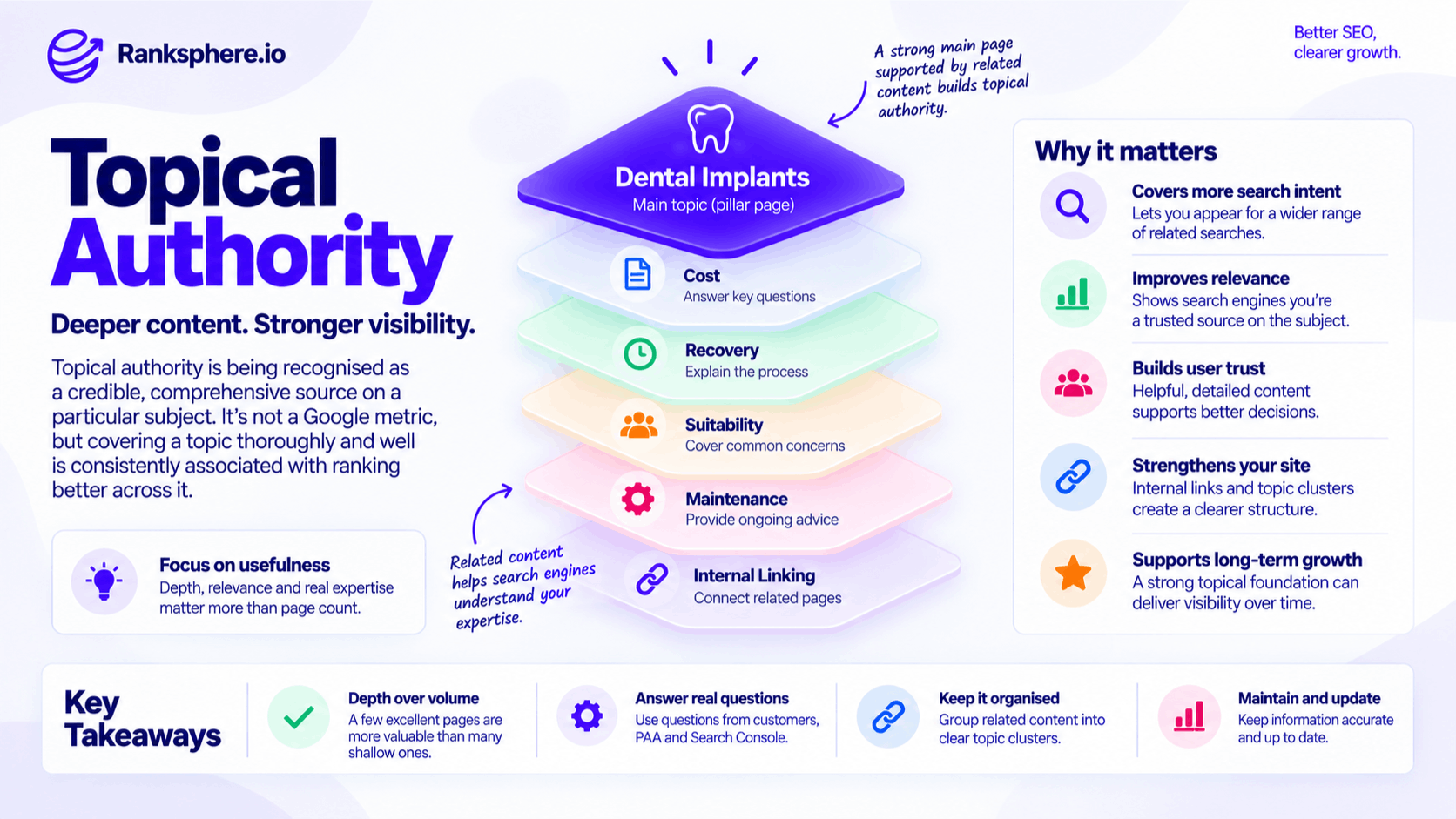
In SEO, topical authority usually describes the strength of a website's coverage around a specific subject.
Imagine two dental websites.
Website A
It has one page about dental implants.
The page gives a basic description of the treatment.
Website B
It has a strong implant treatment page supported by useful content about:
- Implant suitability
- Treatment stages
- Recovery
- Costs
- Gum disease
- Bone grafting
- Implant maintenance
Those pages are logically connected and written or reviewed by qualified clinicians.
Website B gives both users and search engines a much clearer picture that dental implants are a meaningful area of expertise for the practice.
That is what SEOs usually mean by topical authority.
Is topical authority a Google ranking factor?
Not as a named, measurable factor.
Google does not provide:
- A topical authority score
- A topical authority report
- A minimum page count
- A required number of supporting articles
Third-party SEO tools may create their own authority or topical metrics, but those are proprietary estimates.
They are not Google scores.
It is safer to think of topical authority as a useful framework for building a stronger site rather than something you can directly “increase by 12 points”.
Why can topical depth help SEO?
There is no single mechanism behind topical authority.
Instead, strong topic coverage can improve several things that matter independently.
Better search-intent coverage
Different people ask different questions about the same subject.
A useful content library can address:
- Early research
- Comparisons
- Practical concerns
- Costs
- Risks
- Service decisions
That allows the site to be relevant across more searches.
Better internal linking
Related pages can support each other through internal linking.
For example:
Dental Implant Guide
can link naturally to:
- Implant costs
- Implant recovery
- Bone grafting
- Implant maintenance
Those links help users navigate the subject and help search engines understand relationships between pages.
Clearer topical relationships
Modern search systems can understand how concepts relate.
An entity such as:
dental implant
is connected naturally to concepts such as:
- Jawbone
- Osseointegration
- Crown
- Gum health
- Recovery
A website that covers the important relationships around a subject can provide stronger context than one that repeatedly uses the same keyword without saying much.
Greater opportunity to demonstrate expertise
Strong topical content also gives businesses more opportunity to demonstrate:
- Experience
- Expertise
- Original evidence
- Professional knowledge
That aligns with the principles represented by E-E-A-T.
E-E-A-T itself should not be treated as one direct ranking score.
It is a quality framework Google uses in its Search Quality Rater Guidelines.
Topical authority is not simply page count
One of the most common mistakes is assuming:
10 articles are better than 5.
That is not necessarily true.
Consider:
Site A
Publishes 40 short articles that lightly touch related subjects.
Site B
Publishes 8 well-researched pages covering the most important questions comprehensively.
Site B may provide a much stronger resource.
What matters is not how many URLs exist.
It is whether the content genuinely helps users understand and act on the subject.
Topical authority is topic-specific
A website does not become authoritative about everything simply because it performs well in one area.
A veterinary practice may have particularly strong content around:
rabbit medicine
while having relatively limited information about:
canine dermatology
That is normal.
Topical relevance can be uneven across a website.
This is one reason businesses should prioritise subjects where they have genuine experience rather than attempting to cover every adjacent topic.
How topical authority is built
There is no fixed formula.
But several practices can help build stronger topical coverage.
Create topic clusters
Topic clusters are one practical way to organise related content.
A cluster usually contains:
- A broad central page
- Supporting pages covering distinct subtopics
- Logical internal links between them
For example:
Main page
Dental Implants
Supporting content
How much do dental implants cost?
How long do dental implants last?
Dental implant recovery
Dental implants and gum disease
Do I need a bone graft before implants?
The exact structure should follow user intent.
Do not create supporting pages simply to reach a predetermined number.
Cover distinct questions, not keyword variations
The strongest supporting content usually addresses a genuinely different question.
For example:
How much do dental implants cost?
and:
How long do dental implants last?
represent different information needs.
By contrast:
dental implant price
and:
dental implants prices
probably do not require separate pages.
Build around distinct intent rather than minor wording changes.
Cover questions customers actually ask
Customer questions are often a better starting point than arbitrary keyword lists.
Useful sources include:
- Sales calls
- Consultations
- Customer emails
- Search Console
- People Also Ask
- Customer support
- On-site search
- Keyword research
These can reveal the practical concerns surrounding a topic.
For a roofing company, customers may care less about:
What is a flat roof?
and more about:
Can my flat roof be repaired or does it need replacing?
That is the kind of question useful content should answer.
Low-volume questions can still matter
Some valuable questions have little measurable search volume.
That does not make them useless.
A highly specific question can be important when it appears late in a buying decision.
For example:
Can I get dental implants if I have gum disease?
may attract fewer searches than:
dental implants
but the person asking it may have a very specific treatment concern.
Do not assume low-volume topics are automatically easy to rank for.
Difficulty still depends on:
- Competition
- Search intent
- Existing results
- Site strength
- Content quality
The better argument is that small-volume questions can still be commercially valuable.
Add first-hand experience
Original information can make topical content much stronger.
Examples include:
- Case studies
- Original photographs
- Project examples
- Professional observations
- Internal data
- Common customer problems
- Lessons from real work
A generic article explaining:
What causes roof leaks?
can be reproduced by almost anyone.
A roofing company documenting:
Five roof-leak problems we regularly find in 1930s homes in Maidstone
with original photographs and practical explanations provides something more distinctive.
Use named experts where relevant
Where specialist knowledge matters, identify the people behind the content.
That may include:
- Author name
- Role
- Relevant qualifications
- Professional experience
- Reviewer
This is particularly valuable in areas such as:
- Health
- Finance
- Legal services
- Safety
- Technical advice
Do not invent credentials or create fake expert profiles for SEO.
The purpose is transparency.
Earn relevant external recognition
Backlinks and legitimate third-party mentions can provide additional evidence that a website or organisation is recognised within its field.
Relevant sources might include:
- Industry publications
- Professional bodies
- Local press
- Suppliers
- Associations
- Universities
- Specialist websites
Do not turn this into:
“You need X backlinks to establish topical authority.”
There is no fixed threshold.
The value depends on the source, context and relevance.
Internal linking matters
A group of articles does not automatically become a coherent topic cluster simply because they are about similar things.
Connect related content intentionally.
For example:
A page about:
Dental Implant Recovery
may link to:
- Main implant treatment page
- Bone grafting
- Implant maintenance
The main treatment page can link back to those supporting resources where useful.
These connections help users explore the topic and make the site's structure clearer.
Avoid linking everything to everything
Internal linking should remain useful.
Do not turn a topic cluster into a web where every page contains ten links to every other page.
Link where the relationship makes sense.
The goal is to help someone answer their next question.
How deep should a local business go?
There is no universal answer.
A local business does not need 30 or 40 articles around every service.
The right amount of content depends on:
- Complexity of the service
- Customer questions
- Competition
- Available expertise
- Search demand
- Commercial importance
A highly specialised medical procedure may support substantial supporting content.
A straightforward service such as gutter cleaning may not.
Do not manufacture depth where the subject does not require it.
Start with your strongest subjects
For most small businesses, focusing on a few commercially important areas is more manageable than trying to cover everything at once.
Choose topics where:
- The business has genuine expertise
- Customers ask many questions
- The service is commercially important
- There is enough depth to justify supporting content
Finish the important work before spreading resources too thinly.
There is no five-page or eight-page rule
SEO advice sometimes recommends a fixed number of supporting pages per topic cluster.
There is no meaningful universal threshold.
A topic may need:
- 3 pages
- 7 pages
- 15 pages
depending on its complexity.
The right question is not:
How many articles have we published?
It is:
Have we covered the important search intents without creating unnecessary overlap?
Connect informational content to commercial pages
Informational content should not live in isolation.
If someone reads:
How long does dental implant recovery take?
they may eventually need information about:
Dental Implant Treatment
A useful internal link gives them a logical next step.
The same applies to:
- Pricing pages
- Service pages
- Booking pages
- Product pages
Do not force a sales link into every paragraph.
Connect the journey where it makes sense.
Topical authority and local SEO
Topical content can support local businesses, but it does not replace core local SEO.
A local business may still need strong:
- Google Business Profile
- Local landing pages
- Reviews
- Citations
- Local links
- Accurate business information
Which factor matters most depends on the query.
A search such as:
dentist near me
depends heavily on local relevance and proximity.
A search such as:
can dental implants be fitted after bone loss?
is much more informational.
One SEO strategy should account for both.
Topical authority and semantic search
Semantic search helps explain why meaningful topic coverage can work better than keyword repetition.
A strong page can rank for many related search variations because modern search systems can interpret meaning.
That does not mean:
more semantic terms = better rankings.
It means useful coverage of the subject naturally creates relevant context.
Topical authority and entities
Clear entity information can also help search systems understand:
- Who produced the content
- Which organisation it represents
- Which products or services are being discussed
For example, a physiotherapy clinic publishing detailed shoulder-rehabilitation content should also make it clear:
- Which clinic produced it
- Who reviewed it
- Where the clinic operates
- What qualifications the authors have
That makes the source easier to understand.
Topical authority and E-E-A-T
E-E-A-T stands for:
Experience
Expertise
Authoritativeness
Trustworthiness
Topical authority and E-E-A-T overlap conceptually but are not the same thing.
A website can publish extensively about a subject without demonstrating genuine expertise.
Likewise, a highly qualified specialist may have a small website with limited content.
Strong content combines:
subject coverage
with:
credible expertise and trustworthy information.
Content freshness
Topic coverage needs maintenance.
Pages can become outdated when:
- Prices change
- Regulations change
- Products change
- Services change
- Medical or technical guidance evolves
Use a content refresh when the information genuinely needs updating.
Do not refresh everything every January simply to change the publication date.
Update based on need.
Topical authority does not mean writing about everything
Relevance matters.
A plumbing company does not need articles about:
- Interior design
- Property investing
- Gardening
simply because homeowners may also care about those topics.
Stay reasonably close to:
- Services
- Expertise
- Customer problems
- Related decisions
Topical breadth without a meaningful connection can dilute the usefulness of the site.
Topical authority is not permanent
Strong historical content does not guarantee permanent visibility.
Competitors improve.
Search intent changes.
Information becomes outdated.
New services emerge.
Review important topic clusters periodically and ask:
- Is the information still accurate?
- Are important questions missing?
- Are pages overlapping?
- Are links still useful?
- Are new pages actually necessary?
Maintenance matters more than continuously publishing new URLs.
Topic clusters can become bloated
There is also a point where “topical depth” becomes content production for its own sake.
For example, a dental implant cluster does not necessarily need separate pages for:
Can I drink coffee after implants?
Can I drink tea after implants?
Can I drink hot drinks after implants?
Those could probably be addressed within one useful recovery guide.
Good topical architecture consolidates closely related questions instead of multiplying pages endlessly.
Use a content audit
A content audit can reveal whether an existing topic is:
- Strong
- Incomplete
- Repetitive
- Outdated
- Over-segmented
Look for:
- Duplicate intent
- Thin content
- Orphan pages
- Weak internal linking
- Missing questions
- Outdated facts
Ranksphere's website audit surfaces thin pages and content gaps across a site, helping identify where a topic needs stronger coverage rather than simply more pages.
What topical authority is not
It is not keyword density
Repeating the target phrase more often does not create expertise.
It is not word count
A 4,000-word article can still be shallow.
A 700-word page can be excellent if that is all the subject requires.
It is not page count
Publishing 50 weak articles does not automatically establish authority.
It is not a Google score
No one can tell you that your site's official topical authority is:
82/100
because Google does not publish such a metric.
It is not backlinks alone
Links can help, but a large backlink profile does not compensate for poor topic coverage.
It is not site-wide
A business can be highly relevant to one subject and relatively weak on another.
It is not permanent
Useful content needs to remain accurate.
It is not a substitute for technical SEO
Excellent content still needs to be:
- Crawlable
- Indexable
- Internally connected
- Accessible
Topical coverage cannot compensate for fundamental technical problems.
Common topical authority mistakes
- Treating topical authority as a Google metric.
- Publishing more pages purely to increase topic coverage.
- Using arbitrary page-count targets.
- Creating a new URL for every low-volume keyword.
- Assuming obscure questions are automatically easy to rank for.
- Covering subjects the business has little genuine experience in.
- Producing generic content without first-hand evidence.
- Failing to connect related pages through internal links.
- Creating supporting content that never links to relevant commercial pages.
- Treating E-E-A-T as a direct numerical ranking factor.
- Spreading resources across too many topics at once.
- Publishing a cluster and never maintaining it.
- Using word count as a proxy for depth.
Topical authority best practices
- Choose subjects where the business has genuine expertise.
- Start with the most commercially important and useful topics.
- Research the different intents around each subject.
- Build supporting content only when a distinct question deserves it.
- Consolidate closely related variations rather than creating thin pages.
- Use deliberate internal linking.
- Connect informational content to relevant service or product pages.
- Add first-hand evidence, examples, photographs or data where possible.
- Use qualified authors or reviewers where specialist expertise matters.
- Earn relevant third-party recognition rather than chasing arbitrary link counts.
- Update content when facts genuinely change.
- Audit established clusters before automatically publishing more.
Example
“Norbury Veterinary has been publishing two articles every month for several years.
The website now contains dozens of posts across subjects ranging from:
- Rabbits
- Senior cats
- Dogs
- Fleas
- Nutrition
- Behaviour
- Dental care
- Vaccinations
- Travel
- Surgery
The problem is not that the practice lacks content.
It lacks depth and organisation.
Many subjects have only one short article.
Several pages overlap.
Few of the posts link to one another.
The practice runs a content audit and identifies two areas where its vets have particularly strong experience:
rabbit medicine
and:
senior cat care.
Instead of continuing to publish broadly, the practice reorganises its existing material.
Overlapping posts are merged.
Outdated articles are refreshed.
Pages that serve no useful purpose are removed or redirected where appropriate.
The remaining content is organised around distinct questions.
Qualified vets are clearly identified.
Real examples and original photographs are added where appropriate.
Supporting articles link naturally to each other and to the relevant veterinary service pages.
The website ends up with fewer pages than before.
But those pages now form a much clearer, more useful resource around the subjects the practice genuinely knows well.
That is the useful way to think about topical authority.
It is not about becoming the website that has written the most. It is about becoming a genuinely useful source on the subjects where your expertise, content and site structure support that claim.”
See also
- Topic cluster — organising related pages around a central subject
- E-E-A-T — Google's quality framework around experience, expertise, authoritativeness and trust
- Content audit — identifying gaps, overlap and outdated content
- Internal linking — connecting related pages and helping users navigate a topic
- Thin content — pages that provide too little useful value
- Semantic search — understanding meaning and relationships beyond exact keyword repetition