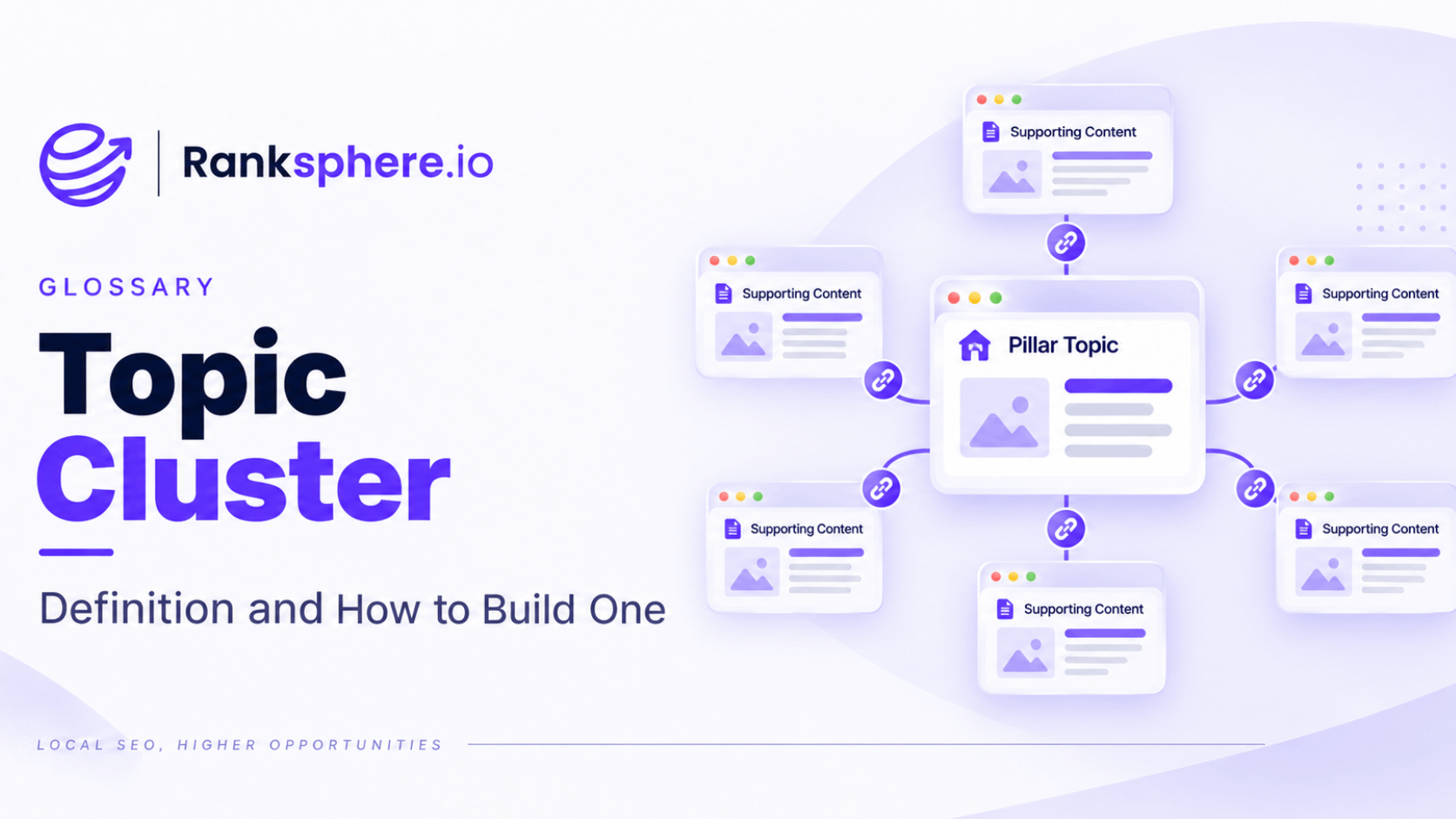
A topic cluster is a group of related pages organised around one broader subject.
The structure usually includes a central pillar page covering the topic at a high level, supported by more focused pages that explore individual questions, subtopics or search intents in greater depth.
These pages are connected through deliberate internal linking.
The purpose is not simply to publish more content.
It is to organise related information so visitors and search engines can understand how the pages fit together.
For example, instead of publishing ten unrelated articles about dental implants across a blog, a practice could group them around a central implant guide and connect each supporting page to the relevant parts of the topic.
That creates a clearer structure for both readers and search engines.
How a topic cluster works
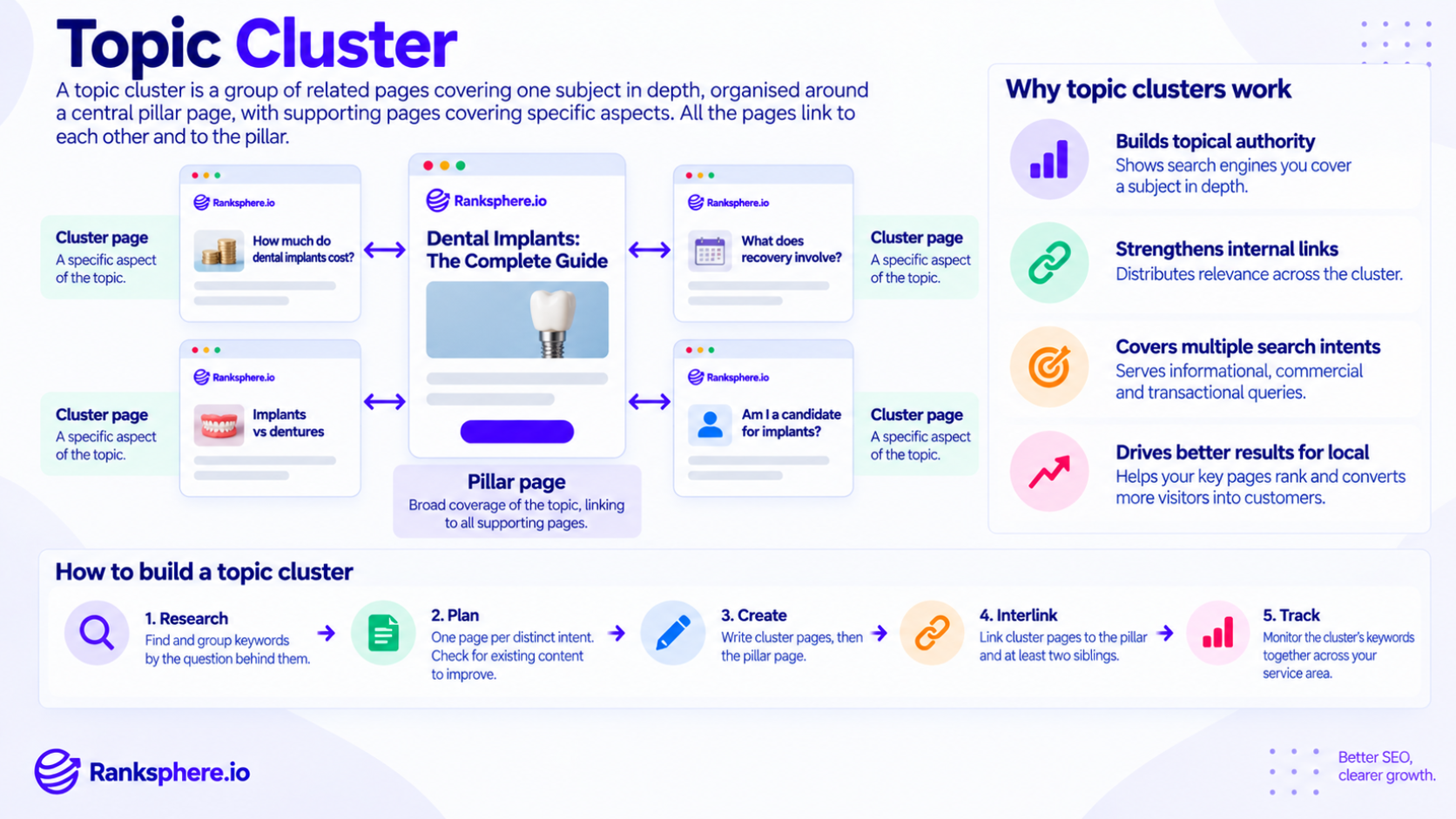
A typical topic cluster contains three main parts.
Pillar page
The pillar page covers the main topic broadly.
It introduces the important areas someone may want to understand and links to more detailed pages where appropriate.
For example:
Complete Guide to Dental Implants
might cover:
- What dental implants are
- Who may be suitable
- The treatment process
- Recovery
- Costs
- Alternatives
- Aftercare
The pillar does not need to answer every possible question in exhaustive detail.
Its job is to provide a strong overview and guide readers towards more specialised information.
Cluster pages
Cluster pages cover narrower parts of the subject.
For example:
- How much do dental implants cost?
- Dental implants vs dentures
- How long does implant recovery take?
- Who is suitable for dental implants?
- How long do dental implants last?
Each page should have its own clear purpose rather than existing merely to target another variation of the same keyword.
Internal links
Internal links connect the cluster.
The pillar can link to relevant supporting pages.
Supporting pages can link back to the pillar and to other related pages where those links genuinely help the reader.
Without these connections, you may simply have several articles on the same subject rather than a deliberate topic cluster.
Why topic clusters can help SEO
Topic clusters do not receive a special ranking bonus simply because they follow a pillar-and-cluster model.
Their value comes from the SEO fundamentals they can improve.
Clearer topic coverage
A cluster allows a website to explore a subject from several useful angles.
One page might explain the basics.
Another may answer pricing questions.
Another might compare alternatives.
Another could address common problems.
Together, they provide more complete coverage than forcing every possible question into one page.
Better internal linking
A cluster creates natural opportunities for relevant internal links.
For example, an article about implant recovery can link to:
- The main dental implants guide
- A page about implant aftercare
- The practice's implant treatment page
These connections can make the site easier to crawl and help explain how the content relates.
Better search intent coverage
Different searches often reflect different search intents.
Someone searching:
what are dental implants
is looking for something different from:
dental implants cost Manchester
or:
book dental implant consultation
Trying to satisfy all three searches with one page can make the content unfocused.
A topic cluster allows each page to serve a distinct intent while remaining connected to the wider subject.
Better user journeys
Clusters can also help visitors move naturally from one question to the next.
Someone reading about:
dental implant recovery
may later want to know:
- How much treatment costs
- Whether implants are right for them
- What alternatives exist
- How to book a consultation
Good internal links make that journey easier.
Topic clusters and topical authority
The term topical authority is widely used in SEO to describe a site's depth, credibility and coverage around a particular subject.
It should not be treated as a formal Google score.
There is no public “topical authority” metric you can optimise directly.
A better way to think about it is this:
A website that consistently publishes accurate, useful and well-connected content around a subject gives users and search engines more context about what the site knows and covers.
A topic cluster can support that by creating a more coherent body of content.
But structure alone is not enough.
Five weak articles linked together are still five weak articles.
Quality matters more than the cluster diagram.
Topic clusters and search intent
Search intent should determine where one page ends and another begins.
Do not create separate pages for every slight keyword variation.
For example:
- Dental implant cost
- Dental implants price
- How much are dental implants?
- Price of dental implants
may all represent essentially the same intent.
Those phrases probably belong on one strong page rather than four separate URLs.
By contrast:
Dental implants vs dentures
serves a different intent and may deserve its own page.
See search intent when deciding how to divide a cluster.
Topic clusters vs keyword cannibalisation
Poorly planned clusters can create keyword cannibalisation.
This happens when several pages compete for essentially the same search intent.
For example:
/dental-implant-cost/
/dental-implant-prices/
/how-much-are-dental-implants/
may not need to exist separately.
A well-designed cluster avoids this by giving each page a distinct role.
One page may cover cost.
Another may cover recovery.
Another may compare implants with dentures.
The subject is shared.
The intent is different.
Topic clusters for local businesses
Local businesses usually do not need enormous content clusters.
A smaller finished cluster is usually more useful than an ambitious content plan that never gets completed.
For a dental practice, a dental implant cluster could look like:
Pillar page
Complete Guide to Dental Implants
A broad overview covering:
- What implants are
- Who they are suitable for
- Treatment stages
- Recovery
- Costs
- Common questions
Supporting page
How Much Do Dental Implants Cost in [City]?
Focused on pricing, what affects the cost and what is included.
Supporting page
Dental Implants vs Dentures
Focused on comparing treatment options.
Supporting page
Dental Implant Recovery: What to Expect
Focused on healing and aftercare.
Supporting page
Am I Suitable for Dental Implants?
Focused on candidacy and assessment.
Commercial page
Dental Implant Treatment
The practice's main service page explaining the treatment it provides and how someone can book.
The informational content and commercial page should connect naturally where relevant.
That gives readers somewhere useful to go when research turns into action.
Pillar page vs service page
A pillar page and a service page do not necessarily serve the same purpose.
For example:
Guide to Dental Implants
may primarily answer informational questions.
Dental Implant Treatment at Smith Dental
may focus on:
- The practice's treatment
- Clinicians
- Consultation process
- Pricing
- Booking
Trying to turn the service page into a giant educational guide can sometimes weaken its commercial purpose.
Likewise, turning the pillar article into a sales page can make it less useful as a guide.
Keep each page focused on its main intent, then connect them through internal links.
How to plan a topic cluster
Start with the subject rather than a list of keywords.
Start with keyword and audience research
Use keyword research to understand what people actually want to know.
Look for questions around:
- Definitions
- Costs
- Comparisons
- Problems
- Processes
- Alternatives
- Buying or booking decisions
Then group searches by intent.
Do not create a page for every phrase.
Audit existing content
Before writing anything new, check whether the website already contains useful pages on the topic.
You may find:
- Several overlapping articles
- An old service guide
- Thin posts that could be merged
- Pages that already perform well
Improve or consolidate existing content where possible instead of creating another competing URL.
A content audit can help identify what is worth keeping.
Define the pillar
Choose one page to act as the broad entry point to the subject.
The pillar should cover enough of the topic to be useful on its own while pointing readers towards deeper pages.
It should not merely be a directory of links.
Define distinct supporting pages
Each supporting page should answer a meaningful question or intent.
Ask:
Would someone specifically search for this information, and does it deserve its own complete answer?
If not, it may simply belong as a section of another page.
Plan the internal links
Think about how someone would naturally move through the cluster.
For example:
Dental Implant Cost
might link to:
- The pillar guide
- Implant treatment
- Implants vs dentures
while:
Implants vs Dentures
might link to:
- The pillar
- Cost
- Candidacy
You do not need every page to link to every other page.
Link where the relationship is useful.
Should you write the pillar page first?
You can, but you do not have to.
Some content teams find it easier to write the supporting pages first because those pages reveal:
- Which questions matter
- Where topics overlap
- What needs its own page
- What the pillar should summarise
Others prefer to build the pillar first as a roadmap.
Either approach can work.
The important thing is that the final structure is coherent.
Internal linking inside a topic cluster
Internal linking is what turns related pages into a connected content system.
Good links can follow several directions:
Pillar → cluster page
The pillar introduces the topic and sends the reader deeper.
Cluster page → pillar
The supporting page links back to the broader guide where useful.
Cluster page → related cluster page
Two supporting pages link when their topics overlap naturally.
Informational page → commercial page
A guide links to the relevant service when the reader may be ready to act.
The aim is not to create a perfectly symmetrical linking pattern.
It is to make relevant pathways obvious.
Topic clusters and site architecture
Topic clusters should fit naturally into the wider site architecture.
For example:
/dental-implants/
/dental-implants/cost/
/dental-implants/recovery/
/dental-implants/implants-vs-dentures/
can be a logical structure.
But the URLs do not have to follow this exact pattern for the cluster to work.
What matters more is:
- Clear organisation
- Useful internal links
- Distinct page intent
- Consistent navigation
Do not restructure a healthy website solely to make the URLs look like a textbook topic cluster.
How large should a topic cluster be?
There is no ideal number of pages.
A cluster might contain:
- Four pages
- Eight pages
- Twenty pages
depending on the subject.
A narrow local service may only justify a handful of useful pages.
A broad subject such as personal finance or software development might support many more.
Do not create content simply to hit a target number.
Stop when the important questions have been covered properly.
Topic clusters and commercial pages
One of the easiest mistakes is creating a large informational cluster that never connects to the business.
Traffic alone is not the goal for most local companies.
If the business provides the service being discussed, relevant informational content should provide a sensible route towards it.
For example:
How long does dental implant recovery take?
could naturally link to:
Dental Implant Treatment
The link should help the reader.
Do not turn every paragraph into a sales pitch.
The service page should appear when it becomes a logical next step.
Ranksphere's rank tracker lets you track a cluster's keywords together across your service area, helping you see whether visibility is improving across the wider topic rather than judging each keyword in isolation.
How to measure topic cluster performance
Do not judge a topic cluster only by whether the pillar page ranks.
Look across the group.
Useful measurements include:
- Search impressions
- Organic clicks
- Rankings for relevant queries
- Number of cluster pages receiving traffic
- Internal traffic between related pages
- Service-page visits from informational content
- Enquiries or conversions
- Indexed pages
- Cannibalisation between cluster pages
You may find that the pillar itself receives moderate traffic while supporting pages generate most of the visibility.
That can still be a successful cluster.
Common topic cluster mistakes
- Creating a cluster without deliberate internal links. Related articles alone do not automatically form a useful structure.
- Publishing one page for every keyword variation. Group by intent instead.
- Making the pillar page compete with every supporting page. Keep the pillar broad and cluster pages focused.
- Linking every page to every other page. Internal links should follow relevance.
- Using rigid internal-link quotas. There is no requirement that every page needs two or three sibling links.
- Ignoring existing content. Improve or merge useful pages before creating new URLs.
- Building huge clusters before finishing smaller ones.
- Publishing generic content simply to appear comprehensive.
- Never connecting informational pages to relevant services.
- Treating topical authority as a measurable Google score.
- Creating a cluster for a topic with little relevance to the actual business.
Topic cluster best practices
- Start with a subject the business genuinely knows and serves.
- Use keyword research to understand real questions and intent.
- Create one page per distinct intent rather than per keyword variation.
- Keep the pillar broad without repeating every supporting page.
- Link related content naturally.
- Connect informational pages to relevant commercial pages.
- Audit existing content before publishing something new.
- Merge competing pages where appropriate.
- Keep the cluster manageable enough to complete and maintain.
- Measure the cluster as a group as well as page by page.
- Prioritise usefulness over the number of pages published.
Example
“Ravenshill Veterinary has published around 40 blog posts over several years.
Nine of them discuss puppy care.
They were written at different times and cover overlapping subjects such as:
- Vaccinations
- Feeding
- First vet visits
- Worming
- Early development
Very few of the posts link to one another.
Several also compete for very similar vaccination-related queries.
Instead of publishing another puppy article, the practice reviews what already exists.
Some posts are merged.
Others are updated.
A small number are removed because they add nothing that is not covered better elsewhere.
The final structure contains:
- A broad puppy care guide
- A puppy vaccination guide
- A first-vet-visit guide
- A puppy feeding and development guide
- The practice's puppy healthcare service page
The pages are then linked according to how the topics relate.
The vaccination page links to the main puppy guide and the healthcare service.
The puppy guide links to all of the supporting resources.
The feeding article links to the first-vet-visit guide where appropriate.
The result is fewer pages than before, but the website now has a clear body of useful puppy-care information instead of several disconnected posts competing with one another.
That is the real point of a topic cluster: not to manufacture more content, but to organise useful content around a subject so each page has a distinct job and the whole group is easier to navigate and understand.”
See also
- Internal linking — what connects the pages within a topic cluster
- Keyword research — identifying the questions and intents worth covering
- Search intent — deciding when a topic deserves its own page
- Keyword cannibalisation — what happens when several pages compete for the same intent
- Content audit — finding existing pages that can be improved or consolidated
- Site architecture — the wider structure that topic clusters sit within