SEO ROI measures the financial return generated from search engine optimisation compared with what the business invested in it.
In simple terms, it asks:
Did SEO generate enough business value to justify what we spent?
That sounds straightforward.
The arithmetic usually is.
The difficult part is deciding:
- Which conversions SEO influenced
- Which of those became customers
- How much those customers were worth
- Which costs should be included
- How much confidence you have in the attribution
For local businesses, the calculation becomes even harder because customers can call, request directions or interact with a Google Business Profile without ever visiting the website.
So SEO ROI should be treated as a financial estimate built from clearly stated assumptions, not as a perfectly precise number.
What is SEO ROI?
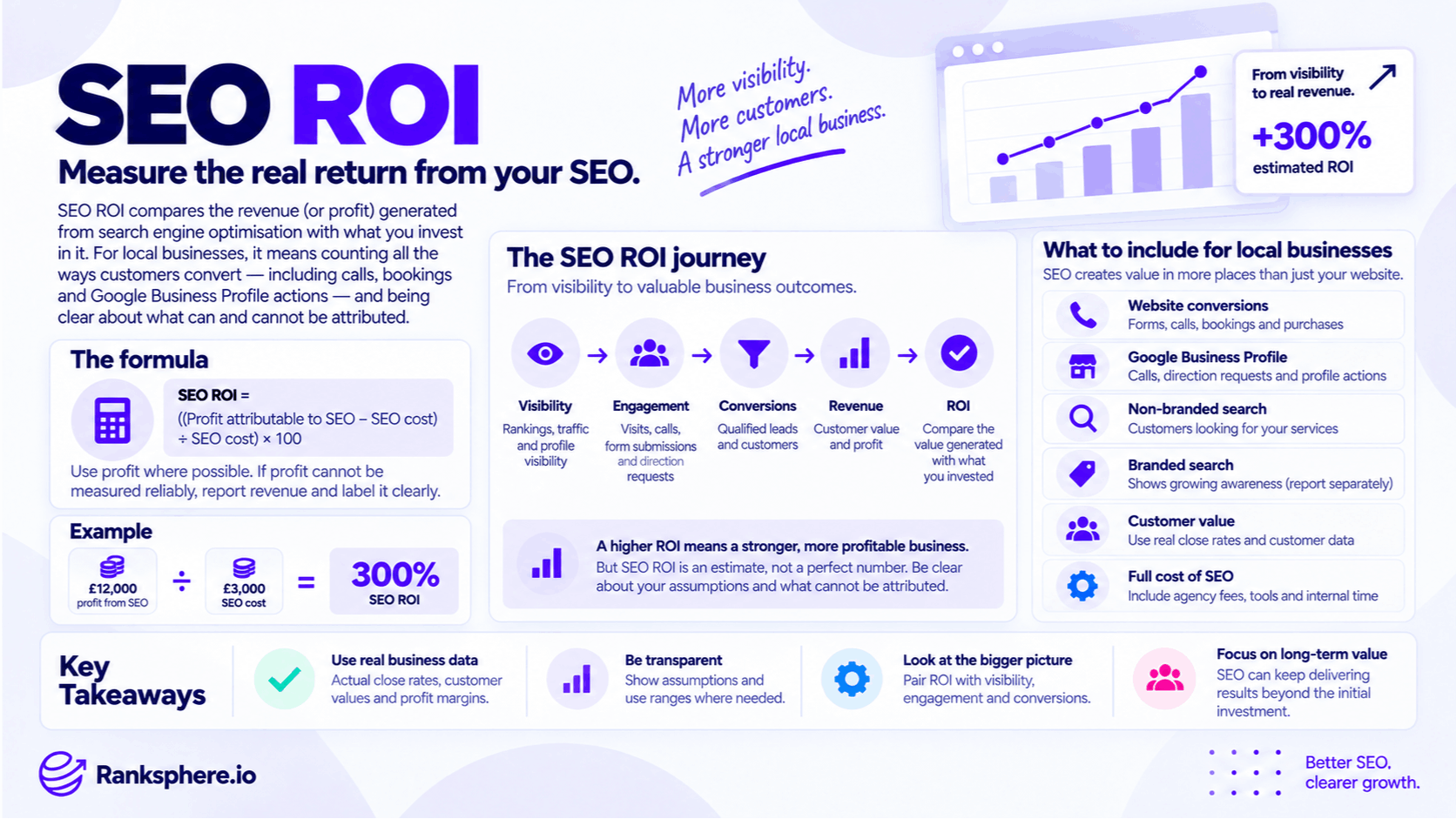
SEO ROI compares the value generated by SEO with the cost of producing that value.
A basic ROI formula is:
ROI = ((profit attributable to SEO − SEO cost) ÷ SEO cost) × 100
For example:
If SEO contributes:
£12,000 in profit
and costs:
£3,000
then:
((£12,000 − £3,000) ÷ £3,000) × 100 = 300% ROI
That means the net return was three times the SEO investment.
The important word here is:
profit
not simply revenue.
SEO revenue vs SEO ROI
These two are often confused.
Suppose SEO generates:
£20,000 in revenue
against:
£4,000 in SEO costs.
It may be tempting to report:
400% ROI
using revenue alone.
But if delivering those sales costs the business:
£10,000
the economics look very different.
A more meaningful ROI calculation would consider the profit or contribution generated after relevant fulfilment costs.
So reporting may need to distinguish:
SEO-attributed revenue
How much revenue was associated with SEO.
SEO-attributed profit
How much of that revenue remained after relevant costs.
SEO ROI
The return compared with the cost of SEO.
That distinction matters most for businesses with significant:
- Labour costs
- Materials
- Product costs
- Fulfilment expenses
The basic SEO ROI formula
A practical formula is:
SEO ROI = ((SEO-attributed profit − SEO investment) ÷ SEO investment) × 100
If profit cannot be measured accurately, revenue can still be reported.
Just label it correctly.
For example:
SEO-attributed revenue: £25,000
is clearer than presenting a revenue-based percentage as though it were precise financial ROI.
What counts as the SEO investment?
The cost side is usually easier to define.
Depending on the business, SEO costs may include:
- Agency retainer
- Consultant fees
- SEO software
- Content production
- Digital PR or outreach
- Development work
- Internal staff time
Not every organisation will include every cost.
The important thing is to use the same definition consistently.
If internal staff time is included one quarter but ignored the next, ROI comparisons become unreliable.
The harder side: value generated
The value side requires more assumptions.
A local service business might estimate revenue using:
Qualified SEO leads × close rate × average customer value
For example:
40 qualified leads
× 30% close rate
= 12 customers
If each new customer is worth an average of:
£480
during the measured period:
12 × £480 = £5,760 estimated revenue
If SEO cost:
£1,200
that tells you the campaign generated considerably more estimated revenue than it cost.
But it is not yet a complete ROI calculation unless you also understand the profit associated with that revenue.
Use qualified leads where possible
Raw conversion counts can overstate value.
Suppose organic and local search generate:
60 calls
but only:
18 are genuine new-business enquiries.
Using all 60 in an ROI calculation would inflate the result.
Where possible, distinguish:
- Calls
- Qualified leads
- Customers
- Revenue
The closer the measurement gets to an actual customer, the more useful the ROI calculation becomes.
Close rate
Close rate measures how many qualified leads become customers.
For example:
20 customers ÷ 50 qualified leads = 40% close rate
This is a critical input.
Do not automatically use:
- An SEO-industry benchmark
- A competitor estimate
- A number from another client
Use the business's actual sales data where possible.
If the true figure is uncertain, report a range rather than inventing precision.
Average customer value
The next input is the value of the customers generated.
For a one-off emergency plumbing job, the business may care primarily about the immediate job value.
For a dental practice, veterinary clinic or subscription service, repeat business may matter much more.
That is why the right value measure depends on the business model.
First-purchase value vs lifetime value
For businesses with repeat customers, using only the first transaction can understate the value of SEO.
A new dental patient may initially book:
one examination
but later return for:
- Hygiene
- Restorative treatment
- Orthodontics
- Other care
In that case, lifetime value may provide a more useful long-term view.
But lifetime value should be used carefully.
Do not assume that every newly acquired customer will remain for the theoretical maximum lifetime.
Use actual historical data where available.
Use an appropriate time horizon
SEO often creates value over a longer period than the month in which the work was performed.
For example:
A service page improved in February may:
- Begin ranking in April
- Generate leads in May
- Continue generating enquiries for the rest of the year
A one-month ROI calculation can therefore be misleading.
The appropriate window depends on:
- Sales cycle
- Seasonality
- Business type
- Campaign maturity
For some businesses, quarterly reporting may be useful.
For others, a rolling 6- or 12-month view provides better context.
There is no universal rule that SEO ROI must always be measured over exactly 12 months.
SEO has a timing problem
Costs and returns rarely happen at the same time.
A business may spend heavily during the early stages on:
- Technical fixes
- Content
- Local profile improvements
- Site restructuring
while the financial benefit appears later.
This can make early ROI look weak even when the work later becomes valuable.
Reporting should therefore separate:
current-period spend
from:
longer-term return
where appropriate.
SEO assets can continue producing value
One reason SEO economics differ from some advertising channels is that some work can continue providing value after the original investment.
For example:
- A useful service page can keep ranking
- A strong guide can keep attracting visitors
- A legitimate backlink can remain
- Technical improvements can continue benefiting the site
This does not mean SEO is free after the work is completed.
Content can age.
Competitors can improve.
Search results can change.
But value does not necessarily stop when the invoice period ends.
The local SEO attribution problem
Local SEO makes ROI particularly difficult because not every conversion happens on the website.
A customer might:
- Search locally.
- See the local pack.
- Read reviews.
- Tap Call.
- Book.
Google Analytics may never record a website visit.
If ROI is based only on website forms, the business may undercount the role local search played.
Google Business Profile calls
Calls from Google Business Profile can be commercially important.
But remember:
Google's call metric can represent a call-button interaction rather than a verified qualified lead.
For better ROI measurement, use call tracking where appropriate to understand:
- Whether the call connected
- Whether the caller was new
- Whether the enquiry was relevant
- Whether it became a customer
A button click and a new paying customer are not the same thing.
Direction requests
Direction requests can show strong intent for:
- Shops
- Restaurants
- Clinics
- Showrooms
But they should not automatically be counted as completed conversions.
A person requesting directions may:
- Visit
- Change their mind
- Visit later
- Never arrive
Treat direction requests as useful local-search interactions unless the business has a reliable way to connect them with actual visits or sales.
Website conversions
Website conversions may include:
- Form submissions
- Phone calls
- Bookings
- Purchases
See conversion rate for the wider measurement problem.
The strongest ROI setup attempts to follow these actions beyond the initial event.
For example:
Form submitted → qualified lead → customer → revenue
is much more useful than:
Form submitted = £500 assumed value
Attribution limits SEO ROI
Attribution is one of the biggest sources of uncertainty in SEO ROI.
Consider this journey:
- Searches a non-branded question.
- Reads the company's article.
- Leaves.
- Sees the company again in local search.
- Reads reviews.
- Searches the business name.
- Calls.
Which interaction generated the customer?
There is no perfect answer.
Analytics can measure parts of the journey.
It cannot always reconstruct the entire decision.
Branded vs non-branded search
Branded search needs careful treatment in SEO ROI calculations.
A branded query contains the company's name or another clearly brand-specific term.
For example:
Kingsdown Roofing
A non-branded query might be:
flat roof repair near me
Non-branded search often gives stronger evidence that search helped the customer discover the business.
But that does not mean every branded conversion should automatically be removed from SEO reporting.
Why branded conversions are complicated
Some branded searches come from people who already knew the company through:
- Existing customer relationships
- Referrals
- Offline advertising
- Previous experience
SEO did not necessarily create that demand.
But SEO can also contribute to branded demand.
For example:
- Someone discovers the company through a non-branded guide.
- Remembers the name.
- Searches the brand later.
- Converts.
Simply excluding the final branded conversion would understate SEO's possible role.
The answer is not:
count all branded conversions
or:
exclude all branded conversions.
It is to report branded and non-branded activity separately and be careful about causal claims.
Separate branded and non-branded performance
A useful reporting structure might show:
Non-branded organic performance
Searches where the user was looking for a:
- Service
- Product
- Problem
- Topic
rather than the company name.
Branded organic performance
Searches specifically for the business or brand.
This lets the client see both without pretending they mean the same thing.
Branded search growth can provide context
An increase in branded search demand may indicate growing awareness.
But it does not tell you what caused that awareness.
Potential influences include:
- SEO
- Paid advertising
- PR
- Social media
- Offline marketing
- Word of mouth
So branded search growth is useful context.
It is not proof that SEO alone created the demand.
Content can create later demand
Content may contribute to conversions that appear elsewhere in analytics.
A customer may read:
How to know when a flat roof needs replacing
and convert weeks later through a branded search.
Last-click reporting may give the content no conversion credit.
That does not prove the article caused the eventual lead.
But it shows why SEO ROI should not be built solely from final-click attribution.
Zero-click search creates another blind spot
Zero-click search means people may receive useful information directly from search without visiting the website.
For a local business, they may see:
- Reviews
- Phone number
- Opening hours
- Location
and then take action.
Similar measurement challenges can occur with other search features where visibility influences awareness without producing a conventional website session.
Not every valuable search interaction will appear neatly in analytics.
Do not solve uncertainty by claiming everything
Attribution gaps can cause two opposite mistakes.
Under-attribution
Counting only directly measured website conversions.
Over-attribution
Giving SEO credit for every organic conversion or every increase in business.
Both are weak.
The better approach is to identify:
- What is measured directly
- What is estimated
- What remains uncertain
Then show the calculation accordingly.
Use ranges when the inputs are uncertain
Suppose a business knows:
- SEO generated approximately 40 qualified leads
- Close rate is somewhere between 25% and 35%
- Average customer value is between £450 and £550
Instead of manufacturing one exact ROI figure, calculate a range.
That allows the client to see how the conclusion changes under conservative and optimistic assumptions.
Ranges are often more credible than false precision.
Conservative, expected and upside scenarios
One practical approach is to calculate three scenarios.
Conservative
Lower close rate Lower customer value
Expected
Most likely assumptions based on actual business data
Upside
Higher but still plausible assumptions
For example:
Estimated SEO ROI: 170%–290%
can be more useful than:
SEO ROI: 241.7%
when the inputs themselves are uncertain.
Use the client's actual numbers
Whenever possible, use:
- Actual close rate
- Actual average customer value
- Actual margins
- Actual lifetime value
- Actual qualified leads
Do not borrow averages from unrelated industry studies unless you have no better data.
A national average cannot tell you precisely how:
this dental practice
closes:
these implant enquiries
at:
this price point.
SEO ROI and profit margins
Suppose SEO generates:
£30,000 in revenue
for a business operating at a:
20% contribution margin.
The contribution generated is:
£6,000
If SEO cost:
£4,000
the financial picture is very different from a revenue-only calculation.
That is why sophisticated ROI reporting should move beyond top-line revenue where the necessary data exists.
SEO ROI for lead-generation businesses
Many local businesses do not sell directly online.
Their journey may be:
SEO → lead → sales process → customer
In that case, ROI depends on the quality of the sales data.
For example:
50 SEO leads
× 40% qualified
= 20 qualified leads
× 30% close rate
= 6 customers
× £2,000 average customer value
= £12,000 revenue
That chain makes every assumption visible.
SEO ROI for ecommerce
Ecommerce can sometimes provide cleaner revenue attribution because purchases happen online.
But it still has complications:
- Repeat customers
- Cross-device journeys
- Branded searches
- Assisted conversions
- Returns
- Product margins
Revenue reporting is easier.
True ROI can still require cost and margin data.
SEO ROI and customer lifetime value
For recurring or repeat-purchase businesses, customer lifetime value can change the economics dramatically.
A client acquired for:
£200
may initially spend:
£300
but eventually be worth:
£2,000
over the relationship.
That does not mean every conversion should immediately be valued at £2,000.
Lifetime value is an estimate.
Use:
- Retention data
- Repeat purchase data
- Historical cohorts
where possible.
Don't double-count value
One person can produce several tracked conversions.
For example:
- Calls
- Submits a form
- Books online
If the reporting counts each as a separate customer, attributed revenue will be inflated.
The ideal measurement connects interactions to:
unique leads
and ultimately:
customers.
This is much easier when SEO data can be linked with a CRM.
Connect SEO data to the CRM
For lead-generation businesses, CRM data can make ROI reporting much stronger.
Useful stages might include:
Lead
Qualified lead
Appointment
Customer
Revenue
Now the business can analyse:
SEO leads generated
and:
SEO customers won
instead of treating every form submission as equal.
SEO ROI vs ROAS
ROI and ROAS are related but different concepts.
ROAS means:
return on ad spend
and is normally associated with advertising.
SEO does not have an advertising spend in exactly the same sense, so ROI is usually the more appropriate concept.
But the same principle applies:
Do not confuse:
revenue generated
with:
profit returned.
SEO ROI is not the only SEO KPI
ROI is important.
It does not need to replace every other KPI.
Supporting metrics help explain why the financial result changed.
For example:
Visibility
- Geo-grid coverage
- Organic impressions
- Rankings
Engagement
- Clicks
- Calls
- Website visits
Conversions
- Qualified enquiries
- Bookings
Financial outcome
- Revenue
- Profit
- ROI
ROI sits near the end of that chain.
The earlier metrics help diagnose what happened.
Report ROI alongside visibility
Ranksphere's white-label reports bring local performance into one client-ready document, allowing ROI discussions to sit alongside the local visibility and profile data that help explain where leads came from.
A financial result is much easier to understand when the client can also see:
- Visibility
- Calls
- Reviews
- Enquiries
- Conversion trends
The report should tell the story rather than display one enormous percentage.
SEO ROI and seasonality
Revenue may change because demand itself changed.
A heating company may generate more leads in winter.
A landscaping company may generate more in spring.
If SEO revenue increases at the same time, do not automatically attribute the full increase to optimisation.
Where appropriate, compare:
- Year over year
- Equivalent seasonal periods
- Longer-term trends
Seasonality belongs in the interpretation.
Establish a baseline
Before major SEO work begins, record what you can about:
- Organic leads
- Local leads
- Revenue
- Branded searches
- Non-branded searches
- Search visibility
That gives you something to compare against later.
Without a baseline, it becomes harder to separate:
new growth
from:
business the company was already receiving.
Incremental SEO value
The strongest ROI question is often not:
How much revenue came through organic search?
but:
How much additional value did SEO create compared with what would probably have happened without the investment?
That is much harder to calculate.
For most local businesses, a perfect counterfactual does not exist.
But using:
- Baselines
- Non-branded performance
- Geographic visibility
- Historical trends
- Qualified leads
can create a more defensible estimate.
Report what you know and what you do not
A credible SEO ROI report might say:
Measured
42 qualified organic/local leads
Client-reported close rate
31%
Average first-year customer value
£520
Estimated revenue
£6,766
SEO investment
£1,500
Limitations
Some branded and offline-assisted journeys cannot be reliably separated.
That is much more useful than:
SEO generated exactly £6,766.24.
Common SEO ROI mistakes
- Using revenue as though it were profit.
- Reporting a precise ROI from uncertain attribution.
- Counting every Google Business Profile interaction as a conversion.
- Treating direction requests as confirmed customers.
- Counting call-button clicks as qualified leads.
- Using every organic conversion as SEO-generated demand.
- Automatically excluding every branded conversion.
- Using an assumed close rate instead of business data.
- Ignoring profit margin.
- Using first-purchase value when repeat business materially changes customer economics.
- Using lifetime value without realistic retention data.
- Measuring over a window too short for the business's sales cycle.
- Ignoring seasonality.
- Double-counting the same person across several conversion events.
- Ignoring attribution gaps.
- Refusing to estimate ROI simply because the measurement is imperfect.
SEO ROI best practices
- Define the calculation during onboarding.
- Use profit or contribution where the data is available.
- Report revenue separately when profit cannot be calculated reliably.
- Use qualified leads rather than raw interactions where possible.
- Use the client's real close rate and customer values.
- Separate branded and non-branded performance.
- Do not assume all branded conversions would have happened anyway.
- Treat Google Business Profile calls and direction requests according to what they actually measure.
- Use call tracking and CRM data where the value justifies it.
- Use lifetime value carefully for businesses with repeat custom.
- Choose a reporting window appropriate to the sales cycle and seasonality.
- Show assumptions openly.
- Use ranges where the inputs are uncertain.
- Separate measured, estimated and untraceable value.
- Connect ROI with supporting visibility and conversion metrics.
Example
“An agency reports:
640% SEO ROI
to Halewood Veterinary.
The percentage looks excellent.
The practice manager asks how it was calculated.
The assumptions quickly become clear.
The report:
- Included every organic conversion
- Treated branded searches as fully SEO-generated
- Used an assumed 50% close rate
- Counted website interactions without checking which became customers
- Used first-visit revenue without considering the actual economics of a new veterinary client
Some assumptions inflate the result.
Others may understate long-term customer value.
The calculation is rebuilt.
The practice supplies its actual sales data.
Qualified leads are separated from raw calls.
Its real close rate is used.
Branded and non-branded search are reported separately rather than assigning all branded demand to SEO.
Customer value is calculated using an agreed first-year period instead of an arbitrary one-off visit.
Profile interactions are included as supporting data, while only sufficiently qualified calls and customers enter the revenue estimate.
The agency also includes the relevant SEO costs.
Instead of one unexplained headline percentage, the report now shows:
SEO investment
Qualified leads
Close rate
Customers won
Estimated revenue
Estimated contribution
ROI range
Every assumption can be challenged or replaced if better data becomes available.
The final percentage may be lower than the original 640%.
That does not make the campaign less successful.
It makes the measurement more credible.
That is the useful way to approach SEO ROI:
show how the money was calculated, distinguish measured revenue from estimated influence, and never let a precise-looking percentage hide uncertain inputs.”
See also
- Conversion rate — measuring how often traffic and interactions become desired actions
- Attribution — understanding which marketing touchpoints receive credit
- KPI — the performance measures that sit underneath ROI
- White-label reporting — where SEO performance and financial return are presented
- SEO retainer — part of the investment side of the calculation
- Churn rate — how client retention affects agency economics