Yelp is a business listing and review platform that helps people discover and evaluate local businesses.
For local SEO, it can serve two roles:
- A third-party business citation
- A customer review and discovery platform
Its importance varies considerably by:
- Country
- Industry
- Audience
- Local market
For some businesses, Yelp generates genuine enquiries and bookings.
For others, it functions mainly as another place where customers may find business information and reviews.
The right approach is not:
“Yelp always matters.”
or:
“Yelp does not matter anymore.”
It is:
check whether your customers actually use it, then manage the listing accordingly.
What is Yelp?
Yelp allows users to search for local businesses, read reviews, view photos and access practical business information.
Businesses can claim their Yelp Page and manage information such as:
- Business name
- Address
- Phone number
- Website
- Opening hours
- Categories
- Photos
- Business details
Yelp says businesses can claim a page for free, update their information, respond to reviews and add photographs.
That makes the listing worth reviewing even if Yelp is not one of the business's largest traffic sources.
Why Yelp matters for local SEO
Yelp should not be treated as a direct Google ranking shortcut.
Its practical value comes from several areas.
It can:
- Give customers another place to discover the business
- Provide independent reviews
- Appear for branded searches
- Supply business information to partner experiences
- Act as part of the wider local citation ecosystem
That makes accuracy and reputation management more important than trying to “optimise Yelp for Google”.
Yelp as a citation
A Yelp Page contains core business information that can function as a local citation.
That includes details such as:
- Name
- Address
- Phone number
- Website
These should accurately represent the real business.
If Yelp still displays:
an address the company left five years ago
or:
an old phone number
that creates a customer problem regardless of whether it has any measurable ranking effect elsewhere.
NAP accuracy
NAP stands for:
Name, Address and Phone number.
The information on Yelp should agree with the real business and other important listings.
That does not mean every platform needs identical punctuation.
These are effectively the same:
15 King Street
and:
15 King St
The problem is a genuine contradiction such as:
Yelp: old address
Google: current address
Focus on factual accuracy, not character-for-character formatting.
Yelp can appear beyond Yelp itself
Yelp says its data is integrated into Apple products and a number of other partner experiences.
That gives businesses another reason to keep their listing accurate.
However, avoid turning that into:
“Every platform uses Yelp.”
Partner relationships and data sources can change.
The safe recommendation is simply to maintain accurate information on significant platforms rather than relying on one listing to propagate perfectly everywhere else.
Yelp and AI discovery
Yelp itself has continued adding AI-powered discovery and conversational features to its platform.
That means its review and business data can increasingly be interpreted inside Yelp's own discovery experience.
But do not claim:
“Yelp reviews feed all AI assistants.”
Different AI products use different:
- Search backends
- Data providers
- Retrieval systems
A public Yelp page may be accessible to search systems, but that is not the same as a documented direct data relationship with every assistant.
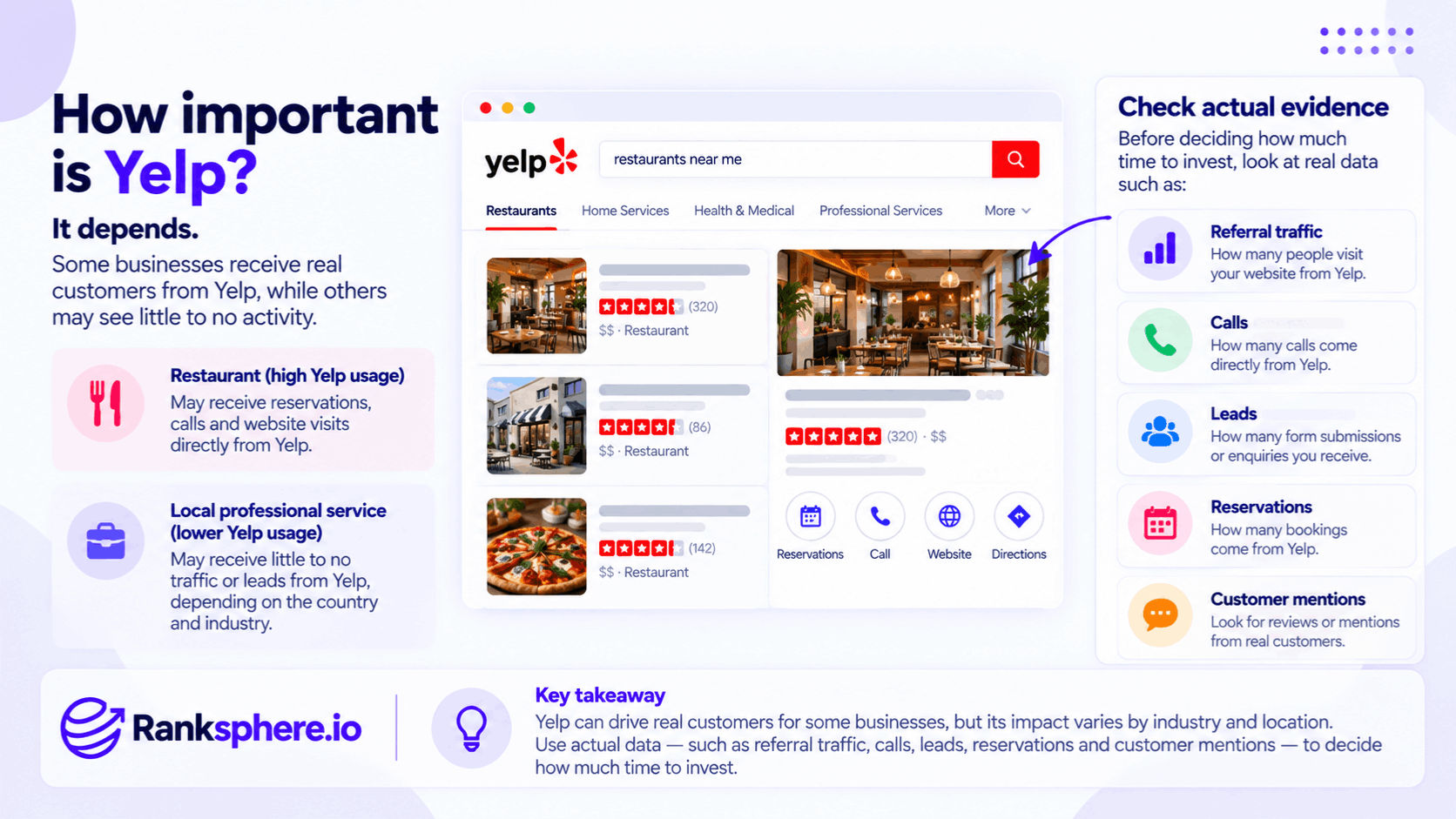
How important is Yelp?
It depends.
A restaurant in a market with heavy Yelp usage may receive:
- Reservations
- Calls
- Website visits
directly from Yelp.
A local professional service in another country may receive almost none.
Check actual evidence such as:
- Referral traffic
- Calls
- Leads
- Reservations
- Customer mentions
before deciding how much time to invest.
Do not use a universal market rule
Avoid blanket statements such as:
“Yelp matters in America but not in Europe.”
Usage varies more subtly than that.
The better question is:
Does Yelp appear in this business's customer journey?
If yes, give it appropriate attention.
If not, maintain the listing accurately without turning it into a major campaign.
Claim the Yelp listing
A business should normally claim its legitimate Yelp Page where Yelp is available and relevant.
Yelp says claiming the business gives owners access to tools for:
- Updating business information
- Uploading photos
- Monitoring customer activity
- Responding to reviews
An unclaimed page can still exist.
Claiming it gives the business more control over the information it is allowed to manage.
Complete the business information
Review the page for:
- Correct business name
- Current address
- Phone number
- Website
- Hours
- Category
- Business description
- Photos
Do not add information purely for keyword coverage.
The listing should first and foremost describe the real business.
Yelp review policy
This is where Yelp differs significantly from several other review platforms.
Yelp's current Trust & Safety guidance says businesses are not permitted to ask customers for Yelp reviews.
That includes deliberately directing customers to Yelp with a request to leave a review.
A business using the same review-request workflow for:
- Yelp
can therefore create a policy problem.
Google and Yelp have different review-request rules
Google explicitly allows businesses to ask customers for genuine reviews and even provides review links and QR codes for that purpose, provided there is no prohibited incentive or manipulation.
Yelp takes a different approach.
That means a review programme should be platform-specific.
Do not create one generic request saying:
Review us on Google, Yelp or wherever you prefer
if that actively solicits Yelp reviews.
Why Yelp discourages review solicitation
Yelp wants reviews to come from users who independently choose to share their experience.
Its Trust & Safety system is designed around identifying reviews it believes are more reliable and useful.
Yelp's recommendation software considers signals that may indicate:
- Conflicts of interest
- Unreliable activity
- Solicited reviews
- Compensated reviews
That does not mean every requested review is fake.
It means solicitation itself can make the review less compatible with Yelp's model.
What businesses can do instead
Yelp recommends passive ways of making customers aware that the business is on Yelp.
Examples include:
- Displaying a “Find Us on Yelp” sticker
- Linking to the Yelp page from the business website
- Maintaining an active, accurate profile
Yelp's own guidance specifically recommends these approaches rather than asking customers to write reviews.
The difference is:
Passive
We are on Yelp.
Solicitation
Please leave us a Yelp review.
Yelp wants businesses to avoid the second.
Do not incentivise Yelp reviews
Paid, rewarded or incentivised review activity is even more problematic.
That can include:
- Discounts
- Gifts
- Cash
- Free products
in exchange for reviews.
Yelp uses Consumer Alerts in cases where it finds evidence of serious deceptive or compensated review activity.
Never try to grow Yelp reviews by purchasing, rewarding or arranging them.
Consumer Alerts
Yelp's Consumer Alert programme is designed to warn users when Yelp identifies certain forms of suspicious or deceptive activity.
Examples can include manipulation involving:
- Compensated reviews
- Review exchanges
- Other deceptive review activity
Do not tell clients:
“Asking once automatically gives you a 90-day Consumer Alert.”
Enforcement is not that mechanical.
The more important advice is:
follow Yelp's review policy and do not solicit, purchase or manipulate reviews.
Yelp's recommendation software
Yelp uses automated recommendation software to decide which reviews it recommends prominently.
Reviews can fall into two broad groups:
Recommended reviews
These contribute to the business's displayed Yelp rating.
Not currently recommended reviews
These remain accessible through a separate section but do not contribute to the displayed star rating.
This is important because a business may see more reviews written than appear prominently on its page.
Not recommended does not mean fake
A review can be genuine and still not be recommended.
Yelp says its software may have limited information about a reviewer or may identify other reliability signals that make it less confident in the review.
Do not tell customers:
“Yelp deleted your review because it thought you were lying.”
That may not be what happened.
The better explanation is:
Yelp's automated system did not currently recommend it.
Reviews can move between states
Yelp's recommendation system continuously evaluates review and reviewer signals, and Yelp's own Trust & Safety materials describe reviews moving between recommended and not-currently-recommended sections.
So the status of a review is not necessarily permanent.
Avoid trying to manipulate reviewer activity in an attempt to force a review into the recommended section.
Let the system operate normally.
Businesses cannot manually override the software
Yelp says its employees cannot manually switch a particular review from recommended to not recommended, or vice versa.
That means an agency generally cannot:
appeal a review into the recommended section
in the way it might appeal a conventional moderation decision.
This is an important expectation to set with clients.
Advertising does not buy recommended reviews
Yelp also states that advertising status is not used to determine whether a review is recommended.
A business should therefore evaluate Yelp Ads separately from its organic review profile.
Do not buy advertising expecting it to:
- Restore hidden reviews
- Improve star ratings
- Change recommendation decisions
Advertising and review moderation are separate issues.
Respond to Yelp reviews
Businesses can respond publicly to Yelp reviews.
That includes:
- Positive reviews
- Critical reviews
A useful response should normally be:
- Professional
- Specific
- Calm
- Brief
Yelp itself advises businesses to avoid responding angrily and to treat public replies as a reflection of their customer service.
How to respond to a positive review
You do not need to write an essay.
A simple response might acknowledge something specific the customer mentioned.
For example:
Thanks for taking the time to share this. We're glad the team could get the repair completed before the weekend.
That sounds more genuine than:
Thank you for your amazing five-star review! We pride ourselves on providing outstanding service!
Avoid turning every reply into promotional copy.
How to respond to a negative review
Do not write the response only for the reviewer.
Other potential customers can read it.
Useful responses generally:
- Acknowledge the concern
- Correct genuine factual errors calmly where necessary
- Avoid disclosing private information
- Invite an offline conversation where appropriate
Do not publicly litigate every detail of the disagreement.
Do not argue publicly
A defensive reply can sometimes do more reputational damage than the original complaint.
Avoid responses such as:
You're lying and this never happened.
Even where you strongly disagree, respond professionally.
If there is a serious factual or policy issue with the review, use the appropriate reporting process separately.
Monitor customer photos
Yelp also allows users to add photos.
These can strongly shape what someone thinks about:
- Restaurants
- Hotels
- Salons
- Trades
- Retailers
Businesses should also upload useful current photographs themselves.
Yelp explicitly gives claimed businesses tools to add photos to their pages.
Use genuine images where possible.
Yelp listings and branded search
A Yelp Page may appear when someone searches for a company's name.
Whether it ranks prominently depends on the:
- Query
- Market
- Business
- Search engine
So avoid promising:
“Yelp always ranks on page one for your brand.”
Instead, check the actual branded SERP.
If Yelp appears prominently, the quality of that listing becomes especially relevant to reputation management.
Reputation management
Yelp should be managed as part of the business's broader online reputation.
That includes:
- Monitoring reviews
- Replying appropriately
- Correcting business information
- Watching for outdated photos
- Reporting policy-violating content where appropriate
Do not focus only on increasing the star rating.
Reputation management also means understanding what customers repeatedly say.
Reviews can reveal operational problems
If several Yelp reviews independently complain about:
- Slow service
- Missed calls
- Parking
- Poor communication
the marketing solution may not be:
get more five-star reviews.
It may be:
fix the customer experience.
Review platforms can provide useful operational feedback.
Yelp and fake reviews
Yelp invests heavily in detecting suspicious review activity.
Its recommendation system considers signals associated with:
- Conflicts of interest
- Solicitation
- Compensation
- Unreliable reviewing behaviour
See Fake review for the broader issue.
Businesses should never:
- Buy Yelp reviews
- Review themselves
- Ask employees or family members to review
- Join review-exchange groups
Review gating
Review gating is the practice of selectively encouraging positive reviewers while diverting unhappy customers elsewhere.
Yelp's broader rule is even simpler:
do not ask customers for Yelp reviews at all.
So a Yelp strategy should not contain:
Ask happy customers, but not unhappy customers.
The solicitation itself is the issue.
Yelp and citation audits
Include Yelp in a citation audit where Yelp maintains a listing for the business.
Check for:
- Old addresses
- Wrong numbers
- Duplicate pages
- Former names
- Incorrect categories
This is particularly important after:
- Moving premises
- Rebranding
- Changing phone numbers
Search using old information
When auditing Yelp, search not only for the current business details but also:
- Former address
- Old telephone number
- Previous trading name
That can uncover older pages a normal brand-name search misses.
Duplicate Yelp pages
Duplicate listings can occur.
Do not automatically create another listing because the first result contains one wrong field.
First determine:
- Whether it represents the same business
- Whether the listing can be claimed
- Whether the information can be corrected
Creating another page can make the problem worse.
Yelp for multi-location businesses
For brands with several branches, each legitimate location should reflect its own information.
That may include different:
- Hours
- Phone numbers
- Photos
- Services
Do not sacrifice accuracy simply to make every branch page identical.
A consistent management process is useful.
Identical business data is not.
Do not overinvest where Yelp has little impact
A local business should not automatically dedicate the same amount of time to Yelp as:
- Google Business Profile
- Its website
- Its highest-performing review platform
If Yelp generates little activity in that market, manage the fundamentals and move on.
Good local SEO prioritisation is about opportunity cost.
Paid Yelp advertising is a separate decision
Whether to buy Yelp Ads should be evaluated separately from whether the free listing should be maintained.
The business might reasonably conclude:
The Yelp Page is worth claiming and monitoring.
while also concluding:
Paid advertising is not currently profitable for us.
Those are separate questions.
Judge advertising using:
- Leads
- Cost
- Lead quality
- Customer acquisition cost
not simply because the listing exists.
Ranksphere and Yelp reviews
Ranksphere's review management consolidates reviews across platforms into one dashboard, helping businesses monitor and respond to customer feedback without forgetting secondary review platforms.
That can be particularly useful when Yelp is not the business's primary review channel but still receives occasional customer feedback that deserves a response.
Common Yelp mistakes
- Asking customers to leave Yelp reviews. Yelp's policy says businesses should not solicit them.
- Using the same review-request workflow for Google and Yelp. The platforms have different rules.
- Offering incentives for Yelp reviews.
- Assuming every non-recommended review is fake.
- Expecting Yelp support to manually move a review into the recommended section.
- Believing advertising changes which reviews Yelp recommends.
- Leaving the Yelp Page unclaimed or inaccurate.
- Treating NAP consistency as exact punctuation rather than factual accuracy.
- Arguing aggressively with negative reviewers.
- Ignoring customer-uploaded photos.
- Assuming Yelp automatically has the same importance in every country and industry.
- Claiming Yelp directly feeds every AI assistant.
- Overinvesting in Yelp where actual customer usage is low.
Yelp best practices
- Claim the legitimate Yelp Page.
- Keep business information current and accurate.
- Use real business photos.
- Respond professionally to both positive and critical reviews.
- Keep Yelp out of active review-request campaigns.
- Use passive Yelp badges or links rather than asking for reviews.
- Understand the difference between recommended and not-currently-recommended reviews.
- Explain Yelp's recommendation system to clients before it creates confusion.
- Audit duplicate and historical listings.
- Include Yelp in periodic citation audits.
- Evaluate paid advertising separately from organic listing management.
- Spend effort according to Yelp's real value in that specific market and sector.
Example
“A restaurant group launches a review programme across several locations.
At the end of every meal, customers receive a card saying:
Review us on Google, Tripadvisor or Yelp.
The programme works well on platforms that permit appropriate review requests.
But Yelp operates under different rules.
The group discovers that Yelp explicitly tells businesses not to ask customers for reviews.
The company changes the process.”
“The restaurant group still:
- Claims every Yelp Page
- Keeps hours and business information accurate
- Uploads current photographs
- Responds to reviews
It may also display approved passive Yelp branding or link to the Yelp Page without explicitly asking customers to write a review.
When several genuine reviews later appear as:
not currently recommended
the team does not assume something is broken or contact customers asking them to change their behaviour.
It understands that Yelp's recommendation software makes that decision automatically and that non-recommended reviews remain accessible but do not contribute to the displayed rating.
The result is a simpler platform-specific policy:
Ask for Google reviews where Google's rules allow it. Let Yelp reviews develop organically under Yelp's rules.
That is the important lesson.
Yelp is both a business listing and a review ecosystem with its own rules. Manage the listing accurately, respond professionally and respect the platform's review policy instead of forcing the same reputation strategy onto every review site.”
See also
- Online review — the wider practice of customer review management
- Review gating — selectively steering customers according to expected sentiment
- Citation — Yelp's role as a third-party business listing
- Reputation management — monitoring and responding to how the business is represented online
- Fake review — deceptive or inauthentic review activity
- NAP — keeping core business information factually accurate across platforms