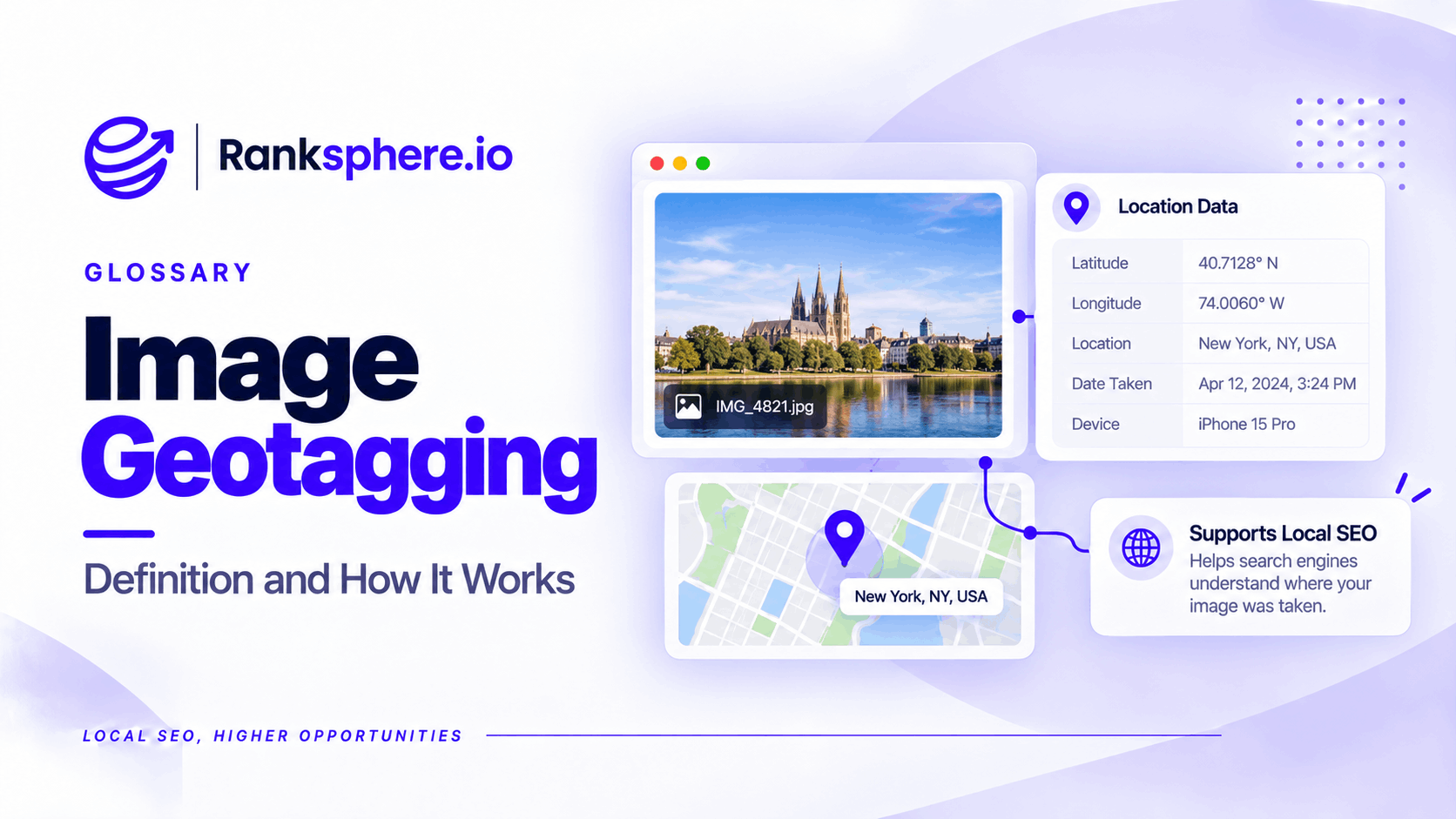
Image geotagging is the practice of adding geographic coordinates to a photograph's metadata, usually through GPS information stored in its EXIF data.
In local SEO, the tactic is often promoted as a way to improve Google Maps rankings by adding a business's latitude and longitude to photographs before uploading them to Google Business Profile.
The theory is that Google reads those coordinates and treats the images as evidence of a business's relevance to a particular location.
There is no reliable evidence that adding GPS coordinates to photographs improves Google Business Profile rankings.
Google has not identified image geotagging as a local ranking factor, yet it continues to appear in SEO packages and optimisation checklists.
What Is Image Geotagging?
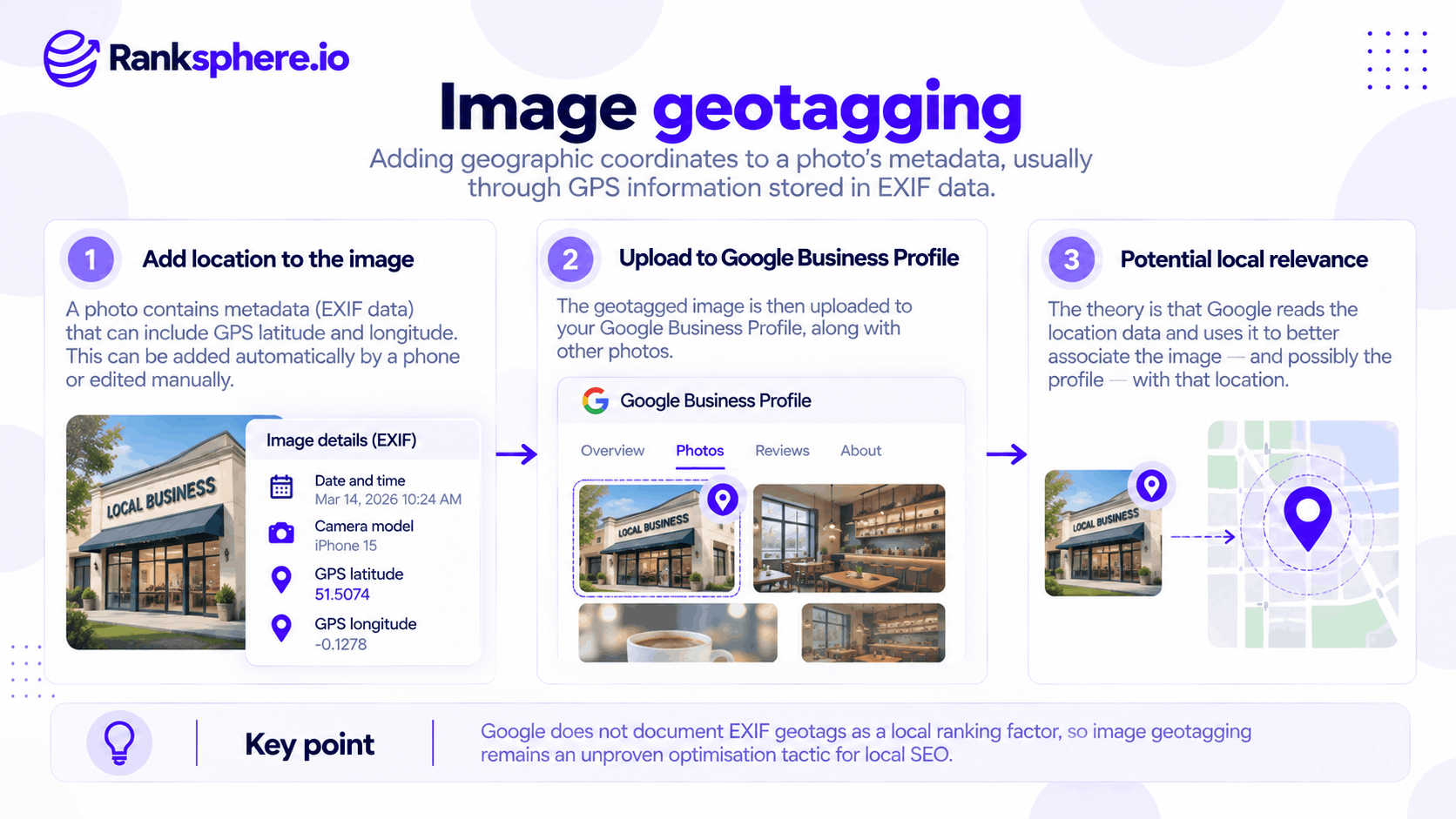
Digital photographs can contain metadata describing how and where an image was captured.
This may include camera details, exposure settings, timestamps and GPS coordinates.
For example, a photograph taken outside a roofing company's office might contain the latitude and longitude recorded by the photographer's phone.
Geotagging tools can also add or edit these coordinates manually.
Some local SEO services use this capability to assign a business's location to photographs before uploading them.
However, adding coordinates doesn't mean Google will use them to determine where the business should rank.
Does Image Geotagging Improve Local SEO?
Google hasn't confirmed that EXIF GPS coordinates influence local business rankings.
Its official local ranking documentation identifies three main factors:
- Relevance: How closely a business matches the search.
- Distance: How far the business is from the searcher or the location associated with the query.
- Prominence: How well-known the business is.
Google also recommends accurate business information, genuine customer reviews and useful photographs.
It does not recommend editing image coordinates to improve any of these factors.
This matters because geotagging is frequently sold alongside legitimate Google Business Profile photo optimisation.
If rankings improve after an agency updates a profile, uploads photographs and corrects business information, there is no basis for attributing that improvement to EXIF geotagging.
Why Is Photo Geotagging Unreliable as an SEO Tactic?
Several issues make the ranking claim difficult to support.
GPS Metadata Can Be Changed
EXIF coordinates are editable.
A photograph taken hundreds of miles away can be assigned the coordinates of a business address.
That makes the data unreliable as independent proof of where an image was captured.
Platforms May Remove Metadata
Some websites and image platforms remove or modify metadata during image processing.
However, it would be inaccurate to claim that every image uploaded to Google has its EXIF data stripped.
The important point is that there is no established ranking benefit from manually adding GPS coordinates.
Google Has Other Location Information
Google already uses business addresses, service areas and other information to understand where eligible businesses operate.
Its local ranking guidance doesn't identify photograph GPS coordinates as a substitute for accurate business information.
A business should therefore correct its actual location details rather than attempt to influence rankings through photo metadata.
What Actually Matters for Image SEO?
The answer differs between photographs published on a website and photographs uploaded to a Google Business Profile.
Website Images
Google's image SEO guidance recommends descriptive filenames, relevant surrounding content and useful alt text.
For example, a plumbing company might publish a photograph of a completed kitchen pipe repair.
A filename such as kitchen-pipe-repair.jpg gives more context than IMG_4521.jpg.
The surrounding page could explain what caused the leak, how it was repaired and which service was provided.
Appropriate alt text should describe the photograph for people who cannot see it.
These are established image SEO practices. They are not dependent on GPS metadata.
Google Business Profile Photos
Google Business Profile does not provide a standard alt text field for uploaded business photographs.
Its official photo guidance focuses on image quality, authenticity and relevance.
Google recommends well-lit, focused photographs that accurately represent the business, its premises, products or services.
Descriptive filenames may help organise photographs before upload, but Google has not confirmed that renaming Business Profile photo files improves local rankings.
The important difference is that customers can actually evaluate the content of the photographs.
Why Does the Geotagging Myth Persist?
Image geotagging sounds technical, is easy to automate and produces a visible deliverable.
An agency can take fifty photographs, add coordinates and report that all fifty have been optimised.
The work is measurable.
Its ranking value is not.
The problem becomes more difficult to identify when geotagging is included alongside useful activities such as publishing genuine photographs and improving business information.
Any subsequent ranking improvement may be attributed to the entire package, even though the effect of geotagging itself hasn't been demonstrated.
A supplier offering geotagging should be able to provide credible evidence of its value rather than relying on an assumption about how Google's systems work.
What Should Local Businesses Do Instead?
The time spent geotagging photographs would generally be better directed towards improving what customers actually see.
For example:
- Upload clear, genuine photographs of premises, products and completed work.
- Replace outdated or poor-quality photographs when better images become available.
- Follow Google's photo guidelines and avoid misleading edits.
- Describe website images with appropriate filenames and alt text.
- Keep Google Business Profile information accurate.
- Check that the business's location and map pin are correct in Google Maps.
Google encourages businesses to add useful photographs, but it does not publish a photo upload frequency or quantity that guarantees better rankings.
A regular upload process can keep a profile informative. It should not be presented as a proven ranking formula.
Ranksphere's GBP Management Tool helps businesses manage supported profile information and media across locations.
Can Image Geotagging Be Harmful?
Geotagging isn't inherently harmful.
GPS information can be useful for personal photo organisation, mapping and other legitimate purposes.
However, publicly sharing location metadata can create privacy concerns.
For example, a contractor might photograph a completed repair at a customer's home.
If that photograph contains precise GPS coordinates, the metadata could reveal the customer's location if it remains accessible after publication.
A photograph taken at a home office could similarly expose an address the business doesn't want to publish.
For this reason, reviewing and removing unnecessary location metadata before sharing photographs is a sensible privacy precaution.
Common Image Geotagging Mistakes
- Paying for geotagging as a ranking service. Its local SEO benefit hasn't been established.
- Treating EXIF coordinates as a confirmed ranking factor. Google doesn't document them as one.
- Attributing ranking gains to geotagging. Other changes may explain the improvement.
- Assuming metadata survives every upload. Platforms process images differently.
- Overlooking photo quality. Blurry or irrelevant images are less useful to customers.
- Exposing private locations. GPS metadata can contain sensitive location information.
- Ignoring inaccurate profile locations. Correct business information matters more than adding coordinates to photographs.
Image Geotagging Best Practices
Don't include EXIF geotagging as a standard local SEO ranking task without credible supporting evidence.
Instead, use real photographs that accurately represent the business.
Follow Google's current photo quality requirements and check that business details are correct.
For website images, use descriptive filenames, appropriate alt text and relevant surrounding content.
Remove unnecessary GPS metadata when photographs could expose private locations.
Measure local search performance through consistent ranking and customer interaction data rather than assuming that edited image metadata produces results.
Example of Image Geotagging for a Plumbing Company
Consider a hypothetical plumbing company purchasing a photo optimisation package.
The agency proposes three activities:
- Add the business's GPS coordinates to every photograph.
- Rename the image files.
- Upload new photographs of completed plumbing work each month.
After several months, the company notices an improvement in Google Business Profile interactions.
The agency attributes the change to image geotagging.
What the Company Finds
The photographs have become considerably more useful.
Instead of a handful of old images, customers can now see recent examples of bathroom installations, pipe repairs and completed projects.
The company's profile information has also been updated.
However, the agency has no evidence that the embedded GPS coordinates contributed to the improvement.
What the Company Changes
The business continues publishing genuine photographs and maintaining accurate profile information.
It stops paying for manual GPS metadata editing.
The team monitors profile interactions and local rankings, recognising that changes in these metrics may have multiple causes.
Example
“The photo programme may have helped customers understand the business's work.
That doesn't establish geotagging as the reason for improved visibility or enquiries.
Image geotagging is easy to perform, but a measurable SEO activity is not necessarily an effective one.
For local businesses, accurate information and useful photographs deserve attention before unverified metadata tactics.”
See Also
- Google Business Profile Photos — Google's guidance for business photographs.
- Alt Text — Describing images on webpages.
- Image SEO — Helping search engines discover and understand website images.
- Google Maps — Business locations and map information.
- Local Ranking Factors — Relevance, distance and prominence in local search.
- Meta Keywords Tag — Another outdated tactic with no established Google ranking benefit.