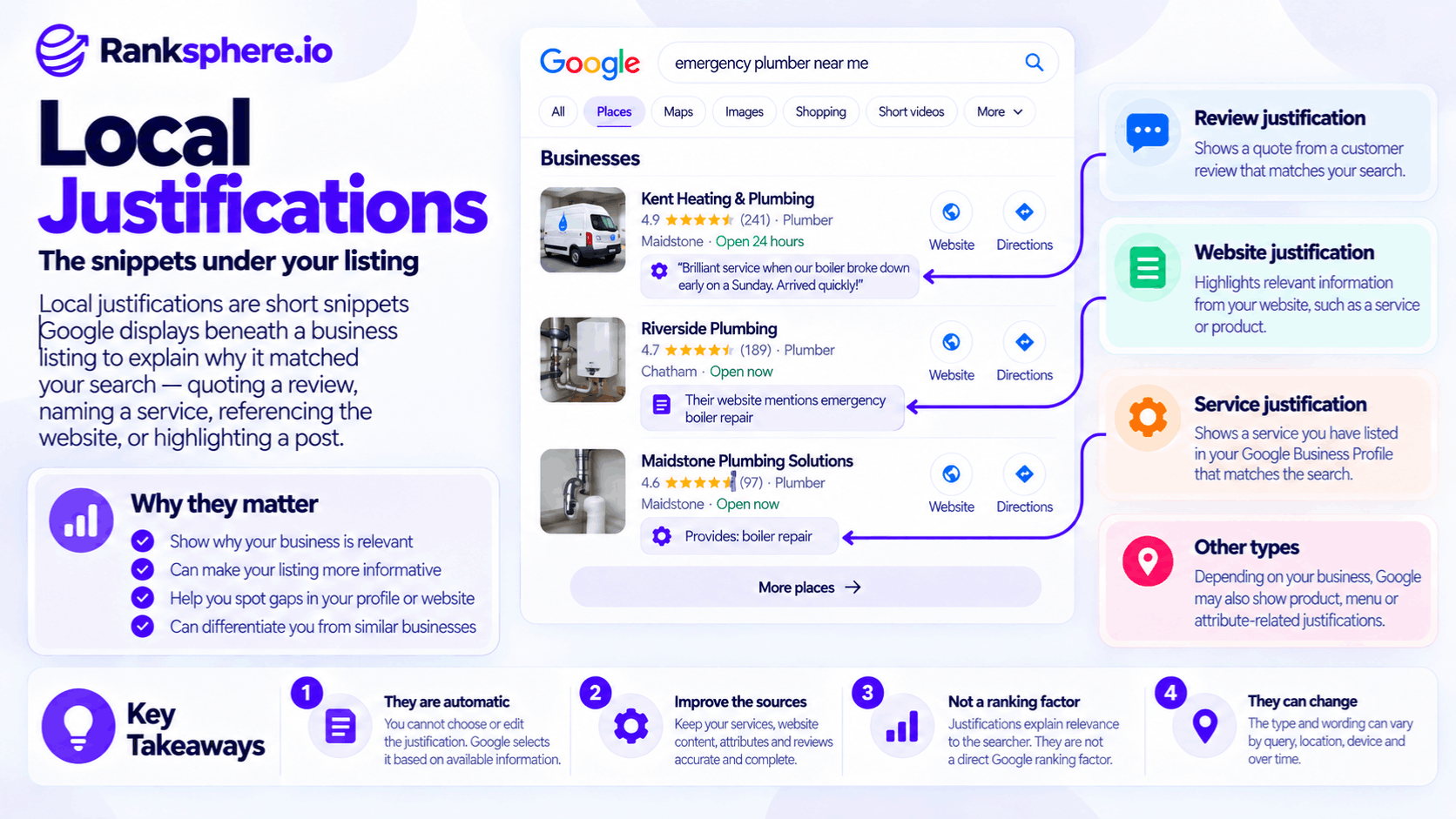
Local justifications are short pieces of supporting information that Google can display with a business in local search results to show why that business may be relevant to the search.
They can appear beneath or alongside local listings and may reference information such as:
- A customer review
- The business's website
- A listed service
- A product or menu item
- Other business information relevant to the query
For example, someone searching for:
emergency boiler repair
might see wording associated with a business showing that its website or service information mentions boiler repair.
Someone searching for a particular treatment may see a relevant phrase from a review.
These snippets are commonly called local justifications by the local SEO industry. Google does not provide a setting called:
Turn on local justifications.
They are generated automatically from information Google has about the business and can vary by:
- Query
- Business type
- Device
- Location
- Search surface
BrightLocal describes them as snippets that help explain why a particular local business is appearing for a search.
Where do local justifications appear?
Justifications have been observed across Google's local-search interfaces, including:
- Local pack
- Local Finder
- Google Maps
Their presentation is not fixed.
A justification visible:
today on mobile
may not necessarily appear:
tomorrow on desktop
for the same business.
Industry testing has found that the type of justification shown can vary according to the device and the search performed.
That makes them a dynamic search-result feature rather than a permanent part of a Business Profile.
What do local justifications do?
A justification provides additional context around a local result.
Suppose two physiotherapy practices have:
- Similar ratings
- Similar locations
- Similar profile information
One listing might include a review snippet referring to:
sciatica treatment
when somebody searches for that service.
That extra information can help the searcher understand why the practice may be relevant without opening the full profile.
The important distinction is:
the justification explains relevance to the searcher.
It should not automatically be interpreted as:
the justification caused the business to rank there.
Are local justifications a ranking factor?
There is no published Google ranking factor called:
Local Justification Score.
Google's official guidance says local results are primarily determined through:
- Relevance
- Distance
- Prominence
Industry research has also repeatedly distinguished between:
a business ranking
and:
Google choosing a relevant justification to display with that result.
So avoid statements such as:
“Get more justifications and you will rank higher.”
There is no documented rule supporting that.
Some of the underlying information—such as relevant business information, reviews or website content—may also matter elsewhere in local search.
But the visible justification itself should be treated primarily as a search-result presentation feature.
Types of local justifications
The exact types Google displays change over time.
That is worth stating because older articles about justifications often present a permanent list.
Google experiments with local-result formats, and some justification types that were common several years ago may now appear less frequently.
Current and recent industry observations include the following.
Review justifications
A review justification can highlight wording from a customer review that relates to the search.
For example, a person searching:
emergency dentist
might see a review excerpt that mentions an emergency appointment.
Reviews themselves are an important part of Business Profiles, and Google says reviews can help businesses stand out while review quantity and positive ratings can contribute to local prominence.
But the appearance of a particular review snippet is controlled by Google.
You cannot select:
“Use this review as my justification.”
Website justifications
A website justification may appear in a form similar to:
Their website mentions…
followed by wording relevant to the search.
This can provide useful insight into how clearly the website communicates a particular:
- Service
- Product
- Feature
- Topic
Industry research has documented Google drawing these justifications from website content.
For example:
If a roofing company genuinely offers:
emergency flat roof repairs
its relevant service page should say so clearly.
Not because you are trying to force a justification.
Because both:
- Customers
- Search engines
need to understand what the business actually offers.
Service justifications
Google Business Profiles can contain a list of services.
For eligible businesses, Google says those services can be highlighted when customers search for an offering the business provides.
Industry practitioners commonly refer to related snippets as:
Provides justifications.
For example:
Provides: boiler repair
might appear for an appropriate query.
That makes the Google Business Profile services section worth completing accurately.
But do not add services merely because you want a keyword to appear.
Only list services the business genuinely provides.
Product and retail justifications
Retail businesses can encounter other types of local-result information.
For example, Google says eligible retailers can display in-store products in local results so customers can see what is available.
Industry sources have documented justification-like labels including:
- In stock
- Sold here
for relevant product searches.
These are much more relevant to:
- Shops
- Product-based businesses
than to a plumber or solicitor.
So do not expect every justification type to apply to every industry.
Menu-related justifications
Restaurants and other food businesses can also receive menu-related result enhancements.
Historically, local SEO research has documented forms such as:
- Menu highlights
- On the menu
But these features can change over time.
Search Engine Land's recent review of local justifications specifically noted that some older versions are now difficult to find consistently.
The practical lesson is:
keep the menu and Business Profile accurate.
Do not build an SEO strategy around forcing one particular snippet format.
What about Google Post justifications?
This part of the original draft needs updating.
Historically, Google Posts were documented as a source of local justifications.
BrightLocal's long-running research includes examples of post-based snippets.
However, more recent industry research suggests traditional Post or Update justifications have become considerably less consistently visible.
Search Engine Land reported in late 2025 that current examples were difficult to find and that local SEO practitioners suspected Google was no longer surfacing them as frequently.
By 2026, practitioners were also reporting newer justification-like elements based on connected social activity.
So I would not tell businesses:
“Publish Google Posts because Google will quote them as justifications.”
Google Posts can still be useful for communicating:
- Updates
- Offers
- Events
- News
to customers. Google confirms that Posts can appear in the Business Profile across Search and Maps.
Treat any justification exposure as a possible additional benefit, not a guaranteed outcome.
Attribute-related information
Google Business Profile attributes describe factual characteristics of a business.
Examples can include:
- Accessibility
- Amenities
- Payment options
- Outdoor seating
depending on the business category and location.
Google says certain attributes can also help a business appear when people search for places with those characteristics.
Attributes can therefore influence how relevant business information is presented in local search.
However, I would avoid treating every visible attribute label as formally belonging to one fixed category called:
attribute justification.
Google's local interfaces change frequently, and not every displayed profile detail uses the same mechanism.
The important action remains the same:
complete every accurate attribute that applies to the business.
Why local justifications matter
Their value is mainly in making a result more informative.
They can clarify relevance
Suppose somebody searches:
physio for sports injury
and one practice's result includes a relevant service or review reference.
The searcher receives additional evidence that the practice may offer what they need.
That can make the listing easier to evaluate.
They can differentiate similar listings
Local results often contain businesses with similar:
- Ratings
- Categories
- Distances
A query-relevant snippet can give one listing additional context.
But do not automatically translate that into:
higher CTR.
A justification may help presentation, but whether it produces more clicks, calls or bookings needs to be measured.
They can reveal useful SEO gaps
Justifications can also be useful diagnostically.
Suppose a competitor repeatedly receives:
Their website mentions emergency roof repair
while your business genuinely offers the same service but your website never states it clearly.
The lesson is not:
copy their wording.
It is:
our own service information may be unclear.
Likewise, if Google highlights a competitor's listed service and your own Business Profile does not include a service you genuinely provide, that is worth correcting.
You cannot choose a justification
There is no Business Profile field where you type:
Local justification: Emergency plumber available 24/7
and instruct Google to display it.
Google decides:
- Whether a justification appears
- Which source it uses
- Which wording is surfaced
- Which search triggers it
So the correct optimisation approach is:
improve the underlying information.
Not:
optimise the justification itself.
How to influence the available information
You cannot control the final snippet.
You can make sure Google has accurate information to work from.
Keep the services list accurate
Use the Google Business Profile services section where it is available.
Google lets eligible businesses select suggested services and add custom services. It also says that relevant services may be highlighted when customers search for them.
For example, if a plumber genuinely provides:
- Boiler repair
- Leak detection
- Toilet repair
those services can be listed accurately.
Do not add:
- Services you do not provide
- Nearby towns as fake services
- Keyword variations pretending to be separate services
The profile should describe the real business.
Use customer language naturally
If customers commonly call a service:
boiler repair
while your website uses only:
domestic heating appliance remediation
you may have a clarity problem.
Use language customers actually understand where it accurately describes the service.
That applies to:
- Service pages
- Business Profile services
- Headings
- General copy
This helps both people and search systems understand the business.
It does not require repeating the same phrase everywhere.
State services clearly on the website
Website justifications are another reason to make important services explicit.
For example, a page about emergency plumbing should clearly explain:
- What emergency work is offered
- Who it is for
- Where it is available
- What the customer should do next
Do not hide the actual service behind vague marketing language such as:
“Solutions when you need them most.”
A user should not need to decode the page.
Ask for reviews — but do not script them
This is the most important policy point in this entry.
Businesses are allowed to ask customers for reviews.
Google even provides:
- Review links
- QR codes
for that purpose.
But Google's current Maps policy says businesses must not request that specific content be included in a review.
So do not send a request such as:
Please mention that we treated your sciatica and include the phrase “sciatica physiotherapy”.
That is exactly the kind of content steering you should avoid.
A safer review request
Ask for an honest account of the customer's genuine experience.
For example:
We'd appreciate an honest Google review if you'd like to share your experience with us.
Then let the customer decide:
- What to mention
- How to describe the service
- Whether the experience was positive or negative
The review remains theirs.
Do not selectively ask only happy customers
Google's policy also prohibits selectively soliciting positive reviews or discouraging negative feedback.
That means you should not create a process where:
Happy customer
Gets sent to Google.
Unhappy customer
Gets diverted to a private form.
The review-request programme should be neutral.
Do not incentivise review wording
Likewise, never offer:
- Discounts
- Gifts
- Free services
- Competition entries
in exchange for a review.
Google classifies incentivised reviews as fake engagement.
That matters regardless of whether your aim is:
- More stars
- More keywords
- More justifications
The review has to reflect a genuine customer experience without manipulation.
Service-business reviews can already contain service context
There is another reason you do not need to coach reviewers.
Google says reviewers of certain service businesses may be asked which tasks the business performed.
Those task options can come from:
- The merchant's service list
- The business website
- Google's standard service information
- Other authoritative sources
So keeping your service information accurate can help Google collect useful context without you telling customers what words to write.
Complete Business Profile attributes
Keep relevant Google Business Profile attributes complete and factual.
Google says attributes help customers understand characteristics of the business and that certain attributes may help the profile appear in searches for places with those features.
But only select attributes that actually apply.
Do not mark:
wheelchair-accessible entrance
if there is no accessible entrance simply because you want to appear for an accessibility-related search.
Publish useful posts for customers
Continue using Google Posts when they help communicate:
- Events
- Offers
- Business updates
- Useful news
Google confirms that Business Profile Posts remain available and can appear to customers in Search and Maps.
But in 2026 I would not build a justification strategy around Posts.
Use them because the information is useful.
If Google also surfaces that information elsewhere, treat that as secondary.
Do not stuff keywords into every source
Once businesses learn that Google may pull justifications from:
- Reviews
- Services
- Website content
the temptation is to repeat the same phrase everywhere.
That is the wrong approach.
For example:
Emergency plumber Manchester, emergency plumbing Manchester, best emergency plumber Manchester
is not a better service description.
Keep information:
- Accurate
- Natural
- Useful
The purpose is to make the business clear.
Not to manufacture snippets.
Ranksphere and Business Profile management
Ranksphere's GBP management keeps services, posts and attributes complete across locations, helping businesses maintain the underlying profile information Google may use across local-search experiences.
The important distinction is:
Ranksphere can help you manage the source information.
It cannot guarantee:
- A particular justification
- A specific phrase
- A ranking position
Google ultimately controls the search-result presentation.
Check justifications manually
One useful exercise is to search several commercially important queries and look at the information Google chooses to show.
For example:
- Emergency plumber
- Boiler repair
- Drain unblocking
Then ask:
- Which businesses receive justifications?
- What type appears?
- What information is being highlighted?
- Is our own business information missing something genuine?
Repeat this from representative locations where necessary because local results vary geographically.
Competitor justifications are clues, not instructions
Suppose a competitor receives:
Provides: emergency boiler repair
and your business does not.
Check whether:
- You actually offer the service.
- The service is listed accurately on your profile.
- Your website explains the service clearly.
Do not simply copy:
- Their exact service wording
- Their category
- Their page copy
The competitor's result gives you something to investigate.
Not a template.
Justifications can change
A justification visible today may disappear later.
Google may:
- Choose another snippet
- Show no justification
- Change the local-result layout
- Use a different source
- Test a new format
Recent industry reporting is a good reminder of this. Several older justification types have become less visible over time, while newer justification-like treatments have appeared.
So avoid building reporting around:
Number of justifications earned this month.
It is not a stable KPI.
Do not confuse a justification with the reason you rank
This is a particularly important SEO distinction.
Suppose Google shows:
Their website mentions boiler repairs
under a listing.
That does not prove:
this exact sentence caused the ranking.
The business may also differ from competitors through:
- Relevance
- Distance
- Reviews
- Links
- Prominence
Google officially says its local results consider multiple factors together.
Treat the snippet as an indication of information Google found relevant to display.
Not a window into the complete ranking algorithm.
Justifications and click-through rate
A relevant snippet may make a listing:
- More informative
- Easier to evaluate
- More visually distinct
But there is no universal CTR percentage associated with having a justification.
Do not claim:
“Listings with justifications receive more clicks.”
unless you have evidence from a controlled dataset.
Google Business Profile Performance also does not provide a native report that directly attributes:
this click happened because of this justification.
So measure broader:
- Calls
- Website clicks
- Bookings
- Local visibility
rather than inventing justification attribution.
Common local-justification mistakes
- Treating the list of justification types as permanent.
- Assuming every historical Post or Offer justification still appears consistently in 2026.
- Calling justifications a direct ranking factor.
- Assuming a visible snippet proves what caused the ranking.
- Trying to set the justification directly.
- Leaving genuine services off the Business Profile.
- Adding services the business does not actually provide.
- Writing vague website copy that never clearly explains important services.
- Keyword-stuffing service fields or website copy to chase a snippet.
- Asking customers to mention a particular service, employee or keyword in their review.
- Selectively requesting reviews only from satisfied customers.
- Offering incentives for reviews.
- Assuming more detailed reviews automatically produce a justification.
- Treating missing justifications as proof that the profile is poorly optimised.
- Claiming a justification automatically increases click-through rate.
Local-justification best practices
- Keep your Google Business Profile services complete and accurate.
- Use natural customer-facing language to describe real services.
- Explain important services clearly on the appropriate website pages.
- Keep relevant Google Business Profile attributes accurate.
- Ask customers for honest reviews without telling them what to write.
- Never incentivise reviews or selectively solicit only positive feedback.
- Use Google Posts to communicate useful updates rather than purely to chase justification snippets.
- Review your own local results and competitor snippets periodically.
- Treat justifications as a presentation opportunity rather than a ranking KPI.
- Remember that Google controls whether a justification appears and which source it uses.
Example
“Consider two hypothetical physiotherapy clinics appearing in the local pack for:
physio for sciatica
Both clinics have:
- Strong ratings
- Similar locations
- Relevant profiles
One result includes a review snippet in which a patient independently discusses their experience receiving treatment for sciatica.
The other result has no query-specific snippet.
It would be tempting to conclude:
“The first clinic gets more calls because it has a justification.”
But that is not something the search result alone can prove.
Likewise, the first clinic should not turn its review process into:
Please mention “sciatica physiotherapy” in your review.
Google's current Maps policy specifically says businesses should not request that reviewers include particular content.
Instead, the second clinic checks the things it can legitimately improve.
Its Google Business Profile services accurately lists the treatments it provides.
Its website explains those services clearly.
Its relevant attributes are complete.
Its review-request process simply invites patients to leave an honest review of their experience, without steering the wording.
Over time, some reviews may naturally mention:
- Conditions
- Treatments
- Appointment experience
- Staff
because those details genuinely mattered to the patients.
Google may choose to display some of that information as a justification.
It may also choose:
- A website justification
- A service justification
- Another result treatment
- No justification at all
That part is Google's decision.
The useful strategy is therefore not:
manufacture local justifications.
It is:
give Google accurate, detailed and trustworthy information about the business wherever that information legitimately belongs.
Local justifications are best thought of as a visible consequence of relevant business information, not an SEO feature you can switch on. Keep the Business Profile accurate, describe real services clearly on the website, collect genuine reviews without steering what customers write, and let Google decide which information is useful enough to surface for each search.”
See also
- Local pack — one of the local-search surfaces where justifications can appear
- Google Business Profile services — service information Google can highlight for relevant searches
- Online review — customer feedback that may provide review context
- Google Posts — Business Profile updates, although traditional Post justifications appear less consistently than in earlier years
- Google Business Profile attributes — factual details that help customers understand the business
- Local Finder — the expanded local-results experience where additional business context may also appear