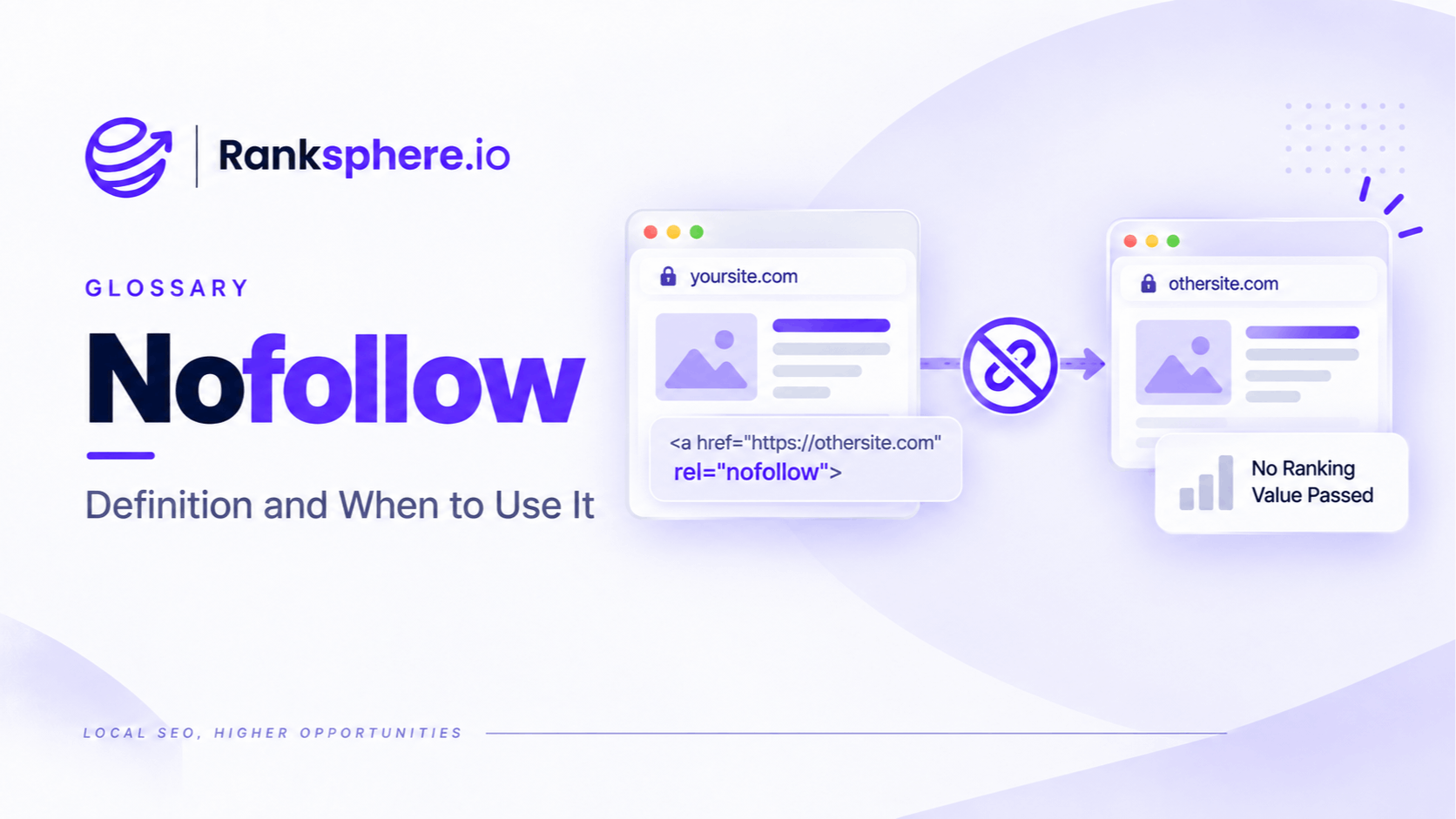
Nofollow is a link attribute used to give search engines additional information about how a link should be treated.
It is written as:
<a href="https://example.com" rel="nofollow">Example link</a>
Originally, nofollow was introduced as a way to tell Google not to follow certain links for ranking purposes.
That interpretation is now outdated.
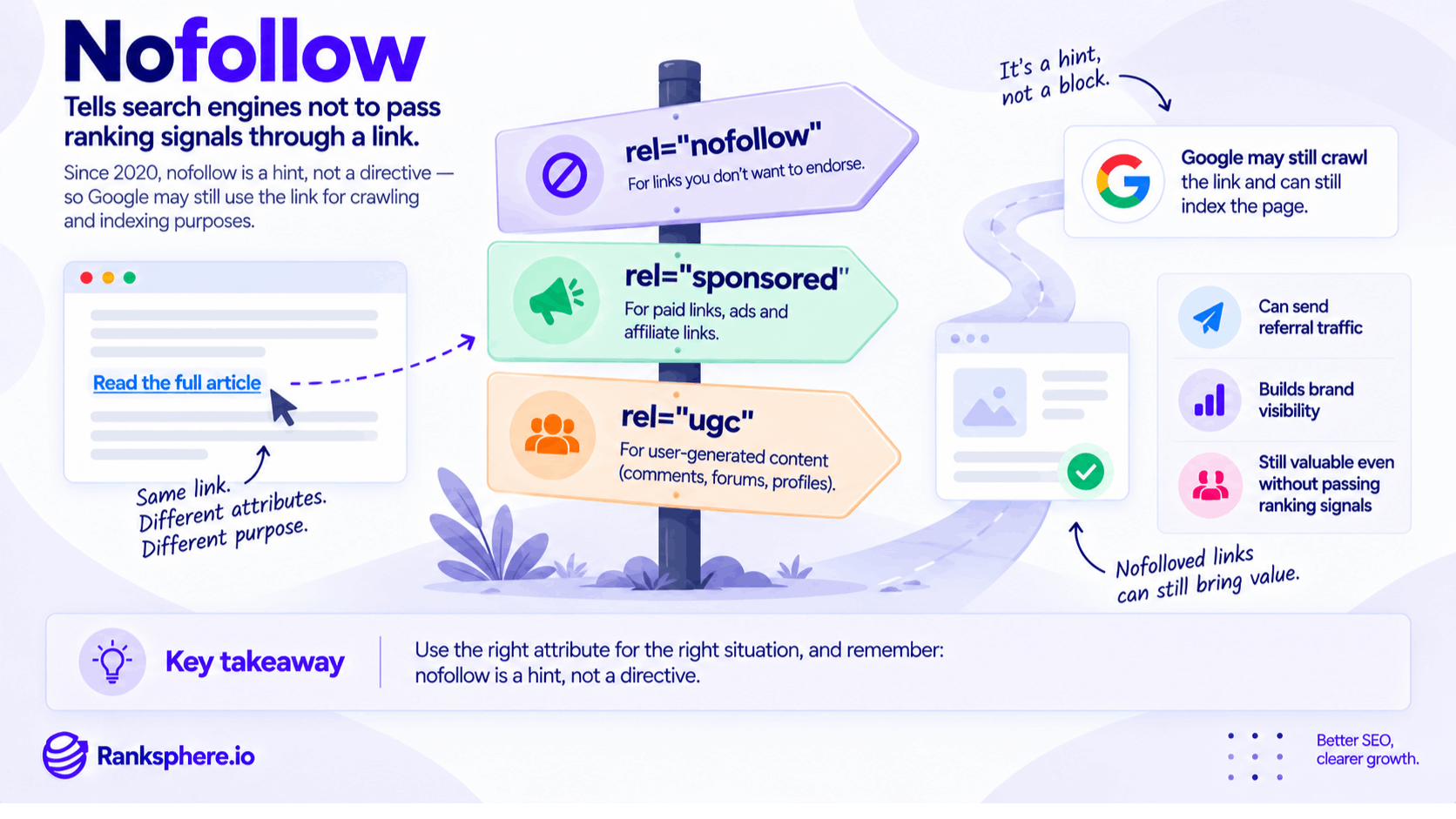
Since March 2020, Google has treated nofollow as a hint rather than a strict directive. This means Google may choose to use a nofollowed link when understanding relationships between pages, discovering URLs or evaluating search signals.
The practical lesson is simple:
nofollow is not an absolute block.
It is information about the relationship behind a link.
What does nofollow mean?
A normal link looks like this:
<a href="https://example.com">Example link</a>
There is no special rel attribute.
A nofollowed link looks like this:
<a href="https://example.com" rel="nofollow">Example link</a>
The nofollow value tells search engines that the publisher does not want the link treated in the same way as an ordinary editorial recommendation.
Historically, Google treated this much more strictly.
Today, it uses the attribute as a hint within its wider systems.
That means you should not think of nofollow as:
“Google completely ignores this link.”
It is more accurate to think of it as:
“Here is additional information about how this link should be considered.”
Nofollow, sponsored and UGC
Google introduced two additional link relationship values in 2019:
- sponsored
- ugc
Together with nofollow, they help describe why a link exists.
rel="nofollow"
Use nofollow when you want to qualify a link and neither sponsored nor ugc describes the relationship more accurately.
Example:
<a href="https://example.com" rel="nofollow">
Example website
</a>
This is the general-purpose option.
rel="sponsored"
Use sponsored for links created as part of advertising, sponsorship or other compensated arrangements.
Example:
<a href="https://example.com" rel="sponsored">
Sponsored partner
</a>
This is usually the clearest choice for:
- Paid placements
- Advertisements
- Sponsorship links
- Affiliate links
- Other compensated links
Google recommends sponsored specifically for paid relationships.
rel="ugc"
ugc stands for user-generated content.
It can be used for links created by users rather than by the website's editorial team.
Examples include:
- Blog comments
- Forum posts
- Community discussions
- User profiles
Example:
<a href="https://example.com" rel="ugc">
User-submitted link
</a>
This helps distinguish user-created links from links deliberately placed by the publisher.
Can link attributes be combined?
Yes.
For example:
<a href="https://example.com" rel="nofollow sponsored">
Sponsored link
</a>
This is valid.
However, if sponsored already accurately describes the relationship, adding nofollow as well is usually unnecessary.
The aim should be to describe the link clearly, not to add as many attributes as possible.
When should you use nofollow?
Nofollow is appropriate when you want to qualify a link but another relationship value does not describe it better.
For example, you might use it when:
- You do not want to associate the site with an ordinary editorial endorsement
- You cannot confidently vouch for the destination
- A platform uses nofollow as a general link policy
It should not be added automatically to every external link.
Normal editorial links generally do not need a special attribute.
When should you use sponsored?
Paid links deserve particular attention.
If money, products, services or another form of compensation influenced the placement of the link, it should be appropriately qualified.
rel="sponsored" is the clearest option.
For example:
<a href="https://example.com/product" rel="sponsored">
View the sponsor's product
</a>
This can apply to:
- Sponsored articles
- Paid advertorials
- Affiliate links
- Paid directory placements
- Commercial sponsorships
Paid exposure itself is not prohibited.
The SEO problem comes from attempting to make a paid link look like an independent editorial recommendation for ranking purposes.
See link building for the wider distinction between legitimate promotion and manipulative link schemes.
Are affiliate links sponsored?
In most cases, yes.
If you receive commission when someone clicks or purchases through a link, that is a commercial relationship.
Using:
rel="sponsored"
is the clearest way to identify it.
Some websites historically used nofollow for affiliate links, and that can still qualify the relationship.
But sponsored is more specific.
When should you use UGC?
Use ugc where links are created by users rather than by the site's editorial team.
For example:
<a href="https://example.com" rel="ugc">
User profile link
</a>
This is particularly useful on sites containing large amounts of:
- Comments
- Forums
- Community content
- User profiles
It helps search engines understand that the website owner did not necessarily choose or endorse every destination.
Are UGC links required to use ugc?
Not necessarily in every situation.
The attribute provides useful context, but the broader goal is controlling abuse and accurately representing how links are created.
If a community is heavily moderated and trusted, the site's implementation may differ from a large open forum where anyone can post a link.
Use the attribute where it accurately describes the content.
Does nofollow stop Google following a link?
Not necessarily.
This is one of the most important changes to understand.
Because nofollow is treated as a hint, Google may still use the link for purposes such as discovery.
So this:
rel="nofollow"
should not be treated as a way to prevent crawling.
If a URL is publicly accessible, search engines may discover it through:
- Other links
- XML sitemaps
- External backlinks
- Previous crawls
- Other sources
Nofollow is not a crawling-control mechanism.
Does nofollow stop a page being indexed?
No.
A page can potentially appear in search even if every known link to it uses nofollow.
If you want a page excluded from search results, use the appropriate indexing control, such as a noindex directive.
See indexing for the wider distinction between discovery, crawling and indexing.
Do not rely on nofollow to keep sensitive or unwanted pages out of Google.
What about robots.txt?
robots.txt controls crawling.
It does not provide the same function as noindex.
That distinction matters.
If a page must not appear in search results, blocking it in robots.txt alone is not a reliable indexing solution because Google may know the URL exists without crawling its contents.
Likewise, if you use noindex, the crawler generally needs access to the page to see that directive.
Use the right control for the job.
Nofollow and link equity
Nofollow is closely related to link equity.
Historically, SEOs often described nofollow as preventing PageRank from passing through a link.
Modern Google's treatment is more nuanced because the attribute is now a hint.
So avoid thinking in terms of:
Followed link = 100% ranking value
Nofollowed link = 0% ranking value
Google does not publish a formula that lets you calculate link equity this way.
The attribute provides context that Google's systems can interpret.
Nofollow and PageRank sculpting
One of the oldest nofollow SEO tactics was PageRank sculpting.
The idea was to use nofollow on less important internal links so more PageRank would flow through the remaining links.
For example, if a page linked to ten URLs, someone might nofollow five of them in the hope that the other five would receive more value.
Google changed how nofollow worked for PageRank calculations in 2009, making this approach ineffective.
Today, nofollow should not be used as a tool for manipulating how internal authority is distributed.
If a page is important:
link to it properly.
If it is not important:
review whether it needs to be linked or indexed at all.
Should you nofollow internal links?
Usually, no.
Normal internal links should generally remain ordinary crawlable links.
For example:
<a href="/services/roof-repair/">
Roof repair services
</a>
There is normally no reason to add:
rel="nofollow"
just because you consider one internal page less important than another.
Internal links help search engines:
- Discover pages
- Understand site structure
- Interpret relationships
- Navigate the website
Using nofollow broadly across your own site can make those relationships less clear.
Nofollow and backlinks
A backlink does not become worthless simply because it is nofollowed.
A nofollowed link can still provide:
- Referral traffic
- Brand exposure
- Visibility
- Customer discovery
- Business relationships
Suppose a major local newspaper mentions your business and links to it using nofollow.
Would you reject the coverage?
Probably not.
The audience may be far more valuable than any theoretical ranking signal.
This is why evaluating backlinks purely by whether they are followed or nofollowed misses much of their real value.
Do nofollowed backlinks help SEO?
There is no simple universal answer.
Google treats nofollow as a hint, so you should avoid categorical statements such as:
“Nofollow links pass absolutely no SEO value.”
At the same time, you should not pursue nofollow links because you assume Google will ignore the attribute and pass ranking value anyway.
The better question is:
Is this a legitimate link from a useful source?
If a respected publication sends relevant visitors and increases brand exposure, the link can be worthwhile regardless of its attribute.
Does a natural backlink profile need nofollow links?
Do not try to manufacture a specific followed-to-nofollow ratio.
There is no public ideal percentage such as:
70% followed, 30% nofollow
or any equivalent formula.
Different websites naturally attract different types of links.
For example, some large platforms may qualify most outbound links by policy.
Others may use ordinary editorial links.
Do not build nofollow links merely to make a backlink profile “look natural.”
Build legitimate relationships and let the resulting profile develop naturally.
Nofollow and paid link schemes
Using nofollow or sponsored is not a magic way to make an otherwise manipulative campaign good SEO.
For example, publishing hundreds of low-quality paid articles solely to generate visibility in backlink tools remains a poor strategy even when the links are qualified.
The attributes tell search engines about the relationship.
They do not turn low-quality marketing into useful content.
Focus on whether the placement reaches a real audience and serves a legitimate purpose.
Can nofollow make a bad backlink safe?
Not necessarily in every sense.
If a website participates in large-scale manipulative linking, adding an attribute after the fact does not automatically turn the wider campaign into a sensible marketing strategy.
The better approach is to avoid:
- Link networks
- Paid ranking links
- Automated link spam
- Large-scale guest-post schemes
- Manufactured exact-match anchors
Use link attributes as intended rather than as protection for manipulative activity.
Should publishers nofollow all outbound links?
Usually, there is no need.
Some websites or platforms choose to qualify most outbound links as part of their own policy.
But an ordinary editorial link to a useful source does not generally require nofollow.
For example, if an article cites:
- Government guidance
- Original research
- Official documentation
- A genuinely useful source
an ordinary link can be perfectly appropriate.
Do not add nofollow to every external link simply because of an old belief that linking out causes a website to lose authority.
CMS and plugin problems
Some content-management systems or plugins automatically modify external links.
For example, a plugin might add:
rel="nofollow"
to every external URL.
That can go unnoticed for years.
It may also apply the wrong attributes to:
- Partner links
- Editorial citations
- Sponsored links
- Affiliate links
Review what your CMS actually outputs rather than assuming the settings are correct.
Ranksphere's website audit checks outbound and internal link attributes, helping identify blanket nofollow rules or inconsistent link treatment across a site.
How to check whether a link is nofollowed
Inspect the HTML.
A standard link might look like:
<a href="https://example.com">
Example
</a>
A nofollow link looks like:
<a href="https://example.com" rel="nofollow">
Example
</a>
A sponsored link might look like:
<a href="https://example.com" rel="sponsored">
Example
</a>
A UGC link might look like:
<a href="https://example.com" rel="ugc">
Example
</a>
Browser developer tools or an SEO crawler can help check these attributes across larger websites.
Common nofollow mistakes
- Treating nofollow as an absolute directive. Google has treated it as a hint since March 2020.
- Using nofollow to prevent indexing. Use an appropriate indexing directive instead.
- Assuming robots.txt and nofollow perform the same job. They do not.
- Nofollowing internal links to sculpt PageRank. This is outdated.
- Leaving paid links unqualified. Use sponsored or another appropriate qualification.
- Assuming nofollowed backlinks are worthless. Referral traffic and visibility still matter.
- Trying to create an artificial follow/nofollow ratio.
- Adding nofollow to every external link automatically.
- Assuming sponsored guarantees Google will treat the link in one exact mathematical way.
- Ignoring CMS or plugin settings that modify link attributes automatically.
Nofollow best practices
- Use sponsored for paid and compensated links.
- Use ugc where it accurately describes user-generated links.
- Use nofollow when you need a general-purpose qualification.
- Leave ordinary editorial links as normal links where appropriate.
- Do not use nofollow as an indexing-control tool.
- Do not nofollow normal internal links simply to sculpt link equity.
- Do not reject a useful backlink purely because it is nofollowed.
- Check affiliate links are appropriately qualified.
- Audit CMS and plugin behaviour periodically.
- Think about why the link exists rather than treating attributes as ranking switches.
Example
“Blackthorn Interiors pays a regional lifestyle publication for a sponsored feature.
The article includes two links to the studio's portfolio pages.
The links are ordinary followed links, even though the placement was paid for.
The problem is not that the article exists.
Sponsored editorial content can be legitimate marketing.
The issue is that the commercial relationship is not reflected in the way the links are marked.
The publication updates them to:
rel="sponsored"
The feature remains live.
Readers can still visit the studio.
The referral traffic is unaffected.
The business still benefits from:
- Exposure
- Brand recognition
- Visits
- Potential enquiries
What changes is that the links now describe the commercial relationship accurately.
That is the right way to think about nofollow and related attributes: they are not switches for turning SEO value on and off. They provide search engines with context about why a link exists and how that relationship should be interpreted.”
See also
- Backlink — an external link that may carry a relationship attribute
- Link building — where sponsored and editorial links need to be distinguished
- Link equity — the SEO concept associated with signals passed through links
- Anchor text — the clickable wording within a link
- Indexing — the process nofollow does not control
- Internal linking — where nofollow is generally unnecessary for normal links