A prospecting audit is a short SEO assessment created for a potential client before an engagement begins.
Its purpose is not to replace a full audit.
It is to show that you understand the business, identify a small number of relevant opportunities or problems, and give the prospect something concrete to discuss.
The strongest prospecting audits are usually:
- Specific
- Easy to understand
- Relevant to the business
- Verifiable
- Focused on a few meaningful findings
They should feel like analysis of this business, not an automated report that could have been sent to anybody.
What is a prospecting audit?
A prospecting audit sits between:
cold outreach
and:
a full paid SEO audit.
It gives a prospect enough evidence to understand:
- What you have noticed
- Why it may matter
- What deserves further investigation
without pretending that you have completed a full strategic engagement for free.
For a local business, that might involve:
- Local visibility
- Google Business Profile setup
- Competitors
- Reviews
- Important service pages
- Indexation
- Obvious technical issues
The exact mix depends on the business.
A prospecting audit is not a full SEO audit
A full audit may involve:
- Technical crawling
- Search Console analysis
- Content review
- Internal linking
- Backlinks
- Conversion tracking
- Local visibility
- Competitor analysis
- Prioritised implementation planning
A prospecting audit is narrower.
It should answer:
“Is there enough evidence here to justify a deeper conversation?”
rather than:
“Have we diagnosed every SEO issue on the site?”
That distinction protects both quality and time.
Specific findings make the audit credible
Generic statements are easy to ignore.
For example:
“Your website could benefit from SEO improvements.”
tells the prospect almost nothing.
A more useful finding might be:
“Your emergency plumbing service page is not currently indexed according to Search Console.”
or:
“Your strongest local competitor appears in the top three across more of the tracked area for this service.”
The difference is specificity.
The prospect can understand what you found and why you raised it.
Use findings that can be checked
Verifiable findings tend to be more persuasive than proprietary scores alone.
For example:
Easy to verify
- Business category
- Review count
- Missing service
- Indexed or non-indexed page
- Visible duplicate listing
- Local ranking difference
Harder for a prospect to interpret
- Proprietary authority score
- “Toxicity” percentage
- Abstract technical health score
That does not make third-party tools useless.
They can be excellent diagnostic tools.
The problem is presenting the score itself as though it proves the business has a problem.
Geo-grid visibility
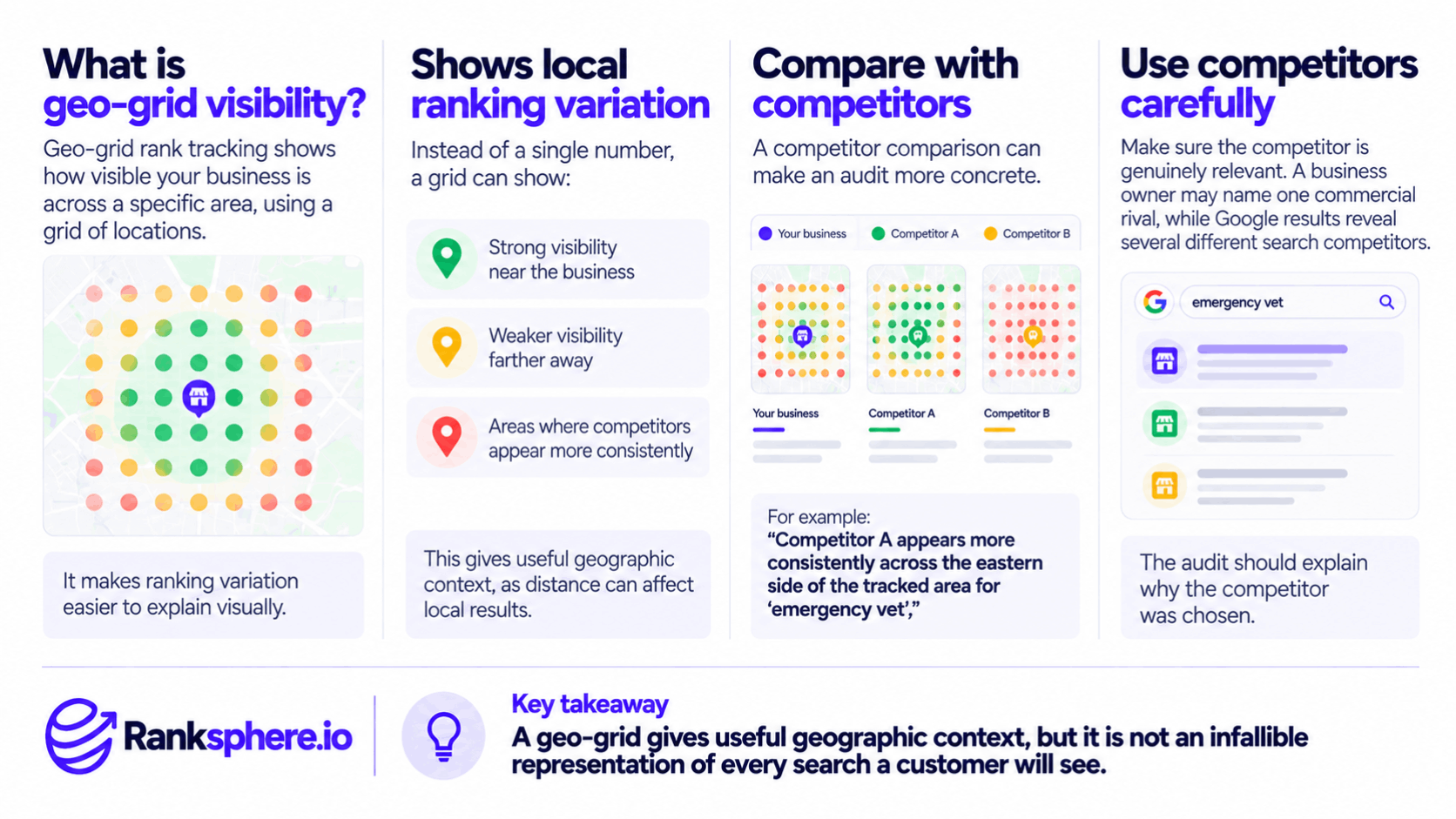
For local SEO, geo-grid rank tracking can make ranking variation easier to explain visually.
Instead of saying:
“You rank number four.”
a grid can show:
- Strong visibility near the business
- Weaker visibility farther away
- Areas where competitors appear more consistently
That is useful because Google says local results are influenced by:
- Relevance
- Distance
- Prominence
and distance changes according to where the searcher is located.
A grid therefore gives useful geographic context.
It should not be presented as an infallible representation of every search a customer will see.
Use named competitors carefully
A competitor comparison can make an audit more concrete.
For example:
Competitor A appears more consistently across the eastern side of the tracked area for “emergency vet”.
That is more useful than:
“Your local SEO is weak.”
But make sure the competitor is genuinely relevant.
A business owner may name one commercial rival while Google results reveal several different search competitors.
The audit should explain why the competitor was chosen.
Business Profile category findings
A Google Business Profile primary category can be worth reviewing.
Google says the primary category should be the category that best represents what the business does. It also allows additional categories for other legitimate areas of the business.
That means a useful finding might be:
“The current primary category may not be the most specific match for the business's main service.”
The wrong approach is:
“Your competitor uses this category, so you should use it too.”
Competitor data creates a question.
It does not override Google's accuracy requirement.
Duplicate listings
A duplicate listing can be a useful prospecting finding if it is genuine and clearly identifiable.
For example:
- Old location
- Duplicate practitioner listing
- Previous business identity
- Duplicate map entry
But do not label two similar profiles as duplicates without checking what they represent.
Different:
- Practitioners
- Departments
- Legitimate locations
may be allowed separate profiles depending on the circumstances.
Treat the finding as something to verify rather than an automatic cleanup task.
Indexation problems
A commercially important service page that is not indexed can be a strong finding.
But check it properly.
Google recommends using Search Console's URL Inspection tool to determine the indexed status of a specific URL.
The tool can show information such as:
- Whether the URL is indexed
- Crawling information
- Google-selected canonical
- Indexability issues
That is stronger evidence than simply typing:
site:example.com/page
into Google and assuming absence proves non-indexation.
An indexed page is not necessarily ranking
There is another distinction.
Google says a page being indexed means it can be eligible to appear in Search, but that does not guarantee it will actually be shown for relevant queries.
So:
Not indexed
and:
Indexed but not visible
are different problems.
Keep the wording accurate.
Review comparisons
Review counts can provide useful competitive context.
Google says review quantity and positive ratings can contribute to local prominence.
For example:
Your profile has 96 reviews while a nearby competitor has 410.
That is factual and easy to understand.
But avoid turning the difference into:
“You need another 314 reviews.”
Review counts alone do not determine local rankings.
Also consider:
- Rating
- Recency
- Customer experience
- Business age
- Market size
The number is context.
Not a target formula.
Profile service gaps
Another useful finding might be:
The business offers rabbit medicine, but that service is not currently represented clearly on the profile or website.
That is relevant if the service genuinely exists.
Again, the audit should not say:
“Add the service and rankings will improve.”
The finding is:
an important service is poorly represented online.
That is useful without making a ranking promise.
What to include in a prospecting audit
A useful prospecting audit might contain a small number of sections such as:
Search visibility
Where the business appears for a few commercially relevant terms.
Competitor comparison
A small number of businesses competing for those searches.
Specific findings
Clear issues or opportunities that can be checked.
Why each finding matters
A short explanation of the possible customer or search impact.
Suggested next step
What would need further investigation or implementation.
Keep it focused enough that the prospect can understand it quickly.
How long should a prospecting audit be?
There is no universal page count.
For many local businesses:
two to five concise pages
may be plenty.
For a larger prospect, more context may be justified.
The principle matters more than the number:
do not make a sales audit so long that the important findings disappear inside it.
A short document with three strong observations can be more useful than a 40-page crawler export.
Automated reports are not inherently bad
Automated tools can save time.
They can help find:
- Broken links
- Missing metadata
- Indexation problems
- Performance issues
The problem is sending raw output without interpretation.
For example:
37 images are larger than 200 KB
may be technically true.
But the prospect still needs to know:
- Does this materially affect the site?
- Is it a priority?
- What is more important?
Tools collect evidence.
The consultant provides judgement.
Technical findings can still matter
Avoid saying technical issues rarely matter in local SEO.
A local business can have serious problems such as:
- Important pages noindexed
- Broken redirects
- Server errors
- Mobile rendering problems
- Poor internal linking
Those can be commercially important.
The right rule is:
lead with the issues that matter most to this business.
Sometimes that will be local visibility.
Sometimes it will be technical.
Domain Authority
Domain authority and similar third-party authority metrics can be useful for comparative analysis.
They are not Google metrics.
So a prospecting audit should not say:
“Your Domain Authority is 19, therefore your SEO is poor.”
That asks the prospect to trust a proprietary score they may not understand.
A specific search or business problem is usually easier to explain.
Toxic-link scores
The same caution applies to toxic link reports.
A third-party tool may classify backlinks as:
- Toxic
- Suspicious
- High risk
That is the vendor's own model.
It does not mean Google has issued a penalty.
Google's own guidance says most sites do not need to use the Disavow Tool because Google can usually determine which links to trust without additional guidance.
So avoid prospecting lines such as:
“You have 380 toxic backlinks and need urgent cleanup.”
without much stronger evidence.
Do not manufacture urgency
Prospecting works better when the problem is real.
Avoid phrases such as:
- Critical SEO emergency
- Google penalty detected
- Immediate action required
unless you genuinely have evidence supporting them.
A business can make a decision without artificial pressure.
Specificity is more credible than alarm.
Do not attack the incumbent agency
If the prospect already works with another agency, keep the audit focused on the evidence.
For example:
“This page is currently not indexed.”
is enough.
You do not need:
“Your current agency clearly has no idea what it is doing.”
You usually do not know:
- Their scope
- What they recommended
- What the client approved
- What happened historically
Critique the observable issue.
Not people you have never spoken to.
Show enough of the solution to be useful
The original advice:
“Show the problem, sell the fix.”
can become too withholding.
A good prospecting audit should demonstrate competence.
That may mean explaining the direction of the solution.
For example:
Finding: Important service page is not indexed.
Next step: Inspect indexability, canonicalisation and crawl signals before deciding whether technical or content changes are required.
That gives the prospect genuine value.
You do not need to deliver the full:
- Technical specification
- Content brief
- Implementation roadmap
before an engagement begins.
The balance is:
be useful without pretending a short prospecting audit is a complete consulting project.
Mention uncertainty where it exists
Not every observation has a certain cause.
For example:
Competitor has more reviews and stronger grid coverage
does not mean:
the reviews caused the stronger coverage.
Google's local results consider multiple factors, including relevance, distance and prominence.
Use wording such as:
“This is one competitive difference worth investigating.”
That is more credible than inventing causation.
Prioritise findings
A prospecting audit becomes much more useful when the findings are ranked by practical importance.
For example:
High priority
Main commercial service page not indexed.
Medium priority
Important service not represented clearly on the Business Profile.
Lower priority
Several non-critical image files are oversized.
That prevents minor crawler warnings from dominating the document.
Ranksphere's smart tasks turn scan and audit findings into a prioritised list, which can help convert raw findings into a clearer:
- Priority
- Responsibility
- Next action
rather than presenting every warning as equally important.
Effort estimates can help
It can be useful to tell the prospect roughly what kind of work a finding involves.
For example:
Low effort
Correct inaccurate profile information.
Medium effort
Improve an existing service page.
Higher effort
Rebuild a problematic location structure.
Avoid pretending you know the exact development hours before you have proper access.
Use broad effort categories at the prospecting stage.
How much time should you spend?
There is no universal 30-to-60-minute rule.
The right investment depends on:
- Prospect value
- Business complexity
- Sales process
- Available data
- Likelihood of fit
A small local business may justify a short review.
A multi-location organisation may justify considerably more.
The important commercial rule is:
decide the level of effort before you start.
Otherwise prospecting can turn into unpaid consulting without a clear sales rationale.
Qualify before doing deep research
It usually makes sense to establish basic fit before spending significant time on a prospecting audit.
Questions might include:
- Is this the type of client we serve?
- Is there a realistic budget?
- Can we actually help?
- Is the geography appropriate?
- Do they offer services we understand?
That reduces time spent analysing opportunities you would never accept.
But not every prospect needs a formal qualification call before any research.
A small amount of initial analysis can itself be part of qualification.
Reuse the structure, not the conclusions
Templates are not inherently bad.
A consistent format makes production faster and easier to review.
For example:
- Local visibility
- Competitor comparison
- Key findings
- Next steps
can work across many prospects.
What should change is:
- Evidence
- Competitors
- Findings
- Priorities
A template becomes a problem when only the logo and company name change.
Make the evidence current
Prospecting findings can become stale quickly.
Review counts change.
Local rankings move.
Business Profile information is edited.
If the audit will not be sent immediately, recheck important facts before presenting them.
This is especially important when using:
- Geo-grid scans
- Review totals
- Categories
- Search-result screenshots
Date-sensitive evidence should be treated as a snapshot.
Screenshots can help
Where useful, show the evidence.
For example:
- Grid screenshot
- Search Console status where access exists
- Business Profile category
- Search result
- Duplicate listing
Visual evidence can reduce explanation.
But do not fill the report with screenshots simply to make it look longer.
Each one should prove or explain something.
Be careful with data you cannot access
Before engagement, you may not have access to:
- Search Console
- GA4
- CRM
- Business Profile management
That limits what you can conclude.
For example, you may suspect a page is poorly indexed or receives no traffic.
Without first-party data, label the finding accurately.
Say:
“This warrants checking in Search Console.”
rather than:
“This page generates no organic traffic.”
Do not pretend public data gives you access to private performance.
Prospecting audits and local ranking scans
A local rank scan is also a snapshot.
Google local results vary according to factors including location.
So do not write:
“You rank number 12.”
when the grid actually shows:
- 2 at some points
- 6 at others
- 14 elsewhere
Describe:
coverage
and:
geographic variation.
That is the value of the grid.
Competitor review counts need a timestamp
If you show:
Prospect: 96 reviews
Competitor: 410 reviews
note that this is:
at the time of the audit.
Reviews can change immediately after the report is created.
This is especially important if the PDF may circulate internally for weeks.
Prospecting audits should not guarantee impact
Avoid statements such as:
“Fixing these three things will increase leads by 40%.”
A pre-engagement audit rarely has enough data to support that.
Instead say:
“These are the clearest opportunities identified in the initial review and deserve deeper investigation.”
That is still commercially useful.
It is also defensible.
Keep implementation separate from diagnosis
The prospecting audit identifies:
what appears to need attention.
The paid engagement can determine:
- Root cause
- Full priority
- Implementation details
- Measurement plan
That makes the distinction between:
prospecting audit
and:
full local SEO audit
clear.
Common prospecting-audit mistakes
- Sending an automated export without analysis.
- Trying to demonstrate expertise through report length.
- Using proprietary scores as the main evidence.
- Calling a competitor's category “better” without checking whether it accurately applies to the prospect.
- Treating review-count differences as proof of why a competitor ranks better.
- Relying on a site: search as definitive evidence that a specific URL is indexed or not indexed.
- Leading with insignificant technical warnings while ignoring commercially important problems.
- Ignoring serious technical findings simply because the business is local.
- Presenting a geo-grid snapshot as a permanent ranking.
- Using fabricated urgency or unsupported penalty claims.
- Criticising an incumbent agency without knowing its scope or history.
- Giving every finding equal priority.
- Turning a short sales assessment into a complete unpaid consulting project.
- Using stale ranking, review or profile data.
Prospecting-audit best practices
- Start with findings that are relevant to the prospect's actual business.
- Use specific, verifiable evidence wherever possible.
- For local businesses, include geographic visibility where it genuinely helps explain the problem.
- Compare against relevant search competitors rather than arbitrary businesses.
- Check Business Profile categories for accuracy rather than simply copying competitors.
- Use Search Console's URL Inspection tool when you have appropriate access and need to verify a specific page's index status.
- Treat review counts, rankings and profile information as time-sensitive snapshots.
- Prioritise findings by likely business importance rather than crawler severity.
- Explain the direction of the solution without pretending the prospecting audit is a full implementation plan.
- Use broad effort estimates where useful, while avoiding false precision.
- Qualify higher-effort prospects before investing significant audit time.
- Reuse the presentation structure while making the actual findings specific to every business.
Example
“Consider two hypothetical local businesses receiving prospecting audits.
A dental practice receives a 38-page automated PDF.
It contains:
- Image compression warnings
- Missing alt attributes
- Heading hierarchy warnings
- A Domain Authority score
- A list of supposedly toxic links
Most of the report is tool output.
Very little explains:
- Which problem matters most
- How the business compares locally
- What customers may be affected
The document contains data.
It does not provide much prioritisation.
A veterinary practice receives a shorter audit built around its actual local market.
The team has tracked a small set of important commercial searches across a defined grid.
The scan shows that a nearby competitor appears in the top three across a larger proportion of the tracked area.
The audit does not say:
“They rank better because they have more reviews.”
Instead, it shows several factual differences worth investigating.
The competitor has broader top-three coverage across the sampled grid.
At the time of the audit:
Veterinary practice: 96
Competitor: 410
Google says review quantity and positive ratings can contribute to local prominence, so the difference is relevant context rather than proof of causation.
The competitor uses a different category.
Rather than instructing the practice to copy it, the audit asks whether the practice's current, primary category is the most accurate representation of its main business.
Google's guidance is to choose the category that best matches what the business actually does.
Rabbit medicine is an important area of the practice but is difficult to find in its public profile and website content.
That is a concrete customer-information gap worth reviewing.
The audit finishes with three next steps:
- Review the primary category for accuracy.
- Assess how the specialist service should be represented across the profile and website.
- Investigate the local visibility difference in more detail before deciding what optimisation work is justified.
There is no invented claim that:
- The prospect called the same day
- The audit had a particular conversion rate
- The competitor is “stealing customers”
- Three fixes will produce a guaranteed ranking gain
The audit is persuasive for a simpler reason.
It demonstrates that the agency looked at the actual business, its real competitors and the search environment it operates in.
That is the value of a good prospecting audit.
It should give a potential client a small number of relevant, credible observations that are worth discussing. It does not need to diagnose the entire website, manufacture urgency or give away a full strategy. Specific evidence and sensible prioritisation do more to establish expertise than the number of pages in the PDF.”
See also
- Local SEO audit — the deeper assessment carried out once a full audit is required
- Geo-grid rank tracking — visualising local visibility geographically
- Competitor analysis — identifying the businesses that genuinely compete in search
- Client onboarding — establishing access, responsibilities and processes after an engagement begins
- Scope of work — defining what the resulting engagement will actually include
- KPI — agreeing how performance will be measured once work starts