The Search Quality Rater Guidelines are a document published by Google that explains how human evaluators should assess the quality of webpages and search results.
Google uses these evaluations to understand whether its automated ranking systems are delivering helpful, relevant and trustworthy information.
The guidelines introduce concepts such as E-E-A-T, Page Quality and Needs Met, which have become central to discussions about SEO.
They are worth reading because they explain what Google considers useful content and a satisfying search experience.
But the guidelines are not a ranking manual. A poor rating from a human evaluator does not directly lower a website's position in Google Search.
That distinction matters. The document describes what Google's systems should achieve, not the exact calculations used to rank webpages.
What Are Google's Search Quality Rater Guidelines?
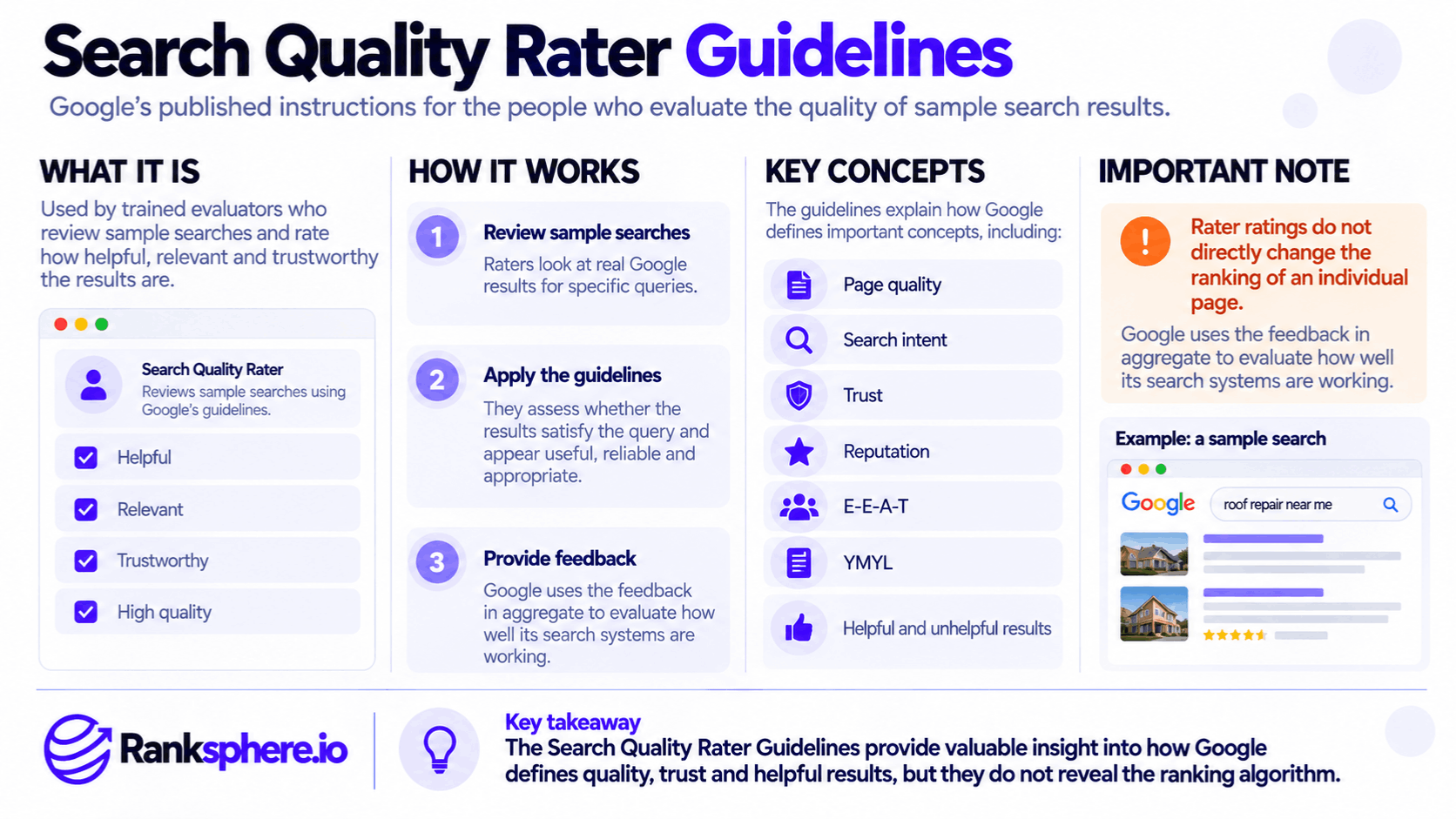
Google works with external search quality evaluators, commonly called quality raters.
These evaluators review search results and assess them using Google's published guidelines.
For example, a rater might evaluate whether a result about dental implant treatment provides trustworthy information and adequately answers the searcher's question.
Their feedback helps Google assess the performance of its ranking systems and proposed changes.
However, raters do not manually determine where websites appear in search results.
Google explicitly states that their ratings are not used directly in its ranking algorithms.
The guidelines are publicly available and revised periodically.
Google's official document is titled General Guidelines, also commonly called the Search Quality Evaluator Guidelines.
What Do Search Quality Raters Evaluate?
Two of the most useful concepts in the document are Page Quality and Needs Met.
Page Quality
Page Quality concerns how well a webpage achieves its purpose and whether it deserves to be trusted.
Evaluators consider factors such as the quality of the main content, information about the website or content creator, and relevant reputation evidence.
For example, a dental practice publishing medical advice should provide accurate information that reflects appropriate professional expertise.
A page doesn't become trustworthy simply because it contains many words or displays an author's photograph.
Its claims, sources and overall reliability matter.
Needs Met
Needs Met describes how well a search result satisfies what someone was looking for.
This closely relates to search intent.
For example, someone searching for "dentist open Sunday in Manchester" needs information about practices offering Sunday appointments.
A detailed article about dental hygiene may be useful in general, but it doesn't answer that particular search.
Needs Met therefore helps evaluators judge whether a result is useful for the actual query, not merely whether the webpage is well written.
How E-E-A-T Fits Into the Guidelines
E-E-A-T stands for:
- Experience: Whether the creator has relevant first-hand experience.
- Expertise: Whether they have the knowledge or skills needed for the topic.
- Authoritativeness: Whether the creator or website is recognised as a relevant source.
- Trustworthiness: Whether the information is accurate, reliable and safe to rely on.
Google explains that trust is the most important aspect.
However, E-E-A-T is not a single ranking factor or a numerical score assigned to websites.
The guidelines help raters evaluate these qualities. Google's automated systems use a range of signals that may help identify content demonstrating them.
What About YMYL?
The guidelines also discuss Your Money or Your Life (YMYL) topics.
These are subjects where inaccurate information could significantly affect someone's health, financial stability, safety or well-being.
For example, medical treatment advice requires particularly careful consideration of accuracy and expertise.
A dental practice's clinical advice should therefore be reviewed by an appropriately qualified professional.
That doesn't mean every page needs the same credentials. The level of expertise expected depends on the topic and its potential consequences.
Which Sections Are Worth Reading?
The document is extensive, but business owners and content teams don't need to memorise every rating instruction.
The most useful areas are:
Page Quality: Understand how evaluators consider a page's purpose, main content, trustworthiness and reputation.
Main Content: Examine whether the page provides enough original, accurate and useful information to achieve its purpose.
Lowest Quality: Review the characteristics associated with misleading, harmful, deceptive or otherwise untrustworthy pages.
Needs Met: Consider whether the content actually satisfies the searcher's query.
Website Reputation: Understand why evaluators may investigate independent information about a website or organisation rather than relying solely on what it says about itself.
The reputation section is especially relevant to local businesses.
For example, a veterinary practice's website may describe its professional experience, but relevant independent sources can provide additional context about its reputation.
That makes accurate public information and genuine customer feedback worth maintaining.
However, it would be incorrect to conclude that every independent review or citation is a confirmed direct ranking factor simply because raters examine reputation.
Are the Guidelines Google Ranking Factors?
No.
The distinction is between evaluation criteria and ranking factors.
Human raters assess whether results appear useful and trustworthy.
Google's automated ranking systems determine how search results are ordered.
The guidelines do not disclose the precise signals, calculations or weightings used by those systems.
For example, providing a detailed author biography may help readers evaluate an article's credibility.
But Google doesn't promise a ranking improvement for adding a biography.
Similarly, a page can meet many quality expectations without achieving a particular ranking.
The guidelines should guide editorial judgement, not be converted into a guaranteed ranking formula.
How Should Businesses Use the Guidelines?
Use them to review whether your pages serve their intended purpose.
For a local dental practice, this might involve checking that treatment pages answer genuine patient questions, identify the professionals responsible for clinical information and avoid unsupported claims.
For a roofing company, it could mean including original photographs, explaining actual services and providing clear contact details.
The approach is practical:
- Identify the purpose of the page and the questions visitors need answered.
- Review the accuracy, originality and usefulness of its main content.
- Check whether relevant expertise and responsibility are clear.
- Look for misleading statements, unsupported claims or missing information.
- Assess whether visitors can achieve their intended goal.
Use Google's Search Essentials alongside the quality guidelines.
Search Essentials explains technical requirements, spam policies and important SEO practices. The rater guidelines explain how people are trained to assess the quality of results.
The two documents serve different purposes.
Common Search Quality Rater Guidelines Mistakes
- Treating the guidelines as a ranking manual. They don't reveal Google's ranking algorithm.
- Claiming an official E-E-A-T score exists. Google publishes no such score.
- Assuming a human rater can penalise a website. Ratings don't directly alter rankings.
- Using outdated guidance without checking the revision date. Google updates the document periodically.
- Turning every criterion into a mandatory SEO task. Different pages have different purposes.
- Confusing quality ratings with Search Essentials policies. The documents have different roles.
- Promising ranking improvements from a rater-guideline audit. Such outcomes cannot be guaranteed.
Best Practices
Read Google's current Page Quality and Needs Met guidance.
Use it to evaluate content quality, accuracy and whether pages satisfy real search needs.
Give additional attention to expertise and trustworthiness for health, financial and other sensitive subjects.
Review independent reputation information where relevant, and make sure website claims can be substantiated.
Check the document's publication date when referencing specific criteria.
Most importantly, use it as an editorial and quality assessment resource, not as a scoring formula.
Example of Using the Guidelines for a Dental Practice
Consider a hypothetical dental practice offered an "E-E-A-T optimisation" package by an SEO agency.
The proposal includes a proprietary score and promises to improve the practice's Google rankings by increasing that score.
The practice manager asks whether Google uses the same measurement.
It doesn't.
What the Agency Actually Recommends
Behind the scoring system are several useful suggestions.
The practice could identify the dentists responsible for clinical articles, include accurate professional qualifications and link to relevant registration information.
It could also improve treatment explanations, use genuine practice photographs and answer common patient questions more clearly.
What the Practice Decides
The practice agrees that these changes would make its website more informative and trustworthy.
However, it declines the idea that an agency-created E-E-A-T score represents Google's assessment.
Instead, the team reviews the pages against the guidelines' underlying principles and has relevant clinical content checked by qualified professionals.
Example
“The recommendations can be worthwhile without a scoring system.
Accurate professional information helps patients assess who is providing advice. Clearer treatment content helps them understand their options.
Neither improvement guarantees a higher Google ranking.
The Search Quality Rater Guidelines are most useful when they help you judge whether your website deserves a visitor's trust, rather than when they are sold as a way to influence Google's algorithm directly.”
See Also
- E-E-A-T — Experience, expertise, authoritativeness and trustworthiness.
- Google Search Essentials — Google's technical requirements, spam policies and SEO guidance.
- Helpful Content — Creating useful information for people rather than search engines alone.
- Ranking Factors — The signals and systems Google uses to order search results.
- Thin Content — Content that provides insufficient value for its intended purpose.
- Search Intent — Understanding what searchers expect from a result.