Google Search Essentials is Google's official documentation explaining the requirements and guidelines for websites that want to appear in Google Search.
Previously known as the Google Webmaster Guidelines, it was renamed and reorganised in 2022.
The documentation covers three areas: technical requirements, spam policies, and key best practices.
Understanding the difference between them is important because SEO recommendations are often presented as mandatory Google rules.
For example, an SEO agency might claim that every page needs a particular word count, keyword density, or number of internal links.
Google doesn't set those requirements.
Google Search Essentials helps website owners distinguish what Google actually requires from what SEO professionals recommend.
It is one of the most useful references when evaluating technical SEO audits, agency proposals, or claims about Google penalties.
What Are the Three Parts of Google Search Essentials?
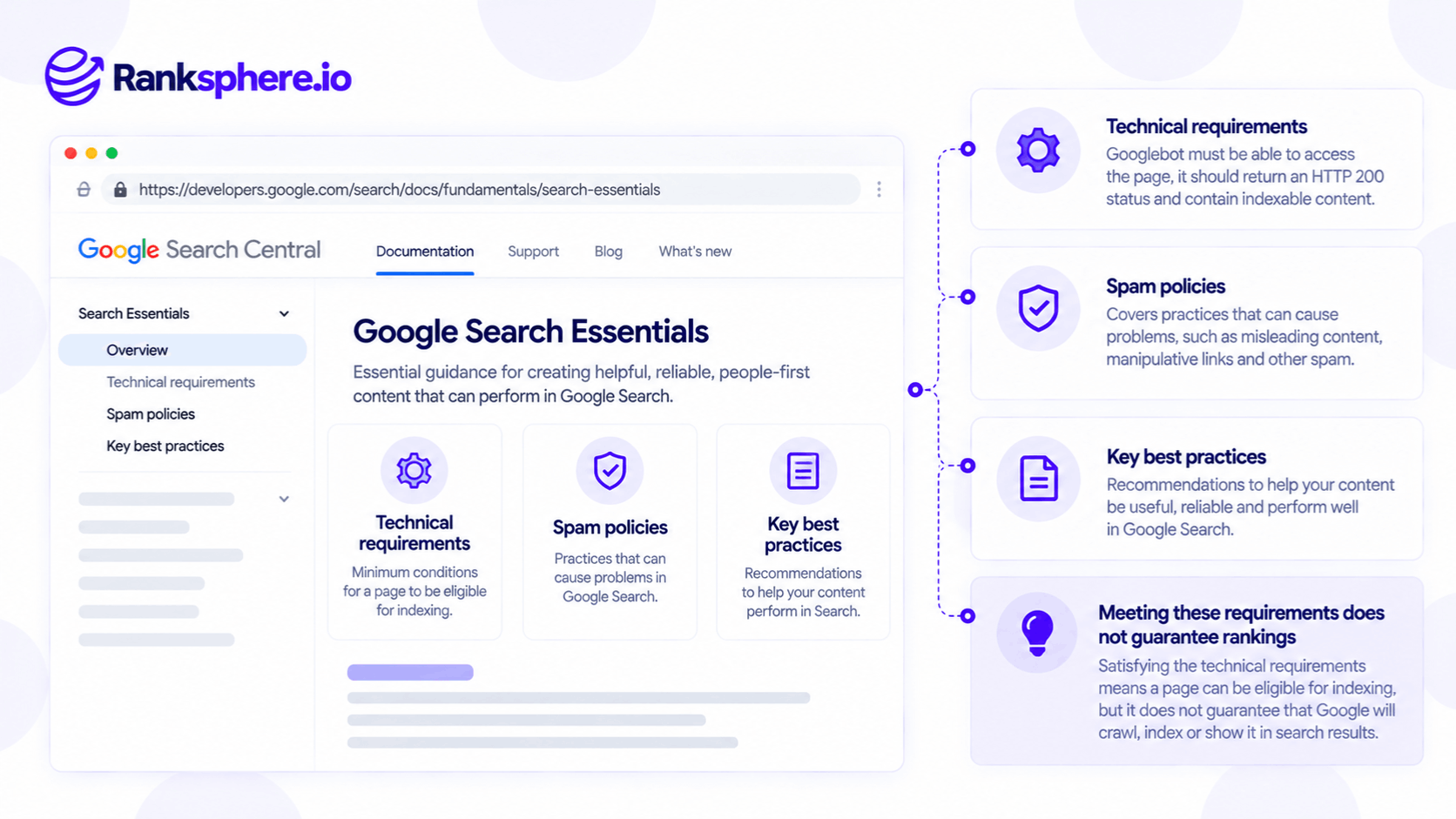
Google divides Search Essentials into three main sections.
Each serves a different purpose.
1. Technical Requirements
Google identifies three minimum technical requirements for a page to be eligible for indexing.
Googlebot must not be blocked.
Google needs to be able to access the page.
For example, a website that accidentally blocks Googlebot through its robots.txt configuration may prevent Google from crawling important content.
A URL blocked by robots.txt can sometimes still appear in search results based on information from elsewhere, but Google generally cannot crawl its content.
The page must work.
Google expects a successful HTTP 200 response from the page it is evaluating for indexing.
A page returning a 404 or server error isn't eligible for indexing as a normal working page.
See HTTP status codes.
The page must contain indexable content.
Google needs content in a supported format that it can process.
The content must also comply with its applicable search policies.
For example, a page carrying a noindex directive isn't eligible to remain in Google's index when Google detects that directive.
These are the minimum technical conditions Google identifies.
However, meeting them doesn't guarantee that a page will be indexed.
Google still decides which eligible pages to crawl, index, and display.
2. Spam Policies
Google's spam policies explain which practices can lead to lower rankings or removal from search results.
These include:
- Cloaking
- Doorway abuse
- Hacked content
- Keyword stuffing
- Link spam
- Scaled content abuse
- Site reputation abuse
- Expired domain abuse
- Misleading functionality
For example, creating hundreds of near-identical pages solely to manipulate location-based search results may violate Google's doorway abuse or scaled content abuse policies, depending on how the pages are implemented.
Likewise, buying links primarily to manipulate search rankings can violate Google's link spam policy.
Not every paid link or duplicated passage is automatically a violation. The circumstances and purpose matter.
See link building for the distinction between legitimate link acquisition and manipulative practices.
Google enforces its spam policies through automated systems and, when necessary, human review.
A human reviewer may issue a manual action.
Automated enforcement can also reduce visibility without a manual action notification.
3. Key Best Practices
Google's key best practices explain how website owners can improve their content's eligibility, discoverability, and presentation in search.
These include:
- Creating helpful, reliable, people-first content
- Using words people search for in prominent, relevant places
- Making links crawlable
- Helping Google discover pages
- Following image and video best practices
- Providing useful information about website content
Other Google Search Central documentation covers related topics such as page titles, structured data, mobile usability, and page experience.
For example, schema markup can help Google understand eligible content and may enable certain search features.
However, a typical webpage doesn't need structured data to be eligible for ordinary Google Search results.
Similarly, a page can appear in search without a custom meta description.
These are optimisation opportunities rather than universal minimum indexing requirements.
Google Requirements vs SEO Best Practices
The distinction between requirements and recommendations is important when prioritising SEO work.
| Area | What it means | Example |
|---|---|---|
| Technical requirements | Minimum conditions for indexing eligibility | Googlebot can access a working page with indexable content |
| Spam policies | Practices that can result in enforcement | Keyword stuffing or manipulative link schemes |
| Best practices | Recommendations that can improve search performance | Helpful content, descriptive titles, crawlable links |
For example, imagine a dental practice has a service page with no custom meta description.
That isn't a Google spam violation or a failure of the three technical requirements.
The page can still be indexed and rank.
However, writing an appropriate meta description may help Google generate a useful search snippet.
Now imagine the same page accidentally contains a noindex directive.
That is a much more immediate concern because it prevents the page from being indexed when the directive is detected.
Both issues may appear in an SEO audit, but they shouldn't receive the same priority.
What Google Search Essentials Does Not Require
Several common SEO recommendations aren't mandatory Google Search Essentials requirements.
Minimum Word Count
Google doesn't require every page to contain a particular number of words.
A short page can be useful if it answers the user's question.
A longer page isn't automatically better.
The amount of content should reflect what people need to know.
Keyword Density
Google doesn't publish a required keyword density percentage.
For example, a service page doesn't need to repeat "roof repair Bristol" a specified number of times.
Using relevant terminology naturally is more useful than forcing exact phrases into the text.
A Fixed Number of Internal Links
There is no universal requirement to include five, ten, or any other fixed number of internal links per page.
Internal links should help visitors navigate the website and help search engines discover relevant content.
The number depends on the page and website structure.
Domain Authority Thresholds
Google doesn't use Moz's Domain Authority metric as an official ranking requirement.
A website doesn't need to reach a particular third-party authority score before it can appear in search.
A Required Publishing Frequency
Google doesn't require websites to publish new content every day or every week.
Regular updates can be useful when they serve a genuine purpose.
However, publishing more frequently doesn't automatically improve rankings.
An llms.txt File
Google Search Essentials doesn't require an llms.txt file for indexing.
Website owners shouldn't treat emerging AI-related file conventions as mandatory Google Search requirements unless Google explicitly documents them as such.
Routine Disavow Submissions
Google doesn't require websites to submit disavow files as part of ordinary SEO maintenance.
Its disavow tool is intended for specific situations involving substantial problematic backlink patterns and actual or likely manual actions.
Using it without a valid reason may create unnecessary risk.
How Search Essentials Applies to Local SEO
Local businesses need to distinguish between Google's website requirements and its Google Business Profile guidelines.
These are separate sets of rules.
Website Requirements
Google Search Essentials applies to the business's website.
For example, a dental practice needs its treatment pages to be accessible to Googlebot and eligible for indexing.
It must also avoid spam practices such as manipulative doorway pages or keyword stuffing.
Google Business Profile Requirements
Google Business Profile has separate guidelines governing how businesses can represent themselves in Search and Maps.
These cover matters such as:
- Business eligibility
- Real-world business names
- Addresses and service areas
- Opening hours
- Business categories
- Duplicate profiles
- Practitioner listings
For example, a plumbing company shouldn't add unrelated keywords to its Google Business Profile name solely to improve local rankings.
Its Google Business Profile categories must also accurately describe the business.
Violating the profile guidelines can lead to restrictions, including Google Business Profile suspension.
This is different from a website receiving a Google Search manual action.
A local business should therefore review both sets of documentation.
How to Use Search Essentials During an SEO Audit
Google Search Essentials is a useful starting point for evaluating audit findings.
However, it isn't a complete technical SEO checklist.
A page can meet the minimum technical requirements and still have problems with canonicalisation, internal links, duplicate content, rendering, or search relevance.
A practical audit should separate findings by their actual consequences.
First — Check Indexing Eligibility
Confirm that important pages:
- Are accessible to Googlebot
- Return the correct successful response
- Contain indexable content
- Aren't unintentionally blocked by noindex
These checks help determine whether Google can consider the pages for indexing.
Second — Investigate Spam Policy Risks
Review practices that could violate Google's policies.
For example, investigate suspicious link schemes, manipulative content production, or misleading redirects where there is relevant evidence.
Don't describe every low-quality page or unfamiliar backlink as a penalty.
Third — Review Technical SEO Problems
Look for other issues that may affect search performance.
For example:
- Broken internal links
- Redirect chains
- Incorrect canonical tags
- Missing important pages
- Poor internal linking
- Rendering problems
These may not violate the three minimum technical requirements, but they can still matter.
Ranksphere's Website Audit Tool helps identify technical website issues that deserve attention.
An audit should explain why each problem matters rather than describe every recommendation as a Google compliance failure.
Fourth — Prioritise Improvements
Once eligibility and serious technical issues have been addressed, review opportunities to improve the website.
For example, update unclear titles, improve thin service descriptions, add useful internal links, or make important pages easier to navigate.
The priority should depend on the likely impact, not simply the number of warnings returned by a tool.
Common Google Search Essentials Mistakes
- Treating recommendations as mandatory requirements. Not every SEO best practice is a condition for indexing.
- Assuming technical eligibility guarantees indexing. Google still decides which pages to index.
- Confusing indexing problems with manual actions. A noindex directive isn't a Google penalty.
- Inventing rules about word counts or keyword density. Google doesn't specify universal targets.
- Treating third-party SEO scores as Google requirements. Metrics from external tools aren't official Google standards.
- Assuming Google Business Profile guidelines are the same as Search Essentials. The two products have different policies.
- Ignoring spam policies. Technical accessibility doesn't excuse manipulative practices.
- Using outdated documentation. Google's policies and guidance change over time.
- Prioritising audit warning counts over actual impact. Hundreds of minor findings can distract from a serious indexing issue.
Google Search Essentials Best Practices
- Start with Google's official documentation when evaluating SEO claims.
- Check the three minimum technical requirements.
- Confirm that important pages are eligible for indexing.
- Review applicable spam policies.
- Distinguish policy violations from ordinary optimisation opportunities.
- Avoid relying on third-party authority scores as Google requirements.
- Prioritise issues according to their impact.
- Use Google Search Console to investigate indexing and search performance.
- Review Google Business Profile guidelines separately for local listings.
- Revisit the documentation when Google announces policy changes.
- Ask vendors to provide an official source when they describe something as a Google requirement.
The aim isn't to treat Search Essentials as the only SEO resource.
It's to use the documentation as a reliable starting point for understanding Google's actual requirements and policies.
Example of Google Search Essentials in a Technical SEO Audit
Consider a hypothetical dental practice that receives a technical SEO audit containing more than 200 findings.
The report groups every issue under a general compliance heading.
It includes problems such as image compression, missing meta descriptions, unused CSS, broken links, and indexing directives.
The practice assumes every warning means the website is breaking Google's rules.
What the SEO Specialist Finds
The specialist reviews the findings against Google Search Essentials.
One important dental implant page contains a noindex directive accidentally inherited from a website template.
That page is not eligible for indexing while Google detects the directive.
The audit also identifies several internal links pointing to missing pages.
Another finding shows that both www and non-www versions of the website are accessible without a consistent preferred URL.
Why the Findings Are Different
The noindex directive directly affects the implant page's indexing eligibility.
Broken internal links are a technical usability and discovery problem.
The inconsistent www and non-www configuration creates a canonicalisation issue.
However, those last two findings aren't themselves failures of Google's three minimum technical requirements.
Other warnings, such as suggested meta description changes, are optimisation opportunities.
They may be worth addressing, but they aren't necessarily urgent.
What the Practice Fixes First
The specialist removes the unintended noindex directive and verifies that the page is accessible and contains indexable content.
The team also repairs important internal links and reviews the website's preferred URL configuration.
Remaining recommendations are prioritised based on their relevance and potential impact.
What Happens Next?
Google can reconsider the implant page for indexing once it recrawls and processes the updated page.
However, removing noindex doesn't guarantee immediate indexing or rankings.
The practice monitors Google Search Console to see whether the page becomes indexed and begins receiving search impressions.
What the Example Shows
The original audit contained many legitimate observations, but it didn't clearly distinguish critical indexing issues from ordinary recommendations.
Google Search Essentials helped establish which findings affected the minimum requirements and which belonged to wider technical SEO work.
Google Search Essentials is most useful when someone claims that an SEO recommendation is a Google requirement.
It gives website owners a way to check the claim, understand the relevant policy, and decide whether the issue is mandatory, potentially harmful, or simply worth improving.
See Also
- Manual Action — How Google enforces spam policies through human review.
- Indexing — How Google discovers, processes, and stores webpages for search.
- Technical SEO — The wider process of improving website accessibility and search engine understanding.
- Google Business Profile Suspension — Enforcement of Google Business Profile policies.
- Keyword Stuffing — A prohibited practice under Google's spam policies.
- AI-Generated Content — How Google's scaled content abuse policies apply regardless of content creation method.