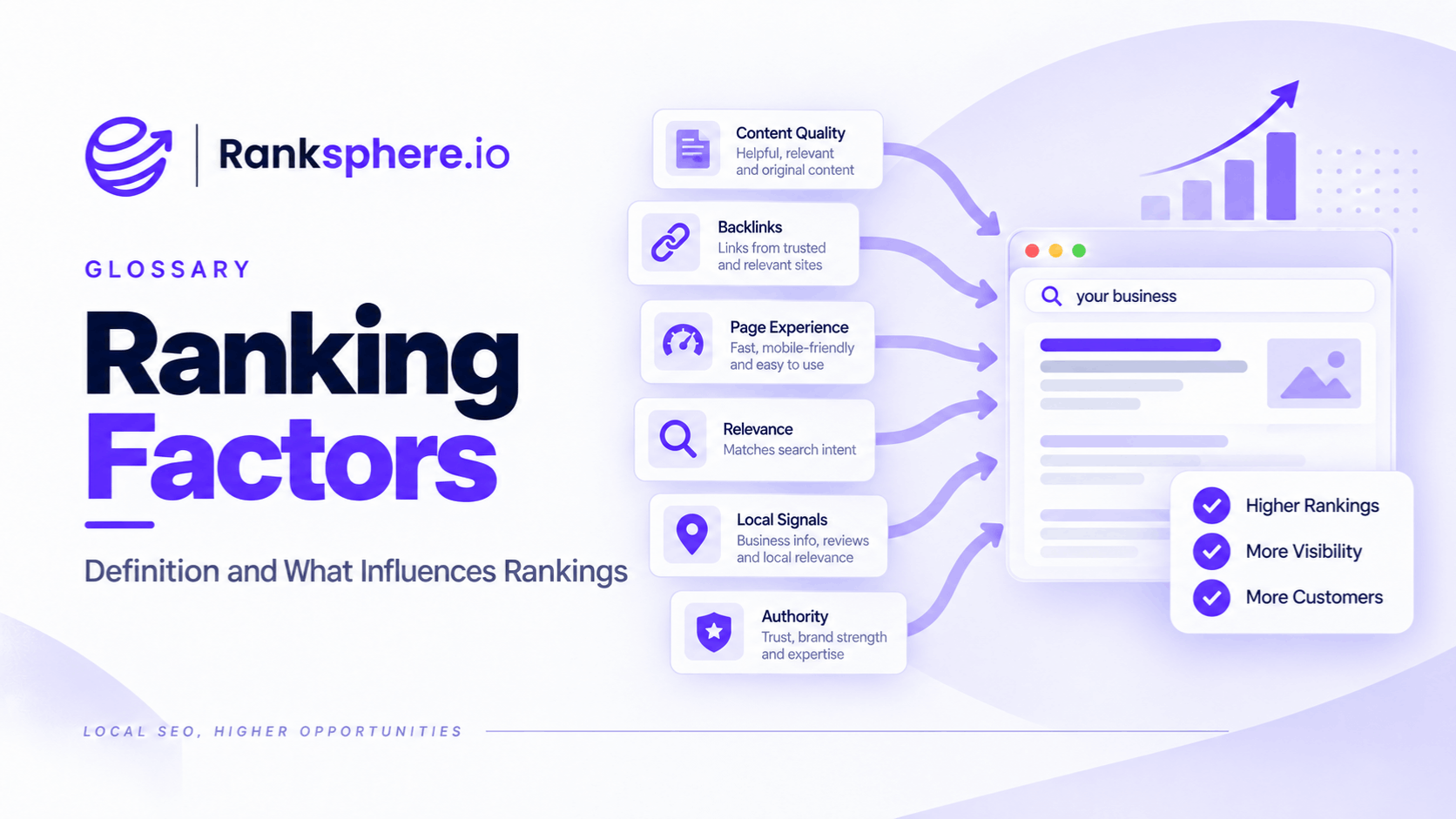
Ranking factors are the signals and information search engines use to decide which webpages or businesses appear in search results and how they are ordered.
Google uses multiple ranking systems to evaluate relevance, usefulness, links, location and other characteristics of webpages.
However, Google has never published a complete list of its ranking factors or explained exactly how much weight each one carries.
That distinction matters because SEO advice often presents assumptions as established facts.
When someone claims a particular change will improve rankings because it is one of Google's 200 ranking factors, the first question should be whether Google has actually confirmed it.
For local businesses, the most useful guidance is considerably simpler. Google publicly identifies three main factors behind local rankings: relevance, distance and prominence.
Does Google Have 200 Ranking Factors?
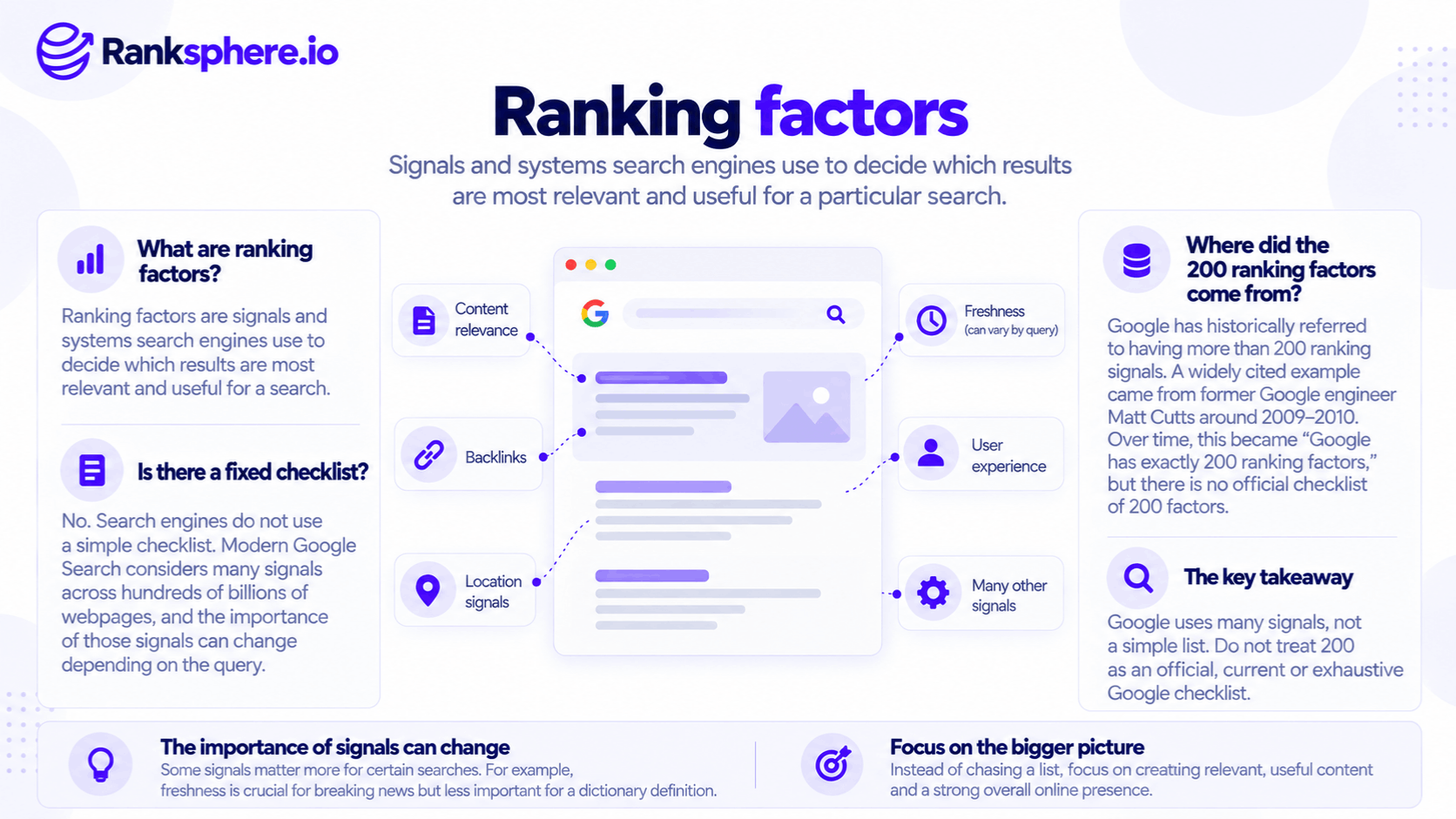
The idea that Google uses 200 ranking factors has circulated throughout the SEO industry for years.
It originated from Google's historical references to using more than 200 signals when evaluating search results.
However, Google never published an official list of 200 factors.
The number also doesn't describe how Google's current ranking systems operate.
Google uses multiple systems that interpret information differently depending on the search query and its context.
For example, freshness may matter considerably when someone searches for a recent news event but much less when they search for a basic mathematical definition.
This makes a fixed list of equally important ranking factors misleading.
Most articles claiming to reveal Google's 200 ranking factors combine documented information, industry research, assumptions and outdated advice.
They should not be treated as official Google documentation.
Which Google Ranking Factors Are Confirmed?
Google documents several ranking systems and signals.
These are among the better-supported considerations.
1. Relevance to the Search Query
Google aims to show results that match what someone is looking for.
For example, someone searching for "emergency plumber in Bristol" is likely looking for a plumbing service, not a general article about how plumbing systems work.
Content, context and search intent all help determine relevance.
Google also uses systems such as RankBrain and neural matching to understand relationships between words and concepts.
Simply repeating a keyword doesn't guarantee relevance.
2. Helpful and Reliable Content
Google's ranking systems aim to surface information that is useful and reliable.
Its guidance on E-E-A-T encourages publishers to consider experience, expertise, authoritativeness and trustworthiness.
However, E-E-A-T isn't a single ranking factor or a numerical score.
Instead, Google uses multiple signals that can help identify qualities associated with useful and trustworthy content.
This is particularly important for health, finance, legal advice and other topics where inaccurate information could cause harm.
3. Links and PageRank
Google confirms that links remain part of its ranking systems.
Its original PageRank algorithm has evolved but continues to contribute to ranking.
Relevant backlinks can help Google understand relationships between webpages.
However, having more backlinks doesn't automatically mean a page will rank higher.
Google also uses systems to detect and neutralise manipulative link practices.
4. Core Web Vitals and Page Experience
Google confirms that Core Web Vitals are used by its ranking systems.
These metrics evaluate loading performance, responsiveness and visual stability.
However, Google doesn't recommend chasing perfect performance scores solely to improve rankings.
A useful, relevant page may still rank above a faster page.
Page experience matters, but it isn't a substitute for satisfying the searcher's needs.
5. HTTPS
Google has confirmed HTTPS as a lightweight ranking signal.
More importantly, HTTPS helps protect information exchanged between the visitor and the website.
Businesses should use it for security and customer trust, not because switching to HTTPS guarantees a ranking increase.
6. Mobile Content
Google primarily uses the mobile version of a website for indexing and evaluating its content.
This is known as mobile-first indexing.
However, mobile-first indexing is an indexing approach rather than a separate ranking score awarded to mobile-friendly websites.
Businesses should ensure important content is accessible and usable on mobile devices.
7. Freshness When Relevant
Google has ranking systems designed to show fresher results when a query calls for recent information.
For example, someone searching for the latest mortgage rates needs current information.
Someone searching for the definition of a common SEO term may not.
Updating the publication date of an article without making meaningful changes doesn't automatically improve rankings.
What Is Not a Confirmed Google Ranking Factor?
Several commonly discussed SEO metrics aren't established direct Google ranking factors.
| Metric or tactic | What to know |
|---|---|
| Domain Authority | A third-party metric, not Google's PageRank |
| Social signals | Likes and follower counts aren't established direct organic ranking factors |
| Meta keywords | Google explicitly ignores this tag for indexing and ranking |
| Keyword density | Google publishes no required percentage |
| Word count | No universal minimum or ideal length determines rankings |
| Google Analytics bounce rate | Not an established direct Google ranking input |
| Readability scores | No required Flesch score or third-party readability threshold |
| Domain age alone | An older registration doesn't guarantee better rankings |
Some of these measurements can still be useful.
For example, readability helps determine whether people can understand your content.
The distinction is that improving a useful editorial metric doesn't necessarily mean Google uses that exact metric in its ranking algorithm.
What Are the Three Main Local SEO Ranking Factors?
For local businesses, Google provides more specific guidance.
According to its official documentation, local results are mainly based on relevance, distance and prominence.
Relevance
Relevance describes how closely a business matches the search.
For example, a dental practice offering orthodontic treatments should provide accurate information about those services.
Selecting appropriate Google Business Profile categories and maintaining detailed business information helps Google understand what the practice offers.
However, adding more categories or services isn't automatically better. The information must accurately represent the business.
Distance
Distance concerns how far a business is from the searcher or the location associated with their query.
For example, a plumber may appear prominently in results close to their operating location but rank differently across surrounding towns.
Businesses cannot eliminate distance from Google's local ranking calculations by adding keywords to their websites.
Prominence
Prominence describes how well-known a business is.
Google explains that this can involve information such as links to the business and customer reviews.
It specifically confirms that more reviews and positive ratings can help local rankings.
However, prominence isn't determined by review count alone.
A competitor with 400 reviews doesn't automatically outrank a business with 100.
Relevance, distance and other available information still matter.
Why SEO Correlation Studies Can Be Misleading
SEO platforms frequently publish research comparing characteristics of high-ranking webpages.
For example, a study may find that pages ranking in the top positions tend to have more backlinks than lower-ranking pages.
That observation can be useful.
However, it doesn't prove that acquiring a particular number of links will produce the same ranking position.
Successful pages may attract more links because they already receive visibility.
Similarly, a page with detailed content may rank because it satisfies a complex query, not simply because it contains more words.
Correlation studies also tend to combine many different search queries.
Results from national informational searches may not apply to local Google Maps rankings.
Use correlation research to identify questions worth investigating, not as a checklist of ranking factors Google has supposedly confirmed.
How Should Local Businesses Use Ranking Factors?
Start with the factors Google actually documents and investigate the business's current weaknesses.
For example, a dental practice struggling to appear in local searches could review whether its Business Profile accurately describes its services, how rankings vary across its area, and what information Google has about its reputation.
Ranksphere's Local Rank Tracker helps businesses and agencies measure ranking positions across selected geographic grid points.
This makes it possible to investigate where visibility is stronger or weaker.
However, a geo-grid scan doesn't reveal Google's exact ranking calculations. It measures results, not the algorithm responsible for them.
For businesses, that distinction is more useful than trying to optimise an unverified list of 200 signals.
Common Ranking Factor Mistakes
- Treating Google's 200 ranking factors as an official list. No complete list has been published.
- Confusing vendor metrics with Google's signals. Third-party scores are estimates.
- Assuming correlation proves causation. High-ranking websites share characteristics for many reasons.
- Treating E-E-A-T as a numerical ranking factor. Google doesn't publish an E-E-A-T score.
- Chasing minor technical improvements while ignoring relevance. A faster page isn't necessarily the better answer.
- Applying general organic SEO research to local results. Maps rankings have additional geographic considerations.
- Assuming one factor determines rankings. Google evaluates multiple signals and systems.
Ranking Factor Best Practices
Use Google's Search Central and Business Profile documentation as the starting point.
Separate confirmed statements from industry interpretations.
For local businesses, assess relevance, distance and prominence before deciding what needs improvement.
Use consistent keywords and geographic settings when monitoring rankings, and measure enquiries alongside visibility wherever possible.
Avoid paying for optimisation based entirely on unsupported scoring systems or guaranteed ranking claims.
Example of Ranking Factors in a Local SEO Campaign
Consider a hypothetical dental practice reviewing a proposal from an SEO agency.
The proposal promises to optimise eighteen ranking factors, including Domain Authority, social engagement, bounce rate and keyword density.
The practice manager asks which of these factors Google actually confirms.
What the Audit Finds
Several proposed measurements are third-party scores or analytics metrics rather than established direct ranking factors.
Meanwhile, the practice's Google Business Profile has an inaccurate primary category and incomplete service information.
Competitors also have more recent customer reviews, although that alone doesn't explain the ranking difference.
What the Agency Changes
Instead of pursuing every item in the original proposal, the agency begins by correcting the business information.
It also helps the practice establish a compliant process for requesting genuine customer reviews.
The team monitors local rankings across consistent grid points, alongside profile interactions and appointment enquiries.
Example
“The work is based on observable problems and Google's documented local ranking guidance.
However, correcting a category or receiving more reviews doesn't guarantee a particular ranking improvement.
The agency still needs to monitor results and investigate other contributing factors.
Ranking factors are useful when they help explain what search engines evaluate. They become misleading when unverified claims are presented as a guaranteed formula for better rankings.
For local businesses, relevance, distance and prominence provide a more useful starting point than any unofficial list of 200 factors.”
See Also
- Local Ranking Factors — Google's three main considerations for local search results.
- E-E-A-T — Experience, expertise, authoritativeness and trust.
- Domain Authority — A third-party metric often confused with Google rankings.
- Social Signals — The difference between social engagement and search ranking signals.
- Google Search Essentials — Google's official technical requirements, spam policies and best practices.
- SEO — The wider practice of improving search visibility.