SERP volatility describes how much search-result positions are changing over a period of time.
SEO tools often measure it by tracking a large set of keywords and calculating how much the rankings move from one day to the next.
A high-volatility reading can indicate that search results are shifting more than usual.
It does not automatically mean:
- Google has confirmed an algorithm update
- Your website was affected
- Something is wrong with your SEO
- A specific ranking system caused the movement
SERP volatility is an industry monitoring concept, not an official Google ranking metric.
Its main value is context.
If your rankings move sharply at the same time that broader search results are unusually unstable, that is useful information.
But it is only the beginning of the investigation.
What is SERP volatility?
Search results are never completely static.
Rankings change because:
- Google updates its systems
- Competitors update pages
- New pages enter the index
- Search intent changes
- Content becomes more or less relevant
- Location and personalisation affect results
- Search-result features change
SERP volatility tools attempt to measure how much of that movement is happening across a wider sample of searches.
A relatively calm day might show minor movement across the monitored keyword set.
A highly volatile day might show substantial reshuffling.
The exact number depends on the provider.
SERP volatility is not a Google metric
Google does not publish an official:
“SERP volatility score.”
The indexes you see in SEO tools are created by third-party providers.
Each can use a different:
- Keyword sample
- Country
- Device type
- Industry classification
- Result depth
- Calculation
That means two tools can look at the same day and produce different volatility readings.
Neither necessarily has to be wrong.
They may simply be measuring different parts of Search.
How volatility trackers work
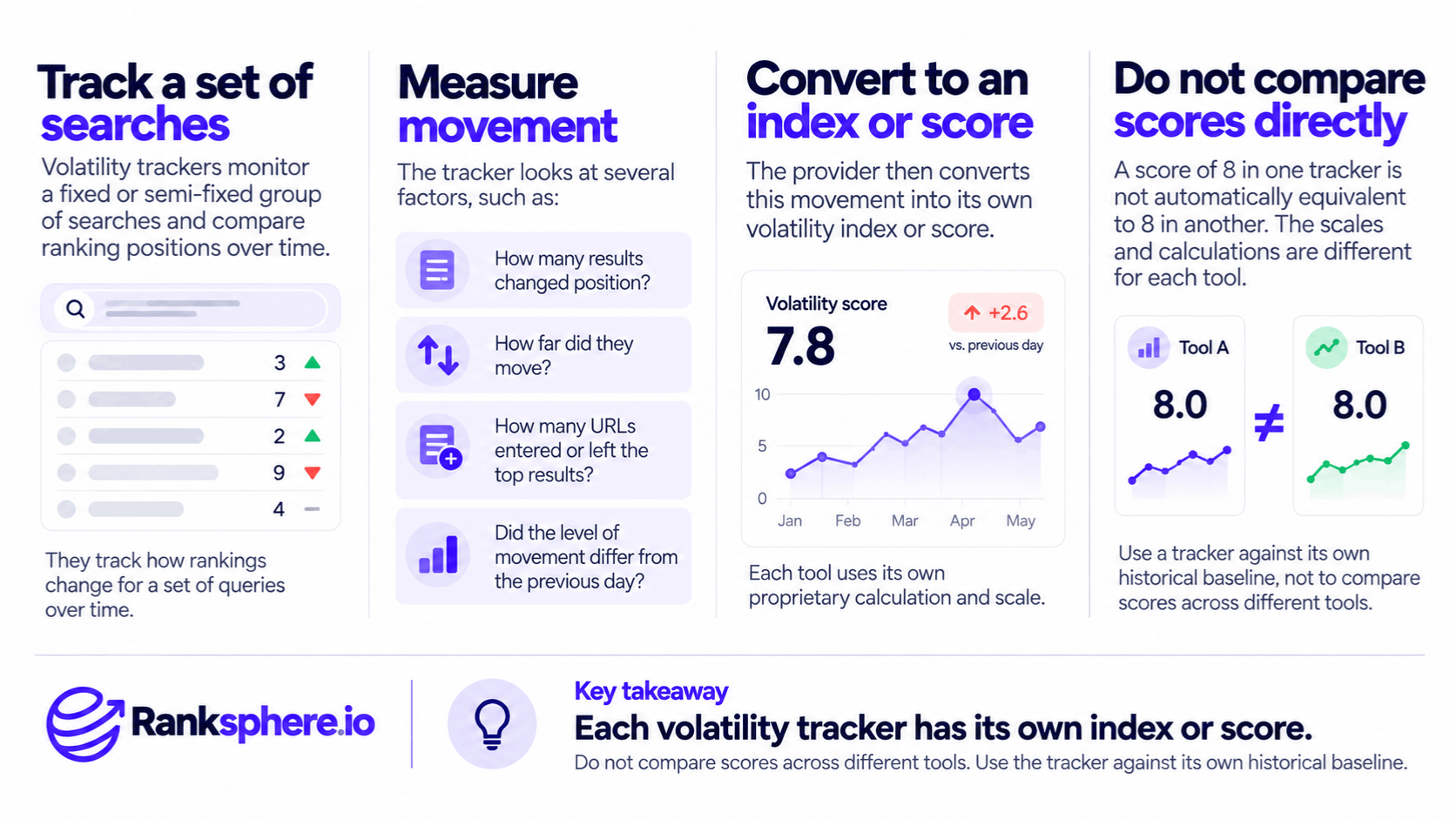
A typical SERP volatility tracker monitors a fixed or semi-fixed group of searches and compares ranking positions over time.
For example, it might ask:
- How many results changed position?
- How far did they move?
- How many URLs entered or left the top results?
- Did the level of movement differ from the previous day?
The provider then converts that movement into its own index or score.
The important phrase is:
its own.
Do not compare scores across tools directly
A score of:
8
in one tracker is not automatically equivalent to:
8
in another.
The scales and calculations are proprietary.
Use a tracker primarily against:
its own historical baseline.
For example:
today is unusually volatile compared with normal readings in this same tool
is useful.
Tool A says 7.2 and Tool B says 5.6, so Tool A detected a bigger update
is not a sound comparison.
What a volatility spike means
A spike means:
the rankings in that tool's monitored search set moved more than usual.
That is all you can conclude immediately.
It does not prove:
Google released an algorithm update.
The movement could reflect:
- An announced ranking update
- Unannounced ranking-system changes
- Search-result layout changes
- Changes concentrated in particular industries
- Changes in the monitored keyword set
- Normal broad ranking movement
Google says it continually updates its search algorithms, including smaller changes that are not announced because they are not widely noticeable.
So volatility and announced updates sometimes overlap.
They are not the same thing.
Confirmed Google updates
Google publishes significant ranking updates that are relevant to site owners through the Google Search Status Dashboard.
The dashboard can show:
- When an update begins
- Whether it is still rolling out
- When the rollout finishes
It also maintains historical information about ranking updates and wider Search incidents.
That makes it the better source for answering:
Has Google actually confirmed an update?
A third-party volatility chart cannot answer that.
Google does not announce every ranking change
The absence of an announcement does not mean:
nothing changed.
Google explicitly says smaller updates happen continually and are often not announced.
But the opposite assumption is equally weak:
volatility spike = secret Google update.
Without confirmation, you simply know that search results moved.
The underlying cause may remain unclear.
What SERP volatility is useful for
Volatility data is useful when it changes the context around your own data.
Understanding whether movement is broader
Suppose your site's rankings fall sharply on Tuesday.
If:
- Several independent volatility trackers show unusual movement
- Other sites in the sector also moved
- Google has announced an update
then you have stronger evidence that the change occurred within a wider Search shift.
That still does not explain why your site moved.
But it changes the first questions you ask.
Deciding where to investigate first
Imagine two situations.
Scenario A
Your site loses visibility.
The wider SERPs are relatively stable.
That makes site-specific causes particularly worth checking, including:
- Technical changes
- Indexing
- Content updates
- Migration problems
- Competitor improvements
Scenario B
Your site loses visibility during a major confirmed core-update rollout.
The first step may be to avoid drawing conclusions from one unstable day and wait until enough post-update data exists.
The volatility information changes the context.
It does not determine the diagnosis.
Volatility does not reduce the importance of a drop
Avoid rules such as:
“If everybody moved, your decline is lower priority.”
A major decline can still matter commercially regardless of whether the rest of the market was volatile.
Instead say:
broad volatility changes the hypothesis, not the importance.
You may investigate differently.
You should not automatically ignore the loss.
Core updates and analysis timing
For confirmed core updates, Google now gives fairly specific advice.
Google recommends:
- Confirm that the update has finished rolling out.
- Wait at least one full week after completion before analysing the change.
- Compare that post-update week with a comparable period before the rollout.
- Look at individual pages and queries to understand where the movement occurred.
That is more useful than reacting to daily movement while the update is still rolling out.
Why analysing mid-rollout can mislead
Rankings can change while a broad update is being deployed.
Google has previously warned that some complex updates can create more fluctuation while different systems are being updated.
So a ranking on:
day three
does not necessarily represent the state after the rollout finishes.
That does not mean:
do nothing whenever rankings fall.
Technical failures still need immediate attention.
It means:
do not redesign working content purely because rankings moved halfway through a confirmed broad ranking rollout.
Google says small and large drops should be treated differently
Google's current core-update guidance also distinguishes between:
Small drops
For example:
position 2 → position 4
Google says there is generally no need for drastic action.
Large sustained drops
For example:
position 4 → position 29
These justify a deeper assessment of the site and its content.
The principle is useful beyond the exact numbers:
magnitude and persistence matter.
Do not treat every ranking fluctuation as an emergency.
What volatility trackers cannot tell you
This is where their limitations become important.
They cannot prove your site was affected
A tracker measures:
its keyword set.
Your website may target:
- Different queries
- Different locations
- Different industries
- Different devices
A major spike in the tracker can happen while your site's important keywords barely move.
Check your own data.
They cannot explain why your site moved
A volatility index cannot tell you:
- Your content became less relevant
- Google changed a particular ranking signal
- A competitor improved
- Your links changed
- Your technical SEO broke
It measures movement.
Not cause.
They cannot tell you what to change
A spike does not create an action list.
Do not respond to:
high volatility
with:
- Rewrite all content
- Build more links
- Change title tags
- Delete pages
Those decisions require diagnosis from your own site data.
SERP volatility and Search Console
Google Search Console is far more useful for confirming whether your own organic visibility changed.
Look at:
- Clicks
- Impressions
- Average position
- Queries
- Pages
- Search type
Google itself recommends using Search Console to assess traffic changes around core updates.
A third-party tracker tells you:
Search may be unstable.
Search Console tells you:
your site actually gained or lost visibility.
Segment the impact
Do not stop at:
organic traffic fell 20%.
Break it down.
For example:
Pages
Which URLs lost?
Queries
Which topics lost?
Search type
Was the movement in:
- Web
- Images
- Video
- News
Google specifically recommends analysing different search types separately when assessing core-update impact.
This often turns a vague:
“the update hit us”
into something much more specific.
Sector-level volatility
Some third-party trackers provide category or industry views.
Those can be more useful than one global score.
For example:
A legal website may care more about movement in:
Legal
than:
Shopping
if the tracker has credible sector segmentation.
But sector categories are still defined by the provider.
They are not Google ranking-system categories.
Use them as context.
Local SERP volatility
Local search needs separate treatment.
A general organic volatility tracker may be monitoring national desktop searches from a controlled location.
A local business, meanwhile, may depend heavily on:
- Local pack visibility
- Searcher proximity
- Business Profile relevance
- Reviews
- Nearby competitors
Those are not necessarily represented well in a national organic volatility index.
Local results vary geographically
Google says local rankings are mainly based on:
- Relevance
- Distance
- Prominence
and distance depends on where the searcher is relative to the business.
That means local ranking variation can exist even on a completely normal day.
A ranking checked at:
Point A
can differ significantly from:
Point B
without any algorithm update.
Geo-grid tracking is more relevant for local visibility
Geo-grid rank tracking measures local visibility across a defined geographic area.
Instead of asking:
Did national SERPs become volatile today?
it can help answer:
Did our local-pack coverage actually change across the area we serve?
Ranksphere's rank tracker runs recurring scans with date-to-date comparison across the service area, making it possible to compare changes geographically over time.
For a local business, that is normally more relevant than a national volatility index.
Organic volatility and local-pack volatility are not the same thing
This distinction is important.
Suppose:
- Google's organic results move heavily during a core update
- Your local-pack grid also changes
You should not automatically conclude:
the core update caused the pack movement.
Those events may overlap without sharing the same cause.
Analyse:
Organic website performance
through Search Console and organic ranking data.
Local-pack visibility
through consistent local tracking and Business Profile data.
Keep the surfaces separate unless you have evidence connecting the change.
Local competitors can create volatility
Local visibility can move because something changed in the competitive environment.
For example:
- A new business opens nearby
- A competitor changes its profile
- A competitor accumulates more reviews
- A business closes
- Google changes which businesses it considers relevant
That movement does not require a broad Google algorithm update.
Local SERPs are competitive and geographic.
Normal ranking fluctuation
Some ranking movement is normal.
Google explicitly says Search results are dynamic and that changes in:
- User expectations
- Web content
- Search systems
can cause gains and losses over time.
That means:
ranking changed
is not itself evidence of:
ranking problem.
The question is whether the change is:
- Large
- Sustained
- Commercially meaningful
Do not create a fixed “normal movement” rule
The draft originally suggested:
positions moving one or two places between scans are normal.
That can often be true.
But do not turn it into a universal threshold.
Moving:
2 → 4
on an important query can matter.
Moving:
67 → 65
probably has little practical significance.
Context matters.
Look at:
- Starting position
- Search volume
- CTR
- Business value
- Persistence
instead of the numerical difference alone.
Daily tracking is not automatically noise
Likewise, avoid saying:
daily scans mostly measure noise.
Daily tracking can be very useful for:
- Detecting update timing
- Diagnosing sudden technical problems
- Understanding volatility
The mistake is reacting to every daily fluctuation as though it were permanent.
For ongoing reporting, weekly or longer-term trends may be easier to interpret.
For diagnosis, daily data can still be valuable.
A single scan is a snapshot
This principle is sound.
One ranking scan tells you:
what the tool observed under those conditions at that time.
It does not establish a trend.
A stronger comparison uses:
- Repeated scans
- The same locations
- The same keywords
- The same device
- The same grid configuration
Consistency makes movement interpretable.
Keep tracking settings stable
If you change:
- Grid size
- Grid spacing
- Search location
- Keyword set
- Device
you may change the result without changing the business's real visibility.
That makes before-and-after comparisons unreliable.
When monitoring volatility, measurement consistency matters almost as much as frequency.
Search-result features can create apparent volatility
A ranking tool may also respond differently when the SERP itself changes.
For example, Google might introduce or remove:
- Local results
- AI Overviews
- Featured snippets
- Video results
That can change:
- What appears
- How tools count positions
- User click behaviour
So a ranking movement does not always mean the underlying page relevance changed.
Check the actual SERP feature mix when important queries behave unexpectedly.
Volatility is not a KPI
SERP volatility tells you about the environment.
It does not tell you whether the SEO campaign succeeded.
A business cannot meaningfully set a target such as:
“keep volatility under 3.”
You do not control the wider SERP.
Track outcomes such as:
- Organic clicks
- Leads
- Revenue
- Local visibility
- Conversions
and use volatility to interpret unusual movement.
See KPI for the distinction.
Do not optimise for volatility
You cannot optimise your website so that Google Search stops moving.
The objective is not:
stable rankings every day.
It is:
a site that remains useful, technically sound and competitive as Search changes.
Some fluctuation is unavoidable.
What to do when rankings suddenly move
A practical process is:
- Confirm the drop in your own data.
- Check whether the issue affects one query, one page or the whole site.
- Check Search Console indexing and technical health.
- Check the Google Search Status Dashboard.
- Use third-party volatility trackers for broader context.
- If a confirmed update is rolling out, avoid premature content changes unless there is an obvious independent problem.
- Analyse sustained performance after the rollout.
That order prevents:
volatility chart first, panic second.
Technical issues should not wait
There is an important exception to the “wait” advice.
If you discover:
- Accidental noindex
- Robots blocking
- Server outage
- Broken canonicalisation
- Failed migration
- Major rendering problem
fix it.
A confirmed Google update does not justify leaving obvious technical problems unresolved.
Waiting applies to attributing ranking movement to the update, not to ignoring genuine site failures.
Do not undo good work because of one bad week
Google's core-update guidance specifically advises against drastic changes when the decline is small and recommends assessing sustained, significant drops more carefully.
That is particularly important for:
- Useful content
- Pages that still convert
- Commercial pages that remain strong
A week of volatility is not enough reason to rebuild everything.
Analyse winners as well as losers
When rankings move, SEO teams often inspect only declining pages.
Look at gains too.
Ask:
- Which topics improved?
- Which page types held?
- Which queries stayed stable?
- Which competitors replaced the losing pages?
This can reveal much more than examining losses in isolation.
Competitor movement provides context
Suppose your page falls:
4 → 8.
Ask what replaced it.
If four competitors with substantially different content moved above you, that tells a different story from:
your own page disappeared from the index.
SERP analysis should include:
- Your movement
- Competitor movement
- Result type
- Search intent
not only your rank-tracker line.
Do not assume every volatility spike requires action
Many volatility spikes pass without requiring a site change.
Google's own Status Dashboard FAQ notes that when a ranking-system update is posted, often there is no specific action needed.
The correct response may simply be:
- Monitor
- Gather data
- Compare after completion
Action should follow evidence.
Current Google update history
The Google Search Status Dashboard maintains the official history of announced ranking updates.
For example, Google's 2026 history currently includes confirmed core and spam updates, including the March and May core updates and later spam updates.
This history is more reliable for confirming:
Google announced an update
than retrospective claims based only on a volatility chart.
Common SERP volatility mistakes
- Treating a third-party volatility index as an official Google metric.
- Assuming a spike means Google confirmed an algorithm update.
- Assuming the tracker represents every website or keyword.
- Comparing numerical volatility scores across different tools.
- Using national organic volatility as the main explanation for local-pack movement.
- Assuming a confirmed core update caused every ranking change that happened during the same week.
- Reacting to one daily ranking movement as though it were permanent.
- Treating all one- or two-position changes as meaningless.
- Assuming daily tracking itself is useless noise.
- Changing content while a confirmed update is still rolling out without a separate reason to do so.
- Waiting to fix obvious technical SEO problems simply because an update is underway.
- Using volatility as a client KPI instead of contextual information.
SERP volatility best practices
- Treat volatility as context rather than diagnosis.
- Check your own Search Console and ranking data before drawing conclusions from a third-party tracker.
- Use the Google Search Status Dashboard to confirm announced ranking updates.
- For confirmed core updates, wait until the rollout finishes and then follow Google's recommendation to allow at least a full week before comparing performance.
- Compare equivalent periods before and after an update.
- Analyse affected pages, queries and search types separately.
- Use category-level tracker data where it provides more relevant context than the global index.
- Use geo-grid rank tracking for geographically sensitive local visibility.
- Keep grid, keyword, device and location settings consistent across comparisons.
- Separate organic ranking changes from local pack changes.
- Fix genuine technical problems immediately rather than blaming them on volatility.
- Judge sustained trends and business impact instead of reacting to every daily movement.
Example
“Consider a hypothetical law firm called Hartwell Legal.
The firm's organic Search Console performance drops sharply over several days.
The first reaction is:
“Something on the website is broken.”
Before changing anything, the team checks:
- Search Console
- Indexing
- Server health
- Recent deployments
No obvious technical problem appears.
A third-party volatility tracker shows unusually strong movement across the wider search market.
That is useful context.
Then the team checks Google's Search Status Dashboard.
A core update is currently rolling out.
At this point, the agency does not conclude:
“The update definitely caused Hartwell's loss.”
It simply knows that a significant Google ranking update and broader SERP movement are occurring at the same time.
Following Google's current guidance, the team waits until the core update has finished and allows a full week before carrying out the main comparison.
Then it compares:
- A stable pre-update period
- A stable post-update period
The loss is not uniform.
Several informational guides have lost substantial visibility.
The firm's main commercial service pages remain comparatively stable.
That is a much more useful diagnosis than:
“the whole site was hit.”
The team can now investigate the affected content specifically.
At the same time, Hartwell's local-pack grid is analysed separately.
If local coverage changed, the agency does not automatically attribute that movement to the organic core update.
It examines:
- Geography
- Competitors
- Business Profile changes
- Local visibility trends
as a separate dataset.
No invented recovery figures are needed.
The lesson is in the process:
SERP volatility can tell you that the search environment is unusually unstable. It cannot tell you why your site moved or what you should change. Confirm the movement in your own data, check whether Google has announced an update, keep organic and local results separate, and diagnose sustained changes only after you have enough stable data to make the comparison meaningful.”
See also
- Google algorithm update — confirmed changes that can coincide with wider volatility
- Rank tracking — monitoring your own search positions over time
- Geo-grid rank tracking — measuring geographic changes in local visibility
- Google Search Console — confirming whether your own site actually gained or lost search performance
- Local pack — a geographically sensitive search surface that general volatility trackers may not represent well
- KPI — why market volatility provides context rather than measuring campaign success