A SERP feature is an SEO industry term for a search-result element that goes beyond a standard text listing.
Depending on the query, Google may show elements such as:
- A local pack
- AI Overviews
- Featured snippets
- People Also Ask
- A knowledge panel
- Rich results
- Image results
- Video results
- Shopping results
- Ads
- Related searches
Google itself uses several different terms for these elements, including visual elements, rich results, exploration features, local results and AI features rather than treating “SERP feature” as one official product category.
For SEO, the terminology matters less than understanding what the search results actually contain.
SERP features matter because they can change:
- What searchers see first
- Which result types receive attention
- How much screen space traditional organic results receive
- Which format appears to satisfy the query
- What a ranking position is realistically worth
They are also useful clues when analysing search intent.
What does SERP mean?
SERP stands for:
Search Engine Results Page
It is the page a search engine returns after somebody performs a search.
A simple SERP might contain mostly traditional text results.
A more complex one could contain:
- Ads
- An AI Overview
- A local pack
- People Also Ask
- Videos
- Organic listings
all for the same query.
That means:
ranking number three
does not always describe the same level of visibility.
Position three on a relatively simple results page is very different from position three underneath several large search features.
SERP features are not fixed
Google Search results change according to many factors.
Google's current Search Central documentation says visual elements may appear differently depending on things such as:
- Device
- Country
- Search language
- Query
and that their appearance can change over time.
So avoid thinking of a keyword as permanently having:
“this SERP layout.”
A feature may:
- Appear
- Disappear
- Move
- Change format
over time.
That is why SERP analysis should be repeated rather than completed once and forgotten.
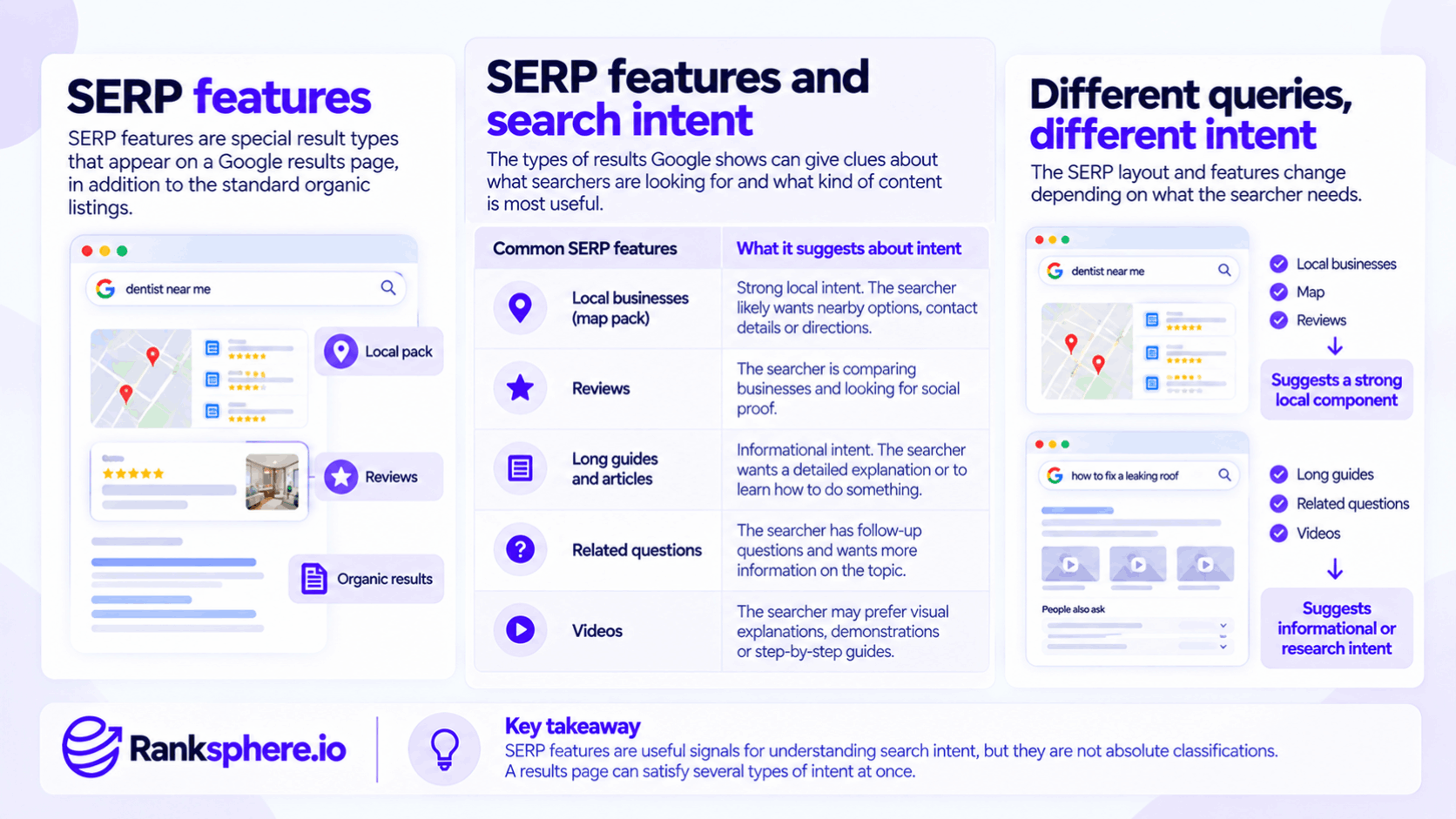
SERP features and search intent
One of the most useful applications of SERP analysis is understanding what kinds of results Google currently considers useful for a query.
For example:
If a query returns:
- Local businesses
- A map
- Reviews
that suggests a strong local component.
If it returns:
- Long guides
- Related questions
- Videos
the searcher may need explanation or research.
But these are signals, not absolute classifications.
A results page can satisfy several types of intent at once.
SERPs can contain mixed intent
Consider:
boiler replacement
One searcher may want to:
- Understand the process
- Compare prices
- Find an installer
- Work out whether repair is still possible
Google may therefore show a mixture of:
- Service businesses
- Informational content
- People Also Ask
- Ads
That does not mean Google has chosen one single intent.
It means the query supports several useful result types.
So use SERP features as evidence when assessing intent rather than treating them as a rigid rule.
Local pack
The local pack is the group of local business results commonly shown with map information.
It may contain information such as:
- Business names
- Ratings
- Location
- Opening information
- Profile details
For a business serving a defined geographical area, the local pack can be an important search surface.
But avoid saying:
“The local pack is always the most valuable SERP feature.”
Its value depends on:
- Query
- Business model
- Location
- Conversion behaviour
For many local service queries it is extremely important.
For informational searches, it may not appear at all.
Local pack presence suggests local intent
If Google shows a local pack for:
emergency plumber
that is useful evidence that location and nearby providers matter to the search.
But the conclusion should not be:
“Only the Business Profile matters.”
Google says local ranking is mainly based on:
- Relevance
- Distance
- Prominence
and explains that prominence can also be informed by factors such as websites linking to the business and reviews.
A Google Business Profile is central to the local result.
The wider web presence still matters.
Local pack and organic rankings are different
A business can perform differently in:
Local results
The map and business listings.
Organic results
The normal website results underneath or around them.
A business might:
- Rank well organically but poorly in the pack
- Rank strongly in the pack but have a weak organic page
Those situations require different diagnosis.
Ranksphere's rank tracker separates pack and organic position across your service area, which helps distinguish local-pack visibility from traditional organic performance.
AI Overviews
AI Overviews are generated responses in Google Search that can bring together information from multiple sources and show supporting links.
Google says AI Overviews are shown where its systems believe they add something useful beyond classic Search results.
They should not be described simply as:
“an informational-query feature.”
Google's broader AI Search systems can support:
- Complex questions
- Exploration
- Comparisons
- Multi-part research
and may use several related searches to build a response.
AI Overview presence is not a page-type instruction
If an AI Overview appears, do not automatically conclude:
“Build a blog post.”
First inspect:
- Which pages are cited
- Which types of sources appear
- What the underlying question requires
- Whether the query also has commercial or local results
A service page may still be relevant to one part of the query.
A guide may be better for another.
The SERP as a whole provides the context.
There is no special AI Overview optimisation formula
Avoid advice such as:
“Write a question heading followed by a 40-word answer and Google will cite it.”
Google says there are no additional technical requirements or special optimisations required to appear in AI Overviews or AI Mode.
The same foundational SEO practices apply, including:
- Being indexable
- Being eligible to appear with a snippet
- Creating useful, reliable content
- Making important information available in text
- Using relevant images and videos where helpful
- Keeping Business Profile information accurate
Clear structure can make content easier for people to understand.
It is not an AI citation switch.
AI search visibility can now be measured separately
This area changed in 2026.
Google introduced dedicated Search Generative AI performance reports in Search Console in June 2026 and says the reports were rolled out to all websites worldwide by 31 August 2026.
The reports can show information such as:
- Generative AI impressions
- Pages appearing in AI features
- Countries
- Devices
- Trends over time
including visibility in AI Overviews and AI Mode.
That provides a better source of evidence than guessing AI visibility from ordinary rankings alone.
Featured snippets
A featured snippet is a special result where Google highlights information from a webpage, typically showing the descriptive content before the standard title link.
Google also says featured snippets can appear inside People Also Ask results.
The important point is:
you cannot mark a page as a featured snippet.
Google explicitly says its systems decide whether a page is suitable for the query.
Featured snippets can suggest answer-seeking behaviour
If a query consistently produces a featured snippet, that may indicate users benefit from a concise answer.
That can help with content planning.
But avoid saying:
“Featured snippet = informational intent, therefore a commercial page cannot rank.”
Search intent can be mixed.
The snippet is one part of the SERP.
Check the other results too.
No official featured-snippet word count exists
There is no Google rule saying:
answers should contain 40–60 words
to win featured snippets.
Google's current documentation explicitly says it does not provide a fixed minimum snippet length because the required amount varies according to factors such as the information, language and platform.
Write the amount required to answer the question clearly.
People Also Ask
People Also Ask is Google's related-questions feature.
Google describes it as a group of questions related to what the user initially searched for.
When someone expands a question, Google can show a featured snippet answering it.
This makes PAA useful for:
- Understanding related questions
- Expanding topic research
- Identifying areas users may need explained
It is not a list of keywords you automatically need separate pages for.
PAA does not automatically mean informational-only intent
People Also Ask can appear alongside:
- Local results
- Shopping results
- Commercial listings
- Organic service pages
So:
PAA present = write a guide
is too simplistic.
Instead, ask:
Does one of these questions belong naturally on the page we are already building?
Often it does.
Knowledge panels
A knowledge panel presents information Google associates with a recognised person, place, organisation or other entity.
Their appearance is particularly common for searches strongly associated with a specific entity.
That makes a knowledge panel useful evidence that Google is interpreting the search as entity-focused.
But avoid reducing this to:
knowledge panels only appear on branded searches.
Entity-driven searches can take many forms.
Rich results
Rich results are enhanced Google Search appearances that often rely on structured data.
Depending on the supported feature, they may display additional information such as:
- Product information
- Recipe details
- Review information
- Event details
Google says structured data helps it understand page information and can make a page eligible for certain richer search appearances.
The keyword is:
eligible.
Structured data does not guarantee rich results
Valid structured data does not guarantee that Google will display a rich result.
Google explicitly states that even correctly implemented markup may not result in the feature being shown.
So avoid reporting:
“Schema added, therefore rich result achieved.”
The correct statement is:
“The page is eligible for the supported feature.”
Google decides whether and when to show it.
Image results
Image-heavy search results can indicate that visual information is useful for the query.
Examples may include:
- Interior design
- Hairstyles
- Landscaping
- Products
- Travel destinations
Google says image results are more likely to appear for image-seeking queries.
That provides a useful content clue.
If users clearly benefit from visual evidence, a page consisting entirely of text may be weaker than one containing useful original images.
Optimising for image visibility
Google recommends image SEO practices such as:
- Making images crawlable
- Using useful landing-page context
- Providing appropriate descriptive information
Alt text helps Google understand images and supports accessibility, but it should describe the image rather than become a keyword field.
Do not reduce image optimisation to:
keyword-rich filename + keyword-rich alt text.
The image itself and the page containing it matter.
Video results
Video results are more likely where Google believes users benefit from video content.
That can provide a useful format clue.
For example:
how to reset a boiler
may lend itself naturally to a demonstration.
But a video feature does not mean every competing business needs to start a YouTube channel.
Ask whether video genuinely improves the answer.
Shopping results
Shopping-oriented features can be strong evidence of commercial or transactional behaviour.
For example:
buy running shoes
is very different from:
how should running shoes fit?
The first may contain:
- Products
- Prices
- Shopping results
while the second may favour:
- Guides
- Videos
- Explanations
But mixed SERPs are common.
A query can contain both product results and informational content because users may still be researching before purchasing.
Ads
Ads are not organic SERP features in the same technical sense as featured snippets or rich results, but they matter when analysing the page because they occupy attention and screen space.
If several ads appear before organic results, the organic position may be visually lower than the ranking number suggests.
That matters when interpreting:
- CTR
- Traffic
- Ranking value
But do not assume ads always reduce organic clicks by a specific percentage.
The effect depends on the query and user behaviour.
SERP features and click-through rate
SERP layouts can influence click-through rate.
For example, the same organic position may appear:
SERP A
- Organic result
SERP B
- Ads
- AI Overview
- Local pack
- Organic result
The ranking number alone does not capture that difference.
So if:
- Average position remains relatively stable
- Impressions remain stable
- Clicks decline
a change in the search-results layout is one thing worth investigating.
It is not the only possibility.
Also check:
- Title and snippet changes
- Demand
- Device mix
- Competitor results
- Seasonality
A CTR decline does not prove a SERP feature caused it
This is another place to avoid overclaiming.
Suppose CTR falls from:
8% to 5%.
At the same time an AI Overview appears.
That is useful evidence.
It does not prove the AI Overview caused all of the decline.
Other things may have changed simultaneously.
Treat SERP changes as part of the diagnosis rather than a complete causal explanation.
SERP features can change the meaning of “position”
A simple ranking report might say:
Keyword: position 2
That sounds strong.
But if the result appears underneath:
- Ads
- A local pack
- PAA
the actual visual exposure may differ significantly from a cleaner SERP.
This is why ranking reports should contain some context around important search-result layouts.
A ranking number is not the entire user experience.
SERP features as keyword-research data
Before prioritising a keyword, inspect its current results.
Ask:
- Is there a local pack?
- Is there an AI Overview?
- Are the results service pages or guides?
- Is PAA present?
- Are images or video prominent?
- Are shopping results present?
This helps explain what types of experiences Google currently considers useful.
Use this alongside:
- Search volume
- Commercial relevance
- Competition
- Search intent
instead of relying on a keyword tool's intent label alone.
Keyword-tool intent labels are estimates
SEO tools commonly classify queries as:
- Informational
- Navigational
- Commercial
- Transactional
Those classifications can be useful.
But the live SERP provides additional context that a static label may miss.
For example, a tool may call a keyword:
commercial
while Google displays:
- A local pack
- Guides
- PAA
- Service pages
That tells you the query is more complex than the label suggests.
Do not let the SERP dictate page format mechanically
The opposite mistake is copying whatever currently ranks.
For example:
“Eight guides rank, so we must write another guide.”
That may be sensible.
But also ask:
- Can we provide something genuinely useful?
- Do we have relevant expertise?
- Does this query matter commercially?
- Is another URL necessary?
SERP analysis informs content strategy.
It should not turn into template copying.
Targeting the local pack
For local pack visibility, focus on legitimate local-search fundamentals.
Google's current guidance emphasises:
- Accurate Business Profile information
- Relevance
- Distance
- Prominence
- Reviews
and notes that links can contribute to prominence.
Do not promise:
“complete your profile and you will enter the pack.”
Distance cannot simply be optimised away.
Targeting featured snippets
You cannot directly mark a page as a featured snippet.
Google chooses them automatically.
What you can do is create content that:
- Answers the question clearly
- Uses sensible headings
- Provides useful context
- Is crawlable and indexable
That improves the page generally.
It does not guarantee the feature.
Targeting People Also Ask
Treat People Also Ask as topic research.
If relevant questions belong naturally on the page, answer them.
Do not create:
- A separate page
- A separate FAQ
- A paragraph
for every PAA question simply because Google displayed it once.
Google itself says related-question features can be useful when deciding topics to write about, but you cannot directly control what appears there.
Targeting AI Overviews
For AI Overviews, avoid invented AEO formulas.
Google says the same foundational SEO principles apply:
- Useful content
- Technical accessibility
- Internal discoverability
- Good page experience
- Important information in text
- Appropriate images and video
- Accurate structured data
- Accurate Business Profile data
No special AI schema or machine-readable AI file is required.
That is a stronger basis for optimisation than:
“put the answer in 50 words.”
Targeting rich results
For rich results:
- Use a supported structured data type.
- Make sure it accurately reflects visible content.
- Follow the feature-specific requirements.
- Validate the implementation.
Then remember:
eligibility is not display.
Google decides whether the rich result is appropriate for the user and query.
Targeting knowledge panels
A knowledge panel should not be treated as something you create with one schema block.
Useful entity work includes making factual information about the business consistent and understandable across relevant sources.
But there is no guaranteed:
knowledge panel optimisation checklist
that forces Google to show one.
See entity for the wider concept.
Targeting image results
For image visibility:
- Use useful original images where possible
- Place them on relevant pages
- Make them crawlable
- Use descriptive alt text
- Provide useful surrounding context
Google's image guidance focuses on discoverability and the quality and relevance of the landing page as well as the image itself.
Do not treat filenames alone as an image-ranking strategy.
SERP features and local SEO
For local SEO, it is useful to track at least two separate layers:
Local-pack visibility
Where the Business Profile appears geographically.
Organic visibility
Where the website ranks.
A third layer now increasingly matters:
Generative AI visibility
Where pages appear in Google's AI features.
Google's 2026 Search Generative AI reports now provide dedicated impression data for AI features in Search.
These should not be collapsed into one ranking score.
SERP features and rank tracking
Ranksphere's rank tracker separates pack and organic position across your service area, which is particularly important for local businesses.
Suppose a business appears:
- Position 2 organically
- Position 7 in the local pack
for the same underlying query.
Saying:
“we rank number two”
would hide an important part of the picture.
Track the surfaces separately.
Features should influence prioritisation
A keyword may have good search volume but little realistic value to a specific business.
For example:
A highly informational query may produce:
- AI Overview
- PAA
- Guides
- Videos
while the business wants immediate service enquiries.
That does not make the keyword useless.
It means you should understand:
- The likely customer stage
- What content would be needed
- What success would look like
before investing.
You do not need to occupy every SERP feature
It is tempting to build an SEO strategy around:
“owning the SERP.”
In practice, not every feature is relevant or realistically controllable.
A local service business may not need:
- Shopping results
- Video results
- A featured snippet
for every commercially important query.
Prioritise features connected to:
- Your customers
- Your content
- Your business model
rather than collecting SERP appearances for reporting purposes.
SERP features change over time
A keyword that today shows:
- A featured snippet
- PAA
may look different six months later.
Google continually changes Search presentation.
Its own visual-element documentation explicitly notes that appearances change over time and vary by context.
That makes periodic rechecking important for high-value keywords.
Common SERP feature mistakes
- Treating “SERP feature” as one official Google product category.
- Assuming one feature proves a single search intent.
- Saying an AI Overview or featured snippet means a sales page cannot rank.
- Assuming a local pack means the website no longer matters.
- Treating People Also Ask as a list of pages you must create.
- Using question headings and short answers as a guaranteed featured-snippet or AI citation formula.
- Assuming valid structured data guarantees a rich result.
- Reading a CTR decline as proof that a new SERP feature caused it.
- Treating local-pack and organic position as the same ranking.
- Judging a keyword only by search volume without looking at the actual results page.
- Assuming SERP features remain stable indefinitely.
- Chasing features that have little connection to business outcomes.
SERP feature best practices
- Inspect the live SERP before prioritising an important keyword.
- Use features as evidence of likely intent rather than absolute rules.
- Look at the full result mix, not one feature in isolation.
- Track local pack and organic visibility separately.
- Review AI Overviews visibility using Google's current generative AI reporting where relevant.
- Create the page type that genuinely satisfies the user rather than copying competitors mechanically.
- Treat PAA questions as research rather than mandatory content slots.
- Use valid structured data for supported rich-result eligibility, not ranking guarantees.
- Use accurate alt text and useful visual content where image results matter.
- Re-check SERPs when CTR or traffic changes unexpectedly.
- Consider demand, snippet changes, device and seasonality alongside SERP features before assigning causation.
- Revisit important SERPs periodically because their composition changes.
Example
“Consider a hypothetical roofing company called Ashgate Roofing.
The team wants to target:
roof replacement cost
with its main roof-replacement service page.
Before rewriting the page, it inspects the search results.
The SERP contains:
- An AI Overview
- People Also Ask
- Several detailed cost guides
- Commercial roofing pages further down the results
There is no strong local pack in the version being analysed.
That suggests the query contains a substantial research component.
The conclusion is not:
“A service page can never rank.”
It is:
“A user searching this phrase appears to need detailed cost information before choosing a contractor.”
Ashgate therefore reviews whether its existing service page can satisfy that need naturally.
Instead of forcing several thousand words of pricing education into a booking page, it decides a separate guide would be useful.
The guide explains:
- What affects roof-replacement cost
- Why prices vary
- Materials
- Roof size
- Access
- Labour
- When a quote is required
The service page remains focused on:
- The service itself
- Process
- Evidence
- Enquiries
The two pages link to each other because they serve related but different needs.
For more directly local searches such as:
roofing contractor near me
the SERP looks different.
A local pack is prominent.
That tells the team that Business Profile visibility, geographic competition and local prominence deserve attention alongside the website.
No outcome is guaranteed.
The guide may or may not appear in:
- Organic results
- People Also Ask
- An AI Overview
and Business Profile improvements do not guarantee better pack rankings because distance and other factors still apply.
The value of the SERP analysis is that the team understands what kind of search experience it is competing within before deciding what to build.
That is the real purpose of SERP feature analysis.
SERP features are not a set of tricks to win individually. They are clues about how Google is presenting a query, what users may need and how much visibility a traditional ranking actually provides. Read the whole results page before deciding what the keyword requires.”
See also
- Search intent — using the result mix to understand what searchers may need
- Local pack — local business results shown in Search
- Featured snippet — highlighted answers selected automatically by Google
- AI Overviews — Google's generated Search responses with supporting links
- Click-through rate — how often search impressions become clicks
- Keyword research — where SERP analysis should inform keyword prioritisation