Service Level Agreement (SLA)
A service level agreement (SLA) is a documented commitment between a service provider and a client that defines measurable standards for delivering a service. It may cover response times, turnaround times, service availability, reporting deadlines, and what happens when agreed standards aren't met.
In SEO, an SLA helps establish what clients can expect from their agency beyond the work listed in the contract.
For example, an SEO agency may commit to responding to client enquiries within one working day, delivering monthly reports by a particular date, or acknowledging urgent website problems within four working hours.
These commitments are different from guaranteeing search rankings.
An agency can control how quickly it responds, when it delivers reports, and whether it completes agreed work. It cannot control Google's ranking algorithms or promise that a website will reach a particular position in search results.
A well-written SLA focuses on the standards the provider can reasonably deliver and gives both parties a clear way to measure whether those standards are being met.
What Should an SEO Service Level Agreement Include?
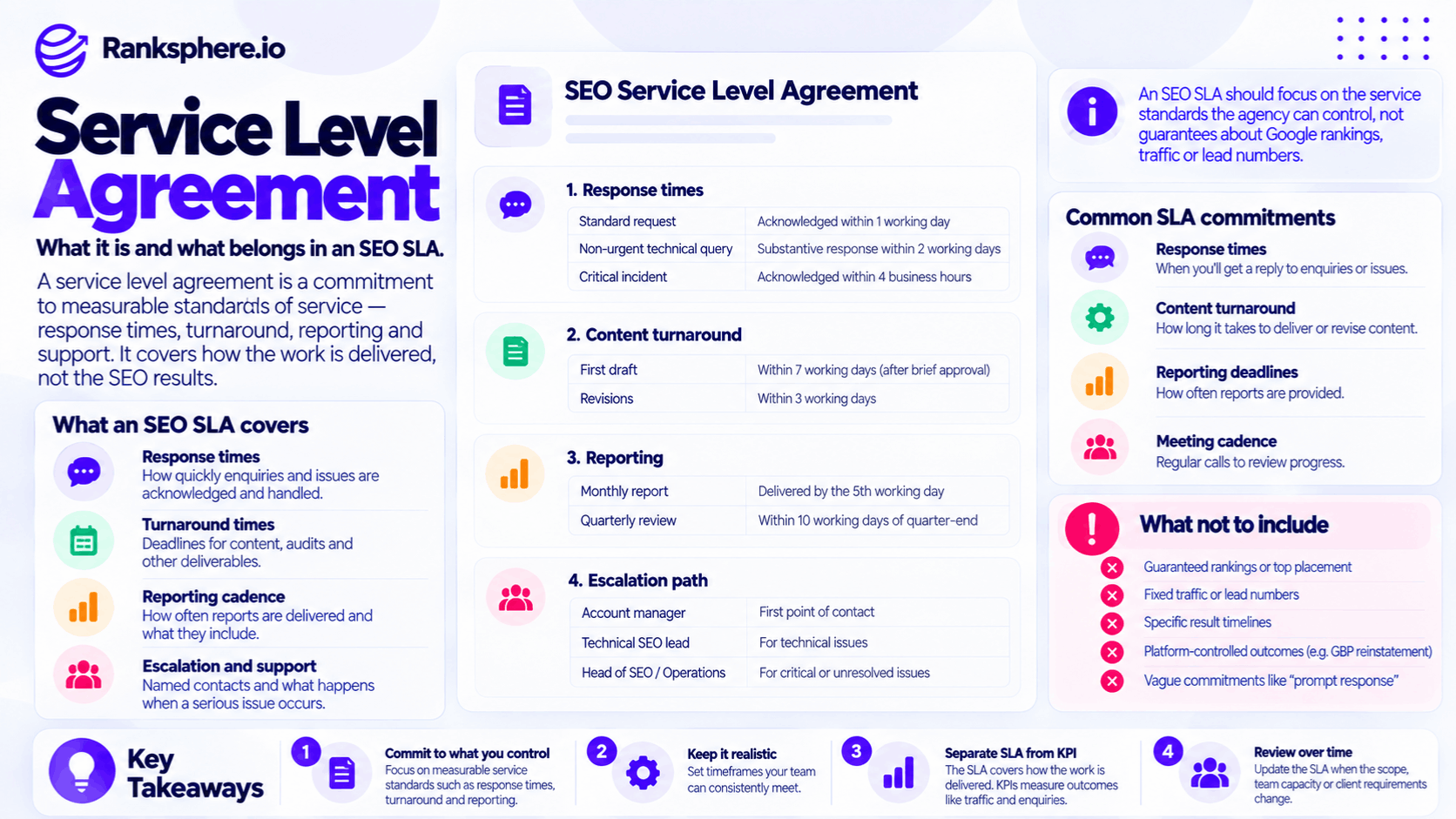
An SEO SLA should focus on specific commitments that can be measured.
Terms such as "prompt communication" or "timely delivery" sound reassuring, but they leave room for different interpretations.
It's better to define what those commitments mean in practice.
1. Client Communication and Response Times
Communication is one of the most common sources of frustration in agency relationships.
An SLA can specify how quickly the agency will acknowledge and respond to client requests.
For example:
- Initial acknowledgement: Within one working day.
- Substantive response: Within two working days.
- Urgent requests: Acknowledged within four working hours.
- Primary contact: A named account manager or designated team.
These are examples, not universal requirements.
The agency should choose commitments it can consistently meet based on staffing, workload, and operating hours.
It's also important to distinguish acknowledging a request from resolving it.
Confirming receipt within four hours doesn't mean every problem can be fixed within that period.
2. Google Review Response Turnaround
For agencies managing Google Business Profiles, an SLA may define how quickly customer reviews should be handled.
For example:
- Negative reviews flagged for attention within one working day.
- Approved review responses published within two working days.
- Reviews requiring client input escalated to the designated contact.
The exact commitment depends on the service agreement.
Some agencies draft responses for client approval, while others may have permission to publish them directly.
As explained in review response, responding to customer feedback is part of ongoing reputation management.
The SLA should make clear whether the agency is responsible for drafting, approval coordination, publishing, or all three.
3. Reporting Deadlines
Monthly reporting is often included in an SEO retainer.
An SLA can define when clients should expect those reports.
For example:
Monthly SEO reports will be delivered by the fifth working day of the following month.
This is more useful than simply promising regular reports.
The agreement should also specify what happens when reporting depends on external data sources or delayed client access.
A reporting commitment should focus on timely delivery and agreed reporting coverage, not promising that every metric will improve each month.
4. Content and Deliverable Turnaround
Content production, website updates, and other recurring SEO tasks may also have agreed turnaround times.
For example:
- First content draft delivered within seven working days of an approved brief.
- Requested revisions completed within three working days.
- Approved content scheduled for publication within five working days.
However, these commitments should account for client dependencies.
If the agency needs photographs, access credentials, brand information, or approval before proceeding, the turnaround period should begin only when those requirements have been met.
These dependencies should also be documented in the scope of work.
Otherwise, an agency may be held responsible for delays outside its control.
5. Meetings and Reviews
An SLA can establish how often the agency and client will meet.
For example:
- One monthly performance call
- One quarterly strategy review
- Additional meetings for significant issues
- Written meeting summaries within an agreed period
Meeting frequency should reflect the size and complexity of the engagement.
A small local business may only need a monthly review, while a larger multi-location client may require more frequent communication.
The important part is that both parties understand the expectation.
6. Escalation Procedures
Sometimes a request cannot be resolved through the usual account contact.
An SLA should explain what happens next.
It may identify:
- Who handles urgent concerns
- When a request should be escalated
- How quickly a senior team member will respond
- Which communication channel should be used
- What happens if the original issue remains unresolved
A defined escalation path prevents clients from having to chase several people to find someone who can help.
7. Incident Response Commitments
Urgent SEO problems deserve particular attention.
Examples include:
- Important pages accidentally marked noindex
- A website becoming inaccessible to search engines
- A failed website migration
- A sudden indexing problem
- A Google Business Profile suspension
These issues may affect customer enquiries and business operations.
An SLA can define how quickly the agency will investigate or acknowledge a reported incident.
For example:
Critical incidents will be acknowledged within four working hours of notification.
That is a measurable service commitment.
However, the SLA should distinguish between response time and resolution time.
An agency may be able to investigate a suspension quickly but cannot guarantee how long Google will take to review or reinstate a Business Profile.
This distinction protects clients from unclear expectations and agencies from making commitments they cannot control.
What Should an SEO Agency Avoid Guaranteeing?
An SLA should focus on service standards, not outcomes controlled by external systems or influenced by factors outside the agency's control.
Guaranteed Search Rankings
An agency should avoid promising that a website will rank first for a particular keyword within a fixed period.
Google determines search rankings using its own systems.
An SEO agency can improve technical issues, create useful content, optimise business information, and develop a search strategy.
It cannot guarantee a specific position in Google's results.
Ranking targets can still be included as objectives or performance indicators, but they shouldn't be presented as guaranteed deliverables.
Guaranteed Traffic or Lead Volumes
Traffic and enquiries are influenced by factors such as:
- Search demand
- Competition
- Seasonality
- Customer behaviour
- Website performance
- Search engine changes
An agency can be accountable for carrying out agreed SEO activities and reporting results.
However, guaranteeing a particular number of organic visitors or leads may create expectations that aren't fully within its control.
Forecasts and targets should be clearly distinguished from contractual guarantees.
Guaranteed SEO Results Within a Fixed Period
SEO improvements don't follow identical timelines for every website.
A technical fix may be implemented quickly, but Google still needs to crawl and process the change.
Content performance may also depend on competition, search intent, and the quality of the wider website.
An SLA can commit to completing the work within a defined period.
It shouldn't guarantee exactly when that work will produce a particular ranking outcome.
Commitments Dependent on Client Approval
Agencies should also avoid unconditional deadlines for work requiring client participation.
For example, an agency may be ready to publish a service page but still be waiting for approval.
If the client takes three weeks to respond, the original delivery deadline may no longer be realistic.
The agreement should explain how deadlines change when required information, access, or approval is delayed.
What Happens When an SLA Is Not Met?
A service level agreement should explain how missed commitments are handled.
Without a defined process, disagreements may arise over whether the agency met its obligations or what should happen next.
The consequences don't need to be excessive.
They should be proportionate to the seriousness and frequency of the issue.
Service Credits or Additional Deliverables
Some agreements offer a limited service credit when defined standards aren't met.
Others may provide an additional agreed deliverable or corrective service.
For example, an agency might offer a partial fee credit after repeated failures to deliver reports by the agreed deadline.
The remedy should be clearly defined in the agreement rather than negotiated after every missed commitment.
Escalation to Senior Management
An SLA may require unresolved service issues to be escalated to a senior contact.
This gives the client another route to resolution when the normal communication process isn't working.
For example, repeated missed response deadlines could trigger a review with the agency's account director.
Performance Review Meetings
Repeated service failures may trigger a formal review.
The purpose is to identify what went wrong, agree on corrective actions, and prevent the issue from recurring.
For example, if content deadlines are regularly missed, the agency and client may need to review approval processes, workloads, or the original scope.
Termination Rights
Some agreements allow clients to end the contract after a defined number of serious or repeated service failures.
The terms should explain:
- What qualifies as a material breach
- Whether the agency has an opportunity to correct the issue
- The notice period
- Any applicable contractual remedies
These provisions should be appropriate to the contract and reviewed with legal advice where necessary.
The objective isn't to punish every minor delay.
It's to create accountability and a clear process when agreed standards aren't met.
Does Every Local SEO Client Need an SLA?
Not necessarily.
For a small business with a straightforward SEO engagement, a separate SLA document may add unnecessary complexity.
A clearly written scope of work can include response times, reporting deadlines, approval processes, and other service commitments.
However, some client relationships benefit from a more formal SLA.
Multi-Location Businesses
Multi-location SEO engagements often involve more people, locations, and recurring tasks.
An agency may be responsible for managing multiple Google Business Profiles, coordinating local content, reviewing business information, and reporting across dozens of locations.
Clearly defined service standards help keep these activities organised.
A delay affecting one location may be manageable.
The same delay repeated across fifty locations can create a much larger operational problem.
Franchise and Enterprise Clients
Larger organisations may have procurement, compliance, or vendor-management requirements.
They may expect formal commitments covering:
- Response times
- Reporting deadlines
- Escalation procedures
- Service availability
- Incident handling
- Remedies for missed commitments
An SLA helps the SEO agency meet those expectations without confusing service delivery standards with search performance guarantees.
White-Label SEO Partnerships
An agency providing SEO services to another agency may also need an SLA.
The reseller depends on the provider to complete agreed work on time so it can meet its own client commitments.
For example, delayed reports or content drafts may affect the reseller's relationship with its customers.
A formal SLA makes responsibilities and turnaround times clearer for both businesses.
Clients with Previous Communication Problems
Some businesses request an SLA because they've had poor experiences with another agency.
They may have dealt with:
- Unanswered emails
- Missed reporting deadlines
- Unclear responsibilities
- Slow responses to urgent issues
- Deliverables completed without communication
In these situations, measurable communication commitments can be more valuable to the client than ambitious performance promises.
Service Level Agreement vs Scope of Work
An SLA and a scope of work are closely related, but they serve different purposes.
| Area | Service Level Agreement | Scope of Work |
|---|---|---|
| Primary purpose | Defines service standards | Defines the work to be completed |
| Response times | Specifies communication deadlines | May identify communication responsibilities |
| Deliverables | Specifies service or delivery standards | Lists agreed tasks and deliverables |
| Reporting | Defines deadlines and service expectations | Defines report content and frequency |
| Missed commitments | May specify remedies or escalation | May address changes, delays, or acceptance |
| SEO rankings | Should not guarantee outcomes outside the provider's control | May include performance objectives |
For example, a scope of work might require an agency to publish two blog articles per month.
The SLA could specify that the first drafts must be delivered within seven working days after the briefs are approved.
One document defines the deliverable.
The other defines the standard for providing it.
Both can be included in the same contract when a separate SLA isn't necessary.
Common SEO Service Level Agreement Mistakes
Several mistakes can make an SLA difficult to follow or enforce.
- Guaranteeing search rankings. Agencies cannot control Google's ranking decisions.
- Using vague commitments. Terms such as "prompt response" or "regular updates" are difficult to measure.
- Ignoring client dependencies. Deadlines should account for access, information, and approvals required from the client.
- Failing to distinguish response from resolution. Acknowledging an incident isn't the same as fixing it.
- Leaving out escalation procedures. Clients need to know who to contact when something goes wrong.
- Providing no remedies for missed commitments. The agreement should explain how failures will be handled.
- Overcommitting during sales. Unrealistic deadlines can damage the relationship after onboarding.
- Never reviewing the agreement. Service requirements and agency capacity may change over time.
A useful SLA should make the working relationship clearer, not create unnecessary administrative work.
SEO Service Level Agreement Best Practices
When preparing an SLA for an SEO engagement:
- Commit to service standards the agency can reasonably control.
- Use measurable deadlines and clearly defined service levels.
- State the business hours and time zone used for response commitments.
- Distinguish acknowledgement times from resolution times.
- Make deadlines conditional on required client inputs.
- Include an escalation process for urgent issues.
- Define how missed commitments will be handled.
- Keep remedies proportionate to the failure.
- Review the SLA when the scope or service requirements change.
- Make sure the commitments match the agency's actual capacity.
The best SLA isn't necessarily the one with the fastest response times.
It's the one that sets clear expectations the agency can consistently meet.
Example of an SLA in an SEO Agency Agreement
“Consider a hypothetical dental group looking for a new SEO agency.
The group has several practice locations and previously worked with an agency that regularly missed deadlines and took weeks to respond to emails.
During the selection process, two agencies submit proposals.
The first agency guarantees that twelve target keywords will reach Google's first page within six months.
The proposal focuses heavily on ranking improvements but provides little detail about communication, reporting, or how urgent issues will be handled.
The dental group is concerned because the previous agency made similar ranking promises.
The second agency doesn't guarantee specific rankings.
Instead, it proposes clear service standards:
- Client enquiries: Acknowledged within one working day.
- Substantive responses: Provided within two working days.
- Negative review responses: Prepared or published within two working days, depending on approval requirements.
- Monthly reports: Delivered by the fifth working day of each month.
- Account management: A named contact with a direct communication channel.
- Critical incidents: Acknowledged within four working hours.
- Escalation: Unresolved urgent issues referred to a senior contact.
The agreement also explains which deadlines depend on client approval and what happens if the agency misses a service commitment.
The second proposal gives the dental group something it can evaluate throughout the engagement.
The client knows when to expect reports, how quickly the agency should respond, and who will handle urgent problems.
The agency is accountable for these commitments without claiming control over Google's rankings.
If a Google Business Profile is suspended, the SLA doesn't promise reinstatement within four hours.
It promises that the agency will acknowledge the incident and begin its defined response process within that period.
That distinction matters.
The business receives a clear service commitment, while the agency avoids guaranteeing an outcome controlled by Google.
The example illustrates why a useful SEO service level agreement focuses on accountability, communication, and delivery standards rather than promises about search rankings.
For many clients, knowing when work will be delivered and how problems will be handled is just as important as understanding the SEO strategy.
A well-written SLA creates those expectations before problems arise.”
See Also
- Scope of Work — Defining the tasks and deliverables included in an engagement.
- SEO Retainer — The recurring commercial arrangement for ongoing SEO services.
- Client Onboarding — Establishing access, responsibilities, and expectations at the start of a project.
- Churn Rate — Measuring how frequently clients stop using a service.
- White-Label Reporting — Delivering branded performance reports to clients.
- KPI — Measuring performance against defined business objectives.