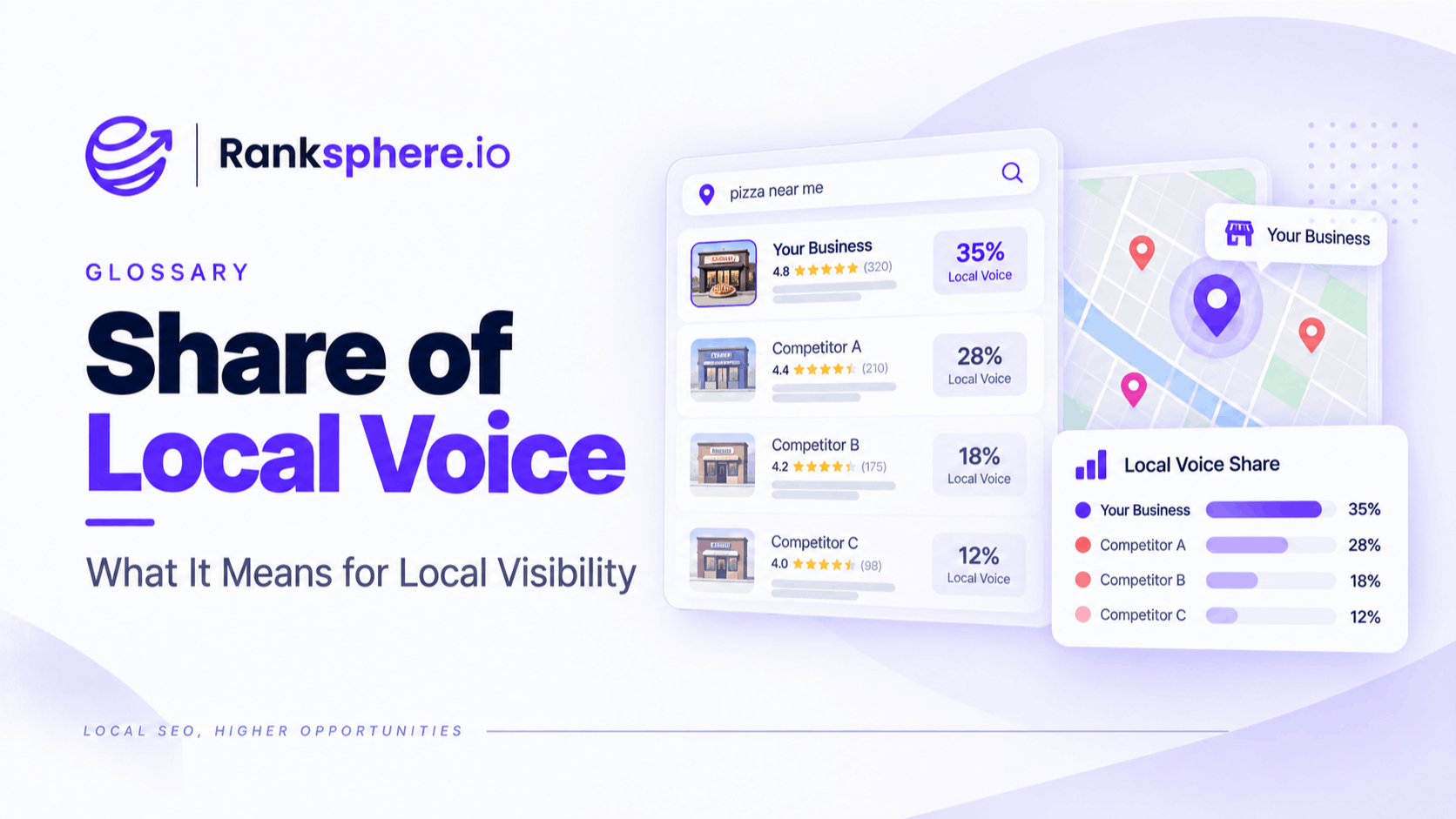
Share of Local Voice, often shortened to SoLV, is a local SEO metric used to compare how visible a business is across a defined geographic area relative to its competitors.
It is usually calculated from local ranking data collected across multiple points on a geographic grid.
Instead of asking:
“What is our average ranking?”
Share of Local Voice asks something closer to:
“How much of the tracked local-search visibility are we capturing compared with the businesses competing against us?”
That distinction can make the metric much easier to use in competitive reporting.
A business might have an average local ranking of:
3.8
That number is useful, but it says little about:
- Where the business is strong
- Where competitors dominate
- How much local visibility each competitor captures
- Whether competitive position is improving
A share-of-voice metric adds that competitive context.
What is Share of Local Voice?
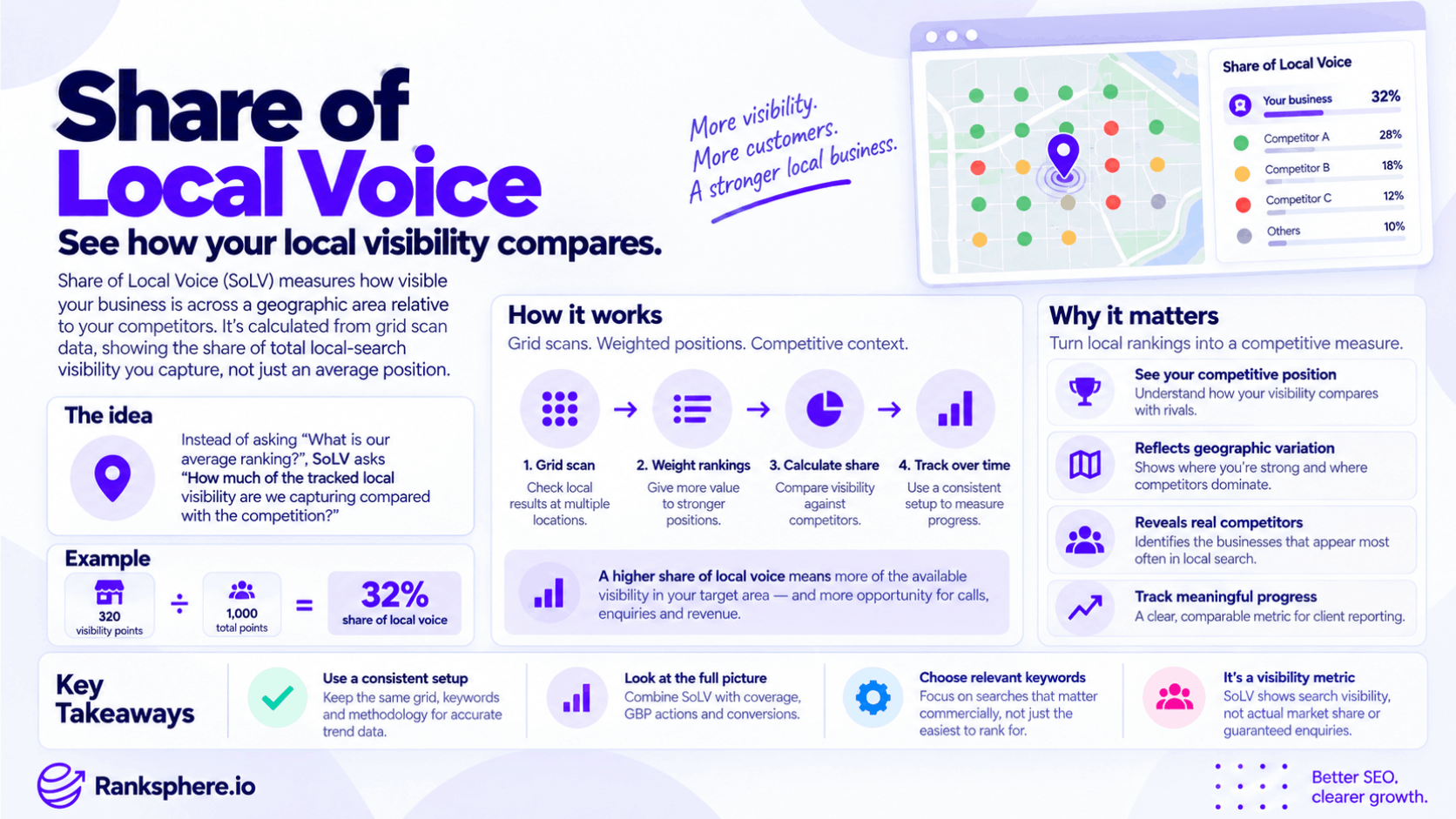
Share of Local Voice measures a business's relative visibility within a selected:
- Geographic area
- Keyword set
- Local ranking environment
It is usually based on data from geo-grid rank tracking.
A grid scan checks local results from multiple points around a business or service area.
The tracking tool can then use those rankings to estimate how much local visibility belongs to:
- Your business
- Competitor A
- Competitor B
- Competitor C
The result is expressed as some form of percentage or share.
The exact calculation depends on the platform.
Share of Local Voice is not a Google metric
Google does not publish a Share of Local Voice score.
It is a third-party SEO measurement created from observed local rankings.
That makes it useful for:
- Competitive analysis
- Reporting
- Trend monitoring
- Local visibility analysis
but it should not be treated as:
- A Google ranking factor
- An official market-share figure
- A direct measure of revenue
- A universal metric that can be compared between every SEO platform
Think of it as a way of summarising local ranking data.
How is Share of Local Voice calculated?
There is no single industry-wide formula.
A common approach looks something like this:
- Run a grid scan for a target keyword.
- Record the businesses appearing at each grid point.
- Assign more visibility value to stronger positions.
- Add those values across the grid.
- Express each business's visibility relative to the other businesses being measured.
For example, a tool might give:
Position 1 more weight than:
Position 3
because the first result is more visible.
Another tool may calculate the score differently.
That is why the methodology matters.
Different tools calculate SoLV differently
One tool might measure only appearances in the local pack.
Another might consider a wider ranking range.
Some may:
- Weight position 1 more heavily
- Include top-10 or top-20 rankings
- Combine several keywords
- Apply search-volume weighting
- Normalise scores against tracked competitors
Because of these differences, a:
32% Share of Local Voice
in one platform does not necessarily mean the same thing as:
32%
in another.
For reporting, consistency is more important than chasing a particular methodology.
Keep the measurement method consistent
Share of Local Voice becomes most useful as a trend metric.
If you track:
28% → 31% → 36% → 41%
using the same:
- Grid
- Search locations
- Keywords
- Tool
- Tracking methodology
you can see a meaningful visibility trend.
If you change the setup halfway through, the comparison may break.
For example, changing from:
7×7 grid
to:
11×11 grid
could change the score even if the business itself did not improve or decline.
Ranksphere Share of Local Voice
Ranksphere's rank tracker reports share of voice alongside coverage and average position across grid scans up to 12×12, with competitors measured across the same geographic grid.
That makes it possible to compare:
- Your visibility
- Competitor visibility
- Geographic coverage
- Ranking trends
without relying on a single search location.
Why average position is not enough
Average position compresses many local rankings into one number.
Imagine a dental practice ranking:
- Position 1 close to the clinic
- Position 2 in nearby streets
- Position 5 two miles away
- Position 12 farther across town
The average might be:
4.6
But that does not show the geography.
It also does not tell you whether another practice dominates the areas where you are weak.
Share of Local Voice adds a competitive dimension to the same underlying ranking data.
Share of Local Voice vs geo-grid coverage
These metrics answer related but different questions.
Geo-grid coverage
Asks:
How much of the tracked area do we appear strongly in?
For example:
Top-three coverage: 24 of 49 grid points
Share of Local Voice
Asks:
How does our visibility compare with competitors across the same tracked market?
Coverage is mainly about your own geographic performance.
Share of voice adds competitor context.
Used together, they can provide a much clearer picture.
Share of Local Voice vs average rank
Average ranking asks:
Where do we rank on average?
Share of Local Voice asks:
How much competitive visibility do we capture?
Neither is automatically better in every situation.
Average rank can still help with:
- Trend analysis
- Comparing keywords
- Understanding broad position changes
Share of voice is particularly useful when the business wants to understand its position relative to competitors.
Why Share of Local Voice is useful
The main advantage is that it turns local rankings into a competitive measure.
Instead of saying:
Average position improved from 4.1 to 3.7.
you may be able to say:
Our share of tracked local visibility increased from 21% to 30%, while the strongest competitor remained at 35%.
That can be easier for a client to interpret.
The number has context.
It reflects geographic variation
Local results change by location.
A business may dominate:
- One neighbourhood
while a competitor dominates:
- Another
SoLV can capture that competitive pattern when it is built from a grid.
That makes it more useful than a ranking checked only from:
- The office
- The business address
- One postcode
It can reveal the real competitors
The businesses an owner thinks about commercially may not be the same businesses competing most strongly in Google.
A competitor analysis using grid data might reveal a previously overlooked business appearing across most of the target area.
Share of Local Voice can help quantify that visibility.
Instead of:
“They seem to show up a lot.”
you have a repeatable measure of how strongly they appear within the tracked search set.
Share of Local Voice by keyword
SoLV should usually be interpreted at the keyword level before being rolled into a broader summary.
A dental practice might have:
dentist — 38% SoLV
but:
emergency dentist — 14%
and:
dental implants — 26%
Those are different competitive landscapes.
A single combined score can hide useful differences.
Do not combine unrelated keywords carelessly
An overall Share of Local Voice score depends heavily on the keyword set.
Suppose an agency adds ten easy, low-value keywords where the business already ranks well.
The combined score may improve.
The business has not necessarily become more visible for the searches that matter commercially.
This is why the keyword set should be:
- Relevant
- Stable
- Commercially meaningful
A metric is only as useful as the searches behind it.
Search volume and commercial importance matter
A high share for:
best blue emergency boiler repair company
may mean little if almost nobody searches it.
A lower share for:
boiler repair near me
could matter much more.
If a platform combines several keywords into one SoLV score, understand whether:
- Each keyword is weighted equally
- Search demand is considered
- Commercial importance is considered
Do not assume a high overall percentage equals high business value.
Use a stable keyword set
When measuring trend, avoid constantly changing the tracked queries.
If you need to add new keywords, document the change.
For major changes, consider establishing a new baseline.
Otherwise:
SoLV increased from 24% to 34%
might simply mean:
we changed the searches being measured.
That is a measurement change, not necessarily an SEO improvement.
Share of Local Voice for multi-location SEO
For multi-location SEO, Share of Local Voice can be useful at the individual-location level.
For example:
Manchester branch
SoLV: 39%
Liverpool branch
SoLV: 18%
Leeds branch
SoLV: 31%
That can help identify where:
- Competitive pressure is strongest
- Visibility is weak
- Additional investigation is needed
Do not rely only on one company-wide score when locations operate in very different markets.
Competitors should come from search data
Do not choose competitors simply because the client names them.
Use competitor analysis to identify the businesses that repeatedly appear across the same grids and searches.
Your commercial competitor may have very little Google visibility.
Another business the client barely knows may be the strongest local search competitor.
SoLV is most useful when it reflects the companies genuinely competing for the same search visibility.
Competitors can change by keyword
A business may compete with:
Practice A
for:
dentist near me
but:
Practice B
for:
emergency dentist
That is normal.
Competitor sets should not be treated as permanently fixed across every query.
The search result determines who is competing.
Competitors can also change geographically
The main competitor in the northern part of town may not be the strongest business in the south.
Geo-grid data can expose those local differences.
For example:
Competitor A may dominate around its own premises.
Competitor B may have broader visibility across the city centre.
Your business may be strongest around another cluster of neighbourhoods.
This is why local competitive reporting benefits from geographic data.
Share of Local Voice is not automatically hard to game
SoLV can be more informative than some vanity metrics, but it is not manipulation-proof.
A score could be made more flattering by:
- Selecting easier keywords
- Excluding difficult competitors
- Shrinking the grid
- Moving the grid centre
- Changing tracking locations
That is why the methodology should be set at the beginning and kept stable.
The goal is not to produce the highest possible SoLV.
It is to measure the same market consistently.
Do competitor shares always total 100%?
Not necessarily.
That depends on how the tool calculates the metric.
Some systems may normalise visibility so the tracked shares collectively represent a fixed total.
Others may calculate independent visibility scores or include businesses outside the manually selected competitor set.
Do not assume:
Our competitor gained 5%, therefore we must have lost exactly 5%.
Check the methodology used by the reporting tool.
Share of Local Voice is not market share
This distinction is important.
If a business has:
35% Share of Local Voice
that does not mean it has:
35% of customers
or:
35% of local revenue.
It means the business captured a certain share of the measured search visibility under that tool's methodology.
Actual market share depends on:
- Demand
- Brand awareness
- Advertising
- Pricing
- Offline reputation
- Sales
- Existing customers
Use the term carefully.
Share of Local Voice is a visibility KPI
SoLV can be a useful KPI when increasing competitive local visibility is an important objective.
But it is still a search visibility metric.
It is not:
- Leads
- Calls
- Bookings
- Revenue
A campaign can improve SoLV without producing equivalent commercial growth.
That does not make the metric useless.
It means it should be connected to business outcomes where possible.
Does higher SoLV mean more enquiries?
Not automatically.
Improved local visibility can create more opportunities for customers to see the business.
But enquiries also depend on:
- Search demand
- Reviews
- Rating
- Offer
- Price
- Brand
- Conversion experience
- Availability
Treat SoLV as an indicator of competitive search visibility, not a guaranteed predictor of lead volume.
Pair it with Google Business Profile actions
A stronger reporting view might combine:
Visibility
Share of Local Voice Top-three grid coverage
Engagement
Google Business Profile calls Website clicks Direction requests
Outcomes
Qualified enquiries Bookings Revenue where available
Now the client can see whether changes in visibility are accompanied by changes farther down the customer journey.
Report the trend, not one scan
A single grid scan is a snapshot.
Local results can fluctuate.
A one-off SoLV score should therefore be treated carefully.
The trend becomes more useful when scans are repeated consistently.
For example:
January: 21%
February: 23%
March: 28%
April: 30%
That tells you more than one isolated score.
How frequently should SoLV be measured?
There is no universal schedule.
Monthly tracking is often enough for client reporting.
More frequent scans may be appropriate when:
- Monitoring a significant change
- Investigating a ranking drop
- Tracking a competitive market
The important thing is consistency.
More scans do not automatically create better decisions.
What if coverage rises but Share of Local Voice falls?
That can happen.
Your business may improve across the grid while competitors improve even more.
For example:
Your business
Top-three coverage:
35% → 42%
Share of Local Voice
29% → 26%
That does not necessarily mean your SEO got worse.
It may indicate that the wider competitive environment changed.
But investigate before drawing a conclusion.
Other possibilities include:
- Keyword changes
- Grid changes
- New competitors
- Calculation changes
Interpret the metrics together.
What if Share of Local Voice rises but leads do not?
Again, this is possible.
Ask:
- Are the tracked keywords commercially relevant?
- Did overall search demand change?
- Are reviews competitive?
- Are customers calling?
- Is the website converting?
- Did the business change availability or pricing?
Higher visibility increases opportunity.
It does not guarantee conversion.
Local pack changes can affect SoLV
The local pack itself is dynamic.
Competitors may:
- Open
- Close
- Move
- Change categories
- Gain or lose prominence
Google's local results can also change.
SoLV should therefore be interpreted within the market context rather than as a score controlled entirely by SEO activity.
Proximity affects Share of Local Voice
Distance is part of local search.
A competitor may have strong visibility in part of the grid simply because its physical location is closer to searchers there.
That does not mean:
their SEO is better in every way.
Likewise, your SoLV may have a natural geographic ceiling in parts of a very large service area.
Use grid visualisation alongside the percentage so you can see where the share comes from.
Share of Local Voice and local ranking factors
SoLV describes the result.
It does not explain why the result happened.
To investigate differences, look at relevant local-search factors such as:
- Relevance
- Distance
- Prominence
- Google Business Profile setup
- Reviews
- Website relevance
- Local links
- Business location
Do not reverse-engineer a ranking formula from the SoLV number itself.
Common Share of Local Voice mistakes
- Treating SoLV as a Google metric.
- Comparing scores from different tools without checking their methodology.
- Changing grid size, spacing or centre during the reporting period.
- Changing keyword sets and treating the new score as comparable with the old one.
- Tracking easy or irrelevant keywords simply to improve the percentage.
- Calling Share of Local Voice actual market share.
- Assuming competitor shares must always sum to 100%.
- Treating SoLV as a direct measure of enquiries or revenue.
- Reporting one scan as though it establishes a trend.
- Using one combined score without checking individual keywords.
- Ignoring proximity and geographic variation.
- Choosing competitors from assumptions rather than actual search results.
- Reporting SoLV without coverage or business outcomes for context.
Share of Local Voice best practices
- Choose commercially relevant keywords.
- Set the grid size, spacing and centre before establishing the baseline.
- Keep the methodology stable over time.
- Use the same tracking platform for trend comparisons.
- Review individual keyword SoLV before relying on an aggregate score.
- Identify competitors from actual search results.
- Track multi-location businesses at the location level.
- Pair SoLV with top-three grid coverage.
- Report Google Business Profile interactions and conversions alongside visibility.
- Use several scans to establish a trend rather than relying on one snapshot.
- Document major changes to keywords, grids or tracking methodology.
- Explain clearly that SoLV represents tracked search visibility, not actual commercial market share.
Example
“Elmswood Dental's monthly report shows:
Average local position: 3.8
Month after month, the number changes very little.
The partners understand that:
3.8 is better than 6.2
but it gives them little sense of their competitive position.
The agency adds Share of Local Voice using the same grid and keyword set.
For one priority search, the starting picture is:
Elmswood Dental: 19%
Competitor A: 46%
Competitor B: 21%
The remaining visibility is distributed across other businesses according to the tracking tool's methodology.
That immediately gives the ranking data more context.
Elmswood can see that one competitor has a much stronger presence across the tracked area.
Over the following months, the agency works on:
- Google Business Profile accuracy
- Review acquisition
- Service-page improvements
- Local relevance
- Technical issues
The same grid is scanned using the same keyword and settings.
Elmswood's tracked Share of Local Voice increases.
Its top-three coverage also improves.
The agency then compares those visibility changes with:
- Google Business Profile calls
- Website enquiries
- New-patient bookings
The reporting no longer depends on one average ranking.
It shows:
where Elmswood is becoming more visible, how that visibility compares with its search competitors and whether the improvement is accompanied by stronger business performance.
That is the useful role of Share of Local Voice.
It turns local rankings into a competitive visibility measure — but it remains a measurement of the search landscape, not a substitute for leads, customers or revenue.”
See also
- Geo-grid rank tracking — the geographic ranking data used to calculate local visibility
- Local pack — the local search results being measured
- Competitor analysis — identifying the businesses competing for the same visibility
- KPI — deciding whether SoLV belongs in client reporting
- Rank tracking — measuring search visibility over time
- White-label reporting — presenting SoLV alongside other local SEO metrics