Keyword research is the process of finding and evaluating the words and phrases people use when searching for products, services or information online. It helps you understand what your audience is looking for, how they describe their needs and which search terms are worth targeting with your website.
A good keyword is not simply one with a high search volume.
For most businesses, the more useful question is whether the search is relevant to what you offer and whether the person using it is likely to become a customer.
This matters even more for local businesses. A keyword may have thousands of searches nationally, but only a small proportion of those searches may come from people inside your service area. Smaller, more specific terms can often be far more valuable when they match what local customers actually need.
Why keyword research matters
Keyword research gives direction to your SEO strategy.
It helps you decide which services deserve their own pages, what questions your content should answer, how pages should connect through internal linking, and which searches are worth tracking over time.
It also shows you how customers describe their problems.
Businesses often use industry terminology that customers would never type into Google. A heating company might talk internally about “planned HVAC maintenance,” while a homeowner searches for “boiler keeps switching off” or “boiler service near me.”
Understanding that difference can completely change the content you create.
Keyword research can help you:
- Identify topics worth creating pages around
- Understand the language customers actually use
- Find search demand you may have overlooked
- Separate useful keywords from high-volume terms with little commercial value
- Match content more closely to what people are trying to accomplish
- Build a clearer structure for SEO tracking and reporting
How local keyword research is different
Local keyword research needs a slightly different approach from national SEO.
The audience is smaller, location matters more, and Google often changes the search results based on where the person is searching from.
Search volume needs context
Most keyword tools show estimated search volume across a country or larger region.
For a business serving one city or a small group of towns, that figure does not tell you exactly how many potential customers are searching locally.
Use search volume as a guide rather than treating it as a precise forecast.
A lower-volume keyword can still be commercially important if the people searching it are close to taking action.
Not every local keyword needs a city name
Customers do not always type their location into the search.
Someone in Manchester may simply search “emergency plumber” rather than “emergency plumber Manchester.” Google can use the searcher's location to return nearby businesses.
That means local keyword research should consider both geo-modified terms and searches without an explicit place name.
The Local Pack changes what you are competing for
For many local searches, Google displays the local pack above or alongside the standard organic results.
In those cases, your Google Business Profile may be just as important as the page targeting the keyword.
The right SEO strategy often needs to consider both.
Keyword difficulty scores need context
A national keyword difficulty score can be useful, but it does not always reflect the competition in your immediate market.
A keyword that looks difficult nationally may have relatively weak local competition. The opposite can also happen.
This is why you should check the actual search results rather than relying on a score alone.
How to do keyword research
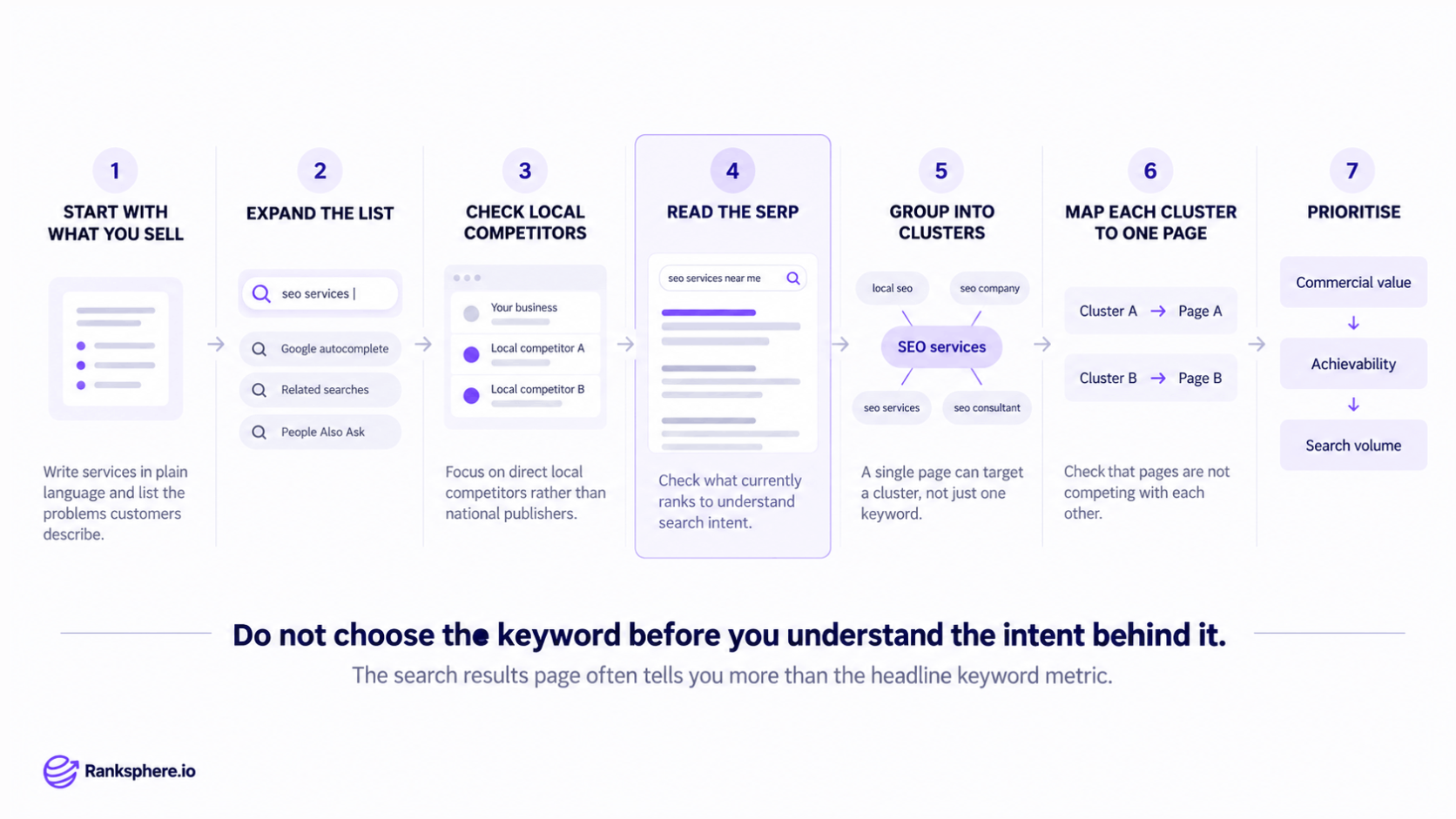
Start with the services you genuinely provide and the problems customers ask you to solve.
Write those down in plain language before opening a keyword tool.
Then expand the list using sources such as:
- Google autocomplete
- Related searches
- People Also Ask
- Google Search Console
- Competitor websites
- Customer enquiries and sales conversations
- Keyword research tools
Once you have a larger list, review each term based on relevance, intent and opportunity.
A practical process is:
- List your main products, services and customer problems
- Find related searches and common variations
- Review the keywords used by direct competitors
- Check search intent by looking at the pages currently ranking
- Group closely related terms into topic clusters
- Decide which page should target each cluster
- Check whether existing pages are cannibalising one another
- Prioritise terms based on relevance, commercial intent, competition and realistic opportunity
One of the most useful steps is simply looking at the search results.
The SERP tells you what Google currently believes people want when they search a term.
If a query returns product pages, maps and local businesses, Google is reading it differently from a query dominated by guides and informational articles. Your content should reflect that intent.
Ranksphere's rank tracker suggests keywords your business already ranks for alongside the terms you add manually, which can help uncover relevant searches you may not have considered during the initial research.
Search intent matters more than volume alone
Two keywords with similar search volumes can have completely different value.
Someone searching:
“What does an accountant do?”
is probably looking for information.
Someone searching:
“accountant for limited company near me”
is much closer to choosing a service provider.
Both searches can be useful, but they belong to different stages of the customer journey and should not necessarily be targeted by the same page.
This is why keyword research should always consider intent alongside volume.
Keyword clustering and page targeting
You do not need a separate page for every small keyword variation.
Search engines can understand that phrases such as:
- emergency plumber
- emergency plumbing service
- 24 hour plumber
- urgent plumber
may belong to the same broader topic.
If the same page can genuinely satisfy all of those searches, they can usually be grouped into one keyword cluster.
Creating dozens of almost identical pages for minor wording changes can lead to thin content and unnecessary keyword cannibalisation.
Instead, build one strong page around a clear topic and support it with related terms naturally.
Common keyword research mistakes
- Choosing keywords only because they have high search volume. Traffic has little value if the searcher is unlikely to need your service.
- Relying on national numbers for a local business. Local demand may look very different.
- Ignoring search intent. A commercial page will struggle to satisfy a query Google clearly treats as informational.
- Creating one page for every keyword variation. Closely related searches usually belong together.
- Only researching service names. Customer problems and questions often reveal valuable long-tail opportunities.
- Trusting keyword difficulty scores without checking the SERP. Scores provide context, not certainty.
- Copying competitor keywords without understanding why they rank. A competitor's strategy may not suit your business.
- Doing keyword research once and never revisiting it. Services change, customer language evolves and new opportunities appear.
Keyword research best practices
- Start with relevance. A keyword should connect clearly to something your business actually offers.
- Prioritise intent before raw volume. Commercially useful searches are often more valuable than broad traffic.
- Check the search results manually. See what Google currently rewards for the query.
- Research local competitors. Businesses competing in your actual market are often more useful references than national websites.
- Group related keywords into clusters. Build pages around topics rather than isolated phrases.
- Include long-tail searches. Specific queries may have less volume but stronger intent.
- Use real customer language. Sales calls, enquiries and support questions can provide excellent keyword ideas.
- Map keywords to existing pages before creating new ones. You may already have a suitable page that simply needs improving.
- Review your keyword strategy regularly. Revisit it when services, locations or search behaviour change.
Example
“Harlow & Finch is an accountancy practice that initially wants to rank for the keyword “accountant.”
The term has plenty of search volume, but it is also extremely broad. People searching it may be looking for anything from career information to definitions, salaries, accounting software or a local firm.
When the practice looks more closely at the searches its potential clients are making, more useful opportunities appear:
- Self assessment help
- Late tax return help
- Switching accountants
- Accountant for limited company
- First year company accounts
- Help with a tax penalty
Each search is more specific and gives the practice a clearer idea of what the person actually needs.
Instead of building its SEO strategy around one broad keyword, the firm creates useful pages around the services and problems that matter to its clients.
Those pages may attract fewer searches individually, but the traffic is much more closely aligned with the work the practice wants to win.
That is what good keyword research should achieve: not the biggest possible keyword list, but a clearer understanding of which searches are genuinely worth your time.”
See also
- Search intent — understanding what someone wants when they search
- Search volume — estimating how often a keyword is searched
- Keyword difficulty — assessing how competitive a search term may be
- Long-tail keyword — more specific searches that often reveal clearer intent
- Keyword cannibalisation — what happens when several pages compete for the same topic
- Local SEO — improving visibility for searches within a specific geographic market